Maguirebridge Before Ice Return30552 BCE
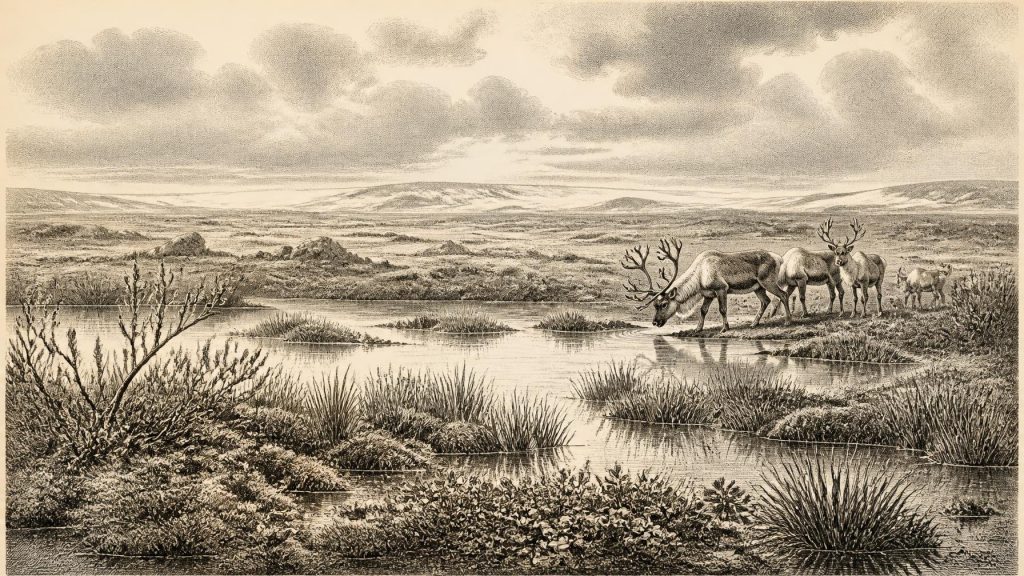
About 30,552 BCE cannot be treated as a recoverable Irish year, but falls within the broad calibrated range of the Derryvree freshwater deposit near Maguiresbridge, County Fermanagh. There, organic wetland sediments between two glacial tills demonstrate a local ice-free interval, supporting tundra-like vegetation, shallow water and severe seasonality. Ireland remained climatically unstable before the Last Glacial Maximum, as ice later expanded and destroyed many earlier landscapes. Cave fauna indicate open habitats supporting mammals including reindeer, mammoth and hyaena. A marked reindeer bone may suggest brief human activity, yet provides no proof of settlement, society or routes of arrival at all.
Dateline
The label “30,552 BCE” offers a useful point on a modern timeline, but it cannot identify a recoverable Irish year. No written record, calendar, named community or datable occupation surface survives from this depth of time. In radiocarbon terms it falls about 32,501 years before AD 1950, in the Late Pleistocene and Marine Isotope Stage 3, during the last glacial cycle. The responsible approach is therefore to use broad calibrated ranges and to distinguish a securely observed sequence of deposits from the larger picture reconstructed from it.
The most informative Irish evidence is an organic, freshwater deposit at Derryvree near Maguiresbridge, County Fermanagh. Exposed in a road cutting through a drumlin, it lay between two tills: unsorted debris deposited by glacier ice. Its crucial radiocarbon determination, BIRM-166, was reported as 30,500 radiocarbon years before present, with a substantial uncertainty of +1,170 and −1,030 years. Radiocarbon years are not calendar years. Once calibrated, the date is best treated as a wide probability range, broadly about 36,900–31,700 calibrated years BP, or approximately 34,950–29,750 BCE. Thus 30,552 BCE lies within the range that the deposit may illuminate, but not at a demonstrable annual resolution.
Fresh Water Between Glaciers
Derryvree’s stratigraphy supplies the firmest conclusion. Ice had reached this part of Fermanagh and left a lower till. Afterwards, fine sands, silts and organic mud accumulated in freshwater and wet ground. Later ice again crossed or affected the locality, leaving the upper till that sealed the older wetland. This is powerful evidence for a non-glacial interval at Derryvree. It is not evidence that every region of Ireland was ice-free at the same time, nor that the island’s changing ice margins followed one simple advance-and-retreat sequence.
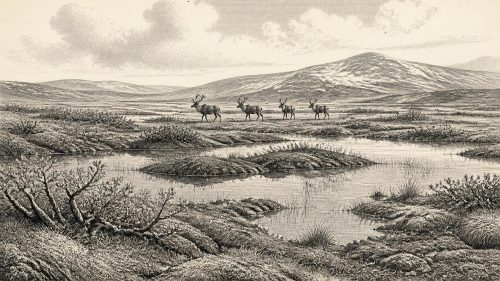
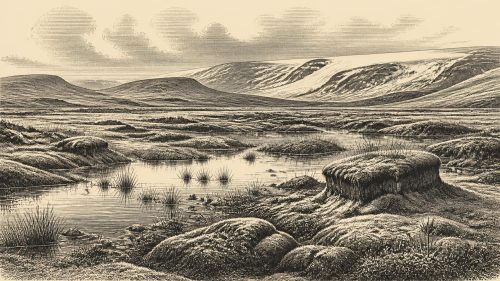
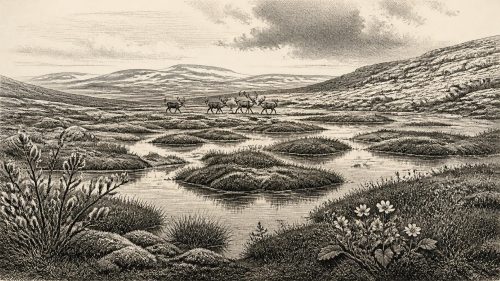
The fossils within the intervening sediments evoke a cold, open landscape rather than woodland. Grasses and sedges, dwarf willow, juniper, herbs, mosses and aquatic plants occur in the record; bogbean and water-milfoil point particularly to shallow or slow-moving freshwater. The combination has been described as a treeless, muskeg-like wetland, with pools, saturated ground and surrounding tundra vegetation. Such a place would have been seasonally productive in summer but exacting in winter. Pollen and plant remains are proxies rather than a photograph of one day: some material can be moved by water, wind or later disturbance. Even so, the agreement of plants, mosses and insects makes the broad environmental interpretation robust.
An Unstable Cold World
This was not yet the fullest extent of the last British–Irish Ice Sheet. Modern reconstructions place major ice growth after roughly 31,000 years ago, with maximum ice volume and extensive marine margins later, principally between about 27,000 and 20,000 calibrated years BP. The timing differed sharply between regions and ice streams. At 30,552 BCE Ireland was therefore in a transitional and climatically volatile part of the glacial cycle: local ice, exposed ground, wetlands and cold-adapted ecosystems could coexist across a changing archipelago of habitats.
Climate records from Greenland ice cores show that the North Atlantic experienced abrupt millennial-scale shifts during this period. They provide a wider climatic context, not a local Irish weather diary. Derryvree itself indicates severe seasonality and no closed forest; it does not allow a precise temperature, snowfall total or statement about conditions elsewhere on the island in the same year. Later expansion of ice would erode, bury or rearrange much of the earlier landscape. This destructive history helps explain why Ireland has so few surviving terrestrial archives from the period.
Animals and Open Country
Cave deposits, especially at Castlepook Cave near Doneraile in north County Cork, show that Late Pleistocene Ireland supported a striking range of mammals over the wider period before the Last Glacial Maximum. The documented fauna includes reindeer, woolly mammoth, giant deer, brown bear, wolf, Arctic fox, mountain hare, lemmings and spotted hyaena. These finds support the interpretation of open, cold habitats and ecological links with Britain and continental north-west Europe. They should not be compressed into a single imaginary herd roaming Ireland in 30,552 BCE. Cave assemblages accumulated over long spans; carnivores, water action and nineteenth- and twentieth-century excavation disturbed some contexts.
Nonetheless, the animal evidence corrects an older image of a wholly lifeless ice-age Ireland. Reindeer and mammoth belong to a broad grassland-tundra mosaic, while hyaena and wolf reveal active predators and scavengers. Caves could serve as dens, traps or places where bones accumulated, not necessarily as human shelters. The fauna provides evidence about ecology and regional connectivity, but does not establish settled communities, territorial boundaries or organised hunting grounds. A creature’s presence in a cave records only that it, or part of it, entered the cave’s complicated history.
The Human Question
The most provocative evidence is a reindeer femur from Castlepook bearing a deep mark interpreted as having been made while the bone was fresh, possibly by a stone tool during carcass processing. The bone was dated to roughly 33,000 radiocarbon years BP. If the mark is confirmed as human-made and contemporary with the animal’s death, it would indicate a very early Upper Palaeolithic human visit to Ireland, far earlier than the island’s securely documented post-glacial settlement record.
That proposition must remain carefully limited. The specimen comes from an old cave collection rather than a newly excavated, sealed human occupation layer. There is no securely associated hearth, stone-tool assemblage, house, burial, artwork or repeated camp at Castlepook of this age. The marked bone cannot identify the visitors’ language, kinship, origin, political organisation or even how long they stayed. It certainly cannot prove a permanent population in Ireland in 30,552 BCE. The strongest formulation is that people may have processed a reindeer in Ireland during the wider pre-maximum glacial period.
No Politics, but Possible Passage
For this date, political affairs, diplomacy and warfare are not hidden chapters waiting to be recovered; they are beyond the evidence. There are no chiefs, tribes, treaties, forts or battlefields that can responsibly be assigned to Ireland. Likewise, no religious practice, formal learning or artistic tradition is evidenced by the Derryvree wetland. It would be misleading to project later Irish identities, Gaelic traditions or prehistoric monuments back more than thirty millennia.
If a small human party did reach the island, its everyday concerns would have been immediate: finding routes through cold terrain, shelter, fuel, fresh water and animal resources. A sharp tool used on a carcass would imply practical knowledge of meat, hide, sinew and bone, but it would not reveal a local economy or sustained trade network. Lower sea levels altered the geography of the Irish Sea world, yet the precise route by which any people arrived remains unproven. Connection with neighbouring lands is best inferred from the movement of animals and from the possibility of human contact, not from an identified road, crossing or exchange system.
A Record of Limits
Ireland around 30,552 BCE is therefore best understood as a cold, unstable environmental frontier. At Derryvree, freshwater and tundra-like wetland developed between episodes of glaciation. Across the broader island, large mammals occupied open habitats at various times before later ice expansion. A marked reindeer bone raises the possibility of a fleeting human presence, but does not yet transform this into a history of settlement. The most important development was not a year-specific event: it was the narrowing of habitable landscapes as the last great ice sheet gathered strength, while fragments of an earlier, living Ireland were sealed beneath it.
Primary Sources
- Figure 6.— The subdivision of the Quaternary Period in Ireland
- References and Recommended Reading
- The Irish Quaternary Fauna Project
- The Irish Quaternary Fauna Project
- Landscapes and environments of the last glacial-interglacial transition: a time of amazingly rapid change in Ireland
- Deglacial rates and controls for the western margin of the British-Irish Ice Sheet
- New data for the Last Glacial Maximum in Great Britain and Ireland
- Late Pleistocene chronostratigraphy and ice sheet limits, southern Ireland
- Growth and retreat of the last British–Irish Ice Sheet, 31,000 to 15,000 years ago: the BRITICE-CHRONO reconstruction
- The deglaciation of the western sector of the Irish Ice Sheet
- Early deglaciation of the British-Irish Ice Sheet on the Atlantic shelf northwest of Ireland driven by glacial lake drainage events
- Dating constraints on the last British-Irish Ice Sheet: a map and database
- Radiocarbon constraints on the age of the maximum advance of the British–Irish Ice Sheet in the Celtic Sea
- Dynamic cycles, ice streams and their impact on the extent, chronology and deglaciation of the British-Irish Ice Sheet
- The IntCal20 Northern Hemisphere Radiocarbon Age Calibration Curve (0–55 cal kBP)
- IntCal Publications
- IntCal History
- North GRIP – Greenland Ice Core Chronology 2005 (GICC05) 60,000 Year, 20 Year Resolution
- Ice Core
- Archaeology Research Excavation Grant 2022: Final Report
- Heritage Artefacts of County Cork
- Advances in Irish Quaternary Studies
- Deposits of the Last Glaciation