Castlepook and the Buried Wetland30509 BCE
Around 30,509 BCE, a label rather than a precise date, Ireland experienced unstable cold conditions before the Last Glacial Maximum. At Derryvree, County Fermanagh, freshwater silts and organic deposits between glacial tills show that local ice-free wetland supported tundra plants and insects during a limited interval. Castlepook Cave, County Cork, preserves bones of mammoth, giant deer, reindeer, bears, wolves, foxes and hyaenas, documenting changing Pleistocene fauna rather than a single ecosystem. A possibly butchered reindeer bone suggests a brief human visit, but permanent settlement remains unproven. Evidence reveals shifting landscapes and animals, not societies, institutions or a detailed year-by-year history.

Dateline
Modern calendar-year precision is not available for Ireland in 30,509 BCE. The number is a useful label for a point deep in prehistory, not the date of a recorded occurrence, reign or migration. There were no written calendars, named peoples or annually datable Irish sites from which to reconstruct a conventional ‘year’. The responsible account is therefore built from broad calibrated ranges, geological sequences and animal remains. In radiocarbon terms, 30,509 BCE is roughly 32,458 years before AD 1950, placing it in the later part of Marine Isotope Stage 3, well before the climatic peak of the Last Glacial Maximum.
Evidence, Not an Anniversary
The closest Irish environmental evidence comes from Derryvree, near Maguiresbridge in County Fermanagh. Roadworks exposed a remarkable succession inside a drumlin: glacial till below, freshwater silts and organic deposits in the middle, and another till above. The sequence establishes a clear order of events. Ice occupied the locality, then a period of standing or slow-moving freshwater allowed fine sediment and organic matter to accumulate, and later ice or glacial meltwater buried that record. It is an unusually valuable Irish window on a time for which exposed landscapes have mostly been erased or remodelled by later glaciation.
Organic material from the intervening deposits, sample BIRM-166, returned a conventional radiocarbon age of 30,500 years BP, with a substantial uncertainty of +1,170/−1,030 years. A radiocarbon age is not a calendar age: atmospheric carbon-14 concentrations changed over time, so dates must be calibrated against independently constructed curves. Earlier calibrations have placed the sample broadly between about 36,900 and 31,700 calibrated years BP; a more recent regional ice-sheet model places it around 33,500 ± 1,200 calendar years BP. The modern label 30,509 BCE lies within the wider chronological neighbourhood illuminated by these estimates, but it cannot identify the exact year in which a plant grew, a pool froze or an animal passed through Derryvree.
The evidence supports a limited but important conclusion: at some point in this broad interval, the Derryvree locality in north-central Ireland was not buried beneath active ice. It does not demonstrate that the whole island was ice-free at once, nor that conditions remained stable from one generation to the next. The Irish landscape was part of a North Atlantic climate system marked by abrupt shifts. The later Last Glacial Maximum, conventionally dated to roughly 26,000–19,000 years ago, would bring far more extensive ice cover. In 30,509 BCE, Ireland stood on the approach to that harsher phase, within an already cold and changeable world.
A Wetland Between Glaciers
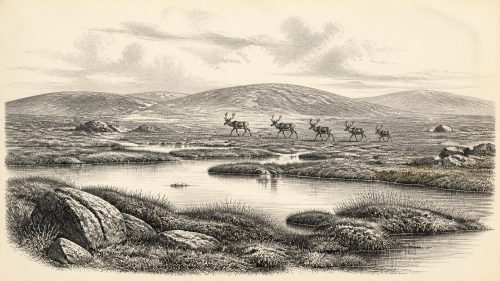
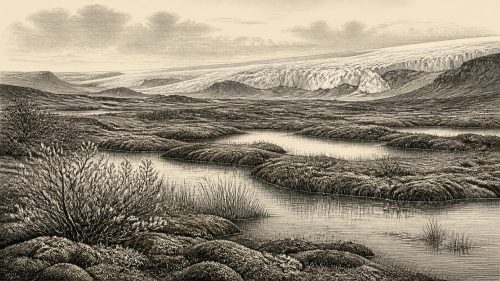
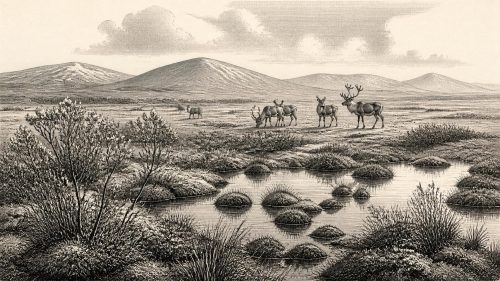
Derryvree’s deposits allow a cautious reconstruction of a local environment rather than a national panorama. The freshwater sediments contain plant and insect evidence consistent with open, cold conditions. Mosses, sedges, dwarf willow, bogbean and other tundra or wetland plants indicate shallow water, damp margins and ground subject to severe seasonal cold. This was not a wooded Irish countryside. Trees would have been scarce or absent around the site; the vegetation was low, patchy and responsive to waterlogging, frost, wind and a short growing season.
Such a setting might be described as tundra wetland, but that phrase should not conjure an unbroken plain. The terrain likely contained pools, sedge-rich edges, exposed mineral ground and better-drained patches, with local differences determined by slope, drainage, snow cover and the proximity of ice. Summer could permit flowing water, plant growth and insect activity; winter brought deep freezing and a greatly contracted food supply. The organic layer is testimony to an interval of ecological opportunity, not proof of benign conditions.
Glacial geology also changes how the map should be imagined. Ireland’s present shoreline did not exist in recognisable form. Global sea level was lower than today because much water was locked in continental ice sheets, but ice, changing coastlines and submerged basins complicate any simple claim of a continuous land bridge. Connections between Ireland, Britain and mainland Europe varied through time and place. Animals and, potentially, people could have moved across a changing north-west European region, but the exact routes available during the Derryvree interval remain uncertain.
Castlepook’s Animal World
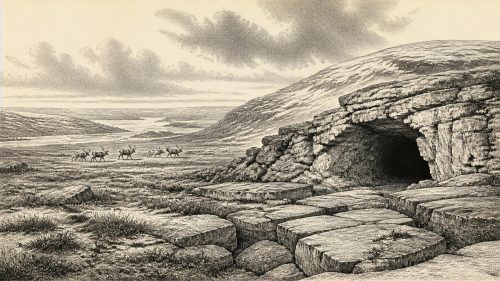
County Cork offers a different, complementary archive. Castlepook Cave, near Doneraile, is Ireland’s richest known repository of pre-Last Glacial Maximum vertebrate remains. More than 2,000 bones have been recovered from its galleries, with dated specimens spanning a long period, approximately 45,700 to 19,950 radiocarbon years BP. Its faunal record includes woolly mammoth, giant deer, reindeer, brown bear, wolf, fox and spotted hyaena, with Arctic fox and lemmings among later cold-stage material.
These finds establish that large mammals capable of living in cold, open landscapes reached Ireland during the wider period. They do not mean that every listed species shared the island, or even the cave’s surroundings, at 30,509 BCE. Cave deposits are accumulations made over long periods. Carnivores may drag prey into caves; water can move bones; excavations undertaken between 1904 and 1918 did not always preserve the fine-grained context expected today. Castlepook is therefore strongest as evidence for regional faunal possibilities and repeated ecological change, rather than a single momentary census.
The mammoth, reindeer and hyaena remains nevertheless make the scale of this lost world vivid. Reindeer could exploit sparse northern vegetation and move seasonally; hyaenas were powerful scavengers and predators; mammoths ranged over open habitats elsewhere in north-west Europe. Giant deer, despite their later association with Irish bog finds, were not the familiar inhabitants of a green island but animals of Pleistocene landscapes repeatedly altered by climate. Their presence in the Irish record reminds us that the island’s modern fauna is a recent and selective remnant of a much more varied past.
The Human Question
The possibility of people in Ireland at this depth of time remains exceptionally important and exceptionally delicate. A reindeer femur from Castlepook has been publicly reported as bearing a deep mark consistent with butchery using a stone tool, and has been presented as roughly 33,000 years old. If the mark is securely identified as human-made and contemporary with the animal’s processing, it would point to a human visit in the broader chronological range relevant here. It would be evidence for an action: people handling a reindeer carcass.
That is not yet evidence for a permanent Irish population. No securely associated stone-tool assemblage, hearth, dwelling surface, burial, human skeleton, cave art or occupation layer has established a settled community in Ireland in the thirty-first millennium BCE. Nor can a marked bone establish the visitors’ language, identity, numbers, route or relationship to later inhabitants. Castlepook’s old excavations and disturbed deposits demand restraint. The most that can responsibly be said is that a short-lived Upper Palaeolithic incursion is possible, while sustained habitation remains unproven.
This distinction also governs claims about society and everyday life. Elsewhere in Europe, Homo sapiens groups of this broad period made sophisticated stone and bone tools, used animal skins, maintained long-distance social contacts and created remarkable art. Those wider comparisons make a temporary visit to Ireland conceivable. They cannot supply missing Irish evidence. It would be wrong to project an Aurignacian or Gravettian camp, a named culture, a clan territory or a local tool tradition onto Castlepook without securely excavated finds.
No Polity, No Archive of Belief
There is no evidence from Ireland around this date for political institutions, chiefs, kingdoms, warfare, diplomacy, law or formal trade. There is equally no Irish evidence for farming, herding, permanent villages, monuments, ritual buildings, literacy or organised religion. These absences are not trivial gaps in a familiar historical record: they define the nature of the period. If people entered Ireland, they would have encountered a sparsely productive, climatically demanding environment in which mobility, close knowledge of animals and seasonal planning were likely more important than durable buildings or territorial states.
Nor should cave animal remains be treated as proof of human hunting. Many bones at Castlepook were probably accumulated by natural agencies, especially carnivores and water. A cave is a selective archive: it records what entered, survived and was later recovered, not everything that lived outside. The best-supported ‘economy’ for Ireland at this point is ecological rather than social—plants converting a short growing season into fodder, herbivores moving through suitable ground, and carnivores exploiting them. Human subsistence can only be discussed conditionally, in relation to the debated reindeer bone.
An Island in Transition
The most significant development around 30,509 BCE was not a political event but an environmental transition. Derryvree preserves an interval in which freshwater, wetland plants and small organisms occupied a landscape later sealed by glacial deposits. Castlepook preserves the broader testimony of cold-stage mammals in the south. Together, they show that Ireland was neither timelessly ice-covered nor steadily hospitable. It was a changing edge of north-west Europe, where local ice-free ground, wet places and animal corridors could briefly coexist with the growing power of glaciers.
For this reason, the year is best understood as a point within a long, uncertain range rather than an episode with a beginning and end. The surviving evidence is physical: silt beneath till, bones in limestone caves, radiocarbon measurements and the scientific revisions that test them. It gives Ireland a deep past of cold water, open ground and Pleistocene animals. It does not yet provide a year-by-year human history—and acknowledging that limit is the most accurate way to approach 30,509 BCE.
Primary Sources
- Cork_CGS_Castlepook_Cave
- The Irish Quaternary Fauna Project
- Exploring controls of the early and stepped deglaciation on the western margin of the British–Irish Ice Sheet
- The timing and magnitude of the British–Irish Ice Sheet between Marine Isotope Stages 5d and 2: implications for glacio-isostatic adjustment, high relative sea levels and ‘giant erratic’ emplacement
- Trimlines, blockfields and the vertical extent of the last ice sheet in southern Ireland
- Dimensions and chronology of the last ice sheet in Western Ireland
- Last Glacial Maximum cirque glaciation in Ireland and implications for reconstructions of the Irish Ice Sheet
- Figure 6.— The subdivision of the Quaternary Period in Ireland
- The IntCal20 Northern Hemisphere radiocarbon age calibration curve (0–55 cal kBP)
- IntCal Publications
- New insights on the fauna of Ireland’s Younger Dryas and Early Holocene from Alice & Gwendoline Cave
- New insights on the fauna of Ireland’s Younger Dryas and Early Holocene from Alice & Gwendoline Cave
- Phylogeographic, ancient DNA, fossil and morphometric analyses reveal ancient and modern introductions of a large mammal: the complex case of red deer (Cervus elaphus) in Ireland
- Occurrence of mammalia relicts at site Castlepook Cave
- Pleistocene vertebrates in the British Isles
- Pleistocene Rodents of the British Isles
- Castlepook Cave, County Cork, 2022
- Heritage Artefacts of County Cork
- Ireland’s Palaeolithic Archaeology – Fleeting Footprints in a Frozen Land
- Reindeer bone found in Cork cave shows human activity in Ireland 33,000 years ago