Derryvree’s 30,500-Year Silts30512 BCE
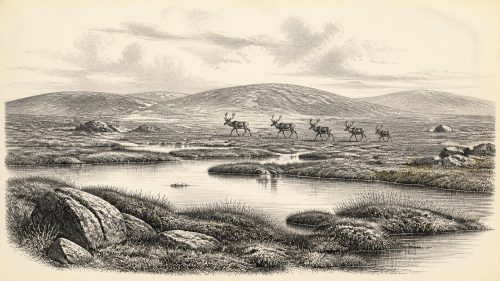
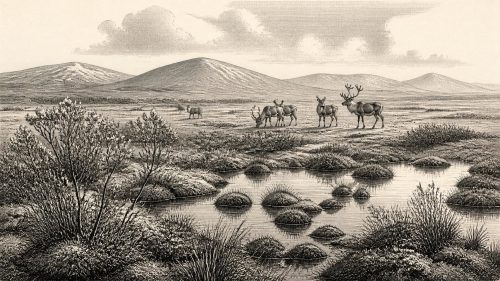
Although 30,512 BCE is a modern, falsely precise label, evidence from MIS 3 illuminates Ice Age Ireland. At Derryvree, Fermanagh, organic freshwater silts between glacial tills, dated broadly to 36,900–31,700 cal BP, record an ice-free tundra wetland during fluctuating conditions. Crag Cave speleothems indicate intermittent milder phases, while low sea levels altered, but did not simply create, connections with Europe. Castlepook Cave’s diverse fauna demonstrates cold-stage animal presence; a marked reindeer bone may signal human butchery, not settlement. No evidence supports contemporary Irish societies or institutions. Later glaciation obscured much evidence, leaving fragmentary records of a dynamic, ecologically connected landscape.
Dateline
“30,512 BCE” is a modern calendar label, not a date at which an event in Ireland can be placed. No Irish calendar, written testimony or archaeological sequence can identify a particular season, person or occurrence in that year. At this depth in time, modern calendar-year precision is unavailable. The useful frame is the Late Pleistocene, within Marine Isotope Stage 3 (MIS 3), a climatically unstable part of the last Ice Age. The notional year falls broadly around 32,462 years before the conventional radiocarbon reference point of 1950, but scientific evidence is normally expressed as ranges in calibrated years before present (cal BP), rather than translated into a falsely exact BCE date.
A Wetland Between Ice Sheets
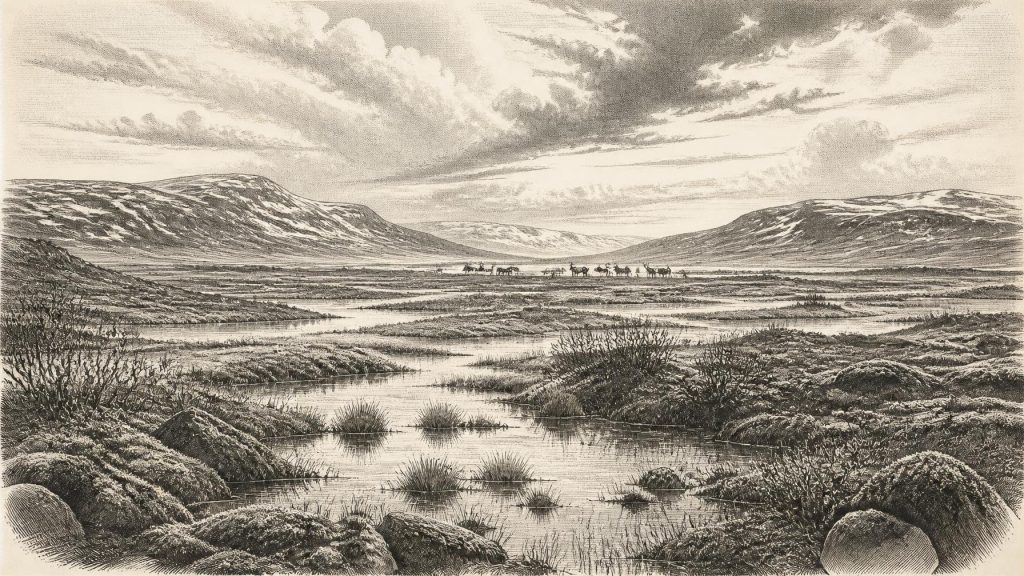
The most important Irish record for this broad interval lies at Derryvree, near Maguiresbridge in County Fermanagh. Roadworks in 1969 cut through a drumlin and revealed a remarkable sequence: glacial till below, freshwater silts and fine sands with organic material in the middle, and another thick till above. This was no ordinary pond deposit. Its position between two ice-laid sediments shows that ice had occupied the locality, then conditions allowed a freshwater environment to develop, before renewed glacial activity buried and protected the evidence.
A conventional radiocarbon determination from the organic horizon, Birm-166, was published as 30,500 radiocarbon years BP, with a wide uncertainty. On later calibration it spans approximately 36,900–31,700 cal BP. That broad range encompasses 30,512 BCE, but the distinction matters: it does not mean that the Derryvree silts record one known year, or even one short-lived generation. They accumulated over time and give a local environmental window, not a national snapshot.
The plants, insects and sediments indicate open tundra vegetation and a periglacial regime. “Periglacial” does not mean an empty expanse of permanent snow; it describes ground subject to severe cold, repeated freezing and thawing, short growing seasons and limited tree growth. At Derryvree, water lay on or beside low ground sufficiently long for fine sediment and organic matter to gather. The landscape supported a working wetland ecosystem, but not the familiar wooded and temperate Ireland of later millennia. The older description of the setting as muskeg captures its wet, mossy, plant-rich character, though it should not be imagined as a modern peat bog transplanted unchanged into the Ice Age.
An Unsteady Ice-Age Ireland
Derryvree is decisive evidence that at least this part of Fermanagh was ice-free long enough for freshwater and tundra communities to form during the relevant broad period. It is not proof that the whole island was simultaneously open, nor does it settle the exact extent of Irish glaciers at every moment. The growth of the British–Irish Ice Sheet was uneven, with ice masses expanding, shifting and sometimes retreating on regional scales. Later glaciation eroded or buried much of the older evidence, which is why surviving deposits such as Derryvree are so valuable and why reconstructions remain provisional.
Other Irish evidence confirms that climatic conditions were not simply steady cold. Speleothems in Crag Cave, County Kerry, formed episodically during the last glacial period. Because stalagmite formation in this shallow cave required infiltrating liquid water and temperatures sufficiently mild to permit it, the deposits register intervals of amelioration amid much colder phases. They cannot provide a weather report for 30,512 BCE, but they support a picture of abrupt North Atlantic climatic oscillations affecting Ireland during MIS 3. The difference between a cold interval and a relatively mild interstadial could transform the availability of water, vegetation, animal forage and usable ground.
Sea level was substantially lower than today because water was held in continental ice sheets. Coastlines and shallow seas around Ireland therefore differed markedly from their modern outlines. Yet lower sea level should not be converted automatically into a simple dry bridge linking Ireland, Britain and continental Europe. The routes available to animals and people altered through time, and ice, water, currents, terrain and season all mattered. The safest conclusion is that Ireland was intermittently connected ecologically to the wider north-west European world, not that a particular crossing route can be mapped for this particular notional year.
The Cave Record in North Cork
County Cork offers a second, very different archive. Castlepook Cave, also called Mammoth Cave, near Doneraile, has yielded Ireland’s richest known pre-Last Glacial Maximum vertebrate assemblage. Its bones include woolly mammoth, reindeer, giant deer, brown bear, wolf, Arctic fox, lemmings and spotted hyaena. The assemblage demonstrates that a varied cold-stage fauna reached Ireland during portions of the last glacial cycle. Re-dating work has shown that several old cave dates were too young, reinforcing the importance of MIS 3 animal histories in southern Ireland.
But Castlepook must not be treated as a single camp or a single moment frozen in place. Caves collect remains through many processes: animals die nearby, carnivores transport prey and carrion into shelter, water moves sediment, frost breaks deposits apart, and earlier excavators remove material without the stratigraphic recording expected today. Some Castlepook animals may have lived thousands of years apart. A bone proves the presence, death or deposition of an animal; it does not automatically demonstrate a complete local food web at one instant, much less a human community.
A reindeer femur from the old Castlepook collection is particularly important. It has been reported as roughly 33,000 years old and bears a deep mark interpreted by zooarchaeologist Ruth Carden as made by a sharp stone tool during butchery. County Cork heritage publications accordingly identify it as a possible Palaeolithic trace, broadly around 31,000 BCE. If the mark is confirmed as human-made and contemporary with the bone’s final processing, it would indicate that one or more people handled a reindeer carcass in Ireland far earlier than the island’s long-established post-glacial settlement record.
That is a major possibility, but it remains a narrow claim. The femur is not accompanied by a securely stratified hearth, stone-tool assemblage, built shelter, burial, human skeleton or settlement surface of the same age. It cannot tell us whether people killed the reindeer, encountered an already-dead animal, processed it at the cave or elsewhere, travelled in a large group, remained for a night, or returned again. The appropriate historical language is therefore “possible human activity” or “possible carcass processing”, not permanent occupation, colonisation or a named Irish Upper Palaeolithic people.
Society Beyond the Evidence
There is no responsible evidence for political affairs, rulers, territories, diplomacy, formal warfare, law or institutions in Ireland around this time. There is likewise no securely dated Irish evidence for houses, villages, monuments, graves, art, ritual sites, language, kin groups or trade networks. Such absences should be stated plainly, rather than filled with attractive stories borrowed from France, central Europe or Britain.
Upper Palaeolithic communities elsewhere in Europe did possess sophisticated stone technologies, social networks and symbolic practices. That comparative evidence makes a human visit to an exposed Ice Age Ireland conceivable, and it helps explain the practical knowledge any visitors would have required: reading animal movements, locating sheltered ground and fresh water, maintaining cutting tools, sharing food and surviving rapid weather changes. Yet comparison is not proof. Ireland has not yielded the objects that would allow those wider cultural achievements to be assigned here in this period.
The same caution applies to economy and exchange. If people briefly visited, a reindeer could have offered meat, marrow, hide, sinew, antler and bone. Those are the potential resources of the animal, not demonstrated products of an Irish economy. No imported flint source, exchange route, cache, workshop or repeated hunting station is known from Ireland at this date. The most secure “economy” was ecological: wet ground, seasonal plant growth, grazing animals, predators, freshwater and shelter determined what life—animal and perhaps occasionally human—could be sustained.
What This Date Can Mean
The chief development around 30,512 BCE is therefore environmental and archaeological, rather than political or biographical. Derryvree shows that part of Ireland supported open tundra and freshwater life during a dated interval between episodes of glaciation. Crag Cave records the sensitivity of Irish conditions to wider North Atlantic climatic shifts. Castlepook demonstrates that a striking range of mammals reached the island before the Last Glacial Maximum, while one marked reindeer bone raises the unresolved possibility of a human visit.
In the following millennia, ice-sheet growth increasingly transformed this fragile world, destroying, covering and rearranging landscapes and their traces. What survives is fragmentary: a buried wetland, cave bones, calcite layers and the landforms of moving ice. Together they do not yield a chronicle for a calendar year. They do, however, reveal an Ireland that was cold, changing and ecologically connected to Ice Age Europe—an island with open ground, shallow waters and roaming animals, poised before more extensive glaciation reshaped the evidence itself.
Primary Sources
- Middle Midlandian Freshwater Series at Derryvree, Maguiresbridge, County Fermanagh, Northern Ireland
- The IntCal20 Northern Hemisphere Radiocarbon Age Calibration Curve (0–55 cal kBP)
- A Reconsideration of the Radiocarbon Dating of the Marine Isotope Stage 3 Fauna from Southern Ireland
- The Irish Quaternary Fauna Project
- Episodic Speleothem Deposition Tracks the Terrestrial Impact of Millennial-Scale Last Glacial Climate Variability in SW Ireland
- Extent and Timing of the Last Glacial Maximum (LGM) in Britain and Ireland: A Review
- Growth and Retreat of the Last British–Irish Ice Sheet, 31,000 to 15,000 Years Ago: the BRITICE-CHRONO Reconstruction
- The Timing and Magnitude of the British–Irish Ice Sheet Between Marine Isotope Stages 5d and 2
- BRITICE Glacial Map, Version 2: A Map and GIS Database of Glacial Landforms of the Last British–Irish Ice Sheet
- Timing, Pace and Controls on Ice Sheet Retreat: an Introduction to the BRITICE-CHRONO Transect Reconstructions of the British–Irish Ice Sheet
- Castlepoook Cave: County Geological Site Report
- 2022:564 – Castlepook Cave, Castlepook South, Cork
- Archaeological Heritage of County Cork
- Heritage Artefacts of County Cork
- Figure 6: The Subdivision of the Quaternary Period in Ireland
- References and Recommended Reading
- New Insights on the Fauna of Ireland’s Younger Dryas and Early Holocene from Alice & Gwendoline Cave
- Advance and Retreat of the Marine-Terminating Irish Sea Ice Stream into the Celtic Sea During the Last Glacial: Timing and Maximum Extent
- The Mesolithic in Ireland: When Was It?
- Ireland’s Palaeolithic Archaeology – Fleeting Footprints in a Frozen Land
- Growth and Retreat of the Last British–Irish Ice Sheet, 31,000 to 15,000 Years Ago: Open-Access Repository Copy
- Episodic Speleothem Deposition Tracks the Terrestrial Impact of Millennial-Scale Last Glacial Climate Variability in SW Ireland: University of Basel Record