Carden’s Femoral Modification30282 BCE
30,282 BCE is a modern label rather than a date recoverable from Irish evidence. During the broader Middle Midlandian, Ireland experienced severe, variable cold, shifting ice and low sea levels before the Last Glacial Maximum. Derryvree, County Fermanagh, preserves an organic freshwater layer between tills, indicating local treeless tundra wetlands with mosses, sedges and cold-adapted plants. Castlepook Cave, County Cork, contains mixed remains of reindeer, mammoth, giant deer, predators and lemmings, but lacks precise single-period context. A modified reindeer femur may indicate brief human handling, although it cannot prove settlement. Later glaciation destroyed evidence, leaving possibilities rather than secure history.
Dateline
“30,282 BCE” is a modern chronological label, not a recoverable Irish date. No calendar, writing system, named community or historical record existed on the island at this depth of time. In simple calendar arithmetic the label lies about 32,231 years before the radiocarbon reference year of AD 1950, but archaeology cannot identify an event, season or generation in Ireland in that particular year. The responsible approach is therefore to place it within the late Middle Midlandian, or Marine Isotope Stage 3, and to use dated ranges, deposits and carefully qualified comparisons.
This was an interval before the Last Glacial Maximum, when the British–Irish Ice Sheet reached its greatest Late Pleistocene extent roughly 26,000–21,000 years ago. It was nevertheless an unstable world of severe cold, fluctuating ice margins, changing coastlines and open vegetation. Conditions varied sharply by region and through time. A date on a bone or organic bed tells us when material was formed or deposited within an uncertainty range; it does not supply a snapshot of the whole island. The evidence most relevant to this article is environmental and faunal, while the evidence for people remains exceptionally slight.
A Date Without a Dated Event
Radiocarbon dating makes this distinction especially important. A conventional radiocarbon age is not identical to a calendar age, because atmospheric carbon-14 has varied through time. Modern calibration curves convert radiocarbon determinations into calendar ranges, often broad and sometimes discontinuous at this antiquity. Thus the Derryvree organic deposit in County Fermanagh, which produced the famous determination BIRM-166 of 30,500 radiocarbon years BP, cannot be translated into one simple BCE year. Its calibrated age belongs broadly in the mid- to later-30,000s cal BP, commonly represented as around 35–37 thousand calibrated years ago.
Derryvree is therefore not a direct record of 30,282 BCE; it is older by several millennia on the best available calibration. Yet it remains indispensable for understanding the kind of Irish landscape that preceded the later, more extensive glaciation. Equally, animal bones from Castlepook Cave near Doneraile, County Cork, derive from a long and mixed sequence rather than a single occupation horizon. They illuminate the wider Middle Midlandian world, but should not be treated as proof that every listed species, or any particular person, was present at this exact notional date.
Water Between the Tills
Derryvree was exposed in 1969 when a road cutting passed through a drumlin about two kilometres north-east of Maguiresbridge. Beneath the familiar streamlined hill lay an extraordinary sequence: an older till deposited by ice, freshwater silts and fine sands with organic material, then a later till. The intervening bed shows that, locally and for a meaningful interval, there had been ice-free ground and standing or slow-moving fresh water between episodes of glaciation.
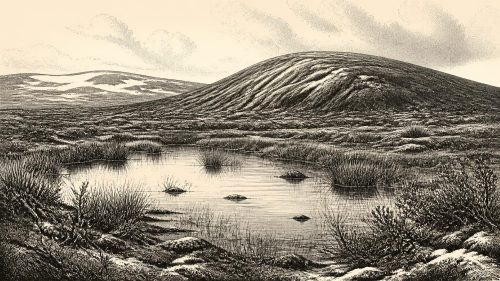
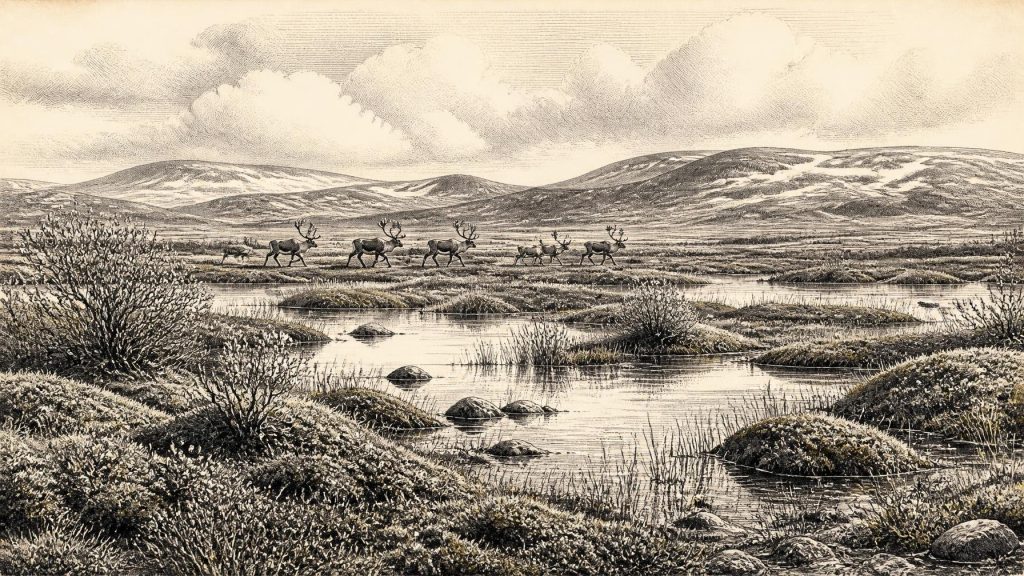
The fossils provide the firmest picture. Moss remains, plant macrofossils, pollen and insects point to open, treeless tundra or muskeg: waterlogged ground, sedge-rich margins, mossy surfaces and shallow pools rather than woodland or a modern Irish bog. Among the recorded plants were cold-tolerant taxa including dwarf willow, mountain avens, buckbean and water-milfoil. These do not mean that every patch of Ireland resembled Derryvree. They demonstrate, rather, that a periglacial freshwater habitat existed in this part of Fermanagh during the deposit’s formation.
That distinction matters for 30,282 BCE. The Derryvree deposit is not an island-wide weather report, and its calibrated range does not precisely overlap the assigned calendar year. But its position between tills reveals a recurrent Late Pleistocene pattern: exposed terrain could support wetlands, vegetation and animal life before glacier advance buried, eroded or rearranged the evidence. Much of the older Irish landscape was subsequently destroyed or concealed by ice, which is why such a thin organic layer carries unusual historical weight.
Castlepook’s Mixed Fauna
Castlepook Cave, also known as Mammoth Cave, is the principal Irish archive for pre-Last Glacial Maximum mammal remains. Antiquarian excavators working there in the early twentieth century recovered a large faunal collection from cave chambers, sands and disturbed deposits. Later reassessment and radiocarbon work confirmed that the collection includes animals of considerable antiquity, but also showed why it must be read cautiously: bones from different episodes were mixed by carnivores, water, sediment movement and earlier excavation.
Its Middle Midlandian fauna includes reindeer, woolly mammoth, giant deer, wolf, fox, Arctic fox, brown bear, spotted hyaena and both collared and Norwegian lemmings. Not all have identical dates, and their presence at Castlepook cannot establish a complete, stable animal community across Ireland at 30,282 BCE. Still, the assemblage makes clear that Ireland periodically supported cold-stage mammals and formidable predators during the wider period. Reindeer and lemmings indicate open, cold habitats; mammoth and giant deer demonstrate that substantial herbivores reached the island; hyaenas and wolves show that carcasses and prey were part of a predator-rich ecological system.
Recent redating has complicated older chronologies. Improved pretreatment of bone collagen made a number of Castlepook ages substantially older than earlier measurements suggested, and researchers have stressed the cave’s complex taphonomy. This is not a weakness to conceal but a central fact of the evidence. Castlepook is a powerful archive of Pleistocene Ireland precisely because it preserves rare remains; it is also an archive in which a bone’s findspot and its original depositional context are not always secure enough to sustain fine-grained reconstruction.
The Reindeer Femur and Human Possibility
A reindeer femur from Castlepook has given this period particular importance. Ruth Carden’s study identified a deep linear modification interpreted as a possible cut mark made with a sharp stone tool on fresh bone. The femur has been reported as approximately 33,000 radiocarbon years old. If the modification is confirmed as anthropogenic, it would be remarkable evidence that humans handled a reindeer in Ireland far earlier than the well-established terminal-Pleistocene and Mesolithic records.
That conclusion must remain deliberately narrow. The marked bone is not a house floor, hearth, tool assemblage, burial, midden or stratified hunting camp. It does not identify the people involved, their numbers, language, route to Ireland, length of stay or whether they returned. Nor does it demonstrate continuous occupation. At most, it supports the possibility of a brief human encounter with an animal during the broader pre-Last Glacial Maximum period. The femur itself is older than the modern label used here once calibrated, so it cannot responsibly be presented as an event of 30,282 BCE.
There is no direct basis for political history at this date. No states, territories, leaders, diplomacy, warfare, law or collective institutions are visible in the Irish record. There is likewise no evidence for ritual sites, monuments, art, formal learning, trade networks or a settled economy. The absence is not proof that people could never have visited; it is a limit on what the surviving record permits historians to say. Describing a tribal society, a seasonal trading system or a religious world here would be invention.
Movement Through a Changing Island
Human and animal movement must be considered against a changing physical geography. Sea level was lower than today during the Late Pleistocene, while glaciers and ice streams repeatedly altered routes, shorelines and habitats around Ireland and Britain. Yet the exact configuration of crossings, coasts and ice at 30,282 BCE is not known with the resolution needed to narrate a journey. The growth and interaction of the British–Irish Ice Sheet before the Last Glacial Maximum remain active subjects of research, with regional sequences often better understood than the island-wide picture.
The important development was ecological, not political: a mobile, cold-adapted landscape was being repeatedly made and unmade. Wet ground could sustain plants and insects; open terrain could support grazers; predators followed prey; caves could serve as dens, traps, shelters or bone accumulators. Later ice advance then reshaped valleys, laid down till and removed many traces of what came before. Ireland’s deep prehistory is consequently patchy not simply because activity was sparse, but because preservation was poor and later glaciation was destructive.
What Can Be Said Responsibly
Ireland at this notional date was not yet the wooded, farmed or politically organised island of later millennia. The strongest evidence points to a cold Late Pleistocene environment, regionally variable and subject to rapid climatic and glacial change. Fermanagh’s buried freshwater deposits demonstrate that tundra wetland habitats existed during the broader Middle Midlandian. Castlepook demonstrates that an impressive range of cold-stage mammals reached southern Ireland, while its altered reindeer femur raises—without settling—the possibility of an early human visit.
For 30,282 BCE, then, the most truthful annual overview is not a fabricated episode but a record of limits and possibilities. Calendar-year precision is unavailable. Derryvree and Castlepook are temporally relevant, not exact witnesses to one year. Their combined evidence reveals an Ireland in which water, moss, sedge, willow, grazing animals, scavengers and advancing ice shaped the recoverable past. Whether people briefly entered that world remains an important archaeological question, rather than an established chapter of continuous Irish settlement.
Primary Sources
- Middle Midlandian Freshwater Series at Derryvree, Maguiresbridge, County Fermanagh, Northern Ireland
- Middle Midlandian Freshwater Series at Derryvree, Maguiresbridge, County Fermanagh, Northern Ireland — Ulster University record
- A Reconsideration of the Radiocarbon Dating of the Marine Isotope Stage 3 Fauna from Southern Ireland
- The Irish Quaternary Fauna Project
- The Exploration of Castlepook Cave, County Cork
- Heritage Artefacts of County Cork
- 2022:564 — Castlepook Cave, Castlepook South, Cork
- Occurrence of Mammalia Relicts at Site Castlepook Cave
- Pleistocene Vertebrates in the British Isles
- Ireland’s Palaeolithic Archaeology – Fleeting Footprints in a Frozen Land
- Palaeoecology
- The Subdivision of the Quaternary Period in Ireland
- Introduction to the Late Quaternary and Holocene of Northern Ireland
- Freshwater Organic Deposits and Stratified Sediments Between Early and Late Midlandian (Devensian) Till Sheets, at Aghnadarragh, County Antrim, Northern Ireland
- The Timing and Magnitude of the British–Irish Ice Sheet Between Marine Isotope Stages 5d and 2
- Growth and Retreat of the Last British–Irish Ice Sheet, 31,000 to 15,000 Years Ago
- Extent and Deglacial Chronology of the Last British–Irish Ice Sheet
- Last Glacial Maximum Cirque Glaciation in Ireland and Implications for Reconstructions of the Irish Ice Sheet
- Trimlines, Blockfields and the Vertical Extent of the Last Ice Sheet in Southern Ireland
- Deglaciation Chronology of the Donegal Ice Centre, North-West Ireland
- The IntCal20 Northern Hemisphere Radiocarbon Age Calibration Curve (0–55 cal kBP)
- The IntCal20 Approach to Radiocarbon Calibration Curve Construction
- NGRIP/GRIP GICC05 Time Scale and Oxygen-Isotope Data
- New Insights on the Fauna of Ireland’s Younger Dryas and Early Holocene from Alice & Gwendoline Cave