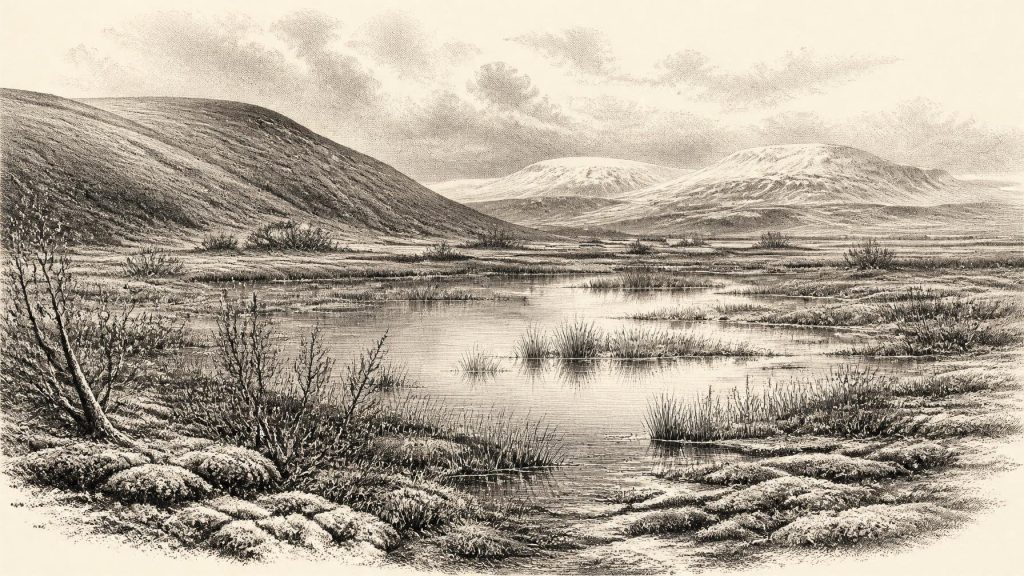
Bogbean Below Fermanagh Drumlins30510 BCE
About 30,510 BCE, Ireland lay within the fluctuating cold of Marine Isotope Stage 3, approaching the Last Glacial Maximum. It was not uniformly ice-covered: organic sediments at Derryvree, Fermanagh, between glacial tills, record an ice-free freshwater wetland with mosses, sedges and cold-adapted insects. Similar regional deposits indicate open, varied tundra or steppe-tundra habitats. Castlepook Cave, Cork, preserves a mixed record of Ice Age mammals, including mammoth, reindeer, giant deer, predators and small cold-climate species, demonstrating intermittent faunal connectivity. A possibly cut-marked reindeer bone may indicate brief human presence, but remains disputed. Evidence supports neither settlement, farming, trade nor political organisation.
Dateline
The label 30,510 BCE is a modern way of placing a point deep in the Late Pleistocene; it is not a date that Ice Age people in Ireland could have recognised, nor can the evidence be resolved to a single calendar year. Counting back from AD 1950, it falls roughly 32,460 calendar years before present. At this depth of time, radiocarbon results need calibration and carry substantial ranges, while deposits may represent years, centuries or longer episodes. The responsible history of Ireland at this point is therefore not an annal of events, rulers or battles. It is a reconstruction from glacial sediments, plant remains, insects, animal bones and the rare, disputed hints of human action.
An Island Approaching Maximum Cold
This was part of Marine Isotope Stage 3, an unstable late-Ice-Age period in which severe cold alternated with comparatively less hostile intervals. Ireland was moving towards the Last Glacial Maximum, when the British–Irish Ice Sheet expanded across and beyond much of the island. Modern reconstructions indicate major ice-sheet growth between about 31,000 and 26,000 calendar years ago. That wider trajectory matters, but it must not be turned into a map for one imagined day in 30,510 BCE. Ice margins advanced and retreated unevenly; conditions differed sharply between uplands, lowlands, coasts and sheltered basins.
The evidence suggests that parts of Ireland had not yet become the wholly ice-covered country associated with the glacial maximum. Yet nor was it a milder, forested island. The more defensible picture is of a cold, open and shifting landscape, with local ice, periglacial ground and freshwater habitats appearing in favourable hollows. Winter freezing, short growing seasons and strong seasonal contrasts are sound inferences from the glacial setting and the organisms recovered from relevant deposits. Precise temperatures, the extent of snow cover in a particular valley, and the position of every ice front remain beyond the evidence.
Derryvree’s Buried Wetland
The most valuable Irish environmental archive for this broad phase lies at Derryvree, near Maguiresbridge in County Fermanagh. There, road cuttings exposed organic-rich freshwater sediments trapped between two tills: compact glacial deposits laid down by separate advances of ice. The order of the layers is the crucial evidence. A lower till records glacial conditions; fine silts and organic material above it show that ice had withdrawn or ceased to dominate locally long enough for a wetland to form; an upper till demonstrates that later ice-related deposition covered and preserved the sequence.
Its published radiocarbon determination, BIRM-166, is 30,500 radiocarbon years BP, with a large uncertainty of +1,170 and −1,030 years. That is a conventional radiocarbon measurement, not a calendar date, and it must not be mechanically equated with 30,510 BCE. Calibration curves such as IntCal20 extend this far into the past, but they produce probability ranges rather than a historical timestamp. Derryvree is best used as evidence for a broad Middle Midlandian, or Devensian, interval relevant to this date label: it demonstrates that northern Ireland contained an ice-free freshwater environment during a fluctuating cold stage.
The plant and insect evidence gives that conclusion texture. Freshwater mosses and sedges occurred at Derryvree, alongside cold-climate insect fauna. Related Fermanagh deposits at Hollymount near Maguiresbridge and Greenagho near Belcoo likewise preserve organic muds or peats formed between glacial episodes. Taken together, these sites show that the region was not simply inert ground beneath permanent ice. Shallow water, saturated margins and patches of vegetation existed. They do not, however, prove a modern-style bog, continuous plant cover across the island, or a stable landscape lasting for millennia.
Open Ground and Fresh Water
For everyday ecology, the Derryvree record is more revealing than any imagined panorama of mammoths. Mosses, sedges and other wetland plants point to water that was still or slow-moving enough for fine sediments and organic remains to accumulate. Beyond such sheltered wet patches lay open ground rather than closed woodland. The broader flora is consistent with a tundra or steppe-tundra mosaic: low vegetation, exposed mineral soils and frost-affected terrain, broken by ponds, marshy hollows and drainage channels. The word “mosaic” is important. It describes environmental variety over a landscape, not a neat belt of uniform habitat.
Such places would have offered limited but real seasonal resources. Plants supported invertebrates; wet margins attracted birds and small animals; water channels shaped routes through the terrain. Larger herbivores could have used productive patches when conditions permitted. But the evidence does not allow the reconstruction of a local food web at a particular Fermanagh pool in a particular year. Nor can deposits in the north be treated as a direct weather report for Cork, Clare or the Irish Sea coast. The island’s relief, ice cover and changing shorelines made regional variation fundamental.
Castlepook’s Long Animal Record
Southern Ireland supplies a different kind of evidence. Castlepook Cave, near Doneraile in north County Cork, is Ireland’s richest pre-Last-Glacial-Maximum vertebrate site. More than 2,000 bones have been recovered from its passages, and direct dates on individual specimens span a long interval, roughly 45,700 to 19,950 radiocarbon years BP. The cave has yielded remains of woolly mammoth, giant deer, reindeer, brown bear and spotted hyaena, with wolf, Arctic fox, lemmings and mountain hare also represented in the wider assemblage.
These animals establish that a striking cold-climate fauna reached Ireland during the Late Pleistocene. Mammoth and reindeer imply open feeding landscapes; hyaenas and wolves reveal predators and scavengers able to exploit carcasses; lemmings and Arctic fox point towards cold conditions. But Castlepook is not a single living community frozen at one moment. Bone accumulations can result from carnivore activity, animals dying naturally, water movement and older excavations. The cave’s dated specimens belong to different phases. It is consequently sound to say that its fauna illuminates the ecological possibilities of Ireland around this era, but unsound to place every listed species together on the Derryvree wetland.
The cave also complicates the old assumption that Ireland was biologically isolated throughout the Ice Age. Animals repeatedly reached the island, though precisely how routes opened and closed remains uncertain. Lower global sea levels altered coastlines, but low sea level alone does not demonstrate a simple, continuously walkable land bridge from Britain. The Irish Sea basin, marine channels, glacial ice and relative sea-level change must all be considered. Faunal movement is evidence of connectivity at some points; it is not a detailed map of crossings.
A Possible Human Trace
One Castlepook object is especially important and requires exceptional caution. A reindeer femur in the National Museum of Ireland’s collections bears a deep mark that zooarchaeologist Ruth Carden has interpreted as a cut or chop made on fresh bone by a sharp stone tool. Cork heritage publications associate the bone with about 31,000 BCE. If the mark is correctly identified and relates to the bone’s age, it would be evidence that people processed a reindeer in Ireland during the Upper Palaeolithic, close to the broad time represented here.
That conclusion remains narrower than popular accounts can suggest. The marked femur is not a securely sealed camp floor. No associated stone-tool assemblage, hearth, built shelter, burial, human remains or repeated domestic refuse of comparable age has yet been demonstrated at Castlepook. Nor does one modified bone identify the people involved, establish permanent residence, or show whether they hunted the animal, found a carcass, stayed briefly, or returned. A passing party of highly mobile hunters is a reasonable interpretation if the cut-mark reading holds; it remains an interpretation, not a documented settlement.
No Polities, No Proven Trade
There is no evidence from Ireland at this time for political authority, diplomacy, warfare between communities, named groups, territorial boundaries or formal institutions. There is equally no basis for identifying a language, ethnicity, religion, art tradition or system of learning. These absences reflect the sparseness of the Irish record, not a claim that any possible visitor lacked beliefs, kinship or social rules. Archaeology simply cannot recover them here.
Nor is there evidence for farming, domestic animals, crops, trade routes or maritime exchange. Reindeer, mammoths and carnivores indicate animal dispersal, not commerce. If people did reach Ireland, their economy would most plausibly have depended on temporary hunting, scavenging and the portable skills of Upper Palaeolithic foragers, but that is an analogy from wider Europe rather than a fact established by Irish artefacts. The strongest conclusion is deliberately modest: around the modern label 30,510 BCE, Ireland was a cold, environmentally varied land in the shadow of expanding ice, where freshwater life persisted in protected Fermanagh basins and Ice Age mammals ranged through at least some regions. Whether people briefly joined that world remains an important but unresolved question.
Primary Sources
- Early Midlandian–Middle Midlandian, Pleistocene, Northern Ireland
- Irish Quaternary Association Field Guide 16
- Castlepook Cave, County Geological Site Report
- The Geological Heritage of County Leitrim
- Pleistocene Vertebrates in the British Isles
- The Irish Quaternary Fauna Project
- Occurrence of Mammalia Relicts at Site Castlepook Cave
- New Insights on the Fauna of Ireland's Younger Dryas and Early Holocene from Alice & Gwendoline Cave
- New Insights on the Fauna of Ireland's Younger Dryas and Early Holocene from Alice & Gwendoline Cave (open PDF)
- Growth and Retreat of the Last British–Irish Ice Sheet, 31,000 to 15,000 Years Ago: the BRITICE-CHRONO Reconstruction
- Growth and Retreat of the Last British–Irish Ice Sheet, 31,000 to 15,000 Years Ago: the BRITICE-CHRONO Reconstruction (University of St Andrews record)
- Timing and Pace of Ice-Sheet Withdrawal Across the Marine–Terrestrial Transition West of Ireland During the Last Glaciation
- The IntCal20 Northern Hemisphere Radiocarbon Age Calibration Curve (0–55 cal kBP)
- IntCal Publications
- Heritage Artefacts of County Cork
- 2022:564 – Castlepook Cave, Castlepook South, Cork
- Archaeology Research Excavation Grant 2022: Castlepook Cave Final Report
- Ireland's Palaeolithic Archaeology – Fleeting Footprints in a Frozen Land
- Middle Midlandian Interstadial Deposits at Greenagho, Near Belcoo, County Fermanagh, Northern Ireland
- Freshwater Organic Deposits and Stratified Sediments Between Early and Late Midlandian (Devensian) Till Sheets, at Aghnadarragh, County Antrim, Northern Ireland