Raids Across Ireland1035 CE
In 1035, Ireland comprised competing regional kingdoms, with no universally accepted high king since 1022. Annals record raids, killings and church plundering, though clerical priorities obscure ordinary life. Donnchad mac Briain defeated Bréifne raiders after their attack on Clonfert, demonstrating the Shannon’s military importance. In Dublin, Sitriuc Silkbeard killed Waterford’s Ragnall ua Ímair and raided Ardbraccan; Mide’s Conchobar retaliated against Swords. Other conflicts involved Leinster, Mide and Donegal, often for cattle, captives and prestige. Churches were political and economic targets, while farming, craftsmanship, learning and trade continued. Archaeology reveals interconnected Gaelic and Hiberno-Norse communities, and annalistic dating remains sometimes uncertain.
Dateline
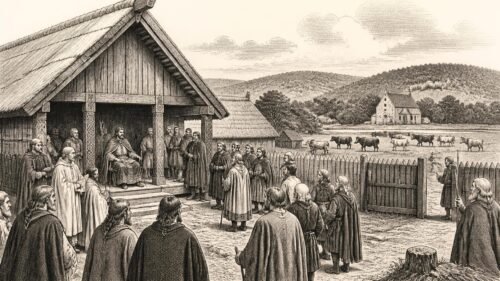
Ireland in 1035 was a country of energetic regional kingdoms rather than a single state governed continuously from one royal centre. Since the death of Máel Sechnaill mac Domnaill in 1022, no ruler had exercised generally accepted authority across the island. Kings of Munster, Mide, Leinster, Connacht, Ailech and numerous smaller territories pursued their interests through alliances, hostages, marriage, raiding and retaliation. The Hiberno-Norse ports, especially Dublin and Waterford, were woven into this political system while retaining maritime connections to Britain and the wider North Atlantic world.
The surviving annals make 1035 appear exceptionally violent. Their entries concentrate on rulers killed, churches plundered, cattle seized and armed expeditions defeated. This reflects both genuine insecurity and the priorities of clerical chroniclers, who rarely described an uneventful harvest, a successful market or the daily work of ordinary households. Archaeology and broader evidence are therefore needed to place the recorded conflicts within a society that continued to farm, trade, worship and produce skilled craftwork.
What Can Be Firmly Dated?
The Annals of Ulster and Annals of Inisfallen preserve independent material under 1035. Their calendar headings agree that the kalends, or 1 January, fell on a Wednesday, although they give different lunar counts. The Annals of the Four Masters, compiled much later from earlier material, adds several events. Its chronology sometimes differs by a year from other collections, so its entries must be used carefully.
One example is the killing of Cathal son of Amalgaid, king of western Leinster, together with his wife and even his hound. The Annals of Ulster places this under 1035, whereas the Four Masters assigns it to 1034. The episode can safely be connected with the period, but its precise calendar year is not beyond dispute. The unusually domestic detail suggests that Cathal was surprised rather than killed in a formal battle. His wife, identified through her male ancestry, probably represented a politically significant marriage alliance.
The Battle on the Rivers
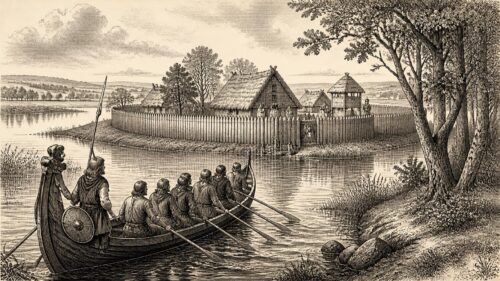
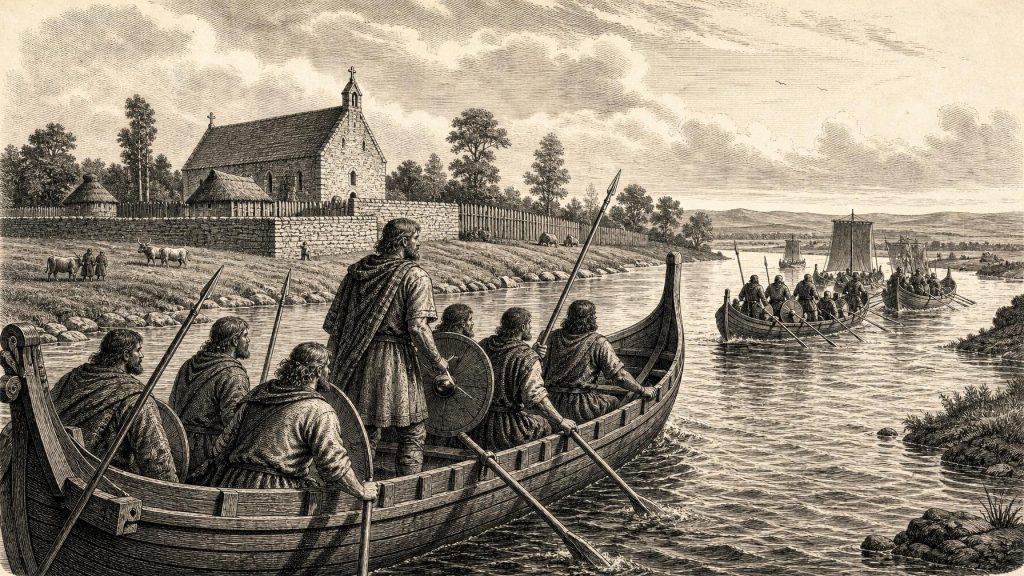
The most substantial narrative securely entered under 1035 comes from the Annals of Inisfallen. Men of Bréifne plundered Clonfert, the monastery of St Brendan beside the Shannon. Donnchad mac Briain, king of Munster and son of Brian Bóruma, then encountered them with the crew of only one vessel. The raiders reportedly possessed fourteen galleys, yet Donnchad defeated them and inflicted heavy losses around the rivers Suck and Shannon.
The figures may have been shaped to magnify Donnchad’s achievement, but the basic episode is credible. It reveals that inland warfare could be thoroughly naval. The Shannon was one of Ireland’s principal routes for armies, traders, pilgrims and churchmen, while tributaries such as the Suck connected territories west of the river with the midlands. Boats allowed raiders to move livestock, captives and portable wealth more rapidly than an overland force could manage.
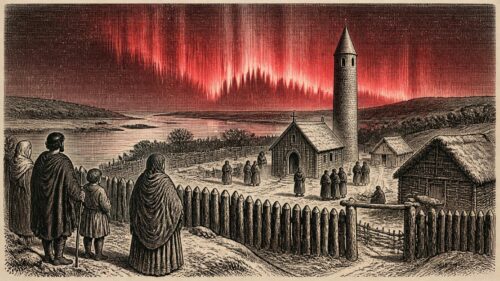
Clonfert was not merely an isolated religious retreat. Founded in the sixth century and associated with Brendan, it was a longstanding centre of worship, learning and pilgrimage. Its community occupied land beside productive callows and a major transport artery. An attack on it could yield animals, food, metal objects and prisoners while also challenging the patrons who claimed to protect the saint’s foundation. Donnchad’s intervention presented him as both warrior and defender of ecclesiastical order. It also carried his power beyond Munster into a strategically contested border region.
Dublin and Waterford
The year’s most important political killing linked Ireland’s two leading Hiberno-Norse ports. Ragnall ua Ímair, king of Waterford, was killed in Dublin by Sitriuc son of Amlaíb, better known as Sitriuc Silkbeard. The annals do not describe a battle, trial or motive, and it would be unsafe to invent one. Nevertheless, the location and the rank of the victim indicate a deliberate act within the competitive politics of the maritime towns.
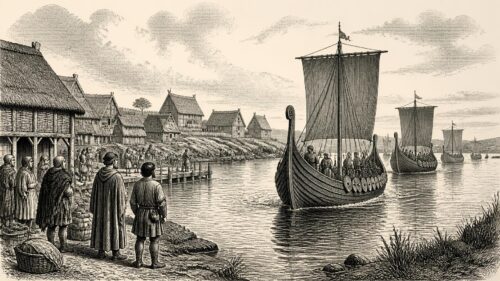
Waterford occupied a commanding position on the Suir and the approaches to the Barrow and Nore. Archaeological evidence suggests that the town underwent significant development around the early eleventh century. Dublin was larger and wealthier, with streets, timber houses, workshops and substantial earth-and-timber defences. Its craftsmen worked wood, iron, bronze, silver, amber, bone and textiles. Merchants handled coins, weighed silver and imported goods from Britain and continental Europe.
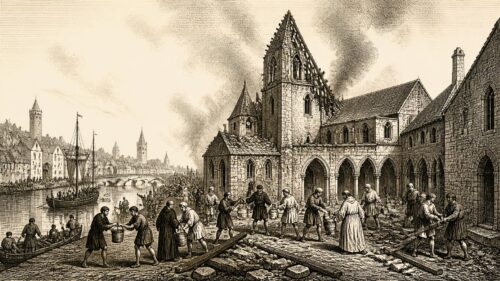
Sitriuc had ruled Dublin through much of a turbulent half-century. He had issued Ireland’s earliest royal coinage and, following a pilgrimage to Rome, supported the foundation of Christ Church. Yet conversion and church patronage did not remove older habits of predation. In 1035 Sitriuc plundered Ardbraccan, an important ecclesiastical centre in Mide. Conchobar Ua Máel Sechnaill, king of Mide and grandson of the former high king, answered by plundering and burning Swords, a Columban church closely connected with Dublin. The annalist explicitly presents the second attack as revenge for the first.
This exchange shows how churches could become political proxies. Ardbraccan lay within Conchobar’s sphere, while Swords stood under Dublin’s influence. Striking a rival’s church damaged revenue, prestige and claims of sacred protection. Such attacks were not simply a contest between pagan Vikings and Christian Irish: both rulers were Christian, and both operated within a mixed political culture shared by Gaelic kingdoms and Hiberno-Norse towns.
Raiding in Leinster and Mide
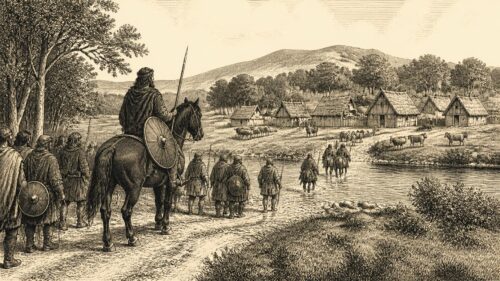
Other annalistic notices depict widespread but localised conflict. Flaithbertach Ua Murchada, king of Cenél Bógaine in the Donegal region, was killed with many companions. No battlefield or enemy is named. Iarnán Ua Flannchada led a foray into Delbna, where a small defending force overtook him. He and many of his followers were killed. The Annals of Ulster calls Iarnán a persecutor of saints and righteous people and credits his defeat to saintly power. Beneath this moral interpretation lies a familiar military pattern: a raiding column, probably burdened with booty, was intercepted by local men who knew the ground.
The Four Masters also records attacks by “foreigners” upon Killashee and Clane, two ecclesiastical sites in Leinster. A son of Donnchad son of Domnall pursued the attackers and inflicted a severe defeat. Although “foreigners” normally denotes Hiberno-Norse forces in entries of this period, the chronicle does not identify their leader. In another notice, Donnchad son of Dúnlang raided the people of Cualu in north Wicklow, carrying away cattle and prisoners.
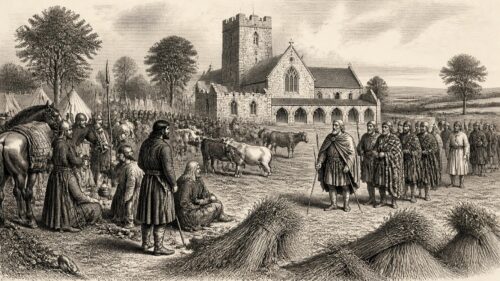
Cattle-raiding was an economic operation as well as a demonstration of kingship. Herds represented food, breeding stock, movable wealth and the capacity to reward followers. Captives could be ransomed, retained as dependants or sold. Raiding also weakened an opponent before future negotiations. A ruler who failed to defend cattle, churches and households risked losing credibility among subordinate lords.
Church, Learning and Memory
The annals’ religious language should be read as evidence in its own right. Chroniclers interpreted sudden reversals as judgements delivered through saints. Violence at consecrated places was remembered as sacrilege, particularly when people were attacked after seeking sanctuary. Yet monasteries were not detached from secular politics. Their leading offices could be held by members of powerful dynasties, and their lands, tenants, relics and schools made them important institutions within regional kingdoms.
Learning continued despite the raids. Communities such as Clonfert, Clonmacnoise, Kells, Armagh and Swords maintained traditions of Latin scholarship, vernacular learning, historical record and manuscript production. The very preservation of brief reports from 1035 reflects this literate culture. The entries were not modern journalism: they were selected, copied and sometimes rearranged across generations. Disagreements between annals therefore remind us to distinguish an event from the date later assigned to it.
Life Beyond the Annals
Most inhabitants of Ireland experienced the year through seasonal work rather than royal campaigning. Rural settlement remained dominated by dispersed farmsteads, including ringforts, with families cultivating cereals and tending cattle, sheep and pigs. Wooden houses, storage buildings and craft areas required regular rebuilding. Monastic settlements combined churches and burial grounds with workshops, farms and accommodation for clergy, students, dependants and visitors.
In the ports, daily life was denser and more specialised. Dublin’s archaeological remains reveal carpenters, smiths, comb-makers, jewellers, leatherworkers, weavers and merchants living along defined plots and streets. Irish and Scandinavian traditions had become closely intermingled: personal names, art styles and material culture resist any simple division between two separate peoples. Waterford, Dublin and other ports connected inland producers with overseas markets, while rivers carried goods and travellers deep into the country.
No famine, epidemic or extraordinary weather is securely recorded for Ireland in 1035. That silence does not prove universal prosperity, only that no such crisis entered the surviving notices. What the year does reveal is a resilient but highly competitive society. Regional kings could mobilise ships and warriors quickly; churches remained wealthy enough to attract attack; and political authority was repeatedly tested through the protection, seizure and recovery of people, livestock and sacred places. The clashes at Clonfert, Dublin, Ardbraccan and Swords capture an Ireland in which river routes, dynastic rivalry and ecclesiastical power were inseparably joined.
Primary Sources
- The Annals of Ulster: Year U1035
- Annals of Inisfallen: Annals AI1032–AI1041
- Annals of the Kingdom of Ireland by the Four Masters
- Chronicon Scotorum
- Chronicon Scotorum: Annals CS1030–CS1034
- Exploring the Irish Annals
- The Chronology and Sources of the Early Irish Annals
- Sitriuc Silkbeard (Sitric, Sigtryggr Ólafsson Silkiskeggi)
- Donnchad, Son of Brian
- Ua Máelshechlainn, Conchobar
- Donnchad, King of Osraige and Overking of Leinster
- Viking Collections
- Early Medieval Ireland, AD 400–1100: The Evidence from Archaeological Excavations
- Clonmacnoise, County Offaly
- Saint Brendan’s Cathedral, Clonfert: Conservation Plan
- Clonfert Cathedral: Archaeological Excavation Report
- Island Monasteries on the River Shannon
- The Dove: The Story of Colmcille in Dublin
- Swords Historic Landscape Characterisation
- Killashee Demesne: Early Medieval Ecclesiastical Site
- The Earth Moved at Killashee
- Viking Dublin and the City Walls
- First Genome Sequences of Irish Vikings Reveal Ties to Norway and Interactions with Local Population
- Sagas & Scéals: The Hiberno-Norse of Waterford
- Archaeological Assessment of Great George’s Street, Waterford
- History and Geography of Waterford City