War Across the Provinces1084 CE
In 1084, Ireland remained a patchwork of kingdoms, where Tairdelbach Ua Briain of Munster maintained overlordship through alliances and warfare while northern rivals strengthened. Raids devastated Ulaid, Munster and church sites, reflecting cattle’s economic and political importance. Donnchad Ua Ruairc led a multi-provincial force into Leinster but was defeated and killed by Muirchertach Ua Briain’s coalition at Móin Cruinneoige, enhancing Ua Briain power. Churches at Glendalough and elsewhere suffered, though Rossory gained a foundation. Dublin’s bishop Gilla Pátraic drowned, highlighting overseas connections. Reports of pestilence, urban commerce and rural disruption reveal a society shaped by conflict, religion and shifting authority.
Dateline
Ireland in 1084 was dominated by ambitious overkings, mobile armies and the struggle to turn temporary submission into lasting authority. The surviving annals record campaigns from Ulaid to Munster, the destruction of churches, the death of a bishop at sea and a major battle involving forces from much of the island. They do not describe a unified kingdom governed from a single capital. Instead, Ireland consisted of provincial and local kingdoms linked by tribute, hostages, dynastic marriage, military service and personal agreements that could quickly be broken.
The fullest accounts were written from different regional perspectives and do not always agree. The Annals of Ulster, Annals of Inisfallen, Annals of Tigernach, Annals of Loch Cé and later Annals of the Four Masters nevertheless preserve a recognisable sequence: pressure from Munster upon the midlands, an alliance centred upon Donnchad Ua Ruairc of Bréifne, destructive counter-raids and victory for Muirchertach Ua Briain at Móin Cruinneoige.
Power in North and South
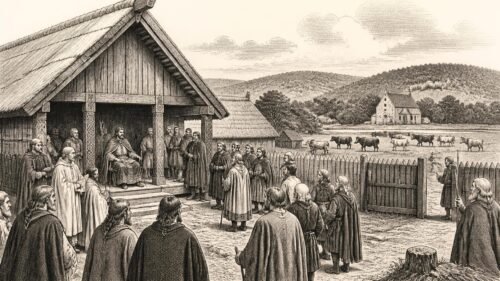
The most powerful Irish ruler was Tairdelbach Ua Briain, king of Munster and grandson of Brian Bórama. Since the death of his former patron, Diarmait mac Máel na mBó, in 1072, Tairdelbach had extended his influence over Leinster, Dublin, Osraige and parts of the midlands. His supremacy remained an overlordship maintained by campaigning and political management, however, rather than direct administration. Connacht was divided by competition among Ua Conchobair and Ua Ruairc leaders, while the north was developing a formidable centre of power under Domnall Ua Lochlainn of Cenél nÉogain.
Tairdelbach’s son Muirchertach was already an important commander. He had previously been placed over Dublin and in 1084 led the southern coalition in the year’s decisive battle. His prominence demonstrates how royal sons could act as governors and war leaders while their fathers remained the senior kings. It also foreshadowed Muirchertach’s later career as one of the dominant rulers of the Irish Sea world.
In the north-east, Donn Sléibe Ua hEochada, king of Ulaid, brought an army to Droichet Átha, the crossing at modern Drogheda. There he gave a stipend or military payment to Donnchad, son of Cailech Ua Ruairc. Such a payment publicly expressed alliance and recognised the recipient’s military value. Domnall Ua Lochlainn exploited Donn Sléibe’s absence by raiding Ulaid and carrying away a large quantity of cattle. This was not incidental theft. Livestock represented food, movable wealth, rents and the capacity to reward followers, so a successful cattle raid weakened an opponent while enriching an army.
Raids and Retaliation
A Munster army campaigned in Mide during the year. Conchobar Ua Cétfada, praised by southern annalists as the glory or dignity of Munster, died during the expedition. No battle is said to have caused his death, and the Annals of Inisfallen explicitly present it as a death in bed while the hosting was under way.
The absence of the main Munster force exposed its own heartland. The Conmaicne moved into Tuadmumu, or Thomond, where they burned forts, enclosures and churches and seized spoil. The places named in the chronicles include Cell Dá Lua, now Killaloe, Tuaim Gréine, now Tomgraney, and Mag nEó in Ormond. Killaloe was especially significant as an ecclesiastical centre closely associated with Dál Cais kingship and the Ua Briain dynasty. An attack upon it therefore struck simultaneously at local resources, royal prestige and sacred authority.
The Annals of Inisfallen preserve an expanded version of this cycle of violence. Tairdelbach’s sons Tadc and Muirchertach burned the territory of Ua Ruairc, whereupon the opposing side moved south against important Munster churches. Donnchad Ua Ruairc then advanced with northern forces and burned Fine Gall, the productive coastal district north of Dublin. Although the exact order of every movement cannot be reconstructed with certainty, the accounts reveal how campaigns generated counter-campaigns across great distances. Armies sought vulnerable lands rather than remaining fixed in defence of their own borders.
The Battle of Móin Cruinneoige
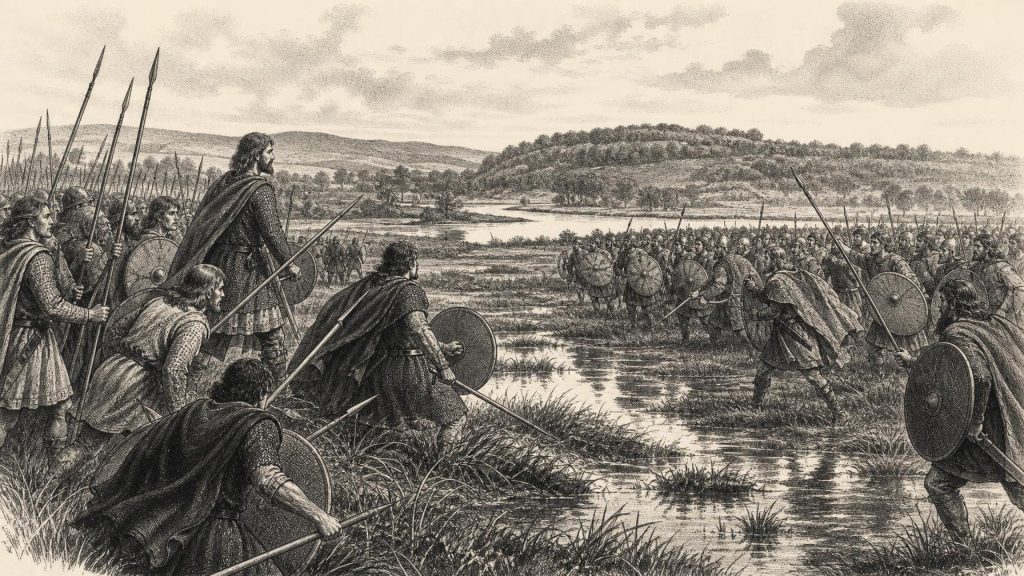
The central military event was the battle of Móin Cruinneoige, probably fought in the Liffey region near modern Leixlip. Donnchad Ua Ruairc entered Leinster with forces drawn from eastern Connacht, Cairbre and Gailenga. His coalition represented more than a local Bréifne war band: it brought together communities whose interests extended across Connacht, Mide and the northern approaches to Leinster.
Muirchertach Ua Briain overtook or confronted them with a broad southern alliance consisting of Munstermen, Leinstermen, the men of Osraige and the Hiberno-Norse forces whom the annals conventionally call the “foreigners”. These were almost certainly troops from Dublin. Their presence illustrates Dublin’s continuing military importance and its connection to Ua Briain power, as well as the increasingly close interaction between Gaelic and Hiberno-Norse elites.
The Annals of Ulster place the battle on 19 October, although a different calendrical formula appears in the much later Four Masters. The exact day should therefore be treated with some caution, but the assignment of the battle to 1084 is well supported. Muirchertach was victorious. Donnchad Ua Ruairc was killed, together with Cennétig Ua Briain, Congalach of the Ua Conchobair Failge, and many others.
Cennétig’s death exposed a dynastic dimension to the struggle. He belonged to a rival branch of the Ua Briain kindred and had found opportunities among Tairdelbach’s enemies. The battle consequently removed both an external challenger and a troublesome kinsman. Some accounts add that Donnchad Ua Ruairc’s head was taken to Limerick, a grim demonstration of victory intended for a royal and urban audience.
The Annals of Tigernach and Four Masters claim that 4,000 people died. Such a total cannot be verified and should not be read as a modern count. Medieval annalists often used large numbers to communicate the scale and horror of defeat. What can safely be concluded is that casualties were considered exceptionally heavy and included leaders from several kingdoms.
Churches Under Pressure
Ecclesiastical settlements were deeply entangled with political life. They held land, livestock, precious objects and food stores; housed clergy, craftsmen, tenants and pilgrims; and provided rulers with ritual legitimacy. Their burning during warfare could be deliberate, accidental or part of a wider attack upon an enemy’s resources. The damage recorded in 1084 was therefore both spiritual and material.
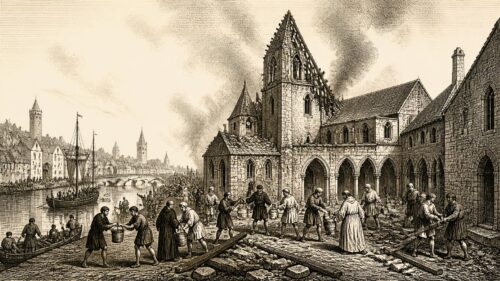
Glendalough, one of Ireland’s foremost ecclesiastical centres, was burned “with its churches”. The terse entry does not identify the attackers or describe the extent of the destruction. Nor does it justify assuming that every surviving monument was damaged. It does show that even a celebrated foundation in the Wicklow mountains was vulnerable. The community’s subsequent history also demonstrates the resilience of major Irish churches, which could rebuild after fire and warfare.
Donnchad Ua Máel Ruanaid, labelled a harrier or persecutor of churches, was killed by the men of Lurg. The unusually condemnatory annalistic language indicates that his offences against ecclesiastical communities were considered serious. At Cluain Eóis, modern Clones, Muiredach Ua Cethnén, the community’s superior or airchinnech, died. The office combined responsibility for church property and dependants with high standing in regional society. The Four Masters also record the death of Niall Ua Seasnáin, described as a learned elder of Munster.
Not all ecclesiastical news concerned destruction. A church dedicated to St Fainche was founded or re-established at Ros Airthir, identified with Rossory near Enniskillen. Fainche’s community had roots in the early Irish church and included a tradition of female religious life. The entry is a useful counterweight to the reports of burning: patrons and communities were still investing in sacred buildings and renewing local cults.
Dublin and the Wider Church
Gilla Pátraic, bishop of Dublin, drowned during 1084. A Dublin tradition gives 10 October and associates his death with a sea journey, although the principal Irish annals record only the year. He had been elected by Dublin’s clergy and people after the death of Bishop Dúnán and was consecrated in 1074 by Lanfranc, archbishop of Canterbury. His profession of obedience to Canterbury reflects Dublin’s maritime connections and the distinctive development of its episcopal church.
Gilla Pátraic had studied in England and maintained links with Worcester. Latin writings were traditionally attributed to him, although modern scholarship has questioned parts of that attribution. His career nevertheless places eleventh-century Dublin within an international ecclesiastical network joining Ireland, England and continental Europe. His drowning also underlines the risks accompanying routine movement across the Irish Sea.
Life Beyond the Armies
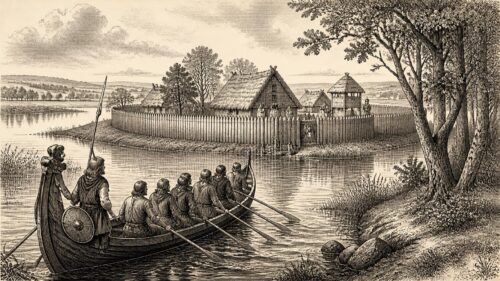
For most people, the year was experienced through local obligations and seasonal work rather than royal strategy. Rural households cultivated grain, managed cattle, sheep and pigs, cut timber and peat, produced cloth and maintained enclosed farmsteads. Ringforts and crannógs remained important forms of settlement. Warfare could destroy harvests, scatter herds, burn houses and churches, and impose the burden of feeding troops upon communities far from any battlefield.
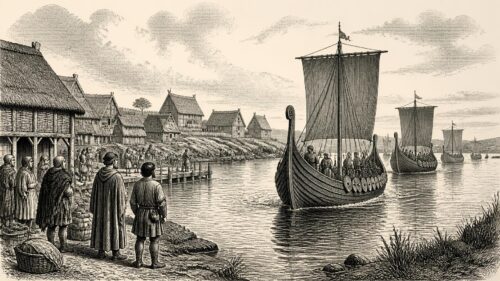
Dublin offered a different environment of closely packed timber houses, workshops, lanes and waterfront activity. Archaeology reveals woodworking, metalworking, textile production, fishing and commerce in imported goods. Silver pennies had been minted there since around the end of the tenth century, although bullion and barter remained important. The city’s warriors fought beside Gaelic allies in 1084, while its merchants and sailors connected the Liffey with Britain, the Isles and continental ports.
The Annals of Tigernach also place a great pestilence in this year and claim that it killed a quarter of Ireland’s men. Its account explains the disease through a supernatural vision involving destructive beings from northern islands. Other chronicles do not securely corroborate that scale, while Chronicon Scotorum records mortality among people and livestock under 1085. Neither the enormous death toll nor the precise chronology can be accepted without reservation. The story remains valuable evidence for how disease could be understood through a mixture of observation, oral tradition and supernatural causation.
A Year of Realignment
The victory at Móin Cruinneoige strengthened Ua Briain authority across southern and central Ireland and enhanced Muirchertach’s reputation. Yet the simultaneous raids on Munster showed the limits of Tairdelbach’s reach. Domnall Ua Lochlainn was consolidating power in the north, while Ulaid, Bréifne, Connacht and Mide remained capable of independent action and changing alliances.
Thus 1084 did not settle the contest for Ireland. It sharpened the division between powerful northern and southern groupings and demonstrated that military coalitions could span provinces, towns and cultural identities. Amid the campaigns, churches burned and were founded, scholars and ecclesiastical leaders died, cattle changed hands and urban trade continued. The annals preserve only fragments, but together they portray a society in which warfare, religion, wealth and reputation were inseparable.
Primary Sources
- The Annals of Ulster: Year U1084
- Annals of Inisfallen
- The Annals of Tigernach
- Annals of Loch Cé: Annal LC1084
- Annals of the Four Masters
- Chronicon Scotorum
- Ua Briain, Tairdelbach
- Ua Briain, Muirchertach
- Ua Lochlainn (Mac Lochlainn), Domnall
- Patrick (Gilla-Pátraic)
- Fainche
- Ua Conchobair, Ruaidrí na Saide Buide
- Glendalough Monastic Site and Visitor Centre
- Glendalough Monastic Site and Visitor Centre Highlights
- Clones Round Tower, Church and High Cross
- High Crosses
- Viking
- Early Medieval
- 950–1450: Vikings, Normans and Medieval Mints
- Nine Unmissable Objects from Clontarf 1014
- Clonmacnoise, County Offaly
- The Dublin Region in the Middle Ages: Settlement, Land-use and Economy
- Ireland in the Middle Ages
- William the Conqueror and Ireland
- Patrick of Dublin
- The Latin Writings of Bishop Patrick
- Early Medieval Archaeology Project: Report 2.1
- Animals and the Economy of Medieval Ireland: A Zooarchaeological Research Report