Famine and Fracture1116 CE
In 1116, Ireland faced intertwined dynastic, military and environmental crises. Munster’s Uí Briain kingship fractured as Diarmait displaced the ailing Muirchertach, enabling Connacht’s Toirdelbach Ua Conchobair to raid Thomond, burn Kincora and challenge Munster forces. Severe winter weather produced famine and pestilence, especially in Leinster and southern Ireland, causing mortality, displacement and abandoned settlements; warfare worsened shortages through plunder and captivity. Fires damaged major ecclesiastical centres, including Armagh, Killaloe, Cork, Emly, Lismore, Aghaboe and Clonard, while attacks struck church communities. Despite disruption, Cellach of Armagh completed a Connacht visitation, demonstrating enduring ecclesiastical authority and institutional resilience amid severe widespread hardship.
Dateline
Ireland entered 1116 under severe strain. A prolonged crisis within the Uí Briain dynasty had weakened Munster, while Toirdelbach Ua Conchobair, the ambitious king of Connacht, was expanding eastwards and southwards. These political pressures coincided with famine, disease, population displacement and an extraordinary series of fires at major ecclesiastical centres. The surviving annals consequently present 1116 not as a year of orderly government or celebrated victories, but as one of profound disruption.
The sources do not always place connected events under the same year. The Annals of Ulster, Chronicon Scotorum and Annals of Tigernach are generally the most important witnesses, while the later Annals of the Four Masters preserve valuable additional detail. Mac Carthaigh’s Book sometimes assigns episodes to an adjacent year or explicitly refers back to earlier developments. Firmly dated notices can therefore be distinguished from campaigns and political changes that belong to the crisis of 1116 but may have unfolded across 1115–17.
A Divided Kingship
Ireland had no single government capable of commanding the entire island. Domnall Ua Lochlainn of Cenél nEógain remained the dominant king in the north and a formidable claimant to the high-kingship. In the south, however, the authority once exercised by Muirchertach Ua Briain was collapsing. Illness had forced Muirchertach to surrender effective rule in 1114, and his brother Diarmait Ua Briain seized the kingship of Munster. Muirchertach recovered sufficiently to imprison Diarmait and regain power in 1115, but the restoration proved temporary.
The Annals of Tigernach place Diarmait in the Munster kingship in 1116 and describe Muirchertach as deposed. Biographical and annalistic evidence indicates that Diarmait again expelled his brother, captured Muirchertach’s son Domnall and drove the old king eastwards towards the protection of Lismore. Mac Carthaigh’s Book regarded Diarmait’s seizure as a violation of guarantees associated with the relics and sanctuaries of Cashel and Lismore. This was more than partisan criticism. Political settlements could be solemnised before clerics and sacred objects, and breaking such protection damaged a ruler’s honour while inviting ecclesiastical opposition.
Muirchertach’s fall transformed the wider balance of power. The Uí Briain still commanded warriors, clients and the allegiance of important towns, including elements of Hiberno-Norse Limerick, but their internal conflict exposed Thomond and the Shannon corridor. Toirdelbach Ua Conchobair exploited that weakness. Although still formally king of Connacht rather than king of Ireland, he was already demonstrating the combination of campaigning, river power, fortification and calculated patronage that would later make him the island’s leading ruler.
War Along the Shannon
Chronicon Scotorum records that Toirdelbach attacked Thomond, destroyed Bóruma, burned Kincora and plundered the country. Kincora, beside Killaloe on the Shannon, was the royal centre most closely associated with Brian Bóruma and his Uí Briain descendants. Its destruction was therefore both strategic and symbolic: a Connacht king had struck at the heart of Dál Cais royal identity.
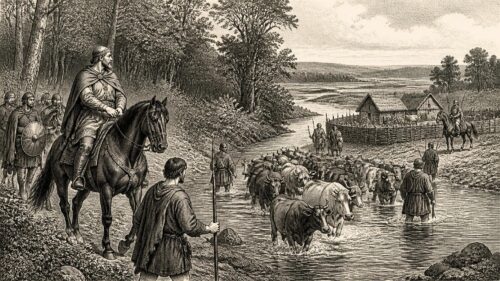
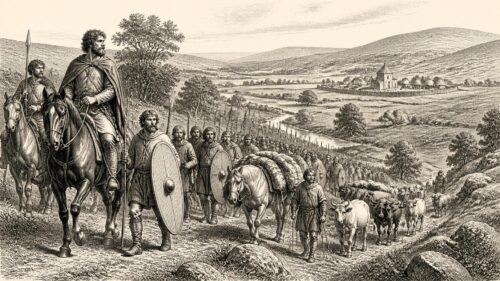
The Four Masters add that Toirdelbach carried away cattle and captives after killing inhabitants. They also state that he released the prisoners “to God and Flannán”, the patron saint of Killaloe. The act combined piety, diplomacy and political theatre. Returning captives under a saint’s protection could limit hostility from an important church while allowing the victor to display control over the fate of the defeated. The cattle, the principal movable wealth of rural Ireland, were apparently retained.
Another expedition shows that the Uí Briain were not merely passive victims. Diarmait led a Munster army into Connacht, but the campaign ended badly at Ruaidbeithech, a location not securely identified. The Annals of Tigernach report a slaughter of the Munstermen, who lost provisions, horses, weapons and armour. The Four Masters phrase the encounter differently, first describing harm inflicted by Diarmait’s army, but likewise record the abandonment of its equipment. The safest conclusion is that the invasion caused destruction before ending in a serious Munster reverse.
Mac Carthaigh’s Book also places a rapid foray by Toirdelbach into western Mide under 1116, westwards from Loch Aininne. This reflects a broader contest for the central midlands, where cattle, hostages, river crossings and the submission of local kings mattered more than permanent territorial occupation. Raiding could feed an army and undermine rivals, but in a year of scarcity it also stripped vulnerable communities of seed grain, animals and stored food.
Famine and Pestilence
The defining calamity was a combination of hunger and disease. Its immediate background is unusually clear. The Four Masters describe severe frost and driving snow from late 1115 into the following spring, killing people, birds and livestock and creating dearth throughout Ireland, especially Leinster. Frozen ground, lost cattle and interrupted transport would have damaged both food supplies and household reserves before the new growing season began.
The Annals of Ulster record a great pestilence in 1116 and say that hunger was so widespread in Leth Moga—the southern half of Ireland, especially Leinster and Munster—that churches, forts, territories and communities were emptied. The disaster subsequently spread elsewhere in Ireland and overseas. The reference to pestilence may indicate epidemic illness accompanying malnutrition and displacement, although the annal does not identify a specific disease.
Chronicon Scotorum gives the most disturbing account. It places the worst famine in spring and claims that parents sold sons and daughters for food, that dogs were eaten and that people even consumed one another. Medieval chroniclers sometimes used reports of cannibalism to express the extremity and moral horror of famine, so individual incidents cannot be independently verified. Nevertheless, the descriptions of abandoned settlements, mortality and mass movement are repeated across independent annalistic traditions and should be taken seriously.
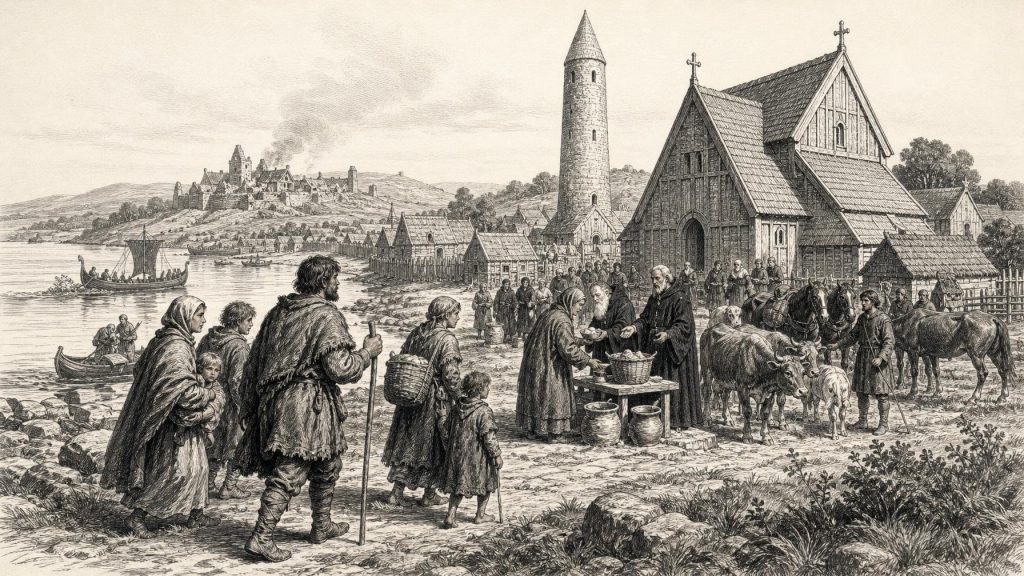
Leinster was said to have been almost emptied, its people scattering across Ireland in search of survival. Such movement placed additional pressure on monasteries, kin groups and neighbouring territories expected to provide hospitality or alms. It also left fields untilled and weakened the social relationships through which seed, livestock and labour were normally shared. The effects must have varied locally, but the evidence supports a genuine subsistence crisis rather than a conventional annalistic complaint about high prices.
Warfare intensified the suffering. Raiding armies took cattle, destroyed buildings and consumed supplies as they moved. Captivity separated labourers from farms, while insecurity discouraged travel to assemblies and markets. The famine cannot simply be blamed on the Uí Briain conflict or Toirdelbach’s campaigns, but military predation reduced communities’ ability to withstand an already severe environmental shock.
Churches in Flames
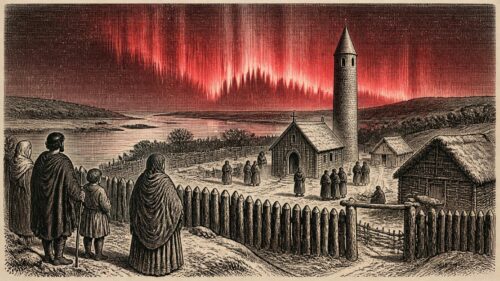
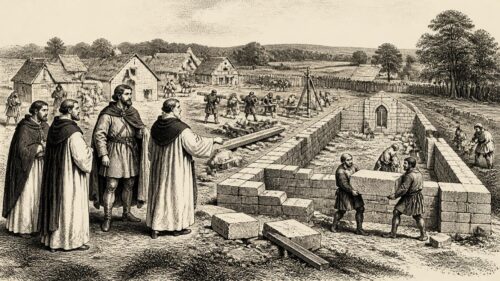
The annals list an exceptional number of fires. Killaloe and its church burned, as did important buildings or sections of Cork, Emly, Lismore, Aghaboe and Clonard. At Armagh, the great residence of the abbots and twenty surrounding houses burned at the beginning of Lent, specifically recorded as 15 February. The concentration is striking, although the sources do not establish a single cause. Some outbreaks may have followed warfare, but accidental fire was a constant danger in densely occupied settlements built largely from timber, wattle and thatch.
These were not isolated cloisters populated only by monks. Major church settlements housed clerics, students, craftspeople, tenants, servants, pilgrims and traders. Clonard and Armagh were centres of learning and ecclesiastical government; Lismore was closely connected with reforming clergy and Uí Briain politics; Killaloe stood beside an important Shannon crossing and royal centre. Fire therefore destroyed homes, food stores, books, workshops and administrative resources as well as places of worship.
The Annals of Tigernach additionally record violence against the ecclesiastical communities of Kildare and Aghaboe. Members of the Uí Bairrche attacked the community of Kildare, while Éile forces killed people belonging to Aghaboe, including a prior named Ua Scolaige. These notices reveal how exposed religious settlements remained. Their sanctity could restrain rulers, but their land, stores, dependants and political connections also made them targets.
Cellach’s Connacht Visitation
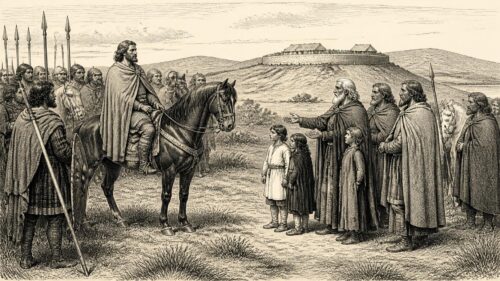
Against this background, Cellach, successor of Patrick and head of the church of Armagh, made his second recorded visitation of Connacht. The annals state that he received his full visitation tribute. A circuit of this kind asserted Armagh’s primatial claims, renewed relationships with churches and rulers, and collected dues that supported its religious and institutional work.
The visitation belonged to the continuing reform of the Irish church. Five years earlier, the Synod of Ráith Bressail had outlined territorial dioceses grouped beneath the metropolitan sees of Armagh and Cashel. Older monastic offices, hereditary interests and local loyalties did not disappear in 1111, however. Cellach’s personal journey through Connacht demonstrates that the new order still depended upon negotiation, recognised sanctity and direct contact with regional elites.
That he completed the circuit during famine and political unrest is particularly significant. Roads were not maintained by a central authority, and travellers relied on river routes, hospitality and protection from successive communities. Cellach’s reception suggests that Armagh’s authority could cross political boundaries even when secular kingship was fragmented.
Life Beyond the Annals
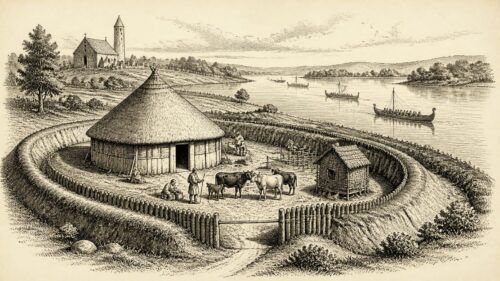
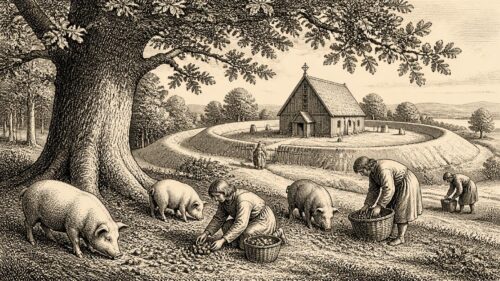
For most inhabitants, daily life remained rural and agricultural. Families lived in dispersed farmsteads, ringforts and unenclosed settlements, tending cattle, sheep and pigs while cultivating oats, barley and wheat. Grain was ground for bread and porridge; milk was processed into butter and cheese; wool was spun and woven. In normal years cattle supplied food and traction while serving as stores of wealth, units of value and the chief prize of warfare. Their loss in 1115–16 struck at nutrition, status and future production simultaneously.
Coastal towns such as Dublin, Waterford, Wexford, Cork and Limerick supported merchants and specialised crafts and connected Ireland with Britain and the wider Irish Sea. Silver coin had been used in Dublin since the late tenth century, although cattle and weighed valuables remained more important across much of the countryside. The statement that famine spread “over sea” hints at a wider regional crisis, but the annals provide no reliable figures for prices, shipping or trade in 1116.
Learning likewise continued amid disaster. Major monasteries preserved Latin scholarship, law, genealogy, poetry and Irish-language narrative. The recently produced Lebor na hUidre, associated with Clonmacnoise, illustrates the intellectual world that still flourished in the early twelfth century. Yet the fires and the death of Congalach son of Gilla Ciaráin, an ecclesiastical superior at Clonmacnoise, remind us how fragile such communities were.
The year’s scattered notices form a coherent picture: dynastic fracture invited invasion; war aggravated scarcity; famine emptied settlements; and fire damaged several of Ireland’s foremost churches. Yet Cellach’s successful visitation and the continued operation of regional kingship, towns and monasteries also reveal institutional resilience. Ireland in 1116 was not collapsing into disorder, but it was enduring one of the harshest convergences of political and subsistence crisis recorded for the early twelfth century.
Primary Sources
- The Annals of Ulster: Year U1116
- Annals of the Kingdom of Ireland: Annal M1116
- The Annals of Tigernach
- Chronicon Scotorum: Annal CS1116
- Mac Carthaigh’s Book: Annal MCB1116
- Ua Briain, Muirchertach
- Ua Conchobair, Tairdelbach (O’Conor, Turlough)
- Ua Lochlainn (Mac Lochlainn), Domnall
- Cellach (Celsus)
- Ua Conchobair, Ruaidrí na Saide Buide
- Ua Briain, Tairdelbach
- The Rock of Cashel
- ‘Regulating the Dioceses of the Bishops of Ireland’
- Kingship, Society, and Sacrality: Rank, Power, and Ideology in Early Medieval Ireland
- The Viking Age in Ireland
- 950–1450: Vikings, Normans and Medieval Mints
- The Archaeology of Livestock and Cereal Production in Early Medieval Ireland, AD 400–1100
- Early Medieval Ireland: Archaeological Excavations, 1930–2009
- Clonmacnoise Visitor Guide
- Irish School of Illumination, c. 650–1100
- High Crosses, c. 800–1150
- The Archaeology of Ireland’s Viking-Age Towns
- Reassessing the Irish ‘Monastic Town’
- Early Medieval Ireland, AD 400–1100: The Evidence from Archaeological Excavations
- Famine and Disease in Ireland: Prehistoric and Early Historic Times to 1850