War Across the Shannon1132 CE
In 1132, Toirdelbach Ua Conchobair’s high-kingship faced coordinated resistance from Munster, Meath, Bréifne, Conmaicne and northern rivals. Using fleets and fortified crossings, he raided Munster, installed Muirchertach Ua Maelsechlainn in Meath and repelled attacks on Athlone. However, Munster forces destroyed Bun Gaillimhe, defeated Iar Connacht and killed leading western nobles, exposing Connacht’s vulnerability. Raiding devastated communities and cattle wealth. In Leinster, Uí Chennselaig attacked Kildare, burning its church, killing many and abducting its female leader. Malachy Ua Morgair was consecrated for Armagh amid reform conflict. The year demonstrated interconnected warfare, dynastic competition, ecclesiastical rivalry and the limits of Toirdelbach’s authority.
Dateline
The surviving annals make 1132 one of the more vividly recorded years of Ireland’s early twelfth century. They describe campaigning by river and sea, attacks on fortresses and churches, cattle-raiding, hostage-taking and struggles over royal and ecclesiastical office. Their chronology is not flawless: some events appear under different years in different compilations, while the order of entries need not preserve the order in which events happened. Even so, the principal military and political developments can be placed responsibly in 1132. The Annals of Tigernach also identify it as a leap year whose first day fell on a Friday, a rare reminder that annalists measured sacred and political time together.
A High-King Under Pressure
Toirdelbach Ua Conchobair remained king of Connacht and the strongest claimant to the high-kingship of Ireland, though never an uncontested monarch in the modern sense. His authority depended on military reach, alliances, hostages and the submission of lesser kings. The events of 1132 show both his formidable resources and the fragility of his supremacy. Opposition linked Munster, Meath, Bréifne and the Conmaicne, while northern rulers sought to detach important allies from him.
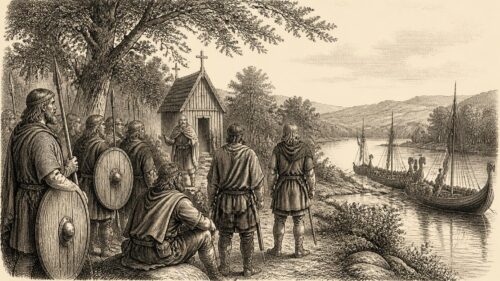
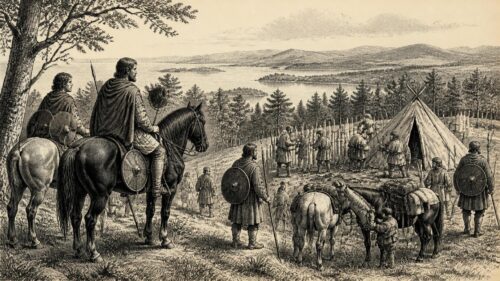
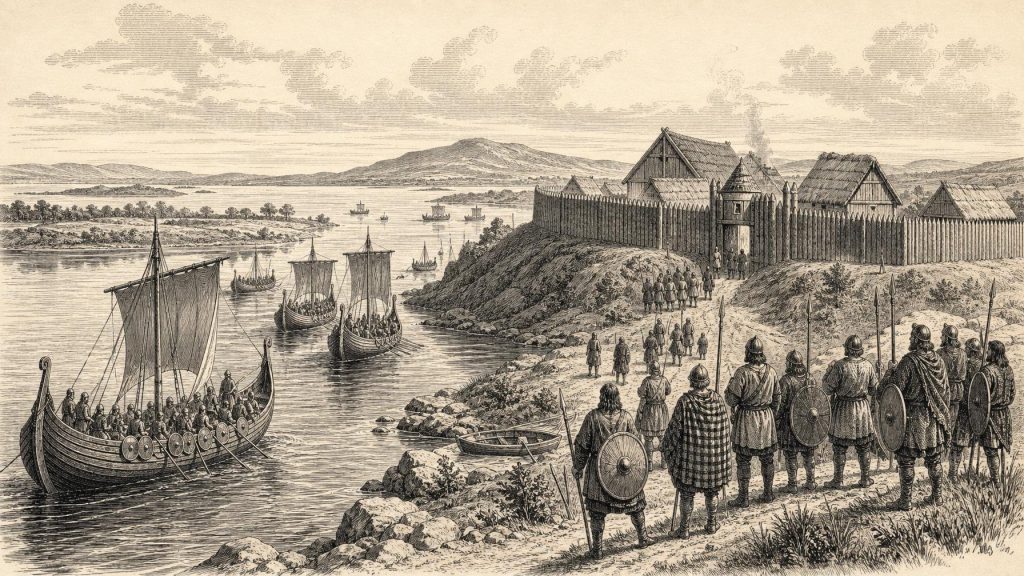
Early in the annalistic account, Toirdelbach brought a large fleet onto Lough Derg and ravaged Munster, taking numerous preys. This was not simply a raid across a provincial frontier. Control of the Shannon and its lakes allowed armies to move supplies, warriors and boats through the centre of Ireland. Toirdelbach had invested heavily in fleets, bridges and fortifications, making waterways central to Connacht’s power.
A subsequent hosting carried him through Munster, where Croom was plundered or destroyed, and onwards into Meath. There he granted the kingship to Muirchertach Ua Maelsechlainn and supported the appointment with hostages. Such an installation illustrates the practical meaning of high-kingship: Toirdelbach attempted to decide disputed successions beyond Connacht and to bind the beneficiary to him. The settlement was coercive rather than permanent, and Meath’s participation in later attacks shows how quickly imposed loyalties could weaken.
Revolt and Counterattack
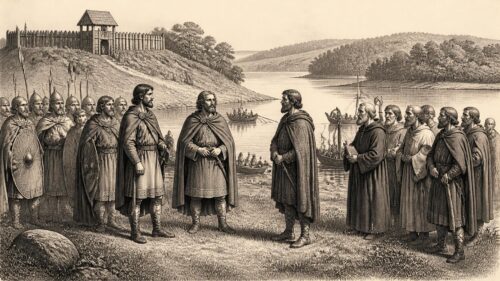
Conchobar Mac Lochlainn, representing the rising northern power of the Cenél nEógain, marched to Áth Fhirdia, modern Ardee. Tigernán Ua Ruairc of Bréifne entered his house and gave hostages. In political language, this signified submission or alliance. Ua Ruairc’s defection threatened Toirdelbach’s eastern approaches and helped separate the Uí Briúin of Bréifne from the Connacht king’s following.
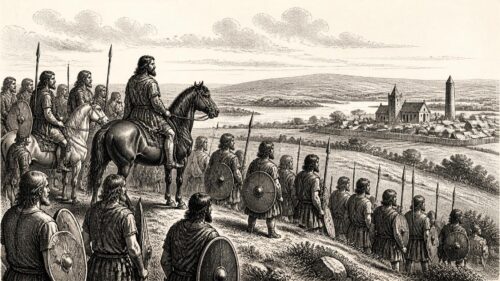
The Annals of Tigernach accordingly record a revolt by Thomond, the Uí Briúin and the Conmaicne. Conchobar Ua Briain of Thomond, supported by Conmaicne and Meath forces, attacked Athlone. The host reportedly contained three Gaelic battalions and a body of ‘Foreigners’, probably warriors recruited from one of Ireland’s Hiberno-Norse towns. They ravaged part of Connacht but failed to force a decisive passage. A second attack on Athlone was likewise unsuccessful. The fortress and crossing therefore performed exactly the frontier role for which Toirdelbach’s military works had been designed.
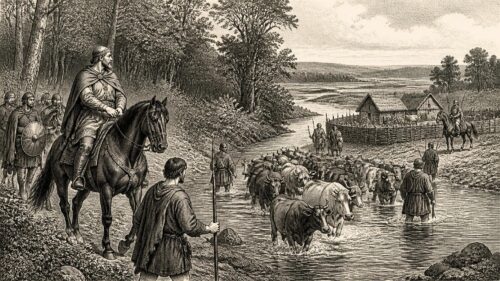
Ua Briain also raided Máenmag in eastern Connacht, plundered Cell Bian and drove away many cattle. The detail is economically significant. Cows represented food, breeding stock, rents, status and the means by which households met obligations to lords. A successful cattle raid could reward an army while weakening an opponent long after the warriors had departed.
The Destruction of Galway
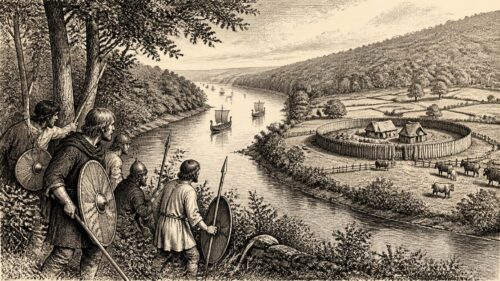
The most dramatic campaign was the Munster assault on Bun Gaillimhe, at the mouth or lower reaches of the River Corrib. Mac Carthaigh’s Book describes a land hosting led by Cormac Mac Carthaig and the nobles of Leth Moga, the southern half of Ireland, accompanied by a fleet approaching by sea. The Annals of Tigernach name Flaithbertach Ua Flaithbertaig as admiral. Together they destroyed the ‘castle’ of Galway and plundered and burned the associated settlement.
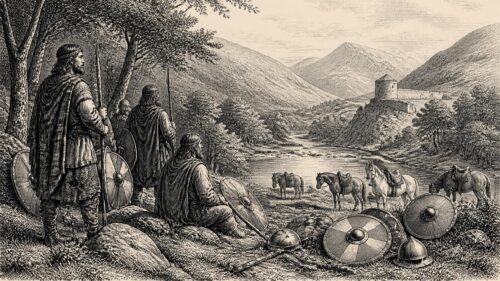
This was not the later stone castle or walled town familiar from Anglo-Norman Galway. The stronghold was probably a timber and earthwork fortress established as part of Toirdelbach’s defence of the western approaches to his Connacht heartland. Its destruction nevertheless mattered. Bun Gaillimhe guarded a river crossing, an anchorage and communications between Galway Bay, Lough Corrib and inland territories. The attack also demonstrated that Munster could combine land and naval forces deep inside Ua Conchobair’s sphere.
The following day, according to Mac Carthaigh’s Book, the invaders defeated the people of Iar Connacht at An Cloidhe. Conchobar Ua Flaithbertaig, king of Iar Connacht, was killed with many of his followers. Other annals add the deaths of two sons or descendants of Cathal Ua Mugróin, Ua Taidg an Teaghlaigh and further nobles. The son of Amlaíb Ua Lochlainn, lord of Corcu Modruad in north-west Munster, also died during the operations. The varying casualty lists reflect the different regional traditions from which the annals were compiled, but they agree that the western Connacht leadership suffered heavily.
The Munstermen also burned Oileán na Beithe, an island in the Shannon, where the Four Masters place the deaths of twenty people and the chief of Muintir Cinaetha. These attacks reveal a campaign spread across connected waters rather than a single battle. Toirdelbach answered with a foray into Uí Farga, a territory in the Irish midlands. The annals do not claim that this restored the wider balance. By year’s end, Connacht had held Athlone but had lost Galway’s fortification and endured extensive raiding.
Violence at Kildare
Far from the western campaign, Kildare witnessed one of the year’s gravest recorded assaults. The Annals of Loch Cé state that the Uí Chennselaig seized the house of the comarb, or successor, of St Brigid, burned it and much of the church, killed many people and carried off the female head of the community, forcing her into a man’s bed. Chronicon Scotorum attributes the abduction to Diarmait Mac Murchada. Later accounts give conflicting totals of 140 or 170 dead, figures that should not be treated as exact; the secure point is that the attack involved major loss of life and destruction.
The outrage was also political. Kildare’s comarbship carried property, prestige and influence, and rival dynasties had already fought over it in 1127. Diarmait’s intervention formed part of the Uí Chennselaig advance into northern Leinster and may have been connected with his alliance by marriage to the Uí Fháeláin. Yet political explanation cannot soften what the sources describe: the violent removal and sexual coercion of a religious woman, accompanied by the burning of a major church settlement.
Armagh and Church Reform
The year was important for Malachy Ua Morgair, the reforming bishop later known as St Malachy. Cellach, the previous head of Armagh, had designated him as successor before dying in 1129, but the hereditary ecclesiastical kindred of Clann Sínaig resisted. In 1132 Malachy was consecrated for Armagh by Gille of Limerick, papal legate and advocate of reform, together with Máel Ísu Ua hAinmire. The Four Masters say that Malachy assumed the succession of Patrick at the clergy’s request.
This did not mean that he immediately secured undisputed possession of Armagh, its lands or its relics. His struggle continued, and other annals associate his effective entry into the see with 1134. The distinction is important: 1132 marks his canonical consecration and recognised claim, not the uncomplicated beginning of settled rule. The dispute pitted reformers favouring episcopal organisation and wider European practice against a powerful local family whose authority rested on inherited control of the Patrician church.
The Four Masters also place several ecclesiastical deaths in the year. Máel Brénainn Ua hAnradáin, successor of Brendan at Clonfert, died, as did Uareirge Ua Nechtáin, head of the Céli Dé at Clonmacnoise. Máel Brigte Mac Doilgén, a senior priest of Armagh, is assigned the unusually precise death date of 27 August. Such notices show the continuing importance of monasteries and church schools as centres of worship, learning, landholding and political mediation.
Work, Wealth and Culture
For most people, 1132 was experienced not through royal titles but through the demands of farming and lordship. Cattle dominated recorded plunder because they were mobile stores of wealth, although households also kept sheep and pigs and cultivated oats, barley and other cereals. Raids meant lost milk, meat, hides, draught power and seed resources, while burned settlements required houses, fences and stores to be rebuilt. Hostages came chiefly from elite families, but ordinary farmers, herders, boatmen, craftspeople and dependants supplied armies and bore much of their cost.
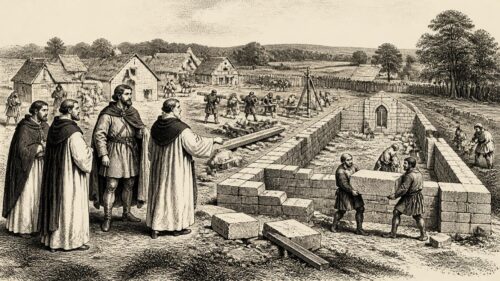
The year also belonged to an era of notable artistic and architectural patronage. Cormac Mac Carthaig, while campaigning against Connacht, was building the Romanesque chapel at Cashel that would be consecrated in 1134. Its carved stonework and continental influences demonstrate that warfare did not isolate Irish courts from European religious culture. Toirdelbach’s recently commissioned Cross of Cong likewise embodied royal ambition, skilled metalworking and devotion to the True Cross. Neither object can be assigned as a new event specifically to 1132, but both formed part of the cultural landscape in which the year’s rulers competed.
Overall, 1132 exposed the limits of Toirdelbach Ua Conchobair’s ascendancy. He could launch fleets, ravage Munster, appoint a king in Meath and defend Athlone, yet he could not prevent rebellion, northern interference or the destruction of Bun Gaillimhe. At Kildare and Armagh, contests over sacred offices proved inseparable from dynastic politics. Ireland remained interconnected by roads, rivers, sea lanes, churches and learned communities, but those same networks carried armies and rival claims across the island.
Primary Sources
- The Annals of Tigernach, Annal 1132: English Translation
- The Annals of Tigernach, Annal 1132: Irish Text
- Chronicon Scotorum, Annal 1132
- Annals of the Four Masters, Annal 1132
- Mac Carthaigh’s Book
- Annals of Loch Cé, Volume I
- The Annals of Ulster
- Exploring the Irish Annals
- Ua Conchobair, Tairdelbach (O’Conor, Turlough)
- Mac Carthaig, Cormac
- Ua Briain, Conchobar
- Mac Murchada, Diarmait (MacMurrough, Dermot)
- Mac Fáeláin, Fáelán
- Malachy (Máel-M’áedóc) Ua Morgair
- Ua Ruairc, Tigernán
- Ua Briain, Tairdelbach
- The Cross of Cong
- The Cross of Cong: The Art, Archaeology and History of a Medieval Irish Treasure
- Conservation Works at Cormac’s Chapel, Rock of Cashel
- Rock of Cashel Guide
- The Zooarchaeology of Medieval Ireland
- The Archaeology of Livestock and Cereal Production in Early Medieval Ireland, AD 400–1100
- Changing Human–Cattle Relationships in Ireland: A 6000-Year Isotopic Perspective
- St Bernard of Clairvaux’s Life of St Malachy of Armagh
- Political Relations Between the Meic Lochlainn Kings of Ailech and the Province of Connacht
- Nation and Kingship in Pre-Norman Ireland