Spotted Hyaena at Castlepook31941 BCE
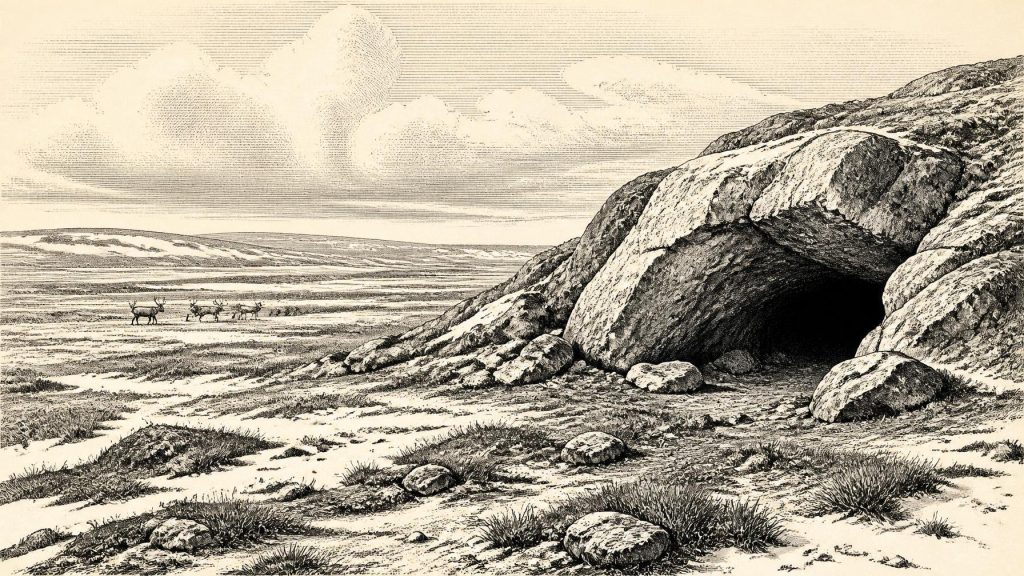
Labelled 31,941 BCE, this period represents approximately 33,900 years before present, during the climatically unstable Late Pleistocene. Ireland was not yet wholly ice-covered, but cold, seasonal tundra-steppe supported animals including reindeer, mammoth, giant deer, lemmings, wolves and rare spotted hyaenas. Castlepook Cave, County Cork, preserves disturbed remains from repeated episodes, demonstrating ecological links with north-west Europe. A reportedly cut-marked, dated reindeer femur may indicate human butchery and brief Upper Palaeolithic visits, but cannot prove settlement or continuity. No contemporary Irish camps, tools, hearths, burials, monuments or cultural evidence are securely known. Later ice expansion profoundly reshaped landscapes and obscured evidence.
Dateline
A Modern Year in Deep Time
“31,941 BCE” is a modern chronological label, not a year that can be isolated in the Irish archaeological record. There were no calendars, written documents, named individuals or dated political events in Ireland at this depth of time. The label corresponds only approximately to 33,900 years before present (where “present” conventionally means AD 1950), within the Late Pleistocene and Marine Isotope Stage 3, a climatically volatile phase of the last Ice Age. Responsible dating is therefore expressed as radiocarbon determinations and calibrated ranges, not as an assertion that a particular event occurred in this numbered year.
For Ireland, this is a particularly difficult but important interval. Later glaciation, erosion, changing sea levels and early cave excavations have erased or disturbed much of the evidence that might once have survived. The country’s evidence is not a sequence of settlements, but a scattered combination of animal remains, cave deposits, glacial landforms and environmental sediments. These sources can illuminate the conditions in which people might have travelled through Ireland; they cannot supply a conventional national history.
Ireland Before the Last Glacial Maximum
At roughly 34,000 calibrated years before present, Ireland had not yet reached the fullest extent of the last British–Irish Ice Sheet. This does not mean that the island was mild, wooded or stable. The climate fluctuated sharply between colder and relatively less severe phases, while snowfields and local ice masses may have occupied high ground. Yet geological evidence indicates that north-central Ireland remained ice-free until at least about 34 ka, before the principal build-up and expansion of the last Irish Ice Sheet. The great expansion that transformed the landscape came later: major ice-sheet growth occurred after about 31 ka, with maximum volume around 23 ka and extensive ice occupying Irish land and surrounding shelves during the global Last Glacial Maximum, conventionally c. 26.5–19 ka.
This distinction matters. Ireland around the notional date was not simply an uninterrupted white ice cap. Some areas could support terrestrial animals, particularly in southern and central lowlands and in intermittently open landscapes. But it would be equally misleading to picture the familiar green island. Conditions were cold, exposed and strongly seasonal. The vegetation was probably dominated locally by treeless tundra-steppe communities: grasses, sedges, herbs, mosses and low shrubs able to withstand wind, frost and short growing seasons. The exact pattern varied with altitude, latitude, soils and the advance or retreat of ice.
Coastlines were also unlike those of modern Ireland. Global sea level was substantially lower during the wider glacial period because vast volumes of water were stored in continental ice sheets. Exposed shelves altered the geography of the Irish Sea and Atlantic margins, but neither the exact extent of dry land nor a practical route into Ireland can be reconstructed for 31,941 BCE with confidence. Later modelling demonstrates that connections between Ireland and Britain were temporary and complicated by ice, sea level and crustal movement. It is safer to say that Ireland was part of a changing north-west European landscape, rather than to imagine an easy, permanent land bridge.
Castlepook Cave and an Animal World
The leading Irish evidence relevant to this period comes from Castlepook Cave near Doneraile in north County Cork. Excavated principally between 1904 and 1914, the cave produced a remarkably rich collection of Pleistocene animal bones. Its deposits and collections are difficult to interpret because material was removed long before modern excavation standards, much was lost, and carnivores, water and later disturbance had mixed some remains. Castlepook is therefore an archive of repeated episodes over a long span, not a snapshot of one year or one living community.
Even so, improved radiocarbon work has shown that the cave preserves significant Marine Isotope Stage 3 fauna. The wider assemblage includes remains of reindeer, woolly mammoth, giant deer, brown bear, wolf, Arctic fox, mountain hare, collared lemming, Norwegian lemming and spotted hyaena. Not all these animals were necessarily present at precisely the same time, and their bones do not automatically indicate an open-air hunting ground nearby. Hyaenas and other carnivores could carry and chew carcass parts in caves; natural death, scavenging, sediment movement and excavation history each shaped the collection.
Nevertheless, the fauna provides firm environmental evidence. Reindeer and lemmings point towards cold-adapted habitats, while mammoth and giant deer indicate that large herbivores could reach or persist in parts of Ireland during the long pre-maximum interval. Predators followed such prey. A cave bearing hyaena remains is especially revealing: spotted hyaena is otherwise extremely rare in Ireland’s Pleistocene record. The animals show that Ireland was connected ecologically to the broader fauna of north-west Europe, even if the routes, durations and seasons of their movements remain uncertain.
A Possible Human Trace
Castlepook has also become central to a much more cautious question: were people present? A reindeer femur from the cave collection has been reported as about 33,000 years old and as bearing a mark interpreted as having been made during butchery with a sharp stone tool. If the mark is confirmed as anthropogenic and contemporary with the animal’s death, it would be a striking indication that Upper Palaeolithic people reached Ireland far earlier than the long-accepted post-glacial settlement horizon.
That possibility must not be converted into certainty. The bone derives from an old and disturbed collection rather than a newly excavated, sealed occupation floor. No securely associated hearth, stone-tool assemblage, dwelling, human bone, burial or art has established a community at Castlepook in the thirty-second millennium BCE. A radiocarbon date tells us the age of the animal bone; deciding whether an incision was made by a human tool rather than another process is a separate taphonomic judgement. Recent work at the cave has sought surviving deposits precisely because the question needs testing through controlled excavation and better contextual evidence.
The evidence therefore supports a limited conclusion. Around the broad period represented by 31,941 BCE, people may have made short visits to Ireland and processed large game there. It does not establish permanent colonisation, a continuous population, or descent from those possible visitors to later inhabitants. Nor can those hypothetical visitors responsibly be given an Irish ethnic identity, a language or a named archaeological culture. Upper Palaeolithic groups elsewhere in Europe made sophisticated stone tools, clothing and artworks, but those wider comparisons are context, not proof that identical practices occurred in Ireland.
Everyday Life Without a Settlement
If humans did reach southern Ireland in this period, their lives would have been mobile and highly practical. A small hunting party moving through a cold, open environment would have required intimate knowledge of animal movement, weather, shelter, fuel and workable stone. A butchered reindeer limb could imply the recovery of meat, marrow, hide, sinew or bone rather than a single purpose. Yet this remains interpretation, not direct Irish evidence of a camp. No excavated site of this age in Ireland currently reveals huts, hearths, storage areas, tool-making floors or a seasonal round.
There is likewise no evidence for farming, livestock, fields, pottery, metalworking or regular trade. Food production lay many millennia in the future. The possible economy was one of foraging, hunting and opportunistic use of animal resources, but even that phrasing should be understood as an inference from the ecological setting and from Upper Palaeolithic parallels, not a documented Irish economy. Caves may have been visited by people, animals or neither at different times; they were not necessarily homes.
No Politics, Monuments or Recorded Belief
Political affairs, diplomacy and warfare cannot be described for Ireland in 31,941 BCE because there is no evidence for states, kingdoms, chiefs, territorial boundaries or organised conflict. Nor is there Irish evidence from this period for shrines, formal burial grounds, ritual monuments, cave art or religious ceremonies. The spectacular tombs, rock art and ceremonial landscapes often associated with prehistoric Ireland belong to vastly later Neolithic and Bronze Age societies. Projecting them backwards by tens of thousands of years would obscure rather than enrich the past.
The same restraint applies to culture and learning. People in Upper Palaeolithic Europe undoubtedly possessed complex knowledge, social traditions and ways of communicating, but Ireland has not yielded securely dated material from this period that can reveal them. There are no personal names, oral texts or visual symbols to recover. The silence of the record is not proof that people had no culture; it is a measure of what survives and what archaeologists can presently demonstrate.
Landscape as Historical Evidence
The principal historical development around this notional year was environmental rather than political: Ireland stood near the threshold of profound glaciation. Over the following millennia, advancing ice would reshape valleys and coasts, transport sediments, scour bedrock and destroy or bury many older surfaces. Drumlins, moraines, meltwater channels and erratic boulders visible in Ireland today are, in part, the long aftermath of that process. Their study explains why evidence for early people is so slight and why a single cut-marked bone can matter so much.
31,941 BCE should therefore be remembered not as a dated Irish event but as a window onto an uncertain Ice Age landscape. Castlepook Cave demonstrates that cold-adapted animals occupied Ireland in the broader period; its reported modified reindeer bone raises the possibility of a fleeting human presence. Beyond that, certainty ends. The most honest history of this time is one built from calibrated ranges, animal remains, ice-sheet reconstructions and the disciplined distinction between evidence and imagination.
Primary Sources
- A reconsideration of the radiocarbon dating of the Marine Isotope Stage 3 fauna from southern Ireland
- Growth and retreat of the last British–Irish Ice Sheet, 31,000 to 15,000 years ago: the BRITICE-CHRONO reconstruction
- Trimlines, blockfields and the vertical extent of the last ice sheet in southern Ireland
- Maximum extent and dynamic behaviour of the last British–Irish Ice Sheet west of Ireland
- Timing and pace of ice-sheet withdrawal across the marine–terrestrial transition west of Ireland during the last glaciation
- Pattern and timing of retreat of the last British-Irish Ice Sheet
- Growth, dynamics and deglaciation of the last British-Irish ice sheet: the deep-sea ice-rafted detritus record
- The Island of Ireland: Drowning the Myth of an Irish Land-Bridge?
- Deglaciation, Earth crustal behaviour and sea-level changes in the determination of insularity: A perspective from Ireland
- The Irish Quaternary Fauna Project
- First evidence of a Late Upper Palaeolithic human presence in Ireland
- The colonization of Ireland: A human ecology perspective
- New insights on the fauna of Ireland's Younger Dryas and Early Holocene from Alice & Gwendoline Cave
- 2019:148 – Alice & Gwendoline Cave, Clare
- 2022:564 – Castlepook Cave, Castlepook South, Cork
- Archaeological Heritage of County Cork
- Heritage Artefacts of County Cork
- The subdivision of the Quaternary Period in Ireland
- Landform modification by palaeo-ice streams in east-central Ireland
- New data for the Last Glacial Maximum in Great Britain and Ireland
- Mesolithic – Iron Age
- Archaeology & Landscape