The Silent Reindeer Femur31822 BCE
31,822 BCE is a modern chronological approximation, not a recorded Irish year. During late Marine Isotope Stage 3, before maximum glaciation, Ireland was a cold, unstable landscape supporting diverse fauna, including mammoth, reindeer, giant deer, hyaena and lemmings. Castlepook Cave in Cork provides crucial but imperfect evidence, affected by old excavation methods and disturbed deposits. A reindeer femur, dated about 33,000 years ago, bears a mark possibly made by a stone tool, suggesting brief Upper Palaeolithic human visitation. However, no associated tools, hearths or settlement prove occupation. Later ice damaged evidence, leaving human presence in Ireland plausible but still unproven.

Dateline
The label “31,822 BCE” can only be used here as a modern way of locating a very remote point in time. It does not identify a recorded year in which an Irish event occurred. No written chronology, annual calendar, named individual or dated settlement exists for Ireland at this depth of prehistory. In archaeological terms, the point falls roughly 33,770 calibrated years before 1950, within Marine Isotope Stage 3 (MIS 3), a climatically unstable part of the Late Pleistocene. The responsible history of Ireland at this moment is therefore not a narrative of rulers or battles, but an account of landscapes, animal remains, cave deposits and the limits of what those traces can say.
It was a world before permanent Irish settlement, before farming, metalwork, monuments, Irish languages and every known political institution on the island. Yet it was not an empty world. Evidence from southern Irish caves demonstrates that a distinctive cold-stage fauna lived in Ireland before the Last Glacial Maximum. One especially important object, a reindeer femur recovered from Castlepook Cave near Doneraile in north Cork, has become central to debate about whether people briefly reached Ireland during this earlier phase of the Ice Age. It gives this otherwise silent interval an unusually tangible focus.
A Date Without a Year
Radiocarbon laboratories measure ages in radiocarbon years, not BCE calendar years. Those measurements must then be calibrated against changing atmospheric carbon levels, producing ranges rather than an exact historical date. At ages beyond thirty millennia, the uncertainties are especially significant. Moreover, the climatic stages used by Quaternary scientists are broad intervals reconstructed from marine sediments, ice cores and terrestrial evidence; their boundaries do not behave like the edges of political eras. It is better to say that 31,822 BCE lies approximately within late MIS 3 than to pretend that it marks a precise turning point.
This caution matters particularly in Ireland, where the surviving record is patchy. Later ice sheets eroded, transported and buried many older land surfaces. Cave collections are often the product of nineteenth- and early twentieth-century excavations, conducted before modern standards of stratigraphic recording. Bones may have been moved by carnivores, water, gravity, earlier digging or later disturbance. A radiocarbon date can establish the age of an individual animal bone, but it does not automatically date every deposit in the cave, nor prove that humans and animals were present together.
Before the Ice-Sheet Peak
At this approximate date, Ireland was approaching rather than enduring the fullest extent of the last British–Irish Ice Sheet. Reconstructions place the maximum, island-wide ice cover later, broadly around 27,000–23,000 calibrated years before present, although the timing and thickness of ice varied considerably between regions. The advance was neither a single smooth wall nor a uniform national event: uplands, coastlines, ice streams and local basins responded differently. By the glacial maximum, ice reached the Atlantic shelf edge west of Ireland and the Celtic Sea shelf edge to the south; at roughly 31,822 BCE, the configuration was still developing.
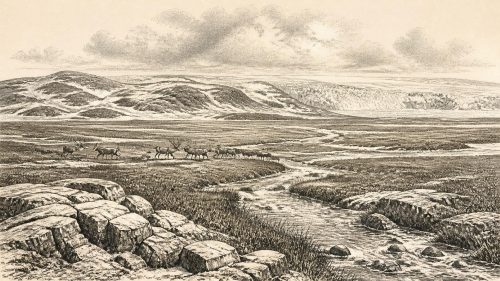
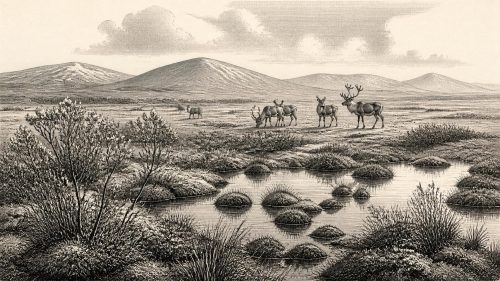
That distinction is crucial. The evidence for MIS 3 mammals indicates that parts of Ireland had supported animal populations during the long lead-up to maximum glaciation. It does not mean that every valley was green, open or equally habitable at the same moment. Climate swung repeatedly between relatively milder interstadials and colder stadials. The prevailing impression is of a rigorous, exposed environment, with treeless or very sparsely wooded habitats, seasonal extremes and changing mosaics of grassland, herb-rich tundra, wet ground, bare mineral soil and low shrubs. Local shelter, slope, drainage and proximity to ice would have mattered greatly.
Ice-age sea levels were lower than today because enormous quantities of water were locked in continental ice. Ireland’s coast therefore did not resemble the modern shore, but neither should low sea level be simplified into a guaranteed dry route from Britain. The Irish Sea basin included deep channels, and ice, water and coastlines shifted over time. Crossings by animals or people, if they occurred, depended upon changing land-and-sea geography, weather and available routes rather than a permanent land bridge. Ireland’s position at Europe’s north-western margin made it an intermittently accessible, ecologically demanding place.
Castlepook and the Faunal Record
Castlepook Cave is the strongest Irish window onto this pre-maximum world. Its deposits and museum collections have yielded remains attributed to woolly mammoth, reindeer, giant deer, brown bear, wolf, fox, hare, lemmings and spotted hyaena. This is a powerful list, but it must be read carefully. A cave is not a census of a living landscape. Hyaenas could drag prey and bones into dens; scavengers, flooding and sediment movement could concentrate material from different places and times. The assemblage nevertheless establishes that southern Ireland was occupied by a fauna far richer, and in several cases very different, from that of later historic Ireland.
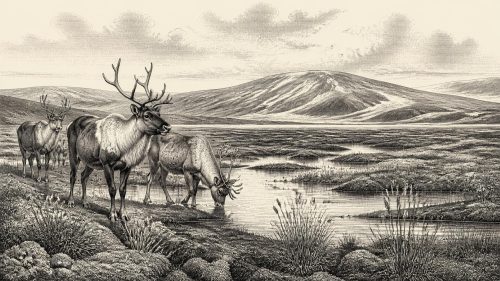
The presence of spotted hyaena is particularly revealing. These were not modern African-style creatures wandering through a savannah, but Ice Age carnivores adapted to a varied northern environment. Their use of caves helps explain why some bones survive there. Mammoth and reindeer point to open-country grazing systems, while smaller mammals such as lemmings help confirm cold conditions. Giant deer, brown bear and wolves add ecological variety. The animals did not form a timeless parade: each species had its own range, habits and dating evidence, and some may not have overlapped precisely. What can responsibly be said is that Ireland formed part of wider north-west European ecological networks during MIS 3.
Recent redating has changed the discussion. Improved pretreatment of bone collagen has shown that some earlier Irish cave dates were too young, and reanalysis of Castlepook, Foley and Shandon cave material has pushed elements of the southern fauna farther back into MIS 3. The revision reinforces the importance of the cave record while also illustrating why archaeological conclusions remain provisional. Better chemistry can alter the apparent timing of animal presence by thousands of years. The record is not fixed simply because the bones were excavated long ago.
The Reindeer Femur Debate
The Castlepook reindeer femur is the most direct item relevant to possible human activity around this broad period. It has been reported as dating to about 33,000 years ago and bears a deep linear modification interpreted by Ruth Carden as a cut or chopping mark made on fresh bone with a sharp stone implement. If that interpretation is sustained, it is evidence that people processed a reindeer in Ireland far earlier than the island’s formerly accepted archaeological starting point. It would indicate an episode of Upper Palaeolithic visitation or activity, not a settled population or a named “first Irish” community.
The qualification is essential. No securely associated hearth, stone-tool assemblage, dwelling floor, human burial or repeated occupational sequence has yet been published from Castlepook for this time. The bone came from an old cave collection rather than a modern excavation with a fully recorded context. Natural damage, carnivore action and the effects of recovery must always be assessed in interpreting marks on bone. The prudent conclusion is that the femur is a serious and potentially transformative indicator of human presence, but not final proof of continuous occupation. Current investigations seek stratified faunal deposits and the kind of securely contextualised evidence that could resolve the question.
Even if people did reach Ireland, their presence may have been brief, seasonal or separated by long absences. They would have been mobile Upper Palaeolithic hunter-gatherers, probably travelling in very small groups and relying on knowledge, co-operation and flexible movement rather than villages or fields. Reindeer could have supplied meat, marrow, hides, sinew and bone, but the Castlepook find alone cannot reconstruct a camp, a hunting method or a social group. It cannot tell us whether visitors arrived from Britain, continental Europe or another route, nor whether they returned.
Society Beyond Recovery
There is no evidence from Ireland around this date for political authority, diplomacy, territorial boundaries, formal warfare, trade routes, markets, religious monuments or writing. Those absences should not be mistaken for evidence that Palaeolithic people lacked social lives, beliefs or cultural knowledge. Across Europe, communities of Homo sapiens possessed elaborate stone and organic technologies, maintained long-distance contacts, created imagery and carried learned traditions. But importing those achievements wholesale into Ireland would be speculation. No Irish object securely dated to around 31,822 BCE demonstrates art, ritual, exchange or a specific tool tradition.
The same restraint applies to everyday life. If the reindeer femur records human butchery, it confirms a practical encounter between people and animal prey. It does not reveal clothing styles, languages, kinship systems, gender roles or religious ideas. Hides and furs were likely valuable in such climates, and fire would have been indispensable for any sustained outdoor stay, but neither is directly evidenced at Castlepook for this time. The archaeological lesson is not that such things did not exist; it is that Irish evidence has not preserved or identified them.
An Island of Possibility
For Ireland, the importance of this date lies less in a supposed event than in a threshold of possibility. Long before the familiar Mesolithic settlement of the early Holocene, the island supported Ice Age animals and may have received human visitors. Subsequent glaciation was capable of destroying or concealing much of the material record, making caves, museum archives and rare protected sediments disproportionately important. The absence of a stone tool or campsite is therefore not simple proof of absence, but neither is it a licence to fill the gap with imaginative history.
At approximately 31,822 BCE, Ireland was a cold, changing north-western landscape on the eve of more extensive glaciation. Reindeer and other mammals are securely part of that story. The marked Castlepook femur may place people beside them, briefly and consequentially, but its meaning remains under examination. That balance—between an extraordinary clue and the discipline of uncertainty—is the most accurate portrait available for Ireland at this remote point in time.
Primary Sources
- A reconsideration of the radiocarbon dating of the Marine Isotope Stage 3 fauna from southern Ireland
- The Irish Quaternary Fauna Project
- First evidence of a Late Upper Palaeolithic human presence in Ireland
- New insights on the fauna of Ireland's Younger Dryas and Early Holocene from Alice & Gwendoline Cave
- Growth and retreat of the last British–Irish Ice Sheet, 31,000 to 15,000 years ago: the BRITICE-CHRONO reconstruction
- Dimensions and chronology of the last ice sheet in Western Ireland
- Late Pleistocene chronostratigraphy and ice sheet limits, southern Ireland
- Ice sheet extension to the Celtic Sea shelf edge at the Last Glacial Maximum
- Timing and pace of ice-sheet withdrawal across the marine–terrestrial transition west of Ireland during the last glaciation
- Early deglaciation of the British-Irish Ice Sheet on the Atlantic shelf northwest of Ireland driven by glacioisostatic depression and high relative sea level
- Ireland: Submerged Prehistoric Sites and Landscapes
- New data for the Last Glacial Maximum in Great Britain and Ireland
- Palaeoecology: The Quaternary of Northern Ireland
- The Quaternary of the Irish Midlands
- Heritage Artefacts of County Cork
- Castlepook Cave, Co. Cork, 2022 excavation report
- The Mesolithic in Ireland: when was it?
- Irish Cave Exploration
- The IntCal20 approach to radiocarbon calibration curve construction: a new methodology using Bayesian splines and errors-in-variables
- IntCal20 Northern Hemisphere Radiocarbon Age Calibration Curve (0–55 cal kBP)