The GPO and Brexit Shock2016 CE
Ireland’s 2016 combined the Easter Rising centenary with political fragmentation and Brexit uncertainty. After an inconclusive election, Enda Kenny led a Fine Gael minority government sustained by Fianna Fáil confidence and supply, amid disputes over water charges, housing and public services. Inclusive commemorations at the GPO, Kilmainham and elsewhere examined 1916’s contested legacy. Britain’s EU withdrawal vote revived concerns about the border, trade, the Common Travel Area and the peace process. Economic recovery, falling unemployment and immigration coincided with homelessness and housing shortages. Ireland challenged the European Commission’s Apple tax ruling, established a Citizens’ Assembly, and joined the Paris Agreement.
Dateline
Ireland in 2016 lived simultaneously in commemoration and uncertainty. The State marked one hundred years since the Easter Rising with an exceptionally large programme of ceremony, scholarship, education and arts. Yet the year also produced a fractured general-election result, a new minority administration and, in June, the United Kingdom’s vote to leave the European Union. That vote did not take Ireland out of the EU, but it made the Irish border, North–South institutions, trade with Britain and the rights associated with the Common Travel Area immediate national concerns.
An Election Without a Majority
The general election of 26 February returned a highly fragmented Thirty-second Dáil. Fine Gael remained the largest party, with 50 seats, but its previous coalition partner, Labour, suffered a severe reverse and retained only seven. Fianna Fáil recovered substantially to 44 seats; Sinn Féin won 23; and Independents and smaller parties occupied an unusually important place in the new chamber. No plausible two-party majority emerged. The result expressed both continuing approval for economic recovery after the financial crisis and widespread impatience with austerity’s social legacy, most visibly the controversy over domestic water charges, insecure housing and strained public services.
Government formation took more than two months. On 6 May, Enda Kenny was re-elected Taoiseach, leading a Fine Gael administration whose Cabinet included Independent TDs. Fianna Fáil did not enter government. Instead, an agreed confidence-and-supply arrangement committed it to facilitate the election of a Fine Gael Taoiseach, budgets consistent with agreed principles, and the survival of the administration in confidence motions, while preserving its status as an Opposition party. The arrangement was an important adjustment in the habits of Irish parliamentary politics: it gave a minority government room to operate, but made negotiation, the position of Independents and the management of the Dáil central to daily government.
The Programme for a Partnership Government set out broad commitments on economic management, public services, housing, rural development and institutional reform. One practical consequence of the post-election settlement was the suspension of domestic water charges while a new system was considered. The issue mattered beyond household bills. It symbolised a larger argument about whether the recovery from the crisis had been fair, who should pay for public infrastructure, and whether public consent had kept pace with administrative reform.
Remembering 1916 in a Changed Ireland
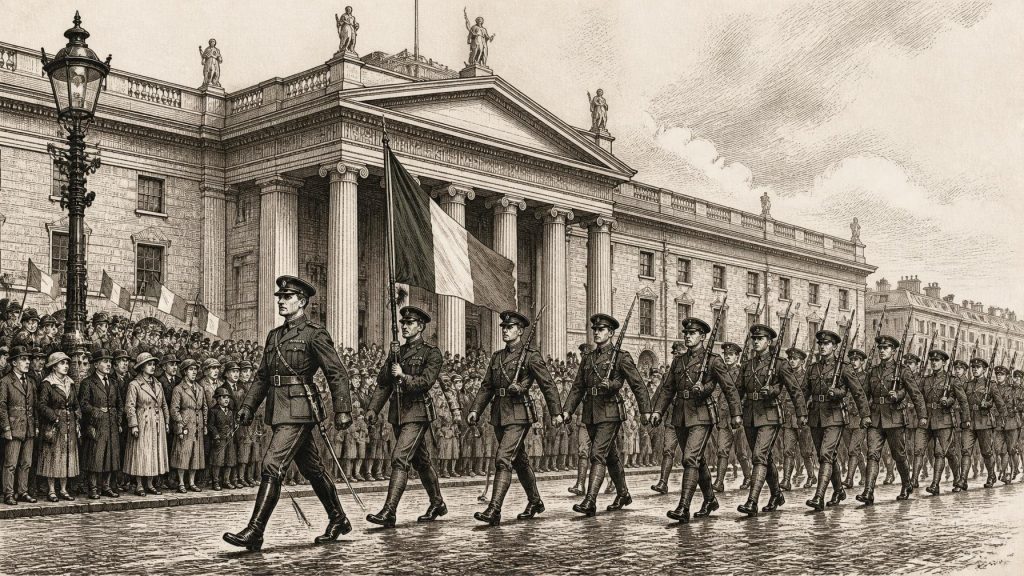
The centenary of the Easter Rising provided the year’s most visible public language. The Ireland 2016 programme was deliberately wider than a military anniversary. Its seven strands included State ceremonial, historical reflection, Irish-language activity, youth, cultural expression, community participation, and events involving the diaspora. Flag-raising ceremonies began the year; schools held Proclamation Day on 15 March; and the central Easter Sunday ceremonies of 27 March included the State commemoration at the General Post Office, wreath-laying at Kilmainham Gaol and a reception at Dublin Castle.
The choice of places mattered. The GPO remained the most recognisable site of the 1916 headquarters, Kilmainham linked the Rising to the execution of its leaders, and Dublin Castle recalled the former centre of British administration. But the commemorations also sought to resist an uncomplicated founding myth. Historical projects, exhibitions, archives, performances and school materials drew attention to civilians, women, children, Irish speakers, people with differing political loyalties and the wider context of the First World War. An interfaith service at the Remembrance Wall in Glasnevin and a State event at Grangegorman Military Cemetery for British soldiers killed during the Rising further indicated an official effort to connect commemoration with reconciliation.
That effort was neither a rejection of the Rising nor merely a celebration of it. Rather, 2016 tested whether the State could honour an insurgent moment that became central to independence while admitting its violence, its contested meanings and the incomplete character of national unity. Cultural participation helped make the centenary an everyday experience as well as a ceremonial one. Schools composed proclamations for a new generation, local communities organised their own projects, and Irish embassies and consulates carried exhibitions, talks and performances to diaspora audiences.
A Border Question Returns
On 23 June the United Kingdom voted to leave the European Union. Ireland was not a participant in that referendum: the State remained an EU member. Northern Ireland, however, was part of the United Kingdom electorate and voted to remain. The outcome consequently exposed a problem unique in the EU: the only land border between the United Kingdom and an EU member state ran across Ireland.
In 2016, the eventual legal and trading arrangements had not been negotiated, and it would be wrong to project later solutions back onto the year. Nonetheless, the immediate stakes were plain. People crossed the border daily for work, education, shopping, healthcare and family life. Firms relied on North–South supply chains, while Britain remained an essential market and transit route for Irish trade. The Good Friday Agreement’s structures and the normality of an open border had developed in a shared European setting. The Irish Government therefore began to treat Brexit as a matter not only of foreign affairs and commerce, but of peace-process stewardship and everyday life on the island.
The political institutions in Northern Ireland remained functioning during 2016, though their foundations were not without tension. The Assembly election of 5 May returned the Democratic Unionist Party and Sinn Féin as the two largest parties. On 12 May Arlene Foster and Martin McGuinness took office again as First Minister and deputy First Minister. The continuation of devolved government supplied an institutional channel for addressing common concerns, while the referendum result showed that the constitutional preferences represented at Stormont did not map neatly onto views of Europe.
Recovery, Migration and the Housing Emergency
Economic indicators gave the government grounds to speak of recovery. The unemployment rate fell over the year, reaching 6.7 per cent on the unadjusted quarterly measure in the final quarter; youth and long-term unemployment also declined. Migration figures for the year to April recorded positive net inward migration for the first time since 2009. These changes brought renewed pressure as well as renewed confidence: employers sought labour, construction activity revived, and many households sought homes in places where supply had lagged far behind demand.
Census night, Sunday 24 April, captured this changing society. The preliminary count released in July enumerated 4,757,976 people, an increase of 169,724 since the 2011 census. The total was provisional and used a de facto count of people present that night, rather than the later usual-resident total; the distinction is important. Still, it showed a country whose population was growing again after the deepest years of recession. The census operation itself, undertaken by thousands of enumerators, was a reminder that national change was being registered household by household, in cities, commuter belts, provincial towns and rural districts.
The recovery was sharply qualified by housing. Rents and prices were rising, homelessness was a prominent public emergency, and the shortage of social and affordable homes shaped political debate. In July the government launched Rebuilding Ireland: Action Plan for Housing and Homelessness. Its ambitions included increasing overall housebuilding to 25,000 homes annually and providing 47,000 social-housing units by 2021. Such targets acknowledged the scale of the supply problem, but they were plans rather than completed homes. For families in emergency accommodation, tenants facing rent increases and younger adults unable to establish independent households, the contrast between national growth and personal security was stark.
Other economic events demonstrated Ireland’s exposure to international decisions. On 30 August the European Commission concluded that Ireland had granted Apple unlawful tax benefits and directed the State to recover up to €13 billion plus interest. The Irish Government disputed the Commission’s finding and decided to appeal. At issue were not only a very large potential sum, but Ireland’s corporate-tax system, its reputation as a location for multinational investment, and the tension between national tax policy and EU state-aid rules.
Deliberation and Longer Horizons
In October the new Citizens’ Assembly met for the first time at Dublin Castle under the chairmanship of Ms Justice Mary Laffoy. Its 99 randomly selected members were intended broadly to reflect the electorate. The Assembly’s agenda included the Eighth Amendment of the Constitution, an ageing population, fixed-term parliaments, referendums and climate change. Its first substantive consideration of the Eighth Amendment began later that autumn. In 2016, its significance lay in the decision to use informed, structured citizen deliberation for issues on which party politics had found sustained agreement difficult.
Climate policy also acquired a clearer international setting. Ireland became party to the Paris Agreement in 2016, as the agreement entered into force for the State in December. This did not settle the difficult questions of emissions from agriculture, transport, heating and energy, but it placed them within a shared international undertaking. The Citizens’ Assembly’s climate remit suggested that environmental policy was becoming linked to wider questions of democratic legitimacy and long-term planning.
By year’s end, Ireland had commemorated the origins of the independent State while confronting pressures that its founders could scarcely have anticipated: a multinational-tax dispute, a housing shortage amid recovery, renewed inward migration and a prospective change in the relationship with Britain and Northern Ireland. The GPO ceremonies supplied a carefully broadened account of national beginnings. Brexit, meanwhile, made geography and the border newly consequential. Together, these developments made 2016 a year in which memory was public, but the future was unusually close at hand.
Primary Sources
- 32nd Dáil: General Election February 2016 – Full Results Book
- 32nd Dáil General Election – February 2016 – Results
- Programme for a Partnership Government
- The Full Document: Fine Gael-Fianna Fáil Deal for Government
- Thirty-Second Dáil (10.03.2016–13.06.2017)
- Easter Sunday: Commemoration to Mark the Anniversary of the 1916 Rising
- Rising to Reconciliation
- Decade of Centenaries: Find Out How the Department of Foreign Affairs and Trade Is Marking the Key Events of the Decade
- Ireland 2016 Centenary Programme for the Education Sector
- Statement by Minister for Jobs, Enterprise and Innovation Mary Mitchell O’Connor TD on UK Vote to Leave the European Union
- EU Referendum Results and Turnout
- 12 May 2016: Minutes of Proceedings
- Election Report: Northern Ireland Assembly Election, 5 May 2016
- Census of Population 2016 – Preliminary Results: Introduction
- Census of Population 2016 – Preliminary Results: Background Notes
- Population and Migration Estimates April 2016
- Quarterly National Household Survey Quarter 4 2016
- Homelessness Data 2016
- Ireland’s Competitiveness Challenge 2016
- State Aid: Ireland Gave Illegal Tax Benefits to Apple Worth up to €13 Billion
- Inaugural Meeting of the Citizens’ Assembly Takes Place at Dublin Castle
- Paris Agreement, Done at Paris on 12 December 2015