The Castlepook Bone Archive31745 BCE
Dateline
31,745 BCE is a modern chronological label, not a recoverable Irish date in the manner of a medieval annal or a later historical year. No community in Ireland recorded a calendar at this depth of time, and neither archaeology nor palaeoclimate research can attach a particular hunt, migration, birth or political decision to this single year. In modern scientific terms, the point lies approximately 33,700 calendar years before AD 1950, within the Late Pleistocene and broadly within Marine Isotope Stage 3 (MIS 3), a long and climatically unstable interval of the last Ice Age. Evidence must therefore be read in calibrated ranges of centuries or millennia, not as a diary of one year.
For Ireland, the most important evidence relevant to this horizon comes from animal bones, cave sediments, glacial deposits and environmental remains. It does not establish a settled population, named people, a polity or a continuous human presence. Yet it does reveal an Irish landscape which, at least during parts of the wider period, sustained large mammals and their predators. The limestone cave system at Castlepook, near Doneraile in north County Cork, is central to that picture. Its difficult, fragmentary archive has also raised the striking possibility that people briefly reached Ireland far earlier than the long-accepted post-glacial settlement record.
A Date Range, Not a Moment
The conversion of a BCE year into an Ice-Age age is necessarily approximate. Radiocarbon years are not calendar years: changing concentrations of atmospheric carbon-14 mean that laboratory results must be calibrated against an internationally maintained curve. IntCal20 extends calibration back to 55,000 calendar years before present, but its results are probability ranges rather than annual timestamps. Consequently, “31,745 BCE” should be understood as an editorial point within the mid-34th millennium before present, not as proof that a specific event occurred on that date.
Ireland then stood on the north-western fringe of Europe, where ice sheets, sea level, vegetation and animal ranges changed repeatedly. The later Last Glacial Maximum, when the British–Irish Ice Sheet covered almost all of Ireland, still lay ahead. Newer reconstructions indicate a rapid growth of ice masses in the wider British–Irish region after about 35,000 years ago, with major expansion by 31,000–30,000 years ago. They do not, however, allow a confident map of every Irish valley or coastline for this precise point around 33,700 cal BP. The responsible conclusion is regional variation and uncertainty: glaciers were becoming more important, but the country cannot simply be imagined as either wholly ice-covered or wholly open.
Castlepook and Its Animals
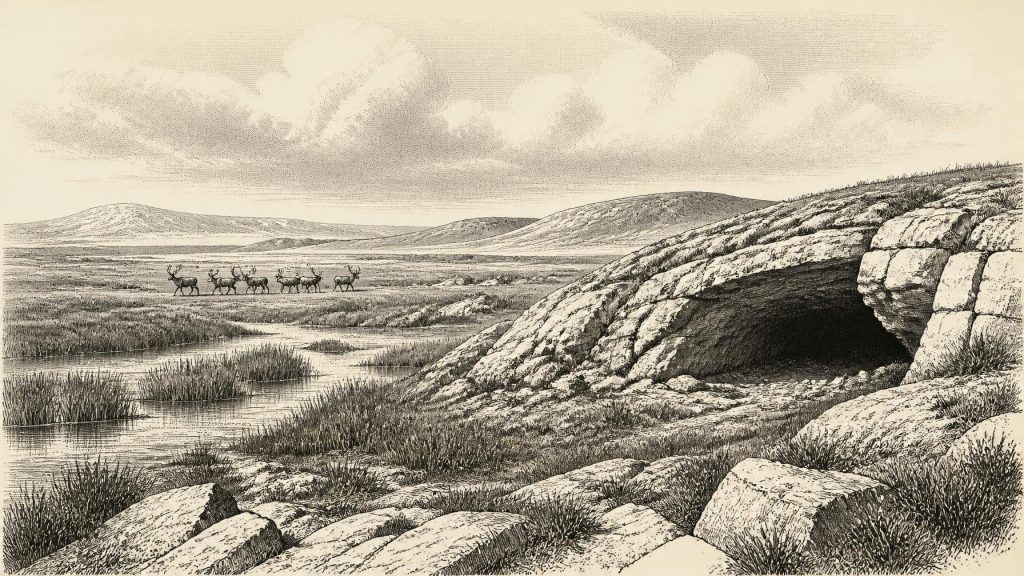
Castlepook Cave is a maze of narrow galleries and chambers formed in Carboniferous limestone. Excavations between 1904 and 1918, supplemented by later work, produced one of Ireland’s richest Pleistocene collections. The cave’s evocative chamber names, including Hyaena Hall and Elephant Hall, recall the animals whose remains were found there. Direct radiocarbon determinations from individual bones extend over a very long span, approximately 45,700 to 19,950 years before present. That is precisely why the site is so valuable, and why it cannot be treated as a single, undisturbed occupation floor.
The wider Castlepook fauna includes woolly mammoth, giant deer, reindeer, brown bear and spotted hyaena, while other deposits have produced Arctic fox, wolf and lemmings. These are direct material traces of animals, not merely an artist’s reconstruction of “Ice-Age Ireland”. Together they indicate that, during favourable intervals of MIS 3, parts of the island or its adjoining landscapes could support a varied cold-climate fauna. Reindeer point towards open country; lemmings and Arctic foxes are consistent with cold conditions; hyaenas and wolves show that carcasses were contested by predators and scavengers. Mammoth and giant deer speak of extensive grazing landscapes, though neither species can responsibly be assigned to the exact year in question merely because it occurs in the cave collection.
Caves are not neutral cupboards of the past. Carnivores can drag in prey; animals can die in fissures; water can transport and mix bone; later excavation can disturb layers. Castlepook’s deposits were also investigated before modern standards of spatial recording, stratigraphic sampling and taphonomic analysis became routine. The bones preserve an exceptional record, but their original associations are often uncertain. A reindeer bone in a cave does not necessarily mean that the reindeer was killed there, and a hyaena-rich chamber need not have been occupied by hyaenas at every moment represented by its sediments.
The Reindeer Femur Question
One object makes this broad period unusually important for Irish human history: a reindeer femur from Castlepook. The bone has been reported as approximately 33,000 radiocarbon years old and bears a deep linear modification interpreted by zooarchaeologist Ruth Carden as a cut or chopping mark made with a sharp stone implement while the bone was fresh. County Cork heritage material has presented this as possible evidence that Palaeolithic hunters processed reindeer in the Doneraile area around 31,000 BCE.
If that interpretation is upheld, the implication is considerable. It would push evidence for human activity in Ireland back many millennia beyond the securely demonstrated terminal Pleistocene evidence from Alice and Gwendoline Cave in County Clare, where a butchered brown-bear patella has calibrated dates of roughly 12,810–12,590 cal BP and 12,810–12,685 cal BP. It would also place a possible Irish human visit within the world of Upper Palaeolithic north-west Europe, whose mobile hunter-gatherers used stone tools and followed seasonal resources across landscapes very different from those of later Ireland.
But possibility is not the same as confirmation of colonisation. The Castlepook femur derives from an older cave collection, not from a newly excavated surface containing the bone alongside demonstrably associated tools, hearths, shelters, butchered refuse and repeated occupation deposits. The radiocarbon result dates the death of the animal; it does not itself date the mark, identify the maker or establish where the carcass was processed. Identifying a mark as a stone-tool cut requires comparison with damage caused by carnivores, trampling, sediment movement, weathering, breakage and excavation. No securely associated lithic assemblage, human remains or dwelling of comparable age has yet been recovered from Ireland.
Landscape, Food and Movement
The available evidence permits a cautious reconstruction of ecological opportunity rather than a detailed account of daily life. Ireland was not an island of familiar green fields, woodland and settled farms. During cold phases, vegetation was likely open, sparse and treeless or shrub-rich, with grasses, sedges, mosses and hardy herbs varying according to drainage, exposure and season. Freshwater deposits at Derryvree near Maguiresbridge, County Fermanagh, sealed beneath later glacial deposits, preserve silts and sands containing a full-glacial flora and fauna radiocarbon dated to 30,500 +1,170/−1,030 BP. Although younger than the editorial date and not a snapshot of Cork, they demonstrate the kind of tundra or wet, muskeg-like habitats that developed in Ireland during the broader cold-stage world.
There is no evidence for farming, permanent villages, livestock, fields, pottery, monuments or long-distance exchange networks in Ireland at this time. If people did reach the island, their economy would have been based on foraging, hunting and the use of animal materials rather than agriculture. Reindeer are particularly relevant because their meat, hides, sinews, antler and bone were valuable resources to Upper Palaeolithic groups elsewhere in Europe. That comparison can suggest what a brief human party might have sought; it cannot demonstrate that a particular Irish group hunted in a particular season or used a particular tool-kit.
Sea levels were lower than today, exposing more of the continental shelf around north-west Europe and changing the geography of the Irish Sea approaches. Nevertheless, lower sea level did not automatically create a simple, permanent dry land bridge from Ireland to Britain or the continent. Any human arrival would have depended on changing coasts, ice margins, water crossings and the capacity of small mobile groups to travel through a hazardous northern environment. There is no archaeological evidence for diplomacy, warfare, leadership or territorial institutions in Ireland at 31,745 BCE. Such categories belong to later social worlds for which evidence exists.
Culture Beyond Recovery
Nor can religion, language, kinship rules, stories or artistic traditions be recovered from the Irish evidence for this horizon. Upper Palaeolithic Europe elsewhere had complex cultural traditions, symbolic objects and sophisticated stone technologies, but none of those finds has been securely linked to Castlepook. It would be misleading to import cave art, named archaeological cultures or ritual practices from France, Iberia or Britain and describe them as Irish facts. The most that can be said is that any humans responsible for the reindeer mark, if it is anthropogenic, were people capable of using a sharp stone edge and operating within wider north-west European networks of movement and knowledge.
The greatest development illuminated by this date is therefore not an ancient event but a modern research question. Improved radiocarbon pretreatment has shown that some earlier Irish cave dates were thousands of radiocarbon years too young, bringing part of the Castlepook fauna securely into MIS 3. Recent excavation and survey have sought intact deposits in areas left untouched by earlier digging. Further stratigraphic, microscopic, genetic and dating work may strengthen, qualify or overturn current interpretations.
For now, Ireland around 31,745 BCE is best understood as a changing Ice-Age environment with an animal record of exceptional importance and a tantalising, contested indication of human activity. The Castlepook femur may mark a fleeting encounter between people and reindeer at the western edge of Upper Palaeolithic Europe. It does not yet reveal an Irish settlement, society or nation. Its power lies in that distinction: one bone can open a new chapter in Ireland’s past, while still demanding restraint about what the evidence can bear.
Primary Sources
- Castlepook Cave, County Cork: County Geological Site Report
- A reconsideration of the radiocarbon dating of the Marine Isotope Stage 3 fauna from southern Ireland
- The Irish Quaternary Fauna Project
- Growth and retreat of the last British–Irish Ice Sheet, 31,000 to 15,000 years ago: the BRITICE-CHRONO reconstruction
- Pattern, style and timing of British–Irish Ice Sheet retreat: Shetland and northern North Sea sector
- Pattern and timing of retreat of the last British-Irish Ice Sheet
- Timing, pace and controls on ice sheet retreat: an introduction to the BRITICE-CHRONO transect reconstructions of the British-Irish Ice Sheet
- Late Pleistocene chronostratigraphy and ice sheet limits, southern Ireland
- Advances in Irish Quaternary Studies
- The IntCal20 Northern Hemisphere radiocarbon age calibration curve (0–55 cal kBP)
- First evidence of a Late Upper Palaeolithic human presence in Ireland
- Prehistoric Details
- Heritage Artefacts of County Cork
- Archaeological Heritage of County Cork
- 2022:564 – Castlepook Cave, Castlepook South, Cork
- Archaeology Research Excavation Grant Report: Castlepook Cave
- Palaeoecology: Irish Quaternary Association Guide
- Landscapes and environments of the last glacial-interglacial transition: a time of amazingly rapid change in Ireland
- New insights on the fauna of Ireland’s Younger Dryas and Early Holocene from Alice & Gwendoline Cave
- Growth and decay of a marine terminating sector of the last British-Irish Ice Sheet: a geomorphological reconstruction