Derryvree’s Marsh Ledger31684 BCE
About 31,684 BCE, Ireland lay within the unstable Late Pleistocene, though no precise event can be dated to that year. Sediments at Derryvree, County Fermanagh, preserved between glacial tills, record an ice-free interval of freshwater marsh, open tundra-steppe vegetation and seasonal productivity. Comparable northern deposits reveal repeated climatic and ecological shifts. Castlepook Cave, County Cork, contains mammoth, reindeer, giant deer, predators and scavengers, indicating rich cold-country fauna. A cut-marked reindeer bone may provide Ireland’s earliest evidence of human butchery, but proves neither settlement nor continuous occupation. Later expansion of the British–Irish Ice Sheet erased or buried Ireland’s fragile archaeological evidence.
Dateline
Modern calendar-year precision is not available for Ireland in 31,684 BCE. The number is a useful point of orientation, not a date at which an identifiable Irish event occurred. In radiocarbon and ice-core terms it falls about 33.6 thousand years before AD 1950, within the Late Pleistocene and broadly within Marine Isotope Stage 3, a long, unstable portion of the last Ice Age. Dates this old carry substantial analytical uncertainty: calibrated ranges, stratigraphic relationships and comparison with wider north-west European records are more responsible guides than an asserted day, season or even single year.
A Landscape Between Ice Advances
The best Irish evidence nearest this horizon comes not from a settlement but from sediments. At Derryvree, near Maguiresbridge in County Fermanagh, road works exposed organic silts and fine sands enclosed between two distinct sheets of glacial till. The lower till shows that ice had previously crossed the district; the upper till records a later advance. Between them lies evidence for a period when water, plants and animals occupied an ice-free local landscape. A conventional radiocarbon determination of 30,500 years BP from the organic sequence has been calibrated broadly to roughly 36,900–31,700 calibrated years BP. Thus 31,684 BCE sits at the younger end of that wide range, but cannot be tied securely to one layer, one season or one human visit.
This is why the Derryvree sequence matters. Ireland’s Pleistocene archive is fragmentary. Later glaciers repeatedly eroded, redeposited and buried older ground surfaces, while rising seas after the Ice Age drowned large areas of the former coastal plain. A deposit protected beneath till can preserve a rare interval otherwise removed from the landscape. It offers a local environmental record, not a complete map of Ireland, and still less a narrative of a community. Yet it establishes an important point: portions of northern Ireland were capable of supporting freshwater habitats during a cold phase before the last major ice-sheet expansion.
Marsh, Pools and Open Ground
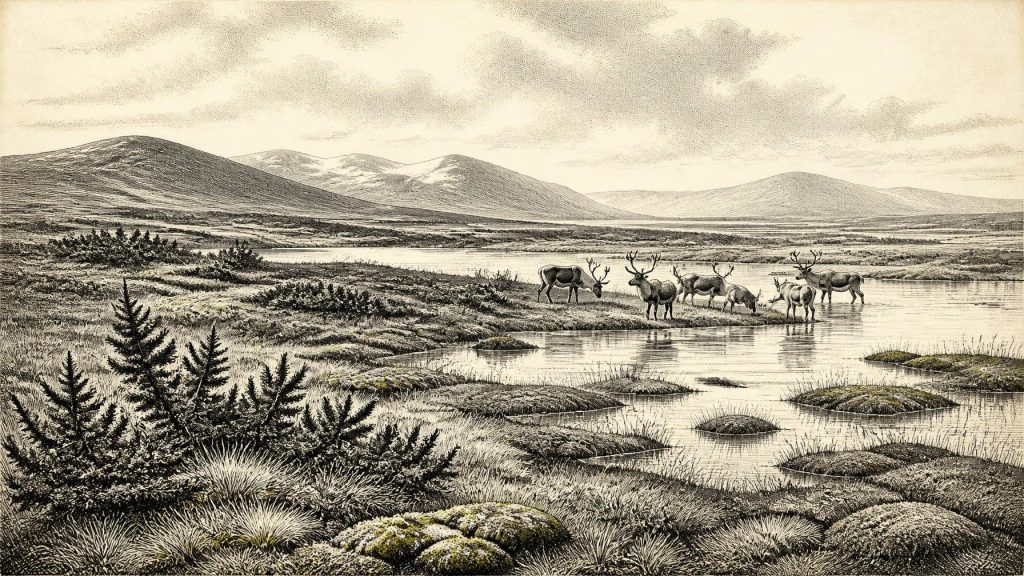
Pollen, plant macrofossils and insects from Derryvree indicate a treeless or nearly treeless environment. Grasses, sedges, juniper and cold-tolerant herbs were among the important elements identified, while mosses and aquatic plants point to saturated ground and standing or slow-moving freshwater. The old term muskeg is useful here if used carefully: it evokes a wet, mossy, peaty landscape with pools and sedge-rich margins, rather than a uniform blanket bog of the kind familiar in later Ireland. The terrain around the water would have included exposed mineral soils, patches of short vegetation and seasonally difficult ground.
Such evidence supports a picture of open tundra-steppe or marshy tundra in this part of Fermanagh, with cold winters and a brief productive growing season. It does not demonstrate a fixed climate for every part of the island. The island’s relief, Atlantic position, snowfall and proximity to ice would all have produced local variation. Nor should an interval without trees be mistaken for a lifeless one. Low vegetation could sustain insects, small mammals and grazing animals; wet places concentrated food and water. In an otherwise severe world, a marsh-edge may have been one of the more biologically varied places in the landscape.
Other northern sites broaden the perspective. Organic deposits at Hollymount, also near Maguiresbridge, and at Greenagho near Belcoo in County Fermanagh preserve evidence of non-glacial conditions within the Midlandian cold stage. At Aghnadarragh near Lough Neagh in County Antrim, a remarkable sequence of tills, freshwater sediments and organic deposits records repeated environmental change over the last glacial cycle. Its older deposits include evidence for woodland in a milder interstadial, while other units contain woolly mammoth and musk ox. These places should not be compressed into one synchronous Irish landscape: their dates and environments differ. Together, however, they show that Ireland’s Ice-Age history was a sequence of advances, retreats and ecological reorganisations, not an uninterrupted white emptiness.
Castlepook and the Animal World
For the fauna of this broad period, Castlepook Cave near Doneraile in north County Cork is indispensable. Excavations and later reassessment of its collections have identified remains including woolly mammoth, reindeer, giant deer, brown bear, wolf, foxes, stoat, mountain hare and lemmings, as well as spotted hyaena. Radiocarbon programmes have shown that the cave’s faunal record is complex and that older dates require careful treatment. Even so, the assemblage demonstrates that parts of Ireland supported a striking mixture of cold-adapted grazers, predators and scavengers during Marine Isotope Stage 3.
The cave should not be imagined as a tranquil museum of animals living side by side at a single instant. Cave deposits accumulate over long periods; bones may be moved by carnivores, water, excavation or collapse. Spotted hyaenas are especially significant because they carried carcass parts into dens, altering what survives and where it lies. Tooth marks on mammoth bone are evidence of carnivore activity, not human hunting. Similarly, the presence of reindeer bone establishes reindeer in Ireland, but cannot on its own reconstruct herd size, migration routes or the exact appearance of the Doneraile countryside in this particular numbered year.
Nevertheless, the animal evidence makes ecological sense beside the Fermanagh sediments. Reindeer are well suited to open, cold terrain; lemmings and Arctic fox likewise signal northern conditions. Mammoths and giant deer imply substantial forage in at least some seasons. Predators and scavengers followed this productivity. Ireland was not yet the familiar wooded island of later prehistory. It was part of a wider, fluctuating north-west European world in which open ground and low sea levels could make movement between regions easier than it would later become, although the exact routes and timing of connections between Ireland, Britain and the Continent remain debated.
The Human Question
There is one potentially momentous human clue. A reindeer femur from Castlepook, recovered during early twentieth-century excavations associated with the naturalist Richard J. Ussher, bears a deep incision interpreted by Ruth Carden as a cut made with a sharp stone tool during butchery. County Cork heritage material dates the bone to about 31,000 BCE and presents it as evidence that Palaeolithic people reached Ireland far earlier than was once accepted. If that interpretation is sustained, it makes Castlepook the earliest known indication of human activity on the island.
But the scale of the claim must match the scale of the evidence. The cut-marked bone does not reveal a village, a permanent population, a language, a named people or a political territory. No securely associated stone-tool assemblage, hearth, dwelling floor, burial ground or art has yet been recovered at Castlepook. The bone also appears to have entered a cave system used by carnivores, so it does not prove that people lived in the cave or killed the animal there. At most, it supports the possibility—indeed, on the published interpretation, the likelihood—that one or more people processed a reindeer in Ireland during this general period.
That distinction is historically important. A short hunting or scavenging visit by mobile hunter-gatherers is very different from continuous settlement. The visitors may have followed animals, crossed during a phase of lower sea level, stayed briefly and left little durable material behind. Their tools would probably have been of stone, wood, bone and hide, but no particular tool type can responsibly be assigned to Ireland from this single bone. Comparisons with Upper Palaeolithic societies in Britain and continental Europe can suggest possibilities—small mobile groups, sophisticated knowledge of animal behaviour, use of hides, meat, marrow and sinew—but they are comparisons, not direct Irish evidence.
No Politics, but a Real Social World
There is no evidence from Ireland around this horizon for rulers, tribes, diplomacy, organised warfare, religious monuments, formal trade networks or institutions of learning. To describe political affairs would be to invent them. Nor can archaeology yet identify ceremonies or beliefs from the Derryvree sediments and Castlepook bones. The absence of such evidence does not mean that any people present lacked social relationships, practical knowledge or cultural traditions; rather, their traces have not survived in forms that allow those things to be described.
What can be said is more modest and more compelling. Survival in a cold, changeable environment required social cooperation if people were present: sharing food, making and maintaining cutting implements, reading weather and animal movements, and transmitting knowledge of routes and safe places. Animal carcasses offered meat, fat, marrow, hide, sinew and bone. Yet Ireland supplies no direct evidence that these resources were systematically exchanged, stored or traded at this date. The most secure economy is the non-human one visible in the deposits: grazing animals converting sparse vegetation into biomass, carnivores and hyaenas exploiting carcasses, and wetland plants growing wherever water and summer warmth allowed.
Approaching a Colder Future
The wider climatic setting was unstable. Greenland ice-core and Atlantic marine records reveal repeated abrupt swings between colder stadials and relatively milder interstadials during Marine Isotope Stage 3. Correlations from an Irish deposit to an individual Greenland event are necessarily tentative, because the dates are broad and local responses vary. Still, Derryvree belongs to a period in which climate could change sharply on timescales meaningful to animal populations and human travellers. A landscape capable of supporting marsh and grazing herds could later be overridden or transformed by ice.
By the Last Glacial Maximum, after about 26,000 calibrated years BP, much of Ireland lay beneath the expanding British–Irish Ice Sheet. Modern reconstructions indicate that major growth and maximum extent came later than the Derryvree freshwater interval, though ice may already have been accumulating on northern high ground by around 31,000 years BP. The future ice would scour and bury evidence, helping to explain why the Irish Palaeolithic record is so slight. Around 31,684 BCE, then, the responsible history is neither a story of empty land nor a story of a settled nation. It is a narrow but powerful record of cold wetlands, open-country animals, possible human butchery and a landscape poised within the long advance of the Ice Age.
Primary Sources
- A Middle Midlandian Freshwater Series at Derryvree, Maguiresbridge, County Fermanagh, Northern Ireland
- Early Midlandian–Middle Midlandian, Pleistocene, Northern Ireland
- Irish Pleistocene Biostratigraphy
- Middle Midlandian Interstadial Deposits at Greenagho, Near Belcoo, County Fermanagh, Northern Ireland
- Aghnadarragh
- Freshwater Organic Deposits and Stratified Sediments Between Early and Late Midlandian (Devensian) Till Sheets at Aghnadarragh, County Antrim, Northern Ireland
- Mammoth and Musk Ox ESR-Dated to the Early Midlandian at Aghnadarragh, County Antrim, Northern Ireland, and the Age of the Fermanagh Stadial
- A Reconsideration of the Radiocarbon Dating of the Marine Isotope Stage 3 Fauna from Southern Ireland
- 2022:564 – Castlepook Cave, Castlepook South, Cork
- Heritage Artefacts of County Cork 2021
- New Insights on the Fauna of Ireland’s Younger Dryas
- Trimlines, Blockfields and the Vertical Extent of the Last Ice Sheet in Southern Ireland
- Late Pleistocene Chronostratigraphy and Ice Sheet Limits, Southern Ireland
- Dimensions and Chronology of the Last Ice Sheet in Western Ireland
- Maximum Extent and Dynamic Behaviour of the Last British–Irish Ice Sheet West of Ireland
- Growth and Retreat of the Last British–Irish Ice Sheet, 31,000 to 15,000 Years Ago: the BRITICE-CHRONO Reconstruction
- Pattern and Timing of Retreat of the Last British-Irish Ice Sheet
- The IntCal20 Northern Hemisphere Radiocarbon Age Calibration Curve (0–55 cal kBP)
- Consistently Dated Atlantic Sediment Cores Over the Last 40 Thousand Years
- The Nature of MIS 3 Stadial–Interstadial Transitions in Europe: New Insights from Model–Data Comparisons
- Figure 6.— The Subdivision of the Quaternary Period in Ireland