
Castlepook’s Mammoth-Steppe31608 BCE
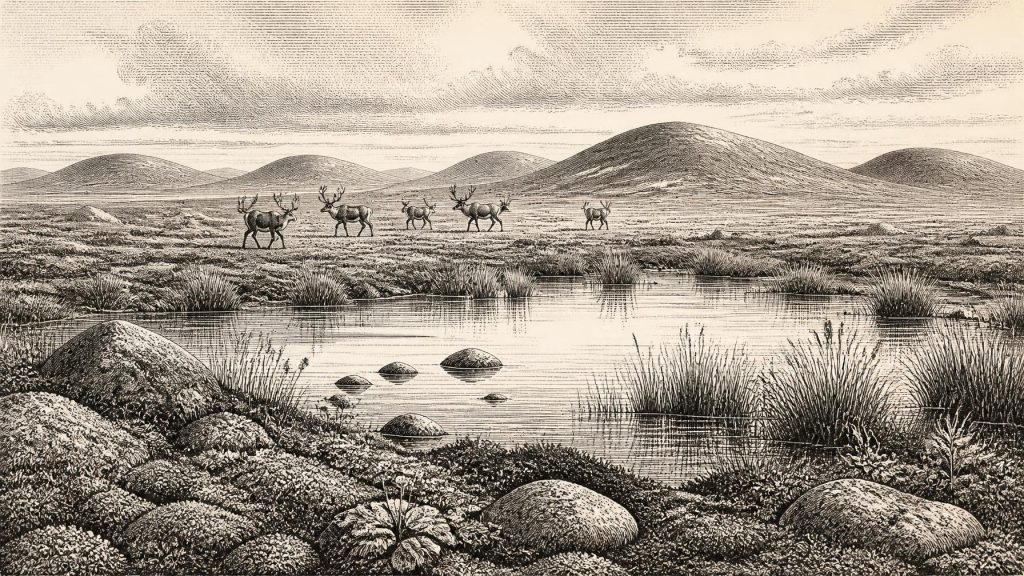
Around 31,608 BCE, Ireland formed a fluctuating Late Pleistocene frontier rather than a uniformly frozen island. Glaciers and open periglacial landscapes varied regionally as climate shifted. At Derryvree, County Fermanagh, freshwater deposits between till sheets preserve evidence of tundra-steppe vegetation, including sedges, herbs, mosses and aquatic plants. Castlepook Cave, County Cork, contains a mixed faunal record of mammoth, reindeer, giant deer, hyena, bear, wolf, Arctic fox and lemmings, reflecting links with wider Europe. A possibly cut-marked reindeer bone suggests brief Upper Palaeolithic human visits, but not settlement. Fragmentary evidence documents climate, water, ice and animal mobility before agriculture or monuments.
Dateline
The label 31,608 BCE offers a useful point of orientation, but it must not be mistaken for a date at which Irish prehistory can be observed year by year. No written records, settlements or securely dated human assemblages allow such precision. In modern chronological terms, the date lies approximately 33,600 calendar years before 1950, within Marine Isotope Stage 3 of the Late Pleistocene. Radiocarbon determinations at this age have substantial uncertainties and require calibration; deposits and bones may also represent long spans of accumulation rather than a single moment. What can responsibly be reconstructed is a changing Ice-Age Ireland, illuminated unevenly by caves, buried freshwater sediments, pollen, plant macrofossils, animal bones and the wider record of the British–Irish Ice Sheet.
A Landscape in Flux
Ireland around this broad period was neither the familiar green island of later millennia nor necessarily a land wholly smothered by ice. It was part of a cold, unstable north-west European world in which glaciers, ice caps, open ground, lakes, rivers and coastal lowlands changed over long timescales. Greenland ice-core records show that the climate of the last glacial period could switch abruptly between relatively milder interstadial phases and harsher stadials. Those records do not provide a local weather report for Ireland in 31,608 BCE, but they explain why a simple image of one unchanging ‘Ice Age’ is misleading.
Ice-sheet reconstructions likewise indicate complexity. The last British–Irish Ice Sheet was building towards its much later maximum, conventionally placed broadly between about 26,000 and 19,000 years ago. Modelling and field evidence suggest that, around 31,000 years ago, a substantial ice mass occupied parts of north-west Ireland, with ice fields or mountain glaciers in several upland areas. Yet conditions varied sharply by region and through time. Southern lowlands could retain open habitats even while the north-west and high ground sustained ice. It is therefore safer to envisage a patchwork of cold environments than an island uniformly frozen or uniformly habitable.
Fermanagh’s Buried Wetland
The most informative Irish environmental evidence close to this general era comes from Derryvree near Maguiresbridge in County Fermanagh. Roadworks exposed a freshwater sequence of silts, sands and organic material sealed between two till sheets in a drumlin. The deposit produced a radiocarbon determination of 30,500 ± 1,170/1,030 radiocarbon years BP. That is not a calendar-year equivalent to 31,608 BCE, and its uncertainty is large; nevertheless, it belongs to the Middle Midlandian, the Irish expression of the last glacial cycle, and demonstrates that at some point between separate glacial advances there was standing or slow-moving freshwater in south Fermanagh.
Its fossil content is especially valuable. Pollen was poorly preserved, but herbaceous pollen and plant remains, including mosses, aquatic species and cold-adapted taxa, point to open tundra or tundra-steppe vegetation under periglacial conditions. The evidence does not justify drawing forests, fields or a settled countryside. Trees, if present locally at all, were sparse and the few pollen grains that might suggest woody plants can be difficult to interpret in such old, disturbed deposits. The stronger conclusion is that sedges, herbs, mosses and wet-ground plants dominated around shallow water and exposed mineral ground. Derryvree records a real Irish habitat, but its exact age and duration must remain broader than the numbered year.
This landscape would have been shaped by frost heave, seasonal snow, meltwater and wind. Rivers carried sediment across open ground; pools and marshy hollows offered sheltered ecological niches. In a climate where the growing season was short and temperatures could shift markedly over centuries or even decades, vegetation was not simply a backdrop. It determined forage for large herbivores, cover for small animals and the availability of any resources that visiting people might have used.
Castlepook’s Animal World
For the period’s larger animals, Castlepook Cave—also called Mammoth Cave—near Doneraile in north County Cork is central. Excavations from the late nineteenth and early twentieth centuries, supplemented by later study and radiocarbon dating, made it Ireland’s richest known cave archive for Late Pleistocene vertebrates. Its deposits include remains attributed to woolly mammoth, reindeer, giant deer, brown bear, wolf, Arctic fox, lemmings and spotted hyena. Not all were present simultaneously, and the old excavations disturbed or mixed some deposits. A list of species from Castlepook is therefore evidence for a broad faunal world, not a census from a single season or a single valley floor.
Even with that caution, the assemblage is striking. Reindeer and lemmings suit open, cold habitats; mammoth implies extensive grazing country rather than closed woodland. Giant deer, despite its later nickname ‘Irish elk’, was not an Irish endemic and should not be treated as a national symbol already tied to a settled Ireland. Spotted hyena, now associated with Africa, was then part of a European Pleistocene carnivore fauna. Hyena bones, teeth and coprolites indicate that caves could be used as dens or places where carcass remains accumulated. Carnivores, scavengers, herbivores and geological processes all helped create the archive. The cave is not simply a hunting camp preserved intact.
The wider implication is that land connections or very narrow sea crossings must at times have enabled mammals to reach Ireland from Britain and, beyond it, continental Europe. Lower global sea levels altered the geography of the Irish Sea basin, but the exact routes depended on ice extent, local relative sea level and changing topography. It would be rash to picture a permanent, broad land bridge. The important point is mobility: Ireland’s fauna was connected to a larger north-west European ecosystem during suitable windows, then repeatedly vulnerable to climatic deterioration and advancing ice.
The Human Question
There is no secure basis for describing a resident Irish population in 31,608 BCE. No houses, hearths, burials, tool-making floors, named communities or enduring settlement network of that antiquity have been established in Ireland. Consequently there can be no responsible account of political authority, diplomacy, territorial borders or organised warfare. Terms such as tribe, chiefdom and nation belong to later interpretative frameworks and would conceal more than they reveal here.
A reindeer femur from Castlepook has nevertheless transformed the question of human presence. A deep incision on the bone has been interpreted as a mark made by a sharp stone tool during carcass processing, and the bone has been publicly associated with an age of about 33,000 years ago. If that interpretation and association are sustained, it indicates that people reached Ireland during the Upper Palaeolithic far earlier than the formerly accepted record suggested. It may represent butchery rather than a settlement: a brief visit, an opportunistic encounter with a carcass, or a small hunting party moving through a wider landscape. It does not by itself establish continuous occupation.
The distinction matters because cave-bone collections pose difficult evidential problems. Many Castlepook finds were excavated before modern recording standards; bones can be moved by hyenas, water, collapse, excavation and later handling. A cut-mark interpretation rests on the form, placement and microscopic character of a mark, while the age of an animal bone does not automatically date the instant at which a mark was made unless their relationship is demonstrated. The careful historical conclusion is therefore twofold: there is important, potentially very early evidence of human activity in Ireland; there is not yet an evidential foundation for a detailed Irish human society at this date.
Life Without Institutions
If people were present, their economy would have been that of mobile hunter-gatherers, not farmers. There were no crops, livestock, metalworking, pottery production or built monuments evidenced for Ireland at this time. Reindeer, where accessible, would have offered meat, fat, hide, sinew, antler and bone; other large herbivores may have been pursued, scavenged or avoided according to opportunity and risk. Such statements are reasonable inferences from Upper Palaeolithic lifeways elsewhere in Europe, not direct proof of a complete Irish subsistence system.
Trade and diplomacy cannot be demonstrated. A travelling group could have carried stone tools or exchanged knowledge across territories now divided by sea, but no securely contemporary Irish artefact assemblage reveals routes, partners or goods. Learning and culture likewise survive only indirectly: the practical knowledge needed to navigate cold terrain, recognise animal movement, manage fire and process carcasses would have been considerable, yet no Irish art, ritual site or language can be recovered. Religion is entirely unknown. Caves can acquire sacred meanings in later societies, but Castlepook’s Pleistocene evidence primarily records animal accumulation and geological shelter, not an identified shrine.
An Ireland of Intervals
The most accurate picture for around 31,608 BCE is thus one of intervals rather than a conventional historical year. In Fermanagh, a freshwater tundra environment survived between glacial episodes. In Cork, caves accumulated the remains of a rich cold-climate fauna whose members moved through a connected European world. Across the island, growing ice and volatile climate restricted and rearranged habitable ground. A possible humanly modified reindeer bone opens the prospect of fleeting Upper Palaeolithic visits, but not of settled communities or recorded events.
That limitation is not an absence of history. It is the history of an island being made and remade by climate, ice, water and animal movement. The deposits beneath the Fermanagh drumlins and the bones in a Cork cave are fragmentary witnesses, but they establish the essential fact: long before farming, monuments or written names, Ireland was an active part of the Late Pleistocene ecological frontier.
Primary Sources
- A Middle Midlandian Freshwater Series at Derryvree, Maguiresbridge, County Fermanagh, Northern Ireland
- The Irish Quaternary Fauna Project
- A Reconsideration of the Radiocarbon Dating of the Marine Isotope Stage 3 Fauna from Southern Ireland
- Castlepook Cave, County Cork: Geological Site Report
- Spotted Hyena Skull
- Palaeoecology: Guide No. 16
- The Exploration of Castlepook Cave, County Cork, Being the Third Report from the Committee Appointed to Explore Irish Caves
- Occurrence of Mammalia Relicts at Site Castlepook Cave
- Castlepook Cave, Co. Cork, 2022 Excavation Report
- Growth and Retreat of the Last British–Irish Ice Sheet, 31,000 to 15,000 Years Ago: the BRITICE-CHRONO Reconstruction
- The Timing and Magnitude of the British–Irish Ice Sheet Between Marine Isotope Stages 5d and 2
- Dimensions and Chronology of the Last Ice Sheet in Western Ireland
- Last Glacial Maximum Cirque Glaciation in Ireland and Implications for Reconstructions of the Irish Ice Sheet
- Deglaciation Chronology of the Donegal Ice Centre, North-west Ireland
- Maximum Extent and Dynamic Behaviour of the Last British–Irish Ice Sheet West of Ireland
- Pattern and Timing of Retreat of the Last British-Irish Ice Sheet
- The Island of Ireland: Drowning the Myth of an Irish Land-Bridge?
- Deglaciation, Earth Crustal Behaviour and Sea-Level Changes in the Determination of Insularity: A Perspective from Ireland
- High-Resolution Record of Northern Hemisphere Climate Extending into the Last Interglacial Period
- A Stratigraphic Framework for Abrupt Climatic Changes During the Last Glacial Period Based on Three Synchronized Greenland Ice-Core Records
- The IntCal20 Northern Hemisphere Radiocarbon Age Calibration Curve (0–55 cal kBP)
- New Data for the Last Glacial Maximum in Great Britain and Ireland