
Castlepook’s Reindeer Puzzle31590 BCE
31,590 BCE is a modern filing date within late Marine Isotope Stage 3, not a recoverable Irish calendar year. Ireland contained varied cold environments, including tundra wetlands at Derryvree and changing regional ice cover. Castlepook Cave’s fauna, re-dated using improved methods, includes reindeer, mammoth, giant deer, hyaena and other cold-adapted animals, though its poorly recorded bones do not represent a single moment or community. A cut-marked reindeer femur may indicate Upper Palaeolithic carcass processing, but lacks associated tools, hearths or human remains. Evidence supports possible fleeting human visits, not settlement, polities or culture. Further excavation and secure dating remain essential.
Dateline
“31,590 BCE” is a modern filing date, not a year that can be recovered from the prehistoric record. No Irish person, event, settlement or political decision can responsibly be assigned to this particular calendar year. At this depth of time, archaeologists work with radiocarbon determinations, calibrated ranges, sediment sequences and changing climate stages rather than annual chronology. The point falls broadly within the later part of Marine Isotope Stage 3, a fluctuating cold interval before the Last Glacial Maximum. It is best understood as part of a several-thousand-year window in which Ireland’s environments, animal populations and ice cover were changing markedly.
The evidence is important precisely because it is thin. Around this approximate date there are no securely excavated houses, hearths, stone-tool scatters, graves, human bones or repeated occupation layers in Ireland. What survives instead is an uneven archive: animal bones from caves, plant remains and pollen preserved beneath later glacial sediments, landforms left by ice, and laboratory dates that must be reconsidered as methods improve. These sources can illuminate an Ice Age Ireland; they cannot supply an annual narrative.
A Cold-Stage Landscape
In broad geological terms, Ireland was moving towards the most extensive phase of the last glaciation, whose maximum came much later, around 24,000–20,000 years ago. That does not mean that the whole island lay continuously beneath a single uniform ice sheet at the time represented by 31,590 BCE. The growth, extent and behaviour of ice varied by region and through time. Research on deposits beneath later ice in north-central Ireland indicates that some areas were ice-free until at least about 34,000 calibrated years before present. Other evidence suggests that ice was accumulating or expanding in parts of the island during the later stages of Marine Isotope Stage 3.
Consequently, the most defensible picture is regional and provisional. Exposed ground, local ice masses, snowfields, rivers, wetlands and windblown sediments may all have existed within Ireland at different times. Low sea levels altered the surrounding shelves, but they do not demonstrate an easy, continuous land route for people from Britain or continental Europe. The Irish Sea basin had its own changing waters and ice, while the detailed palaeogeography of any specific millennium remains debated. Ireland’s later insular history should not be projected simplistically backwards, nor should an Ice Age “land bridge” be assumed without local evidence.
Derryvree’s Buried Wetland
The most revealing environmental comparison comes from Derryvree near Maguiresbridge in County Fermanagh. Roadworks exposed freshwater silts and fine sands sealed beneath glacial deposits in a drumlin. A radiocarbon determination of 30,500 ± 1,170/1,030 years before present was obtained from this deposit. Its calibrated range is broad, rather than an exact equivalent to a BCE year, but it places the sediment within the same general late-MIS-3 world relevant to this article.
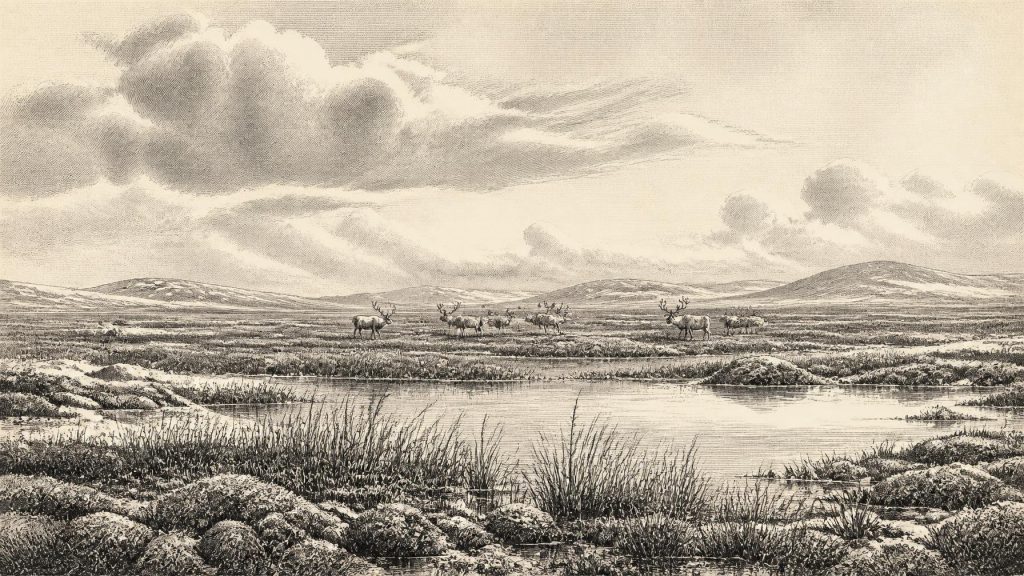
Plant macrofossils, pollen and small-animal evidence from Derryvree point to open tundra vegetation and a periglacial climate. Mosses, sedges and other herbaceous plants indicate wet ground and shallow freshwater conditions, not forest. Sparse pollen preservation prevents a complete reconstruction, but the evidence argues against a densely wooded Ireland. The landscape was probably a mosaic of damp basins, exposed mineral soils, low vegetation and seasonally severe weather. Such a setting could support grazing animals and their predators, while remaining difficult for any human visitors.
Derryvree is not a photograph of all Ireland in 31,590 BCE. It is a local deposit, and its date has uncertainty. Yet it matters because it demonstrates that apparently inhospitable ground could contain productive wetland niches. It also illustrates a central difficulty of Ice Age history: deposits are often preserved only where later sediments or ice sealed them, and their survival may say as much about geological chance as about the former distribution of life.
The Castlepook Fauna
County Cork provides the other major body of evidence. Castlepook Cave, near Doneraile, was explored in the early twentieth century and yielded a remarkable collection of Pleistocene animal remains. The cave has produced evidence for reindeer, woolly mammoth, giant deer, brown bear, wolf, Arctic fox, stoat, collared lemming, Norwegian lemming and spotted hyaena. This is not the fauna of a mild, wooded island. It is a cold-adapted and open-country assemblage, including herbivores able to exploit sparse vegetation and carnivores or scavengers able to follow them.
Modern re-dating has transformed interpretation of the collection. Earlier radiocarbon measurements from Irish caves were often made before improved collagen purification, especially ultrafiltration, became standard. Reassessment of Castlepook material showed that some bones were substantially older than formerly believed, placing important animals in Marine Isotope Stage 3. Scholars have consequently argued that giant deer and spotted hyaena may have disappeared locally before the Last Glacial Maximum, perhaps around 40,000 calibrated years before present. The important point is not a neat list of species all living together in one season, but a sustained record of animal use of southern Irish cave landscapes across a changing cold period.
A cave assemblage is also not a census. Bones may have entered through carnivore activity, scavenging, natural death, water movement, collapse or human collection practices during excavation. Castlepook’s deposits were investigated long before modern standards of recording, and many finds lack the stratigraphic context now expected. Different bones may be separated by centuries or millennia. The presence of mammoth, reindeer and hyaena proves that these animals reached Ireland during the broader period; it does not prove that a single mixed herd wandered together past the cave in 31,590 BCE.
A Possible Human Trace
Castlepook has attracted particular attention because a reindeer femur from the old collection was reported in 2021 to bear a deep incision interpreted as damage made by a sharp stone tool on fresh bone. If that interpretation is confirmed, it would offer a striking indication that Upper Palaeolithic people processed a reindeer carcass in Ireland roughly 33,000 radiocarbon years ago. Such a finding would extend possible human activity on the island far beyond the better-established terminal Pleistocene evidence from Alice and Gwendoline Cave in County Clare.
The qualification is essential. A radiocarbon result dates the animal’s death, not automatically the surface modification or the identity of whoever made it. Distinguishing a stone-tool cut from carnivore damage, breakage, trampling, sediment abrasion or excavation damage requires close taphonomic analysis. Nor has Castlepook yet yielded a securely associated lithic assemblage, hearth, dwelling floor, human bone or sequence of occupations of comparable age. The femur is therefore evidence for a serious hypothesis of early human presence, not proof of a settled Irish population.
If people did reach the area during this broad interval, the most cautious interpretation is of small, mobile parties rather than villages. Reindeer could have supplied meat, fat, hide, sinew, bone and antler; a cut on a limb bone would fit carcass processing. But archaeology cannot tell us whether the animal was hunted locally, found dead, transported to the cave, or processed by one individual or several. It cannot identify their language, ancestry, sex, kinship system or route of arrival. The evidence supports possible activity, not a narrative of colonisation.
No Polities, No Proven Trade
There is no basis for describing kingdoms, chiefs, warfare, alliances, diplomacy or territorial boundaries in Ireland at this point. Nor is there evidence for exchange networks operating within Ireland. Stone tools, ornaments, imported raw materials and structured deposits are absent from the securely dated record for this time. It would be misleading to fill that silence with assumptions drawn from later Mesolithic, Neolithic or medieval Ireland.
Nor can religion, art or formal learning be reconstructed for Ireland itself. Across Upper Palaeolithic Europe, people made sophisticated stone and organic tools, images, personal ornaments and ritualised objects. Those wider comparisons establish what contemporary humans elsewhere were capable of; they do not show that such practices occurred in Ireland. Castlepook offers no securely associated portable art, cave art or symbolic object. Its lesson is one of possibility and restraint: Ireland lay within a north-west European ecological world inhabited by mobile human groups elsewhere, but direct cultural evidence on the island remains elusive.
History at the Edge of Evidence
Everyday life in the Irish evidence is most securely represented by animals and habitats, not by named communities. Wet tundra around Derryvree and the cold-open fauna of Castlepook show that parts of the island could sustain life during an unstable glacial age. They also show why survival was precarious: resources were seasonal, terrain could be exposed, and advancing ice eventually transformed much of the landscape. Caves may have been dens, traps for sediment and repositories of bone long before, after, or without being human shelters.
The responsible historical entry for 31,590 BCE is therefore not an event but an archaeological horizon. Modern calendar-year precision is unavailable. Calibrated ranges, where they can be calculated, remain ranges; cave bones and buried wetlands record episodes rather than an exact day or year. Around this broad point in time, Ireland contained cold-climate environments and a distinctive large-mammal fauna. Castlepook raises the consequential possibility of a fleeting Upper Palaeolithic human visit. Whether that possibility becomes a securely demonstrated chapter of Irish settlement history depends on further excavation, re-dating and the recovery of evidence in undisturbed context.
Primary Sources
- A Reconsideration of the Radiocarbon Dating of the Marine Isotope Stage 3 Fauna from Southern Ireland
- The Irish Quaternary Fauna Project
- First Evidence of a Late Upper Palaeolithic Human Presence in Ireland
- New Insights on the Fauna of Ireland’s Younger Dryas and Early Holocene from Alice & Gwendoline Cave
- Palaeoecology
- Trimlines, Blockfields and the Vertical Extent of the Last Ice Sheet in Southern Ireland
- Dimensions and Chronology of the Last Ice Sheet in Western Ireland
- Timing and Pace of Ice-Sheet Withdrawal Across the Marine–Terrestrial Transition West of Ireland During the Last Glaciation
- The Deglaciation of the Western Sector of the Irish Ice Sheet from the Inner Continental Shelf to its Terrestrial Margin
- Ireland: Submerged Prehistoric Sites and Landscapes
- The Mesolithic in Ireland: When Was It?
- Quaternary Site Descriptions
- Outreach and Education Resources
- Occurrence of Mammalia Relicts at Site Castlepook Cave
- The Exploration of Castlepook Cave, County Cork
- Castlepook Cave, Castlepook South, Cork
- The Colonization of Ireland: A Human Ecology Perspective
- Investigating Seasonal Mobility in Irish Giant Deer (Megaloceros giganteus)
- The IntCal20 Northern Hemisphere Radiocarbon Age Calibration Curve (0–55 cal kBP)
- Advances in Irish Quaternary Studies