Regional Mosaic31481 BCE
Around 31,481 BCE, Ireland experienced a variable MIS 3 glacial climate rather than uniform ice cover. Derryvree sediments in Fermanagh record cold, treeless wetlands during an ice-free interval, while Crag Cave calcite indicates episodic milder conditions in Kerry. Expanding ice sheets created a regional mosaic of glaciers, open ground and freshwater habitats. Castlepook Cave’s fauna, including reindeer, mammoth, hyena and arctic fox, demonstrates cold-stage animal presence, though deposits span time and were disturbed. A marked reindeer femur may indicate butchery by Upper Palaeolithic people, but cannot prove settlement. Evidence supports temporary environmental and human access, while social history remains unknown.
Dateline
Modern calendar-year precision cannot be projected responsibly into this depth of Irish prehistory. No one in Ireland recorded a year equivalent to 31,481 BCE, and neither radiocarbon dating nor glacial deposits can identify happenings within a single calendar year so far back. The label is nevertheless useful as a point of orientation: it falls about 33,431 years before the conventional radiocarbon “present” of AD 1950, during the Late Pleistocene, within Marine Isotope Stage 3 (MIS 3). The evidence most relevant to it consists of cave bones, water-laid sediments, fossil insects and plants, cave calcite, and reconstructions of ancient ice. These sources illuminate environments and possible visits by people, not a continuous Irish population or an event-by-event history.
A Date Within a Range
The closest securely relevant Irish environmental sequence is at Derryvree, near Maguiresbridge in County Fermanagh. There, organic silts and fine sands lay between two layers of glacial till in a drumlin exposure. The order is important: ice had deposited the lower till, an interval without local overriding ice allowed freshwater sediments and organic matter to accumulate, and a subsequent ice advance sealed the deposit beneath another till. A conventional radiocarbon result of 30,500 ± 1,170 radiocarbon years before present has been recalibrated in later discussion to a broad range of roughly 31,700–36,900 calibrated years before present. In calendar terms, that is approximately 34,950–29,750 BCE. The requested year lies within that range, but it cannot be isolated from it.
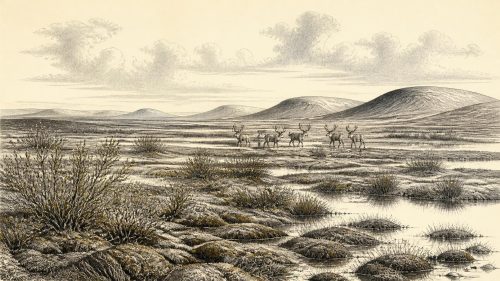
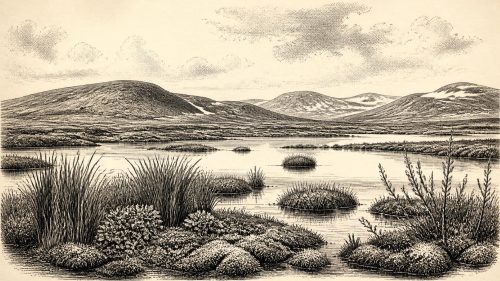
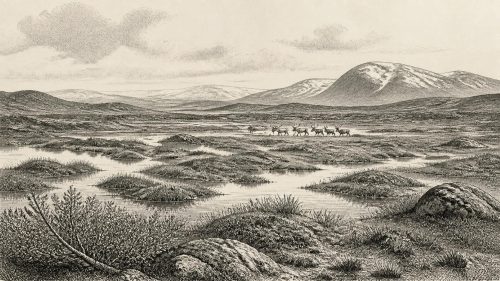
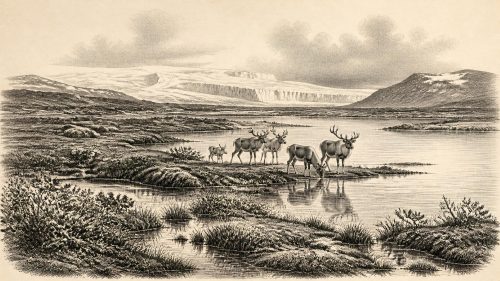
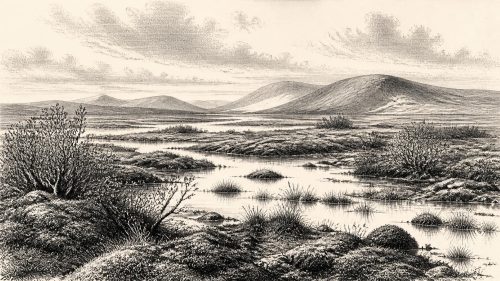
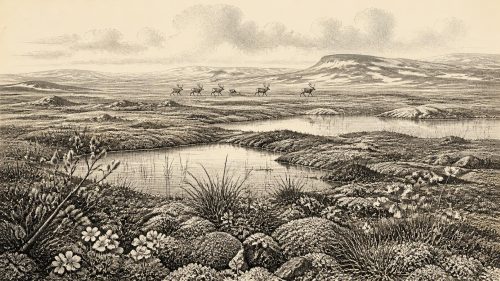
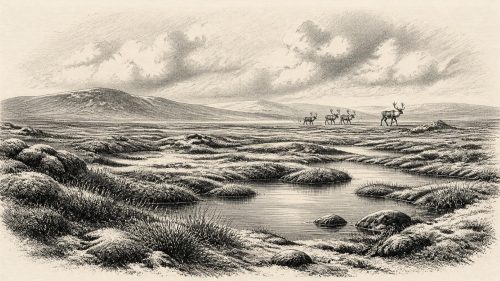
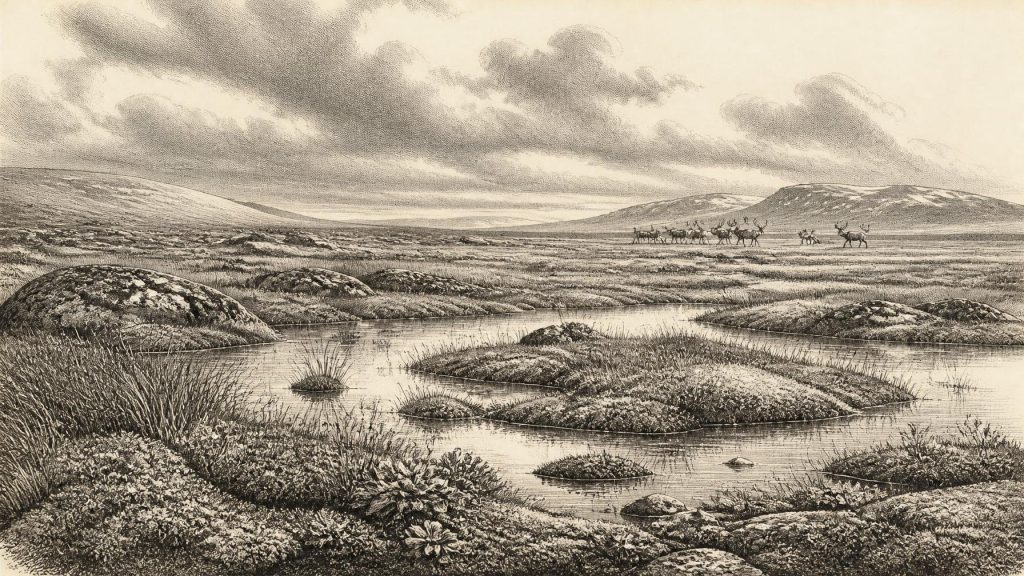
Derryvree therefore supplies evidence for an interval, not a snapshot. Its plant and insect remains point to cold, open country with wet ground: a treeless muskeg or tundra wetland, including pools, mosses, sedges and arctic-alpine plants. The record is local to Fermanagh. It does not prove that every part of Ireland was ice-free, identical in vegetation, or equally habitable at precisely the same time. Yet it decisively complicates any simple picture of a wholly ice-covered island throughout the approach to the Last Glacial Maximum.
Ice, Water and Open Ground
At this stage the climate was severe but not static. MIS 3, broadly c. 59,000–27,600 years ago, contained abrupt North Atlantic swings between colder stadials and relatively milder interstadials. Greenland ice-core sequences provide the master chronology for such changes; Irish records can be compared with it, although correlations are rarely exact. The Derryvree dates have been tentatively associated with several Greenland interstadials, rather than one confidently named phase. The responsible conclusion is that the Fermanagh deposit accumulated during a cold, ice-free episode amid a highly variable glacial climate.
Crag Cave in County Kerry offers a different kind of evidence. Uranium-thorium dates show that calcite formations grew episodically in the cave during MIS 3. Because shallow-cave speleothem growth requires liquid water and conditions generally above sustained freezing, these deposits register episodes of climatic amelioration in south-west Ireland. They do not provide a weather report for 31,481 BCE, nor do they demonstrate open countryside outside the cave at all times. Together with Derryvree, however, they show that Ireland’s climate responded to the rapid oscillations apparent across the North Atlantic.
The great expansion of the last British–Irish Ice Sheet was still gathering force. Recent reconstructions portray substantial ice caps on high ground, including north-west Ireland, around 31,000 years before present, followed by asynchronous growth of a much larger ice sheet. Its maximum volume came later, around 23,000 years ago, while particular Irish and marine sectors reached their greatest extents at different times. At the date considered here, Ireland was thus a regional mosaic: glacierised uplands and ice margins in some areas, but also terrain capable of supporting freshwater wetlands and grazing animals elsewhere. Later ice scour and deposition would erase or bury much of the evidence for that landscape.
The Castlepook Animal World
The clearest southern Irish evidence comes from Castlepook Cave near Doneraile, County Cork, long known as Mammoth Cave. Antiquarian excavations there produced a remarkable but difficult collection of Pleistocene animal bones. Reassessment using improved collagen pretreatment and accelerator mass spectrometry has shown that several old radiocarbon determinations were substantially too young. The revised work places parts of the Castlepook fauna in MIS 3, including animals dated around the broad period relevant here. It demonstrates that cold-stage mammals entered, or survived in, portions of Ireland before the later full glaciation.
The assemblage includes reindeer, woolly mammoth, brown bear, arctic fox, hare, lemming and spotted hyena. Not every species necessarily occupied the landscape simultaneously; a cave collection may amalgamate material accumulated across thousands of years. Nor was a cave simply an unbiased sample of surrounding wildlife. Carnivores could drag carcass parts inside, water could move sediment and bone, and early excavators removed deposits before modern recording standards existed. The National Museum of Ireland’s Castlepook hyena skull, and bones bearing signs of carnivore activity, underline that predators as well as geological processes shaped the collection.
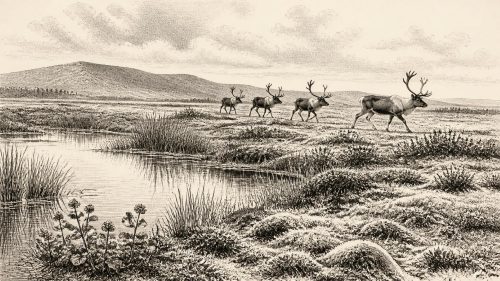
Even with those cautions, the fauna supports a picture of open, cold-adapted habitats rather than woodland. Reindeer could have followed seasonal grazing routes across grass-, herb- and sedge-rich ground. Mammoths and other large herbivores, where present, belonged to a wider north-west European cold-stage ecological world. Hyenas and bears reveal a food web with scavenging, predation and competition for shelter. This was not an empty land awaiting humans. It was a changing ecological frontier, in which animal movements may have been seasonal and in which viable habitats could expand or contract sharply as temperature, snow cover, ice and vegetation altered.
One Marked Bone, Not a Settlement
Castlepook is especially important because a reindeer femur, recovered from the cave’s older collections, has been reported as approximately 33,000 years old and carries a deep linear mark identified by zooarchaeologist Ruth Carden as potentially made by a sharp stone implement during carcass processing. If that interpretation is upheld, it would be extraordinarily early evidence that Upper Palaeolithic people reached Ireland and handled a reindeer carcass. It would move the human story of the island far earlier than the previously accepted terminal-Pleistocene traces.
The qualification matters as much as the possibility. A radiocarbon determination dates the death of the animal, not automatically the making of a surface mark. The femur did not come from a modern excavation of an intact camp floor with associated blades, hearth charcoal, dwelling remains or human bones. Castlepook’s deposits have been disturbed by carnivores, sedimentary processes and earlier digging. Natural damage and recovery damage must be distinguished microscopically from deliberate cutting. The bone is therefore compelling evidence for reindeer in Ireland during this broad interval, and a serious but still limited indication of human activity. It is not proof of a permanent settlement, a named community, or uninterrupted occupation.
What Cannot Be Written
There is no evidence from Ireland around this date for rulers, territories, warfare, diplomacy, law, language, ritual monuments, farming, trade networks or formal learning. It would be misleading to supply them merely because later historical categories invite them. No houses, hearths, tool assemblages, ornaments, graves or rock art can presently be assigned securely to 31,481 BCE in Ireland. Consequently, religious belief and culture cannot be reconstructed from Irish finds of this age. Even if people did briefly arrive, their social organisation, speech, clothing, route and duration of stay remain unknown.
Interpretation can go only a little further. Elsewhere in Upper Palaeolithic Europe, small hunter-gatherer groups used sophisticated stone technologies, fire, tailored clothing and far-reaching social connections. Such knowledge makes a short visit to an Irish cold-stage landscape conceivable, especially during a milder interval and in the presence of migratory game. It does not transfer those practices to Ireland as evidence. Sea level was far lower than today, but the precise geography and accessibility of routes through the Irish Sea region are disputed and changed with ice and relative sea level. Any crossing, whether across exposed ground, ice, water, or a combination of these, remains an inference rather than a demonstrated journey.
An Archaeology of Restraint
The most meaningful development around this notional year is therefore not a battle, dynasty or foundation, but the possibility that Ireland formed part of the humanly reachable northern edge of Upper Palaeolithic Europe before the Last Glacial Maximum. Derryvree preserves evidence of cold freshwater wetlands between ice advances; Crag Cave preserves intervals when liquid water fed calcite growth; Castlepook preserves a varied animal community and one debated possible sign of butchery. Together they replace an older assumption of simple, continuous uninhabitability with a more textured history of temporary environmental windows.
That history remains provisional. New cave excavation, improved recovery of collagen, microscopic study of bone surfaces, ancient biomolecules and better ice-sheet modelling may confirm, qualify or overturn parts of the present picture. For 31,481 BCE, the honest Irish record is sparse but significant: a harsh, treeless and regionally varied land; wetlands alive with cold-adapted plants and insects; reindeer and other mammals moving through available habitats; advancing ice that would later transform the island; and a single bone that may preserve the trace of a human hand.
Source References
Hover over a number to see the source. Select it to open the source.

- [1] A Middle Midlandian Freshwater Series at Derryvree, Maguiresbridge, County Fermanagh, Northern Ireland
- [2] A Reconsideration of the Radiocarbon Dating of the Marine Isotope Stage 3 Fauna from Southern Ireland
- [3] The Irish Quaternary Fauna Project
- [4] Episodic Speleothem Deposition Tracks the Terrestrial Impact of Millennial-Scale Last Glacial Climate Variability in SW Ireland
- [5] Growth and Retreat of the Last British–Irish Ice Sheet, 31,000 to 15,000 Years Ago: the BRITICE-CHRONO Reconstruction
- [6] Behavioural Tendencies of the Last British–Irish Ice Sheet Revealed by Data–Model Comparison
- [7] Maximum Extent and Dynamic Behaviour of the Last British–Irish Ice Sheet West of Ireland
- [8] Pattern and Timing of Retreat of the Last British–Irish Ice Sheet
- [9] The Island of Ireland: Drowning the Myth of an Irish Land-Bridge?
- [10] The Problem of a Late Quaternary Landbridge Between Britain and Ireland
- [11] Deglaciation, Earth Crustal Behaviour and Sea-Level Changes in the Determination of Insularity: A Perspective from Ireland
- [12] A Stratigraphic Framework for Abrupt Climatic Changes During the Last Glacial Period Based on Three Synchronized Greenland Ice-Core Records: Refining and Extending the INTIMATE Event Stratigraphy
- [13] How Did Marine Isotope Stage 3 and Last Glacial Maximum Climates Differ? – Perspectives from Equilibrium Simulations
- [14] Equilibrium Simulations of Marine Isotope Stage 3 Climate
- [15] New Insights on the Fauna of Ireland’s Younger Dryas and Early Holocene from Alice & Gwendoline Cave
- [16] Spotted Hyena Skull
- [17] Occurrence of Mammalia Relicts at Site Castlepook Cave
- [18] Figure 6.— The Subdivision of the Quaternary Period in Ireland
- [19] Archaeological Heritage of County Cork
- [20] The Mesolithic in Ireland: When Was It?
- [21] New Insights on the Fauna of Ireland’s Younger Dryas and Early Holocene from Alice & Gwendoline Cave
Primary Sources
- A Middle Midlandian Freshwater Series at Derryvree, Maguiresbridge, County Fermanagh, Northern Ireland
- A Reconsideration of the Radiocarbon Dating of the Marine Isotope Stage 3 Fauna from Southern Ireland
- The Irish Quaternary Fauna Project
- Episodic Speleothem Deposition Tracks the Terrestrial Impact of Millennial-Scale Last Glacial Climate Variability in SW Ireland
- Growth and Retreat of the Last British–Irish Ice Sheet, 31,000 to 15,000 Years Ago: the BRITICE-CHRONO Reconstruction
- Behavioural Tendencies of the Last British–Irish Ice Sheet Revealed by Data–Model Comparison
- Maximum Extent and Dynamic Behaviour of the Last British–Irish Ice Sheet West of Ireland
- Pattern and Timing of Retreat of the Last British–Irish Ice Sheet
- The Island of Ireland: Drowning the Myth of an Irish Land-Bridge?
- The Problem of a Late Quaternary Landbridge Between Britain and Ireland
- Deglaciation, Earth Crustal Behaviour and Sea-Level Changes in the Determination of Insularity: A Perspective from Ireland
- A Stratigraphic Framework for Abrupt Climatic Changes During the Last Glacial Period Based on Three Synchronized Greenland Ice-Core Records: Refining and Extending the INTIMATE Event Stratigraphy
- How Did Marine Isotope Stage 3 and Last Glacial Maximum Climates Differ? – Perspectives from Equilibrium Simulations
- Equilibrium Simulations of Marine Isotope Stage 3 Climate
- New Insights on the Fauna of Ireland’s Younger Dryas and Early Holocene from Alice & Gwendoline Cave
- Spotted Hyena Skull
- Occurrence of Mammalia Relicts at Site Castlepook Cave
- Figure 6.— The Subdivision of the Quaternary Period in Ireland
- Archaeological Heritage of County Cork
- The Mesolithic in Ireland: When Was It?
- New Insights on the Fauna of Ireland’s Younger Dryas and Early Holocene from Alice & Gwendoline Cave