Wetland Insects31478 BCE
At roughly 33,400 years before present, Ireland lay within the climatically unstable later Last Glacial Period. Evidence is fragmentary, but Derryvree, County Fermanagh, preserves freshwater wetland sediments, indicating open tundra-like ground, mosses, sedges, shrubs, pools and insects between glacial advances. Southern caves document presence of reindeer, mammoth, horse, giant deer, carnivores and other cold-adapted fauna. Ice cover and access varied before the Last Glacial Maximum. A marked reindeer femur from Castlepook Cave may indicate Upper Palaeolithic butchery, although human settlement remains unproven. Lower seas altered routes, without demonstrating a land bridge. Climate, ice, fauna and visits shaped Ireland’s Ice-Age environment.
Dateline
The label 31,478 BCE cannot identify an Irish event in the way that a medieval or modern year can. No calendar, written record, named community or dated settlement survives from this depth of time. Expressed in the archaeological convention of years before present, whose baseline is AD 1950, it falls approximately 33,400 years ago. That conversion is only a chronological convenience: at this age, radiocarbon determinations need calibration and normally resolve spans of centuries or millennia rather than a particular year. The responsible subject is therefore Ireland during the later part of the Last Glacial Period, within Marine Isotope Stage 3 (MIS 3), not an invented annual chronicle.
A Landscape Known in Fragments
Ireland’s evidence for this interval is unusually sparse and difficult. Later ice sheets eroded, displaced and buried earlier ground surfaces; rising seas then submerged much of the former coastal plain. What remains is scattered among cave deposits, sediments sealed beneath glacial tills, fossil plants and insects, animal bones, and mineral layers in caves. These records do not describe the same day, locality or population. Their value lies in combination: they demonstrate that parts of Ireland could sustain life during cold phases before the Last Glacial Maximum, while also showing how incomplete the surviving archive is.
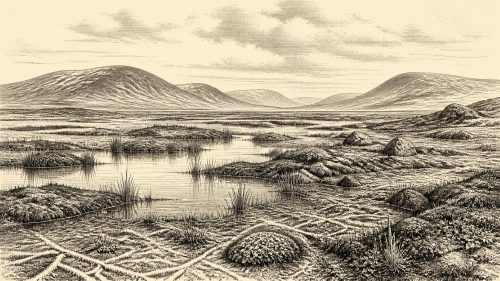
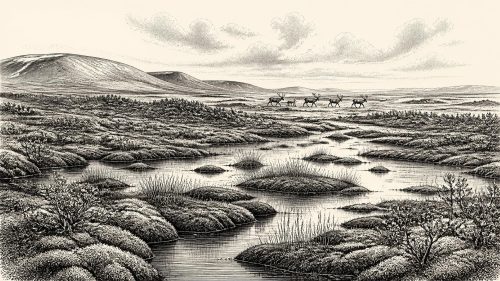
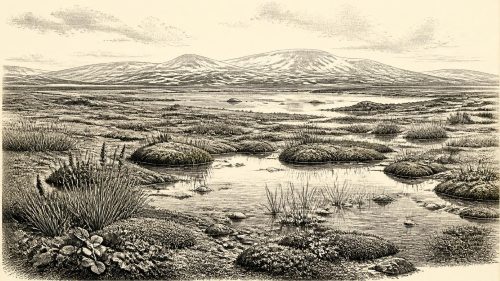
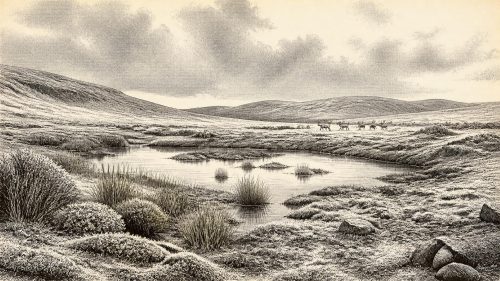
The closest important environmental sequence comes from Derryvree, near Maguiresbridge in County Fermanagh. Roadworks in 1969 exposed organic silts and fine sands caught between two separate sheets of till within a drumlin. The freshwater bed contained plant, pollen and insect evidence which the excavators interpreted as a treeless, cold wetland or muskeg, with mossy ground and open pools. Its conventional radiocarbon age, 30,500 years BP with a substantial error margin, calibrates broadly to about 36,900–31,700 cal BP in later discussion. The notional date considered here sits within that large range, but this does not mean that Derryvree records conditions in 31,478 BCE itself. It is a regional archive spanning a wide and climatically variable interval.
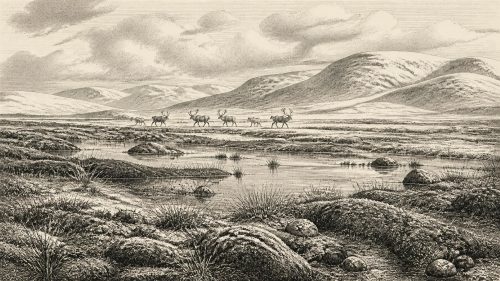
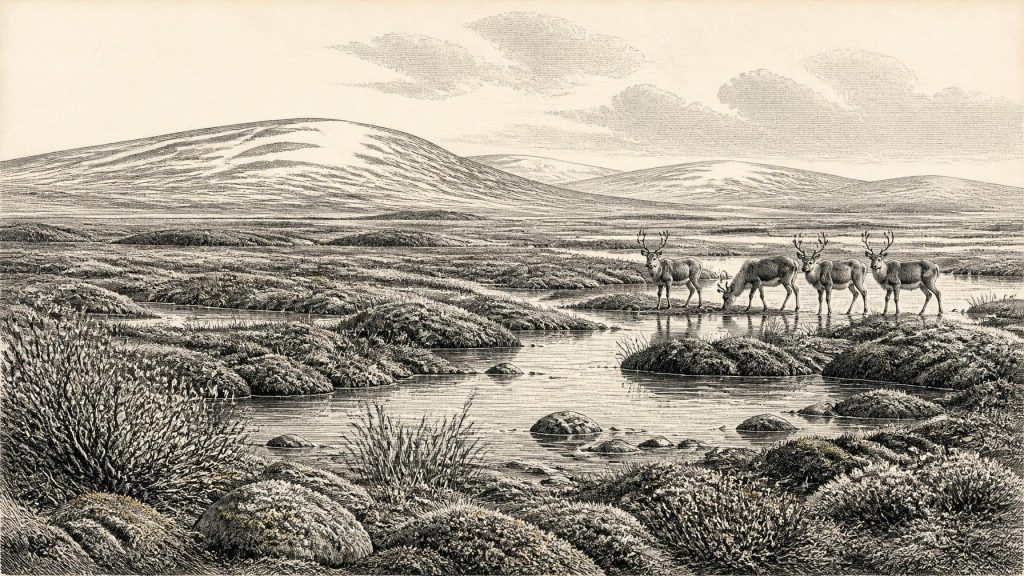
Nonetheless, Derryvree gives the most defensible picture of one kind of Irish terrain available around this broad horizon: open ground rather than forest, cold freshwater habitats rather than settled countryside, and vegetation adapted to short growing seasons and harsh winters. Fossil evidence has been associated with sedges, mosses, dwarf shrubs and tundra plants, including species whose modern distributions evoke arctic or alpine settings. Pools could support aquatic plants and insects even where the wider landscape was exposed to frost, wind and seasonal snow. This was not necessarily a uniform island-wide environment. Altitude, proximity to the Atlantic, local drainage and the shifting margins of ice all mattered.
Before the Great Expansion
This was not yet the Last Glacial Maximum, the later period when the British–Irish Ice Sheet attained far greater extent. Recent ice-sheet reconstructions model substantial growth from about 31,000 years ago, reaching maximum area around 26,000 years ago and maximum volume later still. At roughly 33,400 years before present, the exact outline of Irish ice remains uncertain. Evidence from Derryvree and Greenagho in Fermanagh has been read as showing ice-free conditions in north-central Ireland until at least about 34,000 years ago, while individual uplands and maritime sectors may have behaved differently. It would be unsafe to depict all Ireland either as an open refuge or as an ice-covered waste.
The prudent reconstruction is one of rapid environmental instability. Colder and relatively milder episodes punctuated MIS 3 across the North Atlantic world. At Crag Cave in County Kerry, episodes of speleothem growth show that liquid water periodically percolated through shallow cave systems during this broader glacial age. Such calcite growth is evidence for intervals when conditions locally rose above prolonged freezing, not for a mild Irish climate. The same research indicates that temperature changes between stadial and interstadial conditions could be very large. Ireland’s habitats were consequently liable to contract, expand and change character over timescales far beyond the resolution of a single BCE year.
Reindeer and Cave Faunas
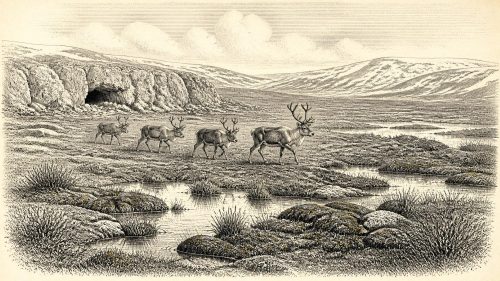
Southern Irish caves provide another essential record. Castlepook Cave near Doneraile, County Cork, long known as Mammoth Cave, yielded large collections during excavations conducted in the early twentieth century. Modern reassessment and radiocarbon dating have demonstrated that some of its animal remains are much older than once believed and belong to MIS 3. The pre-Last Glacial Maximum fauna documented from Irish cave collections includes reindeer, woolly mammoth, giant deer, horse, brown bear, spotted hyaena, Arctic fox, wolves, hares, stoats and lemmings. Not every species was necessarily present at Castlepook at the same time, and none can automatically be assigned to the precise date in this article. Together, however, they establish that Ireland was periodically part of a wider north-west European world of cold-adapted and open-country animals.
Reindeer are especially significant because they suited broad, sparsely wooded grazing landscapes and may have moved over extensive ranges. Mammoth and horse likewise point towards patches of productive herbaceous ground, rather than uninterrupted glacier or dense woodland. Carnivores complicate the picture. Caves can be dens, shelters and traps; hyaenas, bears and other animals may have carried or disturbed bones. A cave bone assemblage is therefore an accumulation shaped by predation, scavenging, water movement, collapse and excavation history, not a census of a living community. It illuminates ecological possibility, but it cannot map a neat food chain across all Ireland.
The Single Human Question
The most consequential possible evidence for people is also the narrowest. A reindeer femur from Castlepook has been publicly reported as dating to about 33,000 years ago and as bearing a deep mark interpreted by zooarchaeologist Ruth Carden as damage made with a sharp stone edge during carcass processing. If that interpretation is confirmed, the bone would be evidence that a person handled a reindeer in Ireland during the Upper Palaeolithic, far earlier than the long-established record of post-glacial settlement. It would be a major finding, but it should not be inflated into proof of an Irish population in 31,478 BCE.
The date obtained from bone establishes the age of the animal, while the identification of a cut mark is a separate specialist judgement. The old Castlepook excavations pre-date modern standards of stratigraphic recording, and the collection does not provide a securely associated hearth, stone-tool assemblage, dwelling floor, burial, art object or occupation surface. Renewed excavation has located surviving deposits and tested parts of the system, but has not yet produced published in-situ evidence sufficient to establish a Palaeolithic camp. The best conclusion is deliberately limited: a brief human visit or visits to Ireland during MIS 3 are plausible, and the marked femur may record one; permanent settlement, population size, route of arrival and continuity with later inhabitants remain unproven.
Movement Without Maps
Lower global sea levels altered the geography of north-west Europe, exposing areas now beneath the sea. Yet lowered sea level did not automatically create an easy continuous land bridge to Ireland. The Irish Sea basin, changing coastlines, rivers, wetlands and ice margins made the practical routes available to animals or people variable and uncertain. Reindeer and other mammals undeniably reached the island during favourable phases. For humans, a movement through changing coastal lowlands, crossings of water, or both remains possible; the evidence does not choose between them. Any claim for a fixed migration corridor at this date would go beyond the surviving record.
There is no evidence for trade in the ordinary historical sense. No securely dated artefact source, exchanged ornament, imported tool kit or repeated seasonal meeting-place demonstrates an Irish exchange network around this time. If people did reach Castlepook, they would have belonged to wider Upper Palaeolithic populations moving through north-west Europe and using highly portable knowledge: stone-working skills, carcass processing, clothing production and routes learned from landscapes and animals. That is an inference from contemporary continental archaeology, not a recovered description of Irish social life.
What Cannot Be Recovered
Political affairs, diplomacy and organised warfare are wholly beyond the evidence. There were no states, kings, borders or institutions that archaeology can identify in Ireland at this date. Nor is there evidence for a named language, religion, mythology, music, ritual place or system of formal learning. Absence of evidence is not proof that any people who visited had no beliefs, family ties or cultural practices; it means that no responsibly specific account can be made for Ireland. The same restraint applies to everyday life. Reindeer, caves and wetlands do not reveal a household, a meal, a hunting party’s size or a child’s experience.
What can be said is important enough. Around the notional date of 31,478 BCE, Ireland was an environmentally changeable Ice Age island or near-island landscape, not an empty backdrop before “real” history. Wetlands in Fermanagh preserved traces of cold-water life between glacial advances. Caves in Cork retained evidence of mammals adapted to open, severe conditions. A single marked reindeer bone raises the possibility of a human encounter, while insisting on further proof. The chief historical development was the unstable relationship between climate, ice, animals and access: a relationship that helped determine whether Ireland could briefly be visited, inhabited by fauna, or rendered inaccessible as the great ice expansion approached.
Source References
Hover over a number to see the source. Select it to open the source.

- [1] A Middle Midlandian Freshwater Series at Derryvree, Maguiresbridge, County Fermanagh, Northern Ireland
- [2] A Reconsideration of the Radiocarbon Dating of the Marine Isotope Stage 3 Fauna from Southern Ireland
- [3] The Irish Quaternary Fauna Project
- [4] Irish Quaternary Vertebrates
- [5] Episodic Speleothem Deposition Tracks the Terrestrial Impact of Millennial-Scale Last Glacial Climate Variability in SW Ireland
- [6] Growth and Retreat of the Last British–Irish Ice Sheet, 31,000 to 15,000 Years Ago: the BRITICE-CHRONO Reconstruction
- [7] Trimlines, Blockfields and the Vertical Extent of the Last Ice Sheet in Southern Ireland
- [8] The IntCal20 Northern Hemisphere Radiocarbon Age Calibration Curve (0–55 cal kBP)
- [9] The IntCal20 Approach to Radiocarbon Calibration Curve Construction: A New Methodology Using Bayesian Splines and Errors-in-Variables
- [10] A Marine Isotope Stage 4 Age for Pleistocene Raised Beach Deposits Near Fethard, Southern Ireland
- [11] Ireland: Submerged Prehistoric Sites and Landscapes
- [12] Figure 6.— The Subdivision of the Quaternary Period in Ireland
- [13] 2022:564 - Castlepook Cave, Castlepook South, Cork
- [14] Archaeology Research Excavation Grant 2022: Castlepook Cave, Co Cork
- [15] Heritage Artefacts of County Cork
- [16] The Glacial Stratigraphy of the Sperrin Mountains and Its Relation to the Glacial Stratigraphy of North-West Ireland
- [17] The Pre-Glacial Raised Beach of the South Coast of Ireland. With 9 Plates.
- [18] Composition and Consequences of the IntCal20 Radiocarbon Calibration Curve
- [19] IntCal
- [20] A North-Western Habitat: the Paleoethology and Colonisation of a European Peninsula
- [21] Ireland’s Palaeolithic Archaeology – Fleeting Footprints in a Frozen Land
- [22] Reindeer Bone Found in Cork Cave Shows Human Activity in Ireland 33,000 Years Ago
Primary Sources
- A Middle Midlandian Freshwater Series at Derryvree, Maguiresbridge, County Fermanagh, Northern Ireland
- A Reconsideration of the Radiocarbon Dating of the Marine Isotope Stage 3 Fauna from Southern Ireland
- The Irish Quaternary Fauna Project
- Irish Quaternary Vertebrates
- Episodic Speleothem Deposition Tracks the Terrestrial Impact of Millennial-Scale Last Glacial Climate Variability in SW Ireland
- Growth and Retreat of the Last British–Irish Ice Sheet, 31,000 to 15,000 Years Ago: the BRITICE-CHRONO Reconstruction
- Trimlines, Blockfields and the Vertical Extent of the Last Ice Sheet in Southern Ireland
- The IntCal20 Northern Hemisphere Radiocarbon Age Calibration Curve (0–55 cal kBP)
- The IntCal20 Approach to Radiocarbon Calibration Curve Construction: A New Methodology Using Bayesian Splines and Errors-in-Variables
- A Marine Isotope Stage 4 Age for Pleistocene Raised Beach Deposits Near Fethard, Southern Ireland
- Ireland: Submerged Prehistoric Sites and Landscapes
- Figure 6.— The Subdivision of the Quaternary Period in Ireland
- 2022:564 – Castlepook Cave, Castlepook South, Cork
- Archaeology Research Excavation Grant 2022: Castlepook Cave, Co Cork
- Heritage Artefacts of County Cork
- The Glacial Stratigraphy of the Sperrin Mountains and Its Relation to the Glacial Stratigraphy of North-West Ireland
- The Pre-Glacial Raised Beach of the South Coast of Ireland. With 9 Plates.
- Composition and Consequences of the IntCal20 Radiocarbon Calibration Curve
- IntCal
- A North-Western Habitat: the Paleoethology and Colonisation of a European Peninsula
- Ireland’s Palaeolithic Archaeology – Fleeting Footprints in a Frozen Land
- Reindeer Bone Found in Cork Cave Shows Human Activity in Ireland 33,000 Years Ago