
Derryvree’s BIRM-166 Waters31433 BCE
Labelled 31,433 BCE, this remote horizon cannot represent a recorded Irish year. During Marine Isotope Stage 3, Derryvree, County Fermanagh, contained freshwater sediments between glacial tills, indicating a locally ice-free, treeless tundra-wetland with cold-adapted plants and insects. Crag Cave records intermittent milder phases within an unstable glacial climate. Castlepook Cave’s MIS 3 fauna included mammoth, reindeer, giant deer, hyaena and wolf, although dates and associations remain uncertain. A marked reindeer femur may show Upper Palaeolithic butchery, but does not prove settlement. No evidence supports polities, permanent communities or cultural institutions. The evidence instead documents dynamic, locally habitable Ice Age environments.
Dateline
The label 31,433 BCE is a modern point on a backwards-counting calendar, not a year that anybody in prehistoric Ireland could have recorded or recognised. There was no writing, named polity or calendar on the island from which an event might be dated so precisely. In conventional calendar arithmetic it falls about 33,382 years before 1950, the reference point used for “before present” chronologies. That conversion is only a guide: it must not be confused with a radiocarbon measurement. For this remote period, responsible history is written in calibrated ranges, sediment layers, animal remains and probabilities, rather than in annual events.
The broad setting is the later part of the Last Glacial period, within Marine Isotope Stage 3. Ireland’s climate was neither a single unchanging winter nor a steady approach to the later glacial maximum. It altered sharply over millennia and sometimes more rapidly, as North Atlantic conditions fluctuated. The evidence nearest to this nominal date comes principally from Derryvree near Maguiresbridge, County Fermanagh, from Crag Cave in County Kerry, and from cave collections at Castlepook near Doneraile, County Cork. These are local archives with different strengths and limitations; together they illuminate an Irish landscape that was cold, dynamic and only patchily preserved in the archaeological record.
Evidence Between the Tills
Derryvree provides the clearest environmental window. Roadworks in 1969 cut through a drumlin and exposed freshwater silts and fine sands enclosed between two substantial sheets of till, debris laid down by moving ice. Organic material from the intervening deposit, laboratory sample Birm-166, returned a conventional radiocarbon age of 30,500 years BP, with a large uncertainty. Subsequent calibration has placed that material broadly between about 36,900 and 31,700 calibrated years BP. The nominal date of 31,433 BCE lies within that wide span, but neither the sample nor the calibration curve can identify conditions in that individual calendar year.
The sequence does establish something important. At some point during the formation of these sediments, the Derryvree locality was not beneath glacier ice. Freshwater accumulated, plants grew, insects lived and organic material entered the basin before a later ice advance sealed and reshaped the deposit. This is evidence for an ice-free interval in this part of Fermanagh, not a map of all Ireland. It cannot demonstrate that every coast, lowland and upland was open at once, nor can it settle the changing limits of ice elsewhere around the island. The later British–Irish Ice Sheet was highly regional and its advance and maximum extent were asynchronous across different sectors.
A Treeless Wetland Landscape
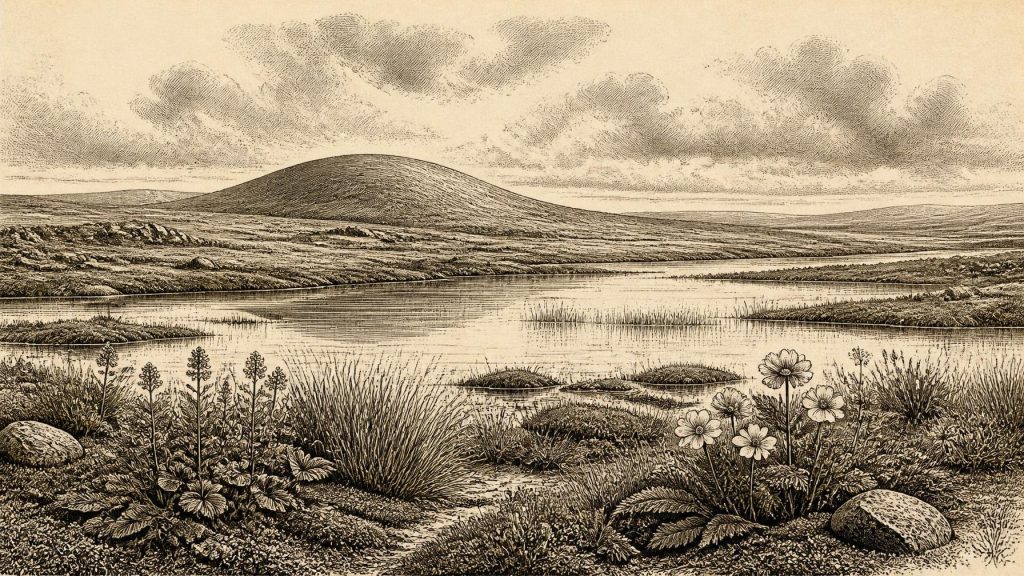
The fossils at Derryvree point to open tundra or muskeg-like ground under periglacial conditions: land affected by persistent cold and repeated freezing and thawing. The evidence includes herb-rich vegetation, mosses, sedges and aquatic or wet-ground plants. Fossil finds recorded from the deposit include mountain avens (Dryas octopetala), bogbean (Menyanthes trifoliata) and alternate water-milfoil (Myriophyllum alterniflorum). Such remains indicate that the locality was not a featureless waste of snow and bare rock. It contained shallow freshwater, wet margins and plant communities adapted to short growing seasons and cold soils.
Yet this was not the wooded Ireland familiar today. The Derryvree deposit supports an interpretation of largely treeless vegetation, with low plants and wet ground rather than continuous forest. Its ecological variety mattered. Pools, sedgy margins, mossy ground and drier exposed surfaces would each have offered different opportunities to insects, birds and mammals. The record nevertheless describes a particular basin and a time-averaged deposit. It cannot tell us the exact temperature of a summer at 31,433 BCE, the depth of winter snow, or whether plant cover looked identical a few kilometres away. The most precise conclusion is that biologically active, cold-stage terrain existed in this part of Ireland during a broad interval overlapping the date in question.
Crag Cave, in south-west Ireland, provides a complementary climatic indication. Uranium-series dates on cave calcite show that speleothems formed episodically during Marine Isotope Stage 3. Because calcite deposition in this shallow cave required liquid water, those episodes are interpreted as relatively milder phases within an overall cold age. The researchers correlate them, within chronological uncertainties, with Greenland interstadials. This does not date a Derryvree plant or prove a particular climate at Castlepook, but it strengthens the wider picture of an Atlantic-margin Ireland responding to repeated climatic shifts rather than enduring one uniform glacial regime.
Animals and Caves
In southern Ireland, Castlepook Cave—also called Mammoth Cave—near Doneraile is the principal pre-Last Glacial Maximum animal archive. Its collections were largely recovered in early twentieth-century excavations, so their original positions and associations are not always known to modern standards. Even so, the cave is exceptionally important. Re-dating and reassessment show that its fauna belongs across a long span of Marine Isotope Stage 3 rather than to one moment. The wider record includes large herbivores and carnivores associated with cold, open-country environments, among them mammoth, reindeer, giant deer, spotted hyaena and wolf. It demonstrates that Irish landscapes could support, or at least be reached by, substantial mammal communities before later ice expansion.
Those animals should not be assembled into an imaginary herd for 31,433 BCE. A cave bone dates an animal, not a whole landscape; individual species may have arrived, disappeared and returned at different times. Improved collagen pretreatment has also shown that several older Irish bone dates require revision. In Castlepook’s case, newly obtained results were thousands of radiocarbon years older than some earlier determinations, and the reassessment suggests that giant deer and spotted hyaena may have been locally lost before the Last Glacial Maximum, around 40,000 calibrated years BP. The changing chronology is a reminder that this field advances through re-examination rather than through fixed textbook certainties.
The Reindeer Femur Question
One Castlepook object gives this period an unusual human significance: a reindeer femur bearing a deep mark interpreted by zooarchaeologist Ruth Carden as damage from a sharp stone tool during butchery. County Cork’s heritage publication assigns the bone approximately to 31,000 BC. If the identification of the mark and its relationship to the bone’s age are sustained, it would be evidence that people handled a reindeer carcass in Ireland during the Upper Palaeolithic, far earlier than the long-established terminal-Pleistocene evidence from County Clare. The find is important precisely because it potentially brings human action into an otherwise predominantly environmental record.
Its meaning must remain carefully limited. The radiocarbon result dates the animal’s death, not a named hunt or the precise instant of cutting. The femur came from an old, complex cave collection, without a securely associated stone-tool assemblage, hearth, habitation surface, human remains or cluster of butchery waste. Nor need the cave have been the place where the animal was killed or processed: carnivores, water movement and earlier excavation all affected the formation of cave collections. The responsible interpretation is therefore possible, perhaps brief, human activity—not demonstrated settlement, a resident population or continuous occupation of Ireland. Renewed excavation at Castlepook has sought better-contextualised evidence, but modern material and disturbance encountered there underline the difficulty of recovering an undisturbed Palaeolithic story.
No Polities, No Proven Culture
Political affairs, diplomacy and organised conflict cannot be reconstructed for Ireland around this date. There are no names, territories, leaders, monuments, weapons caches, language records or ritual deposits from which to infer them. Equally, there is no evidence for Irish trade networks, permanent villages, farming, herding, pottery, metalworking or formal learning. It would be misleading to invent an Ice Age tribe, give it a religion or assign it a later ethnic identity. The absence of such evidence does not prove that no people ever crossed these western margins of north-west Europe; it establishes that archaeology has not yet demonstrated a sustained community and its institutions.
If the marked femur represents human work, comparison with well-attested Upper Palaeolithic societies elsewhere suggests only broad possibilities: small mobile parties, skilful use of stone edges, close knowledge of animal bodies and an ability to operate in severe seasonal landscapes. These are comparative inferences, not facts demonstrated in Ireland. Nor does lower Ice Age sea level itself reveal the route taken by any visitor. Evidence for a crossing, whether by land, ice, watercraft or some combination of changing coastal environments, is absent at this date. The later archaeological debate over Ireland’s colonisation makes clear how difficult it is to turn ecological possibility into proof of human arrival.
A Date Defined by Restraint
The chief development represented by 31,433 BCE is therefore not an event but a recoverable environmental horizon. Derryvree shows an ice-free freshwater setting enclosed between glacial advances, with treeless tundra vegetation and cold-adapted wetland life. Crag Cave records intermittent amelioration within a volatile glacial climate. Castlepook confirms an older Irish fauna of large mammals and carnivores, while one reindeer femur raises the possibility of human butchery. These evidence types overlap imperfectly in time and space; they should be combined to frame questions, not forced into a single scene.
For Ireland, this is deep history at its most demanding. The modern year label is useful for organising an archive, but it cannot bear the weight of a year-by-year narrative in the usual sense. What can responsibly be said is substantial: parts of Ireland supported cold, open and locally wet environments during Marine Isotope Stage 3; animals moved through those environments; and a contested but serious find may indicate a fleeting human encounter with one reindeer. Future dating, cave excavation and study of old museum collections may clarify that encounter. Until then, Derryvree’s buried waters remain the firmer witness to Ireland around this distant point in time.
Primary Sources
- A Middle Midlandian Freshwater Series at Derryvree, Maguiresbridge, County Fermanagh, Northern Ireland
- A Reconsideration of the Radiocarbon Dating of the Marine Isotope Stage 3 Fauna from Southern Ireland
- The Irish Quaternary Fauna Project
- Episodic Speleothem Deposition Tracks the Terrestrial Impact of Millennial-Scale Last Glacial Climate Variability in SW Ireland
- Figure 6.— The Subdivision of the Quaternary Period in Ireland
- Growth and Retreat of the Last British–Irish Ice Sheet, 31 000 to 15 000 Years Ago: The BRITICE-CHRONO Reconstruction
- Maximum Extent and Dynamic Behaviour of the Last British–Irish Ice Sheet West of Ireland
- Late Pleistocene Chronostratigraphy and Ice Sheet Limits, Southern Ireland
- The Colonization of Ireland: A Human Ecology Perspective
- First Evidence of a Late Upper Palaeolithic Human Presence in Ireland
- New Insights on the Fauna of Ireland’s Younger Dryas and Early Holocene from Alice & Gwendoline Cave
- Phylogeographic, Ancient DNA, Fossil and Morphometric Analyses Reveal Ancient and Modern Introductions of a Large Mammal: The Complex Case of Red Deer (Cervus elaphus) in Ireland
- The IntCal20 Northern Hemisphere Radiocarbon Age Calibration Curve (0–55 cal kBP)
- A 60,000 Year Greenland Stratigraphic Ice Core Chronology
- AMS Radiocarbon Dating of Middle and Upper Palaeolithic Bone in the British Isles: Improved Reliability Using Ultrafiltration
- Heritage Artefacts of County Cork
- 2022:564 — Castlepook Cave, Castlepook South, Cork
- Spotted Hyena Skull
- Prehistoric Details
- Dryas octopetala
- Menyanthes trifoliata
- Myriophyllum alterniflorum