Greenagho Silts31401 BCE
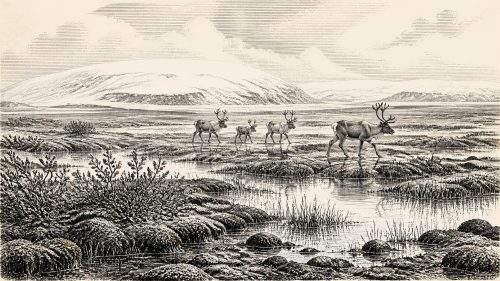
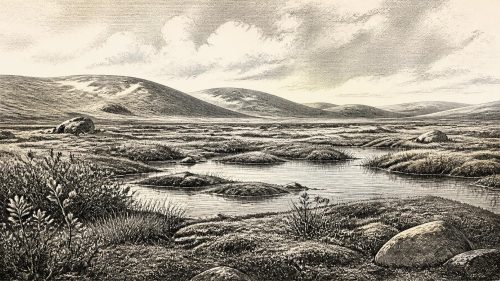
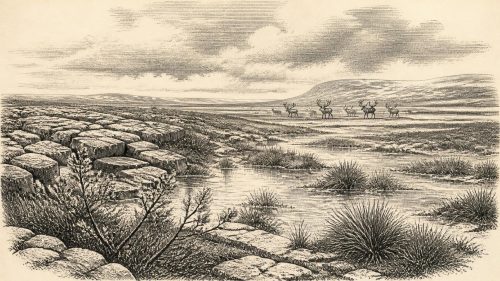
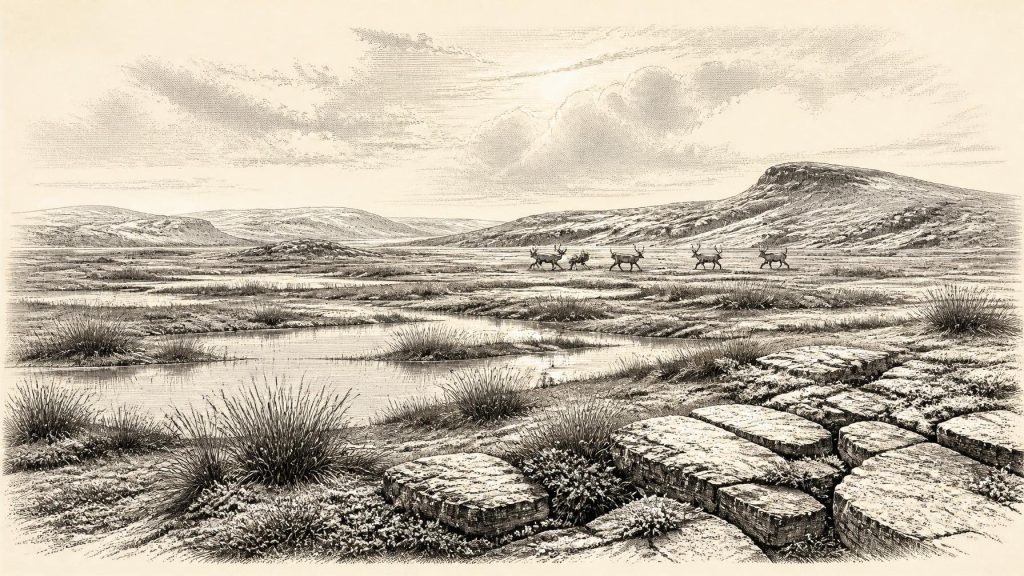
Around 31,401 BCE, Ireland was in the climatically volatile later Pleistocene, before maximum expansion of the British–Irish Ice Sheet. Evidence from Crag Cave indicates intermittent thawing in south-west Ireland, while sub-till deposits at Derryvree and Greenagho record ice-free freshwater tundra, with sedges, mosses and arctic-alpine plants. Castlepook Cave preserves a diverse MIS 3 fauna, including mammoth, reindeer, giant deer, predators and spotted hyena, demonstrating productive open habitats. A cut-marked reindeer femur may indicate brief Upper Palaeolithic human activity, but cannot establish settlement. No polities, agriculture or recorded beliefs existed; surviving evidence instead reveals changing environments and severe archaeological uncertainty overall.
Dateline
Modern calendar-year precision is not available for Ireland in 31,401 BCE. No written calendar, settlement sequence or historical event can be assigned to that single year. The date is best treated as a conventional point within the later part of the Pleistocene, broadly Marine Isotope Stage 3 (MIS 3), about 33,350 years before 1950. Evidence is dated in ranges, not individual years, and the responsible history of this moment is therefore a reconstruction from cave bones, glacial sediments, plant remains and cave mineral deposits. It is a history of environments that could intermittently sustain life, not of named rulers, nations or recorded events.
A Cold Stage, Not One Frozen Scene
Ireland lay within the Midlandian cold stage, the Irish expression of the last glacial cycle. That does not mean the whole island was permanently entombed beneath a uniform ice sheet. MIS 3 was climatically unstable: relatively milder interstadial episodes alternated with more severe stadials over millennia and sometimes much shorter spans. At Crag Cave near Castleisland, County Kerry, uranium-thorium dates show that stalagmites formed episodically during the last glacial. Because calcite growth in this shallow cave required infiltrating liquid water, these deposits provide strong evidence that conditions in south-west Ireland periodically rose above persistent freezing. Their pauses, in contrast, mark colder intervals when permafrost or prolonged freezing interrupted the water and soil processes on which cave calcite depended.
The exact weather, season or extent of ice in 31,401 BCE cannot be recovered. Nor should a dated layer be mistaken for a photograph of every part of Ireland at once. Yet the broad evidence places the date during a long transition before the fullest expansion of the last British–Irish Ice Sheet. A major modern reconstruction models steady ice-sheet growth across Ireland and Britain from about 31,000 to 26,000 years ago, with maximum ice volume later, around 23,000 years ago. Local conditions therefore probably varied sharply by region, altitude and decade: ice, bare sediment, frost-shattered ground, wetlands and open vegetation could exist in different combinations across the island.
Derryvree’s Buried Freshwater
The closest securely relevant Irish environmental archive is at Derryvree, near Maguiresbridge in County Fermanagh. Road works there exposed organic silts and fine sands trapped between two substantial sheets of glacial till. The deposit produced a conventional radiocarbon determination of 30,500 +1,170/−1,030 radiocarbon years BP. Published calibrations place its broad age range at roughly 36,900–31,700 calendar years BP, a range that includes the conventional equivalent of 31,401 BCE. Its importance is not that it names this year, but that it demonstrates an ice-free freshwater environment in north-central Ireland before later ice overran and sealed it.
Fossil pollen, seeds, insect remains and mosses from Derryvree point to open tundra or muskeg: a wet, cold landscape with sedges, mosses and low herbaceous plants, rather than a closed forest. The assemblage includes plants associated with arctic or alpine conditions, such as mountain avens, dwarf willow and bogbean. Some pollen grains may have travelled far on the wind, so isolated occurrences cannot be used to conjure woodland nearby. The stronger conclusion is modest but vivid: shallow water, saturated ground and sparse plant cover existed in at least one Fermanagh basin during a cold interval. A comparable sub-till freshwater deposit at Greenagho, near Belcoo, has also been dated broadly to the middle part of the last glacial, reinforcing the picture of changing, locally habitable terrain before the later ice advance.
Animals at Castlepook
In north County Cork, Castlepook Cave, also called Mammoth Cave, preserves Ireland’s best-known pre-Last Glacial Maximum animal assemblage. Antiquarian excavations between 1904 and 1908 recovered bones from a complicated cave archive later entrusted to the National Museum of Ireland. Subsequent study and improved radiocarbon methods have shown that important parts of the fauna are substantially older than early dating suggested. Castlepook has produced remains attributed to woolly mammoth, giant deer, reindeer, brown bear, wolf, Arctic fox, mountain hare and spotted hyena. The cave is especially important for the latter: the National Museum identifies it as Ireland’s principal site for cold-stage spotted-hyena remains.
These finds demonstrate that, at intervals during MIS 3, Ireland supported a far richer large-mammal community than its later and modern fauna might suggest. They do not prove that every listed species stood together in one herd or belonged to precisely 31,401 BCE. Cave deposits can accumulate through carnivore activity, natural death, water movement and disturbance by early excavators. The animal record is consequently a time-transgressive archive. Still, the presence of grazers and browsers alongside predators indicates open landscapes with enough plant production and prey to sustain food chains. A hyena skull and gnawed bones are also reminders that caves were not neutral storehouses: they could be dens, scavenging sites and traps into which bones were carried from elsewhere.
The Reindeer Femur and Human Possibility
One Castlepook object gives this distant date exceptional archaeological interest: a reindeer femur bearing a deep linear mark interpreted by zooarchaeologist Ruth Carden as damage made with a sharp stone tool while the bone was fresh. County Cork heritage material presents the specimen as c. 31,000 BCE. If that interpretation and approximate association are sustained, it is possible evidence that Upper Palaeolithic people butchered a reindeer in Ireland during the wider period represented by this article.
That possibility must not be enlarged into a settled Palaeolithic Ireland. The bone is not accompanied by a securely stratified hearth, dwelling floor, tool assemblage, human burial, repeated butchery area or other excavated evidence of a camp. Its radiocarbon age dates the death of the reindeer, not an independently dated moment when the incision was made. Nor can the bone establish where the animal was killed: a discarded limb could have been moved before reaching the cave, perhaps by scavengers. The most that can responsibly be said is that the femur is a serious, potentially transformative clue to a brief human encounter with an animal, not proof of a permanent population.
If people did reach Ireland at this time, the best comparison is with small, mobile Upper Palaeolithic groups in north-west Europe, whose survival depended on detailed knowledge of animal movements, raw materials and seasonal terrain. Even that is an inference from neighbouring regions, not a description of an Irish household. No Irish flint toolkit of this age has yet been recovered, and no evidence identifies language, kinship, clothing, shelters or the size of any visiting party. The landscape may have been accessible at some periods through lowered sea levels and changing coastal shelves, but the routes used by animals or people remain uncertain. There is no basis for claiming regular travel, exchange networks or trade across the Irish Sea.
No Polities, No Recorded Beliefs
Political affairs, diplomacy and warfare leave no identifiable evidence in Ireland at this depth of time. There were no documented kingdoms, borders, leaders, treaties or institutions. Likewise, the archaeological record offers no securely dated shrine, grave, image, musical instrument or ceremonial deposit for 31,401 BCE. It would be misleading to assign later Irish traditions, monuments or religious ideas to these conditions. Culture and learning, if humans were present at all, were embodied in practical knowledge: reading weather, finding water, recognising animal behaviour and making stone tools. But this remains a general human possibility, not an observable Irish tradition.
The economy was ecological rather than agricultural. There was no farming, herding, cereal cultivation, metalworking or settled market economy. The plant and animal evidence instead speaks to naturally occurring resources: grazing lands for herbivores, freshwater margins, carrion and predators. A reindeer carcass, were the Castlepook mark confirmed as human-made, would imply meat, marrow, hide and possibly sinew as valuable materials. Yet one marked bone cannot reveal a diet, a hunting strategy or a season of use. It is evidence of an action, not an economy in full.
An Island of Fragmentary Windows
The strongest theme for Ireland around 31,401 BCE is regional change. Fermanagh’s buried wetland, Kerry’s intermittently growing cave calcite and Cork’s cave fauna each record different facets of a cold, variable island on the approach to major glaciation. Their survival is itself accidental. Later ice eroded much of the land surface, while nineteenth- and early twentieth-century cave excavations often removed or mixed deposits before modern recording standards existed. Re-dating museum collections, reassessing cut marks and testing old assumptions are therefore as important as new excavation.
For this year, certainty lies not in a human chronicle but in that methodological lesson. Ireland was neither timeless wilderness nor a stage for invented Ice Age tribes. It was a changing Pleistocene environment, intermittently capable of supporting wetlands, cold-adapted animals and perhaps rare human visitors. The evidence is compelling precisely because it is limited: it asks us to recognise the real depth of Ireland’s past without pretending that a single numbered year can supply a story it has not preserved.
Source References
Hover over a number to see the source. Select it to open the source.

- [1] A Middle Midlandian Freshwater Series at Derryvree, Maguiresbridge, County Fermanagh, Northern Ireland
- [2] Middle Midlandian Interstadial Deposits at Greenagho, Near Belcoo, County Fermanagh, Northern Ireland
- [3] The Irish Quaternary Fauna Project
- [4] A Reconsideration of the Radiocarbon Dating of the Marine Isotope Stage 3 Fauna from Southern Ireland
- [5] Trimlines, Blockfields and the Vertical Extent of the Last Ice Sheet in Southern Ireland
- [6] Growth and Retreat of the Last British–Irish Ice Sheet, 31,000 to 15,000 Years Ago: the BRITICE-CHRONO Reconstruction
- [7] Episodic Speleothem Deposition Tracks the Terrestrial Impact of Millennial-Scale Last Glacial Climate Variability in SW Ireland
- [8] Maximum Extent and Dynamic Behaviour of the Last British–Irish Ice Sheet West of Ireland
- [9] New Data for the Last Glacial Maximum in Great Britain and Ireland
- [10] New Insights on the Fauna of Ireland’s Younger Dryas and Early Holocene from Alice & Gwendoline Cave
- [11] The IntCal20 Northern Hemisphere Radiocarbon Age Calibration Curve (0–55 cal kBP)
- [12] Spatio-Temporal Dynamics of Speleothem Growth and Glaciation in the British Isles
- [13] Exploring Controls of the Early and Stepped Deglaciation on the Western Margin of the British-Irish Ice Sheet
- [14] Palaeoecology: The Middle Midlandian Palaeoenvironment of South Fermanagh
- [15] Spotted Hyena Skull
- [16] Heritage Artefacts of County Cork
- [17] Growth and Retreat of the Last British–Irish Ice Sheet, 31,000 to 15,000 Years Ago: the BRITICE-CHRONO Reconstruction
- [18] The Mesolithic in Ireland: When Was It?
- [19] Occurrence of Mammalia Relicts at Site Castlepook Cave
- [20] Proceedings of the Royal Irish Academy: Cave Exploration Reports Including Castlepook Cave
Primary Sources
- A Middle Midlandian Freshwater Series at Derryvree, Maguiresbridge, County Fermanagh, Northern Ireland
- Middle Midlandian Interstadial Deposits at Greenagho, Near Belcoo, County Fermanagh, Northern Ireland
- The Irish Quaternary Fauna Project
- A Reconsideration of the Radiocarbon Dating of the Marine Isotope Stage 3 Fauna from Southern Ireland
- Trimlines, Blockfields and the Vertical Extent of the Last Ice Sheet in Southern Ireland
- Growth and Retreat of the Last British–Irish Ice Sheet, 31,000 to 15,000 Years Ago: the BRITICE-CHRONO Reconstruction
- Episodic Speleothem Deposition Tracks the Terrestrial Impact of Millennial-Scale Last Glacial Climate Variability in SW Ireland
- Maximum Extent and Dynamic Behaviour of the Last British–Irish Ice Sheet West of Ireland
- New Data for the Last Glacial Maximum in Great Britain and Ireland
- New Insights on the Fauna of Ireland’s Younger Dryas and Early Holocene from Alice & Gwendoline Cave
- The IntCal20 Northern Hemisphere Radiocarbon Age Calibration Curve (0–55 cal kBP)
- Spatio-Temporal Dynamics of Speleothem Growth and Glaciation in the British Isles
- Exploring Controls of the Early and Stepped Deglaciation on the Western Margin of the British-Irish Ice Sheet
- Palaeoecology: The Middle Midlandian Palaeoenvironment of South Fermanagh
- Spotted Hyena Skull
- Heritage Artefacts of County Cork
- Growth and Retreat of the Last British–Irish Ice Sheet, 31,000 to 15,000 Years Ago: the BRITICE-CHRONO Reconstruction
- The Mesolithic in Ireland: When Was It?
- Occurrence of Mammalia Relicts at Site Castlepook Cave
- Proceedings of the Royal Irish Academy: Cave Exploration Reports Including Castlepook Cave