Castlepook’s Hyaena Range31359 BCE
At c. 33.3 ka cal BP, Ireland experienced unstable MIS 3 cold-stage environment rather than a datable year. Derryvree, County Fermanagh, preserves organic wetland sediments between tills, showing ice-free intervals with open, treeless tundra vegetation, freshwater pools and periglacial conditions. Castlepook Cave, County Cork, yielded mammoth, reindeer, giant deer, hyaena and other fauna, demonstrating intermittent ecological links with north-west Europe, though deposits span time and are biased. Revised dating places some fauna earlier than believed. A marked reindeer bone may indicate human butchery around 33,000 years ago but cannot prove settlement. Evidence supports changing landscapes, animals and possible human visits.

Dateline
Modern calendar precision cannot be projected into Ireland’s Ice Age. “31,359 BCE” is a useful filing label, not a date that can be matched to a witnessed event, a ruler, a settlement or even a single season. Measured from the conventional radiocarbon reference year of AD 1950, it lies about 33,308 calendar years before present, or c. 33.3 ka cal BP. The evidence relevant to this point belongs broadly to Marine Isotope Stage 3, a long and climatically unstable part of the last glacial cycle. Dates from this depth of time carry wide uncertainties, and Irish deposits do not provide an annual sequence. The responsible account, therefore, is of a changing cold-stage landscape rather than a diary of a particular year.
A Cold Interval, Not a Frozen Island
Ireland was not simply either ice-covered or ice-free throughout this period. Its glacial history involved advances, retreats and locally different conditions. The great maximum expansion of the last British–Irish Ice Sheet came later, broadly after c. 26 ka BP, but earlier ice had already reshaped much of the country and further advances lay ahead. Sediments, landforms and offshore records show that ice margins and climates were dynamic. For the date represented here, it is safest to say that at least some Irish ground could be free of glacier ice, while conditions remained rigorously cold and vulnerable to abrupt change. An apparently hospitable valley, wet hollow or limestone cave could exist within a wider world of severe winters, frozen ground and advancing ice.
The most informative terrestrial record is at Derryvree near Maguiresbridge, County Fermanagh. A road cutting exposed freshwater silts and fine sands trapped between two distinct sheets of till: deposits left by ice. The lower till records an earlier glacial episode; the organic layer records an intervening ice-free environment; the upper till demonstrates that ice later returned to, or expanded over, the place. This sequence is an unusually clear reminder that the Irish landscape had a history before the final sweeping glaciation, even where later ice altered or buried much of the earlier evidence.
Derryvree’s Wet Ground
The Derryvree organic deposits produced the conventional radiocarbon measurement Birm-166, 30,500 radiocarbon years BP, with a large uncertainty of +1,170/−1,030 years. Calibration and modelling place the deposit broadly in the middle part of MIS 3; one published synthesis gives approximately 35.9 ± 1.1 thousand calibrated years BP, while other treatments express an overlapping broad range rather than a single point. That range is more useful than an artificial conversion to one BCE year. It makes Derryvree directly relevant to the environmental world of c. 33.3 ka cal BP, but does not prove that its sediments formed in 31,359 BCE itself.
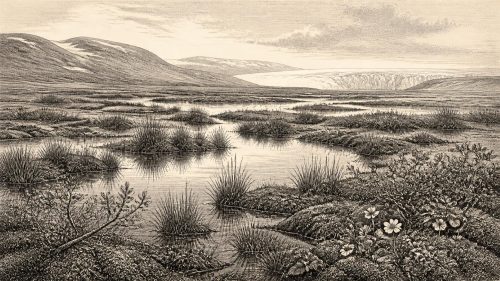
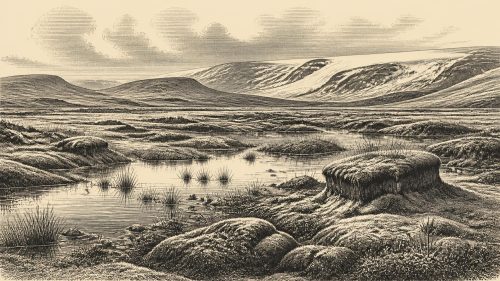
What do the silts preserve? Pollen, plant macrofossils, mosses and insects indicate open, treeless vegetation and a periglacial climate. Grasses and sedges were important, with juniper and cold-adapted herbs. Finds include bogbean, mountain avens and lesser clubmoss: species consistent with damp, open ground, mineral-rich pools and short growing seasons. The evidence points not to an empty white desert but to a low, varied tundra or muskeg landscape: mossy wetland, sedge cover, shallow pools, exposed sediment and patches of sparse vegetation. Such ground would have changed markedly with drainage, snow cover and season.
This was a productive environment in its own limited way. Aquatic plants and insects imply standing or slow-moving freshwater, while the abundance of organic matter in wet hollows provided small but significant ecological refuges. In summer, daylight and brief warmth could support flowering plants, grazing animals and invertebrates; winter brought an entirely different regime. Yet palaeoenvironmental reconstruction should not be mistaken for a photograph. The fossils identify organisms accumulated over time at one locality. They support an interpretation of an open periglacial wetland, not a claim that every part of Ireland looked identical or that the weather in any named month can be recovered.
Castlepook and the Faunal Evidence
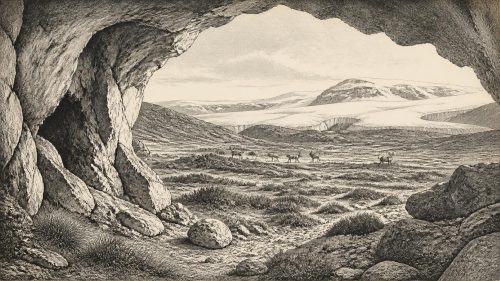
County Cork supplies the other major strand of evidence. Castlepook Cave, near Doneraile in the Awbeg valley, has yielded Ireland’s richest known assemblage of pre-Last Glacial Maximum vertebrate remains. Material recovered principally in early twentieth-century excavations includes woolly mammoth, reindeer, giant deer, brown bear, wolf, fox, Arctic fox, mountain hare, collared and Norwegian lemmings, and spotted hyaena. In combination, these animals demonstrate that cold-stage Ireland was intermittently connected ecologically to north-western Europe. They do not establish that every species lived together at the cave on the same day. Cave deposits accumulated through time and were disturbed by excavation, carnivore activity and natural movement of sediment.
Spotted hyaena is especially revealing. Modern associations can mislead: the Ice Age spotted hyaena was a widespread European large carnivore, not evidence for an African-type climate in Cork. At Castlepook, hyaenas may have used the cave or its passages as a den and could have carried bones inside, chewed carcasses or altered the assemblage. Their presence, alongside mammoth and reindeer, evokes an open large-mammal landscape in which carcasses and shelter sites were contested resources. Wolves, foxes and bears added further ecological complexity. But the cave was not an unbiased census of local wildlife. It is a concentrated archive shaped by the behaviours of scavengers, predators, water and people who excavated it thousands of years later.
Recent re-dating has fundamentally changed the chronology. Improved pretreatment of bone collagen showed that several older radiocarbon results from Castlepook were too young, moving elements of the fauna much further back into MIS 3. The revised study indicates that some species, notably giant deer and spotted hyaena, may have vanished locally before the Last Glacial Maximum, around 40 ka cal BP. Thus Castlepook’s fauna demonstrates occupation or passage through Ireland during a broad cold-stage interval, but the safest wording for c. 33.3 ka cal BP is conditional: reindeer and other cold-adapted mammals were demonstrably part of the relevant Irish ecological record, while the exact overlap of every specimen, species and locality remains unresolved.
The Human Question
A reindeer femur from Castlepook has made this period important to Irish archaeology as well as palaeontology. It has been reported as roughly 33,000 years old and bears a deep linear modification interpreted by zooarchaeologist Ruth Carden as a cut or chopping mark made by a sharp stone tool during the processing of fresh bone. If that interpretation is confirmed, it is evidence that Upper Palaeolithic people reached Ireland far earlier than the long-accepted post-glacial colonisation. It would be a brief trace of human action: the handling and butchery of one animal, perhaps by a small mobile party.
That conclusion requires restraint. The femur derives from an old cave collection, rather than from a modern excavation of an intact floor with securely associated artefacts. No indisputable stone-tool assemblage, hearth, dwelling, burial, repeated occupation surface or human remains of this age has been recovered in Ireland. Nor does one marked bone demonstrate a permanent population, a migration of families, or a continuous Irish Palaeolithic tradition. The mark is significant precisely because the remainder of the evidence is so slight. Ongoing work at Castlepook aims to identify undisturbed fossil-bearing deposits and to seek direct, in-situ evidence capable of testing the proposition more firmly.
Society Beyond the Evidence
No political history can responsibly be written for Ireland at this date. There were no recorded polities, named communities, frontiers, diplomatic encounters or institutions. There is likewise no evidence for organised warfare, territorial rule, formal religion, monuments, art or learning within Ireland. It would be wrong to turn the possible reindeer butchers into a people with a language, ethnicity or belief system merely because comparable Upper Palaeolithic groups existed elsewhere in Europe.
Comparison with those neighbouring groups can, however, frame a limited interpretation. If people did visit, they would almost certainly have depended on portable knowledge: the making and maintenance of stone tools, the reading of animal movements, the sharing of food, and decisions about shelter and travel in dangerous conditions. Reindeer, mammoth and giant deer could offer meat, fat, hide, sinew, bone and antler, but none of these uses is directly demonstrated at Castlepook beyond the contested implication of carcass processing. Any visit may have been seasonal and short-lived. Water levels were much lower than today during glacial phases, changing coastlines and the geography of sea crossings, but an accessible landscape was not necessarily an easy one.
An Island in Formation
Economy and trade, in the usual historical sense, cannot be identified. There is no evidence for farming, herding, pottery, metalworking, exchange networks or settled villages. The only defensible “economy” is ecological subsistence: wild animals exploiting grassland and wetland, carnivores following prey and carrion, and perhaps people opportunistically taking part in that system. Nor is there evidence for a permanent settlement anywhere in Ireland. Caves such as Castlepook are records of animal bone and geological processes, not proof of houses or communities.
The central development around this remote date was environmental possibility. Ireland contained, at least intermittently, ice-free habitats capable of sustaining tundra plants, freshwater life and sizeable mammals. It also stood within a shifting north-west European world in which ice, sea level, vegetation and animal ranges changed together. Derryvree preserves the quiet evidence of wet ground between ice advances; Castlepook preserves a more dramatic record of mammals and perhaps a human intervention. Together they overturn the notion of an entirely lifeless, uniformly ice-bound Ireland before the last glacial maximum. They do not, however, fill the silence with kings, tribes or calendar events. At 31,359 BCE, the history that can be told is one of sediments, bones, climate and a carefully bounded human possibility.
Primary Sources
- A Middle Midlandian Freshwater Series at Derryvree, Maguiresbridge, County Fermanagh, Northern Ireland
- A Reconsideration of the Radiocarbon Dating of the Marine Isotope Stage 3 Fauna from Southern Ireland
- New Insights on the Fauna of Ireland’s Younger Dryas and Early Holocene from Alice & Gwendoline Cave
- Exploring Controls of the Early and Stepped Deglaciation on the Western Margin of the British-Irish Ice Sheet
- Castlepook Cave: County Geological Site Report
- Figure 6.— The Subdivision of the Quaternary Period in Ireland
- Publications
- Quaternary Geological Map of Ireland 1:500,000 Scale
- Geological Mapping Programme
- Quaternary Sediments 1:50,000 Ireland (ROI) ITM
- Menyanthes trifoliata
- Dryas octopetala
- Selaginella selaginoides
- Spotted Hyena Skull
- Castlepook Cave Excavation, County Cork, 2022
- Heritage Artefacts of County Cork
- The Irish Quaternary Fauna Project
- Landscapes and Environments of the Last Glacial-Interglacial Transition: A Time of Amazingly Rapid Change in Ireland
- Reindeer Bone Found in Cork Cave Shows Human Activity in Ireland 33,000 Years Ago
- Ireland’s Palaeolithic Archaeology – Fleeting Footprints in a Frozen Land
- UCD School of Archaeology Research Day 2022