Doneraile’s Marked Reindeer31351 BCE
31,351 BCE is a modern label for a broad MIS 3 interval, not a recoverable Irish year. Castlepook Cave, County Cork, preserves Pleistocene fauna including reindeer, mammoth, giant deer, carnivores and cold-adapted species, indicating fluctuating open environments and repeated animal access. A roughly 33,000-year-old reindeer femur bears a possible fresh-bone stone-tool mark, potentially Ireland’s earliest human evidence. However, its historic collection context, uncertain modification and lack of associated tools or occupation deposits prevent claims of settlement or continuous habitation. Lower sea levels do not establish a land bridge. Recent investigations and redating emphasise mixed deposits, earlier dating errors, requiring analysis.
Dateline
31,351 BCE is a modern chronological label, not a year for which Ireland possesses calendar-level history. It falls roughly 33,300 calendar years before the radiocarbon convention of AD 1950, in the later part of the Late Pleistocene and broadly within Marine Isotope Stage 3 (MIS 3). At this depth of time, dates are expressed as laboratory ages and calibrated ranges spanning centuries or millennia, not as a particular season, day or event. The closest material evidence is a difficult cave archive in north County Cork. It illuminates an Ice Age landscape and an important archaeological question, but it cannot responsibly yield a narrative of what happened in Ireland in this exact numbered year.
That question centres on Castlepook Cave, near Doneraile. Its animal remains demonstrate that Ice Age mammals reached southern Ireland during parts of MIS 3. A reindeer femur in the historic collection has been reported as approximately 33,000 years old and bears a deep linear mark interpreted by its researcher as damage made by a sharp stone implement while the bone was fresh. If that interpretation is sustained, it may be Ireland’s earliest known evidence of human activity. It is not, however, proof of a settlement, a named hunting party, or a securely dated butchery episode in 31,351 BCE.
A Date Measured in Millennia
The appropriate chronological frame is not an Irish “year” in the ordinary historical sense, but a broad interval around the mid-30th millennium before present. MIS 3 was a long, climatically unstable part of the last glacial cycle, extending well beyond any one human lifetime or archaeological generation. Conditions across the North Atlantic world altered repeatedly between colder stadials and relatively milder interstadials. Ireland’s surviving evidence is too discontinuous to identify which precise climatic oscillation prevailed at Castlepook on a particular year, still less to map local snow cover, coastlines or ice margins with confidence.
The great expansion of the last British–Irish Ice Sheet lay ahead. The best-supported reconstruction places the principal Late Devensian or Late Midlandian ice-sheet growth and decay within roughly 31,000–15,000 years ago, while grounded ice reached the outer western shelf during the global Last Glacial Maximum at about 26,500–26,200 calibrated years BP. Those benchmarks matter because they show that a date around 33,300 years before AD 1950 belongs before the well-documented maximum extent of that later ice sheet. They do not demonstrate that all Ireland was ice-free at once, or that any particular valley was open country.
Modern Ireland’s familiar insular geography should not be projected uncritically into this period. Sea level was lower than today, but ice, changing shorelines and the complex topography of the Irish Sea governed possible routes between Ireland, Britain and continental Europe. Geological studies have warned against treating low sea level as automatic proof of a broad, enduring land bridge. How animals and any people reached Ireland around this time remains unresolved; seasonal movement, shifting coastal corridors and short sea crossings are all matters for evidence rather than assumption.
Castlepook’s Animal World
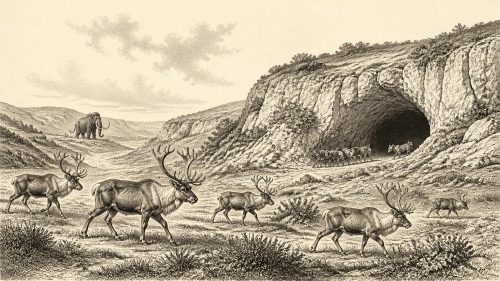
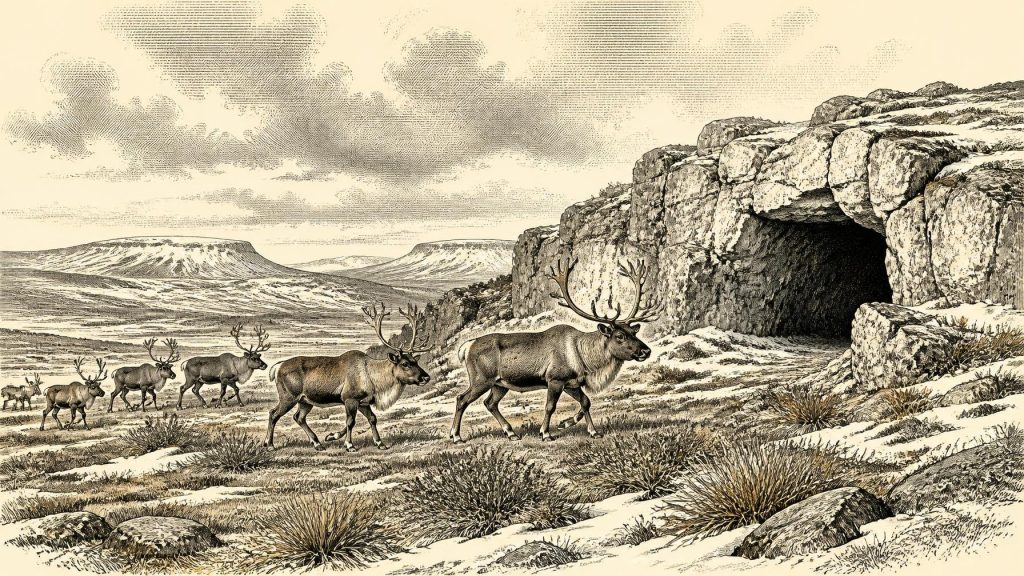
What is secure is that Castlepook preserves an unusually important concentration of Pleistocene bones. Older excavations, chiefly undertaken in the early twentieth century, recovered remains attributed to reindeer, woolly mammoth, giant deer, brown bear, wolf, foxes, hares, lemmings and spotted hyaena. Some of these creatures were cold-adapted; others signal that conditions and habitats changed over the lengthy period represented by the cave. Their presence should not be compressed into a single imagined herd browsing outside the entrance on one afternoon. The collections contain remains of differing ages, and cave deposits can be moved by scavengers, water, sediment collapse, frost action and later disturbance.
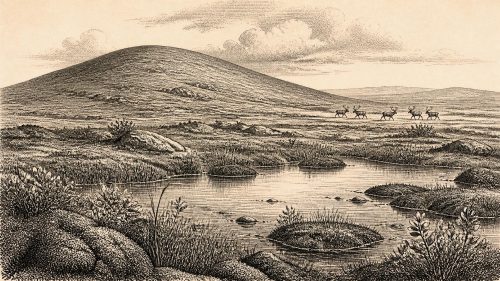
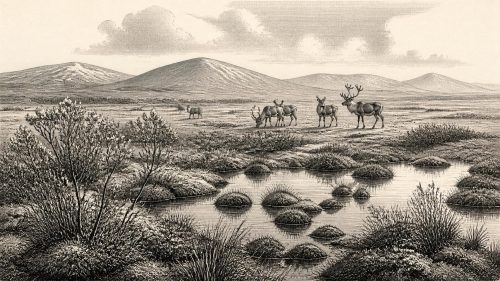
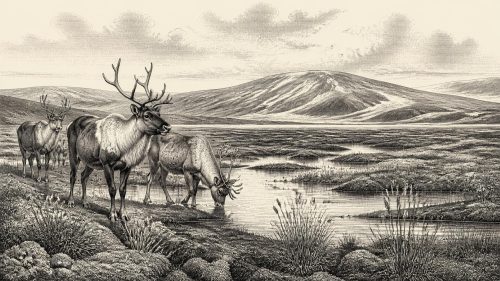
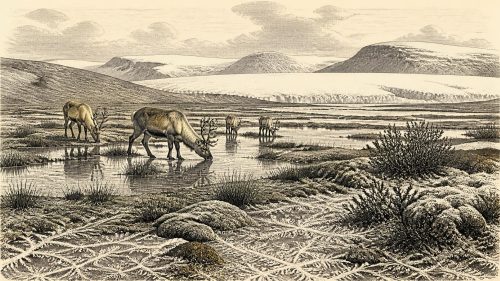
Nevertheless, the fauna provides a responsible outline of the wider environment. Reindeer, lemmings and arctic foxes fit a cold, largely open landscape with grass, herbs, low shrubs and patches of wet ground rather than later Holocene woodland. Mammoth and giant deer indicate that, at intervals, large herbivores found sufficient forage. Spotted hyaena, wolf and bear remind us that carcasses had several potential consumers and that caves could be used by animals as dens, refuges or accumulations of bone, not simply as places entered by people.
The most revealing lesson is one of ecological instability. The cave’s faunal assemblage is a time-averaged record: it shows repeated access to Ireland by animals across changing conditions, not a census of one intact ecosystem. Re-dating of southern Irish cave material with improved pretreatment has shown that several earlier determinations were thousands of radiocarbon years too young. The reassessment placed important fauna firmly in MIS 3 and suggested that giant deer and spotted hyaena may have disappeared locally before the Last Glacial Maximum, around 40,000 calibrated years BP. Scientific revision here is not a weakness; it is how a fragile archive becomes more reliable.
The Femur and the Human Question
The marked reindeer femur gives the period its exceptional archaeological interest. A sharp, deep incision on fresh bone can be consistent with cutting or chopping during carcass processing. In north-west Europe, Upper Palaeolithic hunter-gatherers certainly possessed stone tools and depended on knowledge of animal movement, seasonal conditions and edible resources. Were the Castlepook mark conclusively shown to be a stone-tool cut, it would be compatible with a brief human encounter with a reindeer carcass on the island.
But compatibility is not confirmation. The bone comes from an older collection rather than a modern excavation that recovered it in a sealed occupation layer alongside tools, hearths, butchered debris and a dwelling surface. A radiocarbon determination dates the death of the animal, not automatically the making of every alteration on its surface, the location of carcass processing, the identity of the agent or the length of any visit. Carnivore action, sediment abrasion, breakage and the limitations of historic excavation must all be assessed. The 2022 Castlepook project itself stressed that no stone or bone tool could yet be identified with certainty as evidence of a human Palaeolithic presence in Ireland.
The balanced conclusion is therefore deliberately modest. Ireland may have received one or more short-lived Upper Palaeolithic visits around this broad period; Castlepook’s femur is a serious lead, not an established settlement history. It cannot identify a population, language, kin group or migration route. Nor can it prove that people lived continuously in Ireland through the later advance of the ice sheet. Such claims would require independently dated artefacts and securely stratified occupation deposits.
Society Without Settlements
No political institutions, rulers, diplomatic arrangements or organised conflicts can be recovered for Ireland at this date. There are no written sources, graves, houses, enclosures, art assemblages or settlement plans securely attributable to a human community around 31,351 BCE. It would be misleading to manufacture a “tribe” or a chiefdom from a single contested bone modification. If people did reach Castlepook’s district, the scale of evidence presently favours a short, task-specific episode over a permanent village.
The same restraint applies to everyday life. There is no direct Irish evidence for clothing, fire-making, shelter construction, food-sharing practices or family organisation at this time. Inference from contemporary Upper Palaeolithic societies elsewhere in Europe can suggest the kinds of skills that a visiting group might have possessed—stone-working, hide processing, butchery and close ecological knowledge—but it cannot turn those possibilities into observed Irish facts. No religion or formal ritual is identifiable. The cave is archaeologically important because of its preserved fauna, not because it has supplied demonstrable Palaeolithic ceremony or symbolic art.
Economy, Movement and Exchange
There is likewise no evidence for farming, herding, metalwork, pottery, trade networks or exchange between communities in Ireland. Any human economy, if present, would have been based on wild resources. Yet even the phrase “reindeer hunting” goes beyond the evidence unless the Castlepook incision is verified as human-made: a person could have scavenged, butchered or transported part of an animal already dead, while hyaenas and wolves were also capable of modifying and dispersing bone.
Animal movement is better attested than human movement. Reindeer and other mammals reached or occupied parts of Ireland despite the severe, fluctuating climate. Their presence establishes ecological connections with the wider north-west European world, although it does not reveal the frequency of crossings or the exact configuration of land and water. The sparse record is also shaped by survival: caves and favourable sediments preserve bone far better than exposed landscapes later eroded or overridden by ice.
An Archive Still Being Tested
Recent work at Castlepook has begun to improve a collection created before modern excavation standards. A 2022 investigation used survey and excavation, recovered animal bone from several contexts and sought undisturbed Pleistocene deposits. Its initial samples included material of mixed ages, with tested charcoal proving modern or medieval rather than Palaeolithic—an instructive warning that a cave’s contents cannot be treated as one layer or one moment. Further dating, sediment analysis, zooarchaeology and microscopic study are essential before the reindeer femur can bear the weight of a revised national origin story.
For now, the importance of this point in deep time lies in the question it preserves. Around the broad interval represented by 31,351 BCE, Ireland was a cold and changing Pleistocene environment inhabited at intervals by large herbivores and carnivores. Castlepook offers firm evidence of that animal world and a tantalising, still unconfirmed indication that people may have entered it. The difference between those two propositions—demonstrated fauna and possible human activity—is the crucial fact of the age.
Primary Sources
- A Reconsideration of the Radiocarbon Dating of the Marine Isotope Stage 3 Fauna from Southern Ireland
- The Irish Quaternary Fauna Project
- Dublin Radiocarbon Dates II
- Archaeology Research Excavation Grant 2022: Castlepook Caves Project Final Report
- 2022:564 – Castlepook Cave, Castlepook South, Cork
- Archaeological Heritage of County Cork
- Heritage Artefacts of County Cork
- Ireland’s Palaeolithic Archaeology – Fleeting Footprints in a Frozen Land
- New Insights on the Fauna of Ireland’s Younger Dryas and Early Holocene from Alice & Gwendoline Cave
- Phylogeographic, Ancient DNA, Fossil and Morphometric Analyses Reveal Ancient and Modern Introductions of a Large Mammal: The Complex Case of Red Deer in Ireland
- Growth and Retreat of the Last British–Irish Ice Sheet, 31,000 to 15,000 Years Ago: The BRITICE-CHRONO Reconstruction
- Timing and Pace of Ice-Sheet Withdrawal Across the Marine–Terrestrial Transition West of Ireland During the Last Glaciation
- Maximum Extent and Dynamic Behaviour of the Last British–Irish Ice Sheet West of Ireland
- Stratigraphic and Palaeo-Geomorphological Evidence for the Glacial-Deglacial History of the Last British-Irish Ice Sheet in the North-Western Irish Sea
- Dimensions and Chronology of the Last Ice Sheet in Western Ireland
- Vertical Dimensions and Age of the Wicklow Mountains Ice Dome, Eastern Ireland, and Implications for the Extent of the Last Irish Ice Sheet
- The Problem of a Late Quaternary Landbridge Between Britain and Ireland
- Deglaciation, Earth Crustal Behaviour and Sea-Level Changes in the Determination of Insularity: A Perspective from Ireland
- Palaeoecology: Irish Quaternary Association Field Guide
- The Bears of Scotland