Castlepook’s Open-Country Fauna31201 BCE
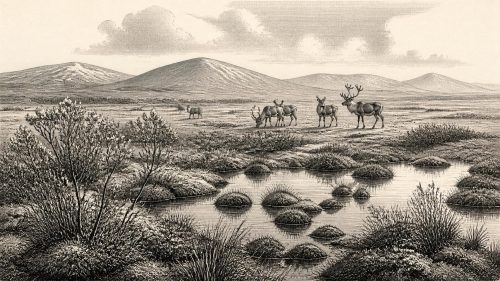
Castlepook Cave in County Cork preserves Ireland’s richest disturbed record of vertebrate fauna before the Last Glacial Maximum, during the climatically unstable later Marine Isotope Stage 3. Around 34,000–32,000 calibrated years ago, Ireland contained shifting cold, open habitats, developing ice and altered coastlines, rather than a uniformly frozen landscape. Mammoth, reindeer, giant deer, bear, wolf, hyena, lemmings and Arctic fox demonstrate connections with wider north-west European ecosystems. A tool-marked reindeer femur suggests fleeting Upper Palaeolithic activity, but cannot establish settlement or occupation. Dating, bone deposition and excavation methods require caution. Castlepook documents an ecological frontier increasingly transformed by advancing ice.
Dateline
31,201 BCE is not a date at which Ireland can be described year by year. No community on the island kept a calendar, and no archaeological deposit can be assigned responsibly to this single modern calendar year. The label is a backwards conversion, placing the point about 33,150 years before AD 1950. At this depth of time, radiocarbon dates must be calibrated and normally produce probability ranges rather than anniversaries; revised calibration curves and changing interpretations of cave deposits can alter the chronological picture. The responsible subject is therefore Ireland during the later part of Marine Isotope Stage 3, broadly around 34,000–32,000 calibrated years ago, not an event on a particular day or in a particular season.
A Changing Ice-Age Ireland
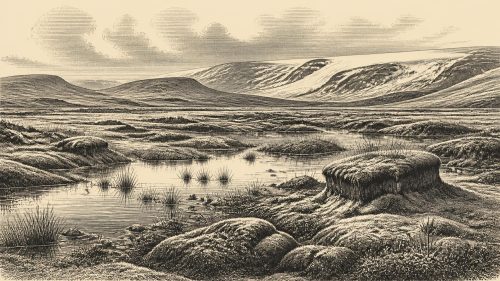
Ireland then stood within the Last Glacial Period, but not yet at the fullest extent of the last British–Irish Ice Sheet. The later maximum is generally reconstructed between about 27,000 and 24,000 years ago, although its growth, margins and timing varied greatly from one sector to another. Modelling and geological evidence indicate that ice masses were already developing across the Irish and British uplands by roughly 31,000 years ago, coalescing rapidly thereafter. For a point somewhat earlier than that, such as 31,201 BCE, the exact distribution of ice, open ground and coastal water around Ireland remains uncertain. It would be wrong to picture the whole island either as a uniform white ice cap or as an unbroken habitable plain.
What is secure is that the landscape was cold, treeless in many exposed places and ecologically mobile. Temperatures and precipitation did not remain steady: Greenland ice cores show abrupt northern climatic oscillations during the last glacial period, while Irish evidence records the local consequences only unevenly. Vegetation, animal ranges, snow cover, permafrost and the availability of sheltered ground could all alter over centuries or less. The coasts were also unlike those of modern Ireland because global sea level was substantially lower, while local land levels were affected by the growing weight of ice. Yet lower sea level does not license a simple claim of a permanent land bridge to Britain. The geography of the Irish Sea and North Channel was changing, and the practical routes available to animals or people are still reconstructed from incomplete terrestrial and marine evidence.
Castlepook’s Uneven Archive
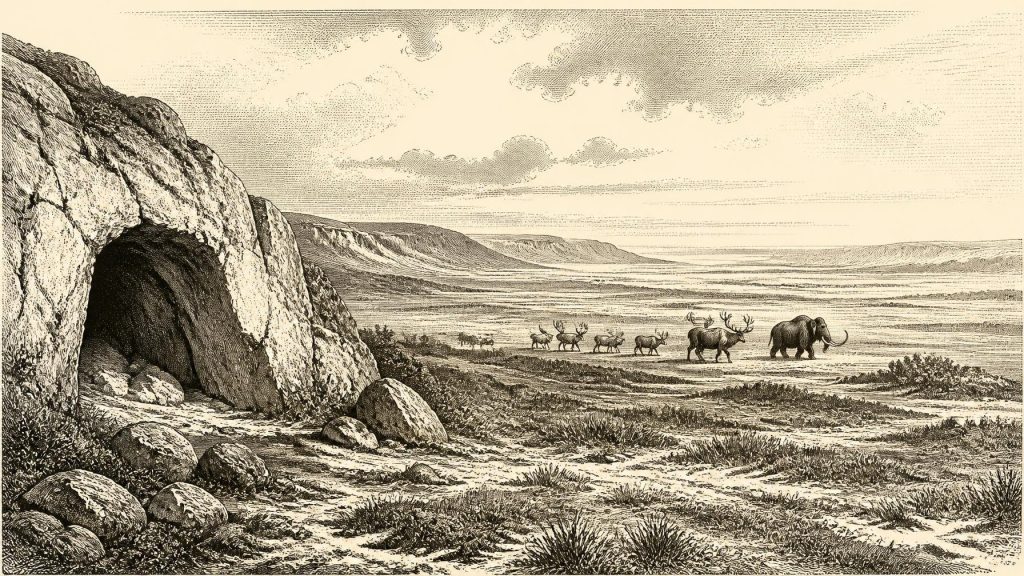
The most illuminating Irish place for this broad interval is Castlepook Cave, also called Mammoth Cave, near Doneraile in north County Cork. It is not a settlement site in the ordinary sense. Rather, it is a limestone cave system whose deposits and old collections preserve an exceptional, though disturbed, record of Pleistocene vertebrates. Excavations by Richard J. Ussher and others in the early twentieth century removed large quantities of material; later reassessment, radiocarbon dating and renewed fieldwork have made the cave central to the study of Ireland before the Last Glacial Maximum. Geological Survey Ireland calls it the country’s richest site for vertebrate fauna leading up to that maximum.
Its animal assemblage includes woolly mammoth, reindeer, giant deer, brown bear, wolf and spotted hyena, alongside smaller cold-adapted mammals such as lemmings and Arctic fox in later Ice-Age material. This is powerful evidence that Ireland, or at least accessible parts of it during favourable intervals, supported a far more varied mammalian community than the island possesses today. It is also evidence of ecological connections beyond Ireland. Mammals of this kind did not evolve independently in Cork: their presence reflects movements within north-west European environments whose coastlines, ice barriers and open habitats were repeatedly rearranged by climate.
But a cave bone-bed is not a census taken in one year. Carnivores may have dragged prey or carrion underground; water could move bones; excavation methods a century ago did not meet modern standards; and specimens from different galleries, layers and millennia can end up discussed together as “the Castlepook fauna”. Spotted hyena behaviour is particularly important, since a den or scavenging place can assemble a selective collection of bones. The cave therefore reveals that these species occurred in the wider regional world, but it cannot prove that mammoth, hyena, reindeer and people stood together outside its entrance in 31,201 BCE.
Reindeer and the Human Question
A reindeer femur from Castlepook has given this period special public prominence. County Cork heritage material dates it approximately to 31,000 BC and identifies a mark interpreted by zoologist Ruth Carden as having been made by a sharp stone tool during butchery. If that interpretation is sustained by further analysis, it would be evidence for a brief Upper Palaeolithic human presence in Ireland far earlier than the long-accepted terminal-Pleistocene evidence from Alice and Gwendoline Cave in County Clare. It would suggest that one or more people handled a reindeer carcass, not that they founded a village, controlled a territory or formed a continuous population.
The distinction matters. Ireland has no securely dated stone-tool assemblage, hearth, dwelling floor, human skeleton, burial, cave art or settlement plan from around this point in the early thirty-second millennium BCE. Nor does Castlepook presently provide a demonstrable hunting camp. A cut or chop mark on one bone, however suggestive, is evidence of a particular action only if its human origin and its association with the animal’s death are accepted. It cannot supply the language, identity, kinship rules, beliefs or political organisation of the people who may have made it. The most cautious conclusion is that Castlepook preserves a serious possibility of fleeting human activity amid a richer and better-established animal record.
This caution is strengthened by the cave’s dating history. Earlier radiocarbon programmes placed several Castlepook animals in the broad range of roughly 33,000–38,000 radiocarbon years before present. A 2020 reassessment found that some of the southern Irish Marine Isotope Stage 3 fauna were older in calibrated calendar terms than had formerly been supposed, and argued that giant deer and spotted hyena may have disappeared locally before about 40,000 calibrated years ago. Consequently, “around 31,201 BCE” is a useful editorial waypoint, not a claim that every relevant Castlepook specimen belongs in that calendar decade.
Life Without a Recorded Society
Political affairs, warfare and diplomacy cannot be recovered for Ireland at this date. There were no states, kingdoms, written agreements or named leaders, and there is no basis for projecting later Irish peoples or traditions backwards into this Ice-Age setting. If humans visited, they were almost certainly part of small, mobile Upper Palaeolithic foraging groups operating at the far western edge of wider European networks. That is an inference from the probable nature of the evidence and from contemporary European archaeology, not a demonstrated Irish social map.
Everyday life is similarly difficult to reconstruct. A successful party in open, cold country would have needed close knowledge of animal movement, weather, shelter, fire and stone-working, but no Irish hearth or toolkit of this age has yet established those practices locally. Reindeer could have provided meat, hide, sinew, bone and antler; such possibilities explain why a butchered reindeer bone is important, but they must not be mistaken for direct evidence of clothing, tents or specialised hunting equipment in Cork. Mammoth and giant deer bones indicate impressive animals in the regional fauna, not necessarily human prey.
There is no Irish evidence for religion, formal ritual, artistic production, teaching institutions or long-distance trade at this date. Upper Palaeolithic communities elsewhere in Europe created sophisticated tools and symbolic works, but Castlepook has yielded no securely contemporary equivalent. Nor can trade be inferred merely because animals crossed changing landscapes. The central cultural fact for Ireland is absence: the island’s subsequent glaciation, erosion, acidic soils and rising seas have destroyed, buried or submerged much of the evidence that might once have survived.
An Ecological Frontier
Economy, insofar as the term can be used here, was ecological rather than agricultural. There were no farms, fields, livestock, cereal crops, permanent towns or mines. The available evidence points instead to an open-country food web in which grazing and browsing mammals, predators, scavengers and small cold-adapted animals occupied shifting patches of grassland, herb-rich tundra, wet ground and sheltered terrain. Reindeer and lemmings point towards cold conditions; hyena, mammoth and giant deer demonstrate that the environment cannot be reduced to a featureless polar desert.
Regional change is the great historical development. Ireland was approaching a phase in which expanding ice would overwhelm or isolate much of its available habitat. The faunal evidence from Castlepook records a world before that later climax: a world capable of sustaining large mammals, and perhaps admitting occasional people, but vulnerable to rapid environmental transformation. The cave’s importance lies not in offering a finished origin story for Ireland’s population. It instead preserves fragments of a frontier landscape, where animal movement is demonstrable, human presence remains possible but sparse, and the coming ice would make the record still harder to read.
Primary Sources
- A Reconsideration of the Radiocarbon Dating of the Marine Isotope Stage 3 Fauna from Southern Ireland
- The Irish Quaternary Fauna Project
- Castlepook Cave, County Cork: County Geological Site Report
- Archaeological Heritage of County Cork
- Heritage Artefacts of County Cork
- Growth and Retreat of the Last British–Irish Ice Sheet, 31,000 to 15,000 Years Ago: The BRITICE-CHRONO Reconstruction
- The Timing and Magnitude of the British–Irish Ice Sheet Between Marine Isotope Stages 5d and 2: Implications for Glacio-Isostatic Adjustment, High Relative Sea Levels and ‘Giant Erratic’ Emplacement
- Trimlines, Blockfields and the Vertical Extent of the Last Ice Sheet in Southern Ireland
- Deglaciation Chronology of the Donegal Ice Centre, North-West Ireland
- Marine Geophysical Evidence for Late Pleistocene Ice Sheet Extent and Recession Off Northwest Ireland
- First Evidence of a Late Upper Palaeolithic Human Presence in Ireland
- Spotted Hyena Skull
- Mammals: National Museum of Ireland Natural History Collections
- 2022:564 – Castlepook Cave, Castlepook South, Cork
- The IntCal20 Northern Hemisphere Radiocarbon Age Calibration Curve (0–55 cal kBP)
- IntCal Publications
- A Stratigraphic Framework for Abrupt Climatic Changes During the Last Glacial Period Based on Three Synchronized Greenland Ice-Core Records
- Ireland Before 3000 B.C.
- Castlepook Caves
- Karst of Ireland
- Dimensions and Chronology of the Last Ice Sheet in Western Ireland
- Restricted Cirque Glaciers in the Wicklow Mountains, Ireland, During the Nahanagan Stadial (Greenland Stadial-1/Younger Dryas)