Tundra Habitat31055 BCE
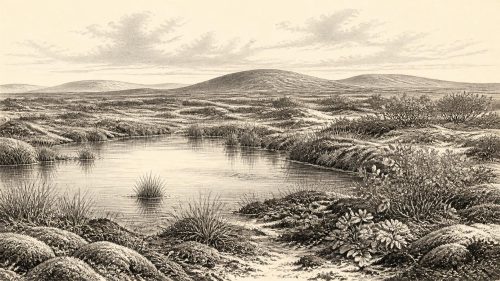
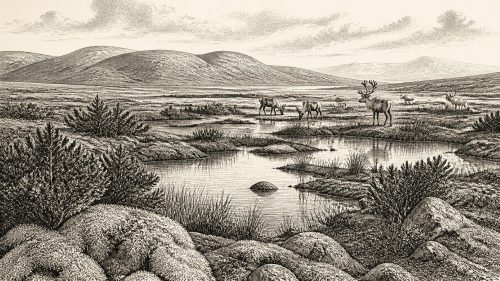
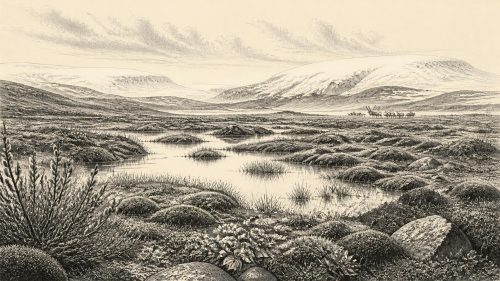
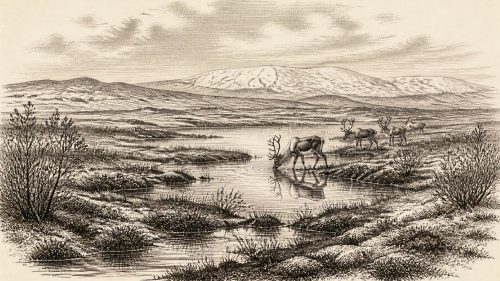
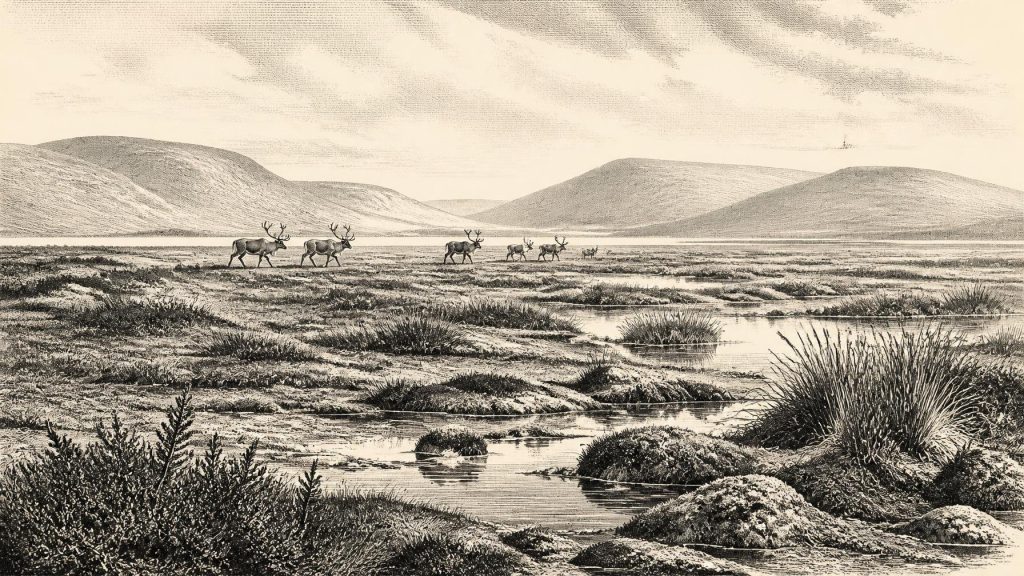
31,055 BCE is a modern label rather than a recoverable Irish year. Derryvree, County Fermanagh, preserves freshwater sediments between glacial tills, dated broadly to 36,900–31,700 cal BP, showing a cold, wet, locally ice-free tundra landscape with plants and small animals. Ireland was entering greater glaciation, which later reworked or buried evidence. Castlepook Cave, County Cork, contains diverse cold-stage fauna, including reindeer, mammoth and hyaena. A marked reindeer femur may indicate Upper Palaeolithic butchery about 33,000 years ago, but lacks associated tools or occupation evidence. Thus Ireland supported animals and perhaps brief human visits, not securely demonstrable settlement, societies or ritual.
Dateline
31,055 BCE is a modern chronological label, not a recoverable year in Ireland’s prehistoric record. No community on the island kept a calendar that can be correlated with it, and neither radiocarbon dating nor glacial stratigraphy can identify an event, season or person in one particular year so far back. In calendar arithmetic it falls roughly 33,000 years before AD 1950, within the later part of the Last Glacial Period. The responsible history of Ireland at this point is therefore a history of dated ranges, sediments, animal remains and uncertainty rather than rulers, battles or foundations.
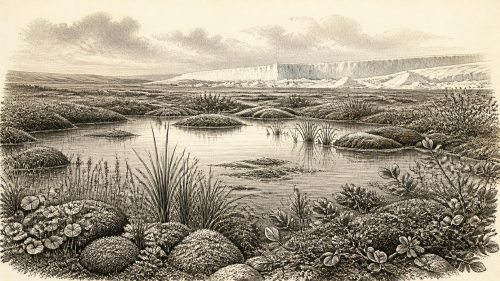
The closest Irish environmental archive is at Derryvree, near Maguiresbridge in County Fermanagh. Road works in 1969 exposed a remarkable sequence inside a drumlin: an older glacial till, then freshwater silts and fine sands containing organic material, then a later till. The buried wetland proves that this particular place was ice-free long enough for water, sediment, plants and small animals to establish themselves between episodes of glaciation. A conventional radiocarbon measurement, BIRM-166, returned 30,500 radiocarbon years BP, with a large published uncertainty of +1,170/−1,030 years. Calibrated estimates have placed the deposit broadly around 36,900–31,700 cal BP. The notional year 31,055 BCE lies within that broad range, but it cannot be made to represent a single layer or moment in the deposit.
A Landscape Between Glaciers
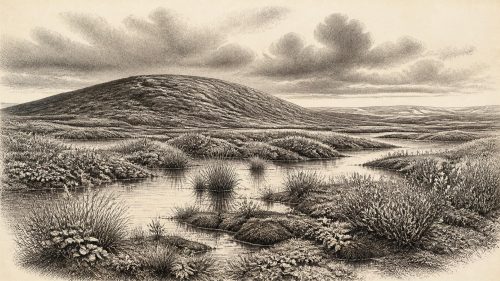
Derryvree belongs to a climatically unstable interval generally discussed within Marine Isotope Stage 3, a long phase of the Late Pleistocene when the climate repeatedly shifted but had not yet reached the full severity of the Last Glacial Maximum. The evidence from the inter-till deposits indicates a cold, open and wet environment, not a temperate woodland. Mosses, sedges, grasses, herbs, dwarf shrubs and aquatic plants point to tundra or muskeg-like ground, with shallow pools, saturated soils and freshwater channels. In this kind of landscape, the apparent emptiness of a treeless horizon should not be mistaken for lifelessness: wetland vegetation, insects and small animals could exploit sheltered, waterlogged niches even in a harsh continental climate.
That is evidence for one Fermanagh locality, not a precise map of the whole island. Ireland’s relief, rainfall, exposure to Atlantic weather, and the changing extent of ice would have created local variation. The modern reconstruction of the British–Irish Ice Sheet also cautions against a simple image of an island either wholly white or wholly green. Its detailed chronology begins at 31,000 years BP, approximately 29,050 BCE, and depicts ice growing on uplands in northern Ireland and elsewhere. That valuable model is later than the requested label and has its own spatial uncertainties. It nonetheless makes the wider trajectory clear: the favourable window represented at Derryvree belonged to a world in which ice was becoming more important, not retreating for good.
Within several millennia, the ice sheet would expand across Ireland and its surrounding shelf, profoundly reworking older land surfaces. The Last Glacial Maximum is usually placed broadly between about 27,000 and 23,000 cal BP in the Irish sector, with maximum British–Irish Ice Sheet volume reconstructed around 23,000 years BP. Glacial erosion, deposition and later rising seas help explain why evidence from earlier human visits is so sparse. The scarcity is meaningful, but it is not proof that no one ever reached Ireland: some sites may have been destroyed, deeply buried, or now lie beneath the sea.
Castlepook and the Human Question
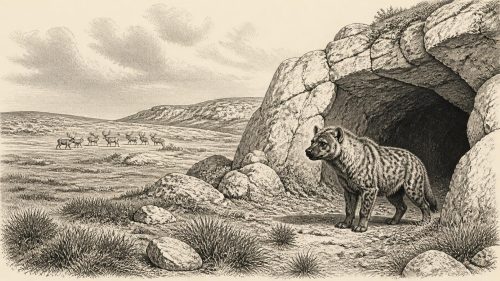
The major question for Irish history at this depth of time comes from Castlepook Cave, near Doneraile in north County Cork. The cave has produced the country’s richest known collection of pre-Last Glacial Maximum mammal remains. Its fauna includes woolly mammoth, reindeer, giant deer, brown bear, spotted hyaena, wolf, Arctic fox, wild horse, mountain hare and lemmings. The assemblage is not the refuse of one camp or one season. It accumulated through a mixture of carnivore activity, natural deaths, sediment movement and antiquarian excavation; modern redating has also shown that some earlier radiocarbon determinations had underestimated the age of Castlepook material.
A reindeer femur in the historic collection is especially important. It has been reported as directly dated to about 33,000 years ago and bears a deep mark interpreted by zooarchaeologist Ruth Carden as having been made while fresh bone was cut or chopped with a stone tool. If that interpretation is upheld, it is evidence that a person handled a reindeer carcass in Ireland during the Upper Palaeolithic, far earlier than the previously secure Irish human record. It would fit a broad period rather than the exact year 31,055 BCE. Radiocarbon dates the animal’s death, while identifying the mark and establishing its relationship to carcass processing are separate taphonomic judgements.
The limits are as important as the possibility. Castlepook has not yielded a securely associated stone-tool assemblage, hearth, dwelling floor, burial, human remains or repeated occupation surface of comparable age. Nor does the femur establish where the animal was killed, how many people were present, whether they slept in the cave, or whether visits were regular. The most defensible formulation is therefore possible human activity or carcass processing, not a settled Palaeolithic population. The better-attested butchered bear bone from Alice and Gwendoline Cave, County Clare, belongs much later, around 12,810–12,590 cal BP, and cannot fill this earlier gap.
Animals, Mobility and Subsistence
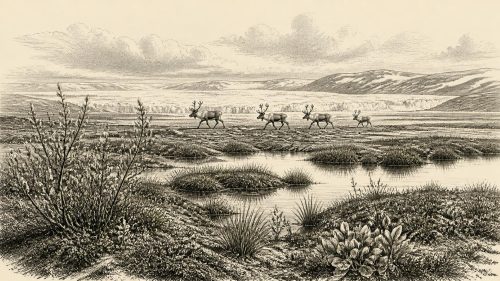
Even without a confirmed camp, Castlepook’s fauna reveals an Irish landscape that could sustain large grazing mammals and their predators. Reindeer are strongly associated with open, cold-country habitats and seasonal movement; mammoths, hyaenas and lemmings add to the picture of a very different ecological community from modern Ireland’s. These species should not be imagined as forming a timeless herd in one place. Individual specimens may differ considerably in age, and caves collect bones across long intervals. Still, their presence shows that northern European cold-stage fauna reached Ireland before the main ice-sheet advance.
If people did visit, they would probably have travelled in small, highly mobile hunting groups and relied on intimate knowledge of animal behaviour, weather, fuel, stone and shelter. That is an inference from Upper Palaeolithic lifeways elsewhere in north-west Europe, not a fact demonstrated by an Irish house or toolkit. A reindeer carcass could have supplied meat, marrow, hide, sinew and bone, but no Irish evidence allows us to reconstruct diet, clothing or hunting methods for this episode. There is likewise no basis for asserting farming, permanent villages, crop cultivation, livestock, pottery or long-distance exchange networks. Such developments belong to vastly later chapters of Irish prehistory.
The geography of approach is also uncertain. Sea level was much lower than today and broad areas of the present continental shelf were dry land or altered coastal terrain, while glaciers and meltwater changed possible routes. Models indicate that Britain and Ireland had land connections at parts of the Last Glacial Maximum, but the exact nature, timing and passability of routes around 33,000 cal BP remain debated. A human arrival need not imply a simple walk across a stable bridge; ice margins, waterways, exposed plains and changing coastlines all mattered. The reindeer itself demonstrates animal movement into Ireland, but does not prescribe the route used by people.
No Polities, No Proven Ritual
There is no evidence for political authority, territorial states, diplomacy, organised warfare or identifiable communities in Ireland at this horizon. It would be misleading to turn a possible butchery mark into a tribal history. Small mobile groups elsewhere certainly depended on co-operation, shared skills, kinship and the transmission of knowledge, but Irish evidence cannot identify their language, beliefs, social rules or artistic traditions. Nor does the presence of bones in a cave establish ritual use. Caves could act as carnivore dens, natural traps, shelters, sediment basins and excavation sites; their later spiritual significance elsewhere cannot be projected backwards without material support.
Culture and learning survive here only indirectly, in the possibility that a shaped stone edge was used skilfully on fresh bone, and in the ecological knowledge required by any successful visitor. Economy, if humans were present, would have centred on immediate subsistence rather than markets or trade: obtaining food and usable animal materials in an exposed, seasonal landscape. The primary historical development was environmental. Wetlands like Derryvree existed in an interval of local ice-free ground, while the wider climatic system was moving towards greater glaciation and the eventual erasure or burial of many older traces.
An Archive of Limits
Ireland around the modern label 31,055 BCE was neither a known empty wilderness nor a documented homeland. Derryvree provides firm local evidence for cold freshwater habitats between glacial episodes; Castlepook provides firm evidence for a striking cold-stage fauna and a tantalising, but contextually limited, claim for human butchery. Together they replace an older assumption of uninterrupted ice cover or total archaeological silence with a more careful picture: an environmentally varied, vulnerable land on Europe’s north-western edge, capable of supporting animals and perhaps brief human forays before expanding ice transformed it. The date remains calendarless, but the sediments and bones give it a real, if fragmentary, Irish setting.
Source References
Hover over a number to see the source. Select it to open the source.

- [1] A Middle Midlandian Freshwater Series at Derryvree, Maguiresbridge, County Fermanagh, Northern Ireland
- [2] A Middle Midlandian Freshwater Series at Derryvree, Maguiresbridge, County Fermanagh, Northern Ireland
- [3] A Reconsideration of the Radiocarbon Dating of the Marine Isotope Stage 3 Fauna from Southern Ireland
- [4] The Irish Quaternary Fauna Project
- [5] Irish Pleistocene Biostratigraphy
- [6] Figure 6.— The Subdivision of the Quaternary Period in Ireland
- [7] Growth and Retreat of the Last British–Irish Ice Sheet, 31,000 to 15,000 Years Ago: the BRITICE-CHRONO Reconstruction
- [8] Growth and Retreat of the Last British–Irish Ice Sheet, 31,000 to 15,000 Years Ago: the BRITICE-CHRONO Reconstruction
- [9] Exploring Controls of the Early and Stepped Deglaciation on the Western Margin of the British-Irish Ice Sheet
- [10] Late Pleistocene Chronostratigraphy and Ice Sheet Limits, Southern Ireland
- [11] The Timing and Magnitude of the British–Irish Ice Sheet Between Marine Isotope Stages 5d and 2
- [12] Trimlines, Blockfields and the Vertical Extent of the Last Ice Sheet in Southern Ireland
- [13] Castlepook Caves
- [14] Heritage Artefacts of County Cork
- [15] Archaeological Heritage of County Cork
- [16] The Island of Ireland: Drowning the Myth of an Irish Land-Bridge?
- [17] Deglaciation, Earth Crustal Behaviour and Sea-Level Changes in the Determination of Insularity: A Perspective from Ireland
- [18] Ireland: Submerged Prehistoric Sites and Landscapes
- [19] The Colonization of Ireland: A Human Ecology Perspective
- [20] First Evidence of a Late Upper Palaeolithic Human Presence in Ireland
- [21] New Insights on the Fauna of Ireland’s Younger Dryas and Early Holocene from Alice & Gwendoline Cave
- [22] The IntCal20 Northern Hemisphere Radiocarbon Age Calibration Curve (0–55 cal kBP)
- [23] The Archaeology of Caves in Ireland
- [24] The Mesolithic in Ireland: When Was It?
Primary Sources
- A Middle Midlandian Freshwater Series at Derryvree, Maguiresbridge, County Fermanagh, Northern Ireland
- A Middle Midlandian Freshwater Series at Derryvree, Maguiresbridge, County Fermanagh, Northern Ireland
- A Reconsideration of the Radiocarbon Dating of the Marine Isotope Stage 3 Fauna from Southern Ireland
- The Irish Quaternary Fauna Project
- Irish Pleistocene Biostratigraphy
- Figure 6.— The Subdivision of the Quaternary Period in Ireland
- Growth and Retreat of the Last British–Irish Ice Sheet, 31,000 to 15,000 Years Ago: the BRITICE-CHRONO Reconstruction
- Growth and Retreat of the Last British–Irish Ice Sheet, 31,000 to 15,000 Years Ago: the BRITICE-CHRONO Reconstruction
- Exploring Controls of the Early and Stepped Deglaciation on the Western Margin of the British-Irish Ice Sheet
- Late Pleistocene Chronostratigraphy and Ice Sheet Limits, Southern Ireland
- The Timing and Magnitude of the British–Irish Ice Sheet Between Marine Isotope Stages 5d and 2
- Trimlines, Blockfields and the Vertical Extent of the Last Ice Sheet in Southern Ireland
- Castlepook Caves
- Heritage Artefacts of County Cork
- Archaeological Heritage of County Cork
- The Island of Ireland: Drowning the Myth of an Irish Land-Bridge?
- Deglaciation, Earth Crustal Behaviour and Sea-Level Changes in the Determination of Insularity: A Perspective from Ireland
- Ireland: Submerged Prehistoric Sites and Landscapes
- The Colonization of Ireland: A Human Ecology Perspective
- First Evidence of a Late Upper Palaeolithic Human Presence in Ireland
- New Insights on the Fauna of Ireland’s Younger Dryas and Early Holocene from Alice & Gwendoline Cave
- The IntCal20 Northern Hemisphere Radiocarbon Age Calibration Curve (0–55 cal kBP)
- The Archaeology of Caves in Ireland
- The Mesolithic in Ireland: When Was It?