The Doneraile Femur Cut30760 BCE
Around 30,760 BCE, Ireland lay within the fluctuating cold conditions of Marine Isotope Stage 3, with tundra-like wetlands, open grasslands and changing ice margins. Evidence from Derryvree and Castlepook Cave shows that reindeer, mammoths, giant deer, hyaenas and other cold-adapted animals inhabited parts of the island. Castlepook’s mixed bone deposits reflect animal deaths, scavenging and denning, not a proven settlement. A reindeer femur, possibly cut by a stone tool, suggests brief Upper Palaeolithic human visits or carcass processing near Doneraile. However, no securely associated tools, hearths, dwellings or burials confirm occupation. Subsequent glaciation erased or buried much earlier evidence there.
Dateline
“30,760 BCE” is a modern calendar label, not a date that Ice Age people in Ireland could have known or recorded. It corresponds roughly to 32,710 years before AD 1950, the conventional radiocarbon ‘present’, but no archaeological evidence can be tied responsibly to a single year. The most useful frame is the later part of Marine Isotope Stage 3, a fluctuating cold phase before the Last Glacial Maximum. For Ireland, the evidence is unusually fragmentary: cave bones, glacial sediments, pollen and plant remains, and a small number of radiocarbon determinations. These illuminate broad conditions and possibilities, rather than an annual narrative.
An Island in a Changing Ice Age
Around this broad period, Ireland lay at the north-western edge of Upper Palaeolithic Europe. The climate was far colder and generally drier than today, but it was not a simple, unchanging white wilderness. Marine Isotope Stage 3 contained abrupt shifts between colder stadials and somewhat milder interstadials. The advance towards the Last Glacial Maximum was under way on a continental scale, yet the British–Irish Ice Sheet did not reach its greatest overall extent until much later, broadly between c. 26,500 and 19,000 years ago. Its growth, maximum and retreat were regionally asynchronous. It is therefore unsafe to picture all of Ireland either as wholly ice-covered or as uniformly open ground in any one notional year around 30,760 BCE.
Sea level was substantially lower than today because immense quantities of water were locked in northern ice sheets. Coastlines lay farther seaward, and the geography of the Irish Sea basin differed greatly from the modern map. Lower sea level may have altered routes between Ireland, Britain and the European mainland, but it does not by itself prove a convenient, continuous land crossing at this particular time. Ice margins, rivers, marshes, exposed shelves and sea channels all changed through time. Any movement of animals or people would have depended on those local conditions, not on a simple line drawn between modern islands.
Cold Grassland and Wet Ground
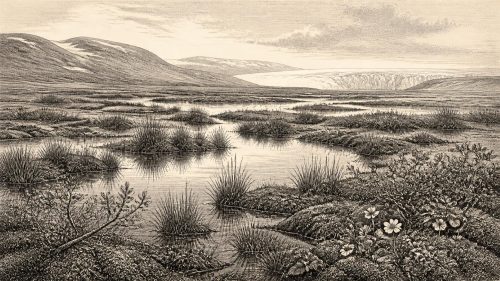
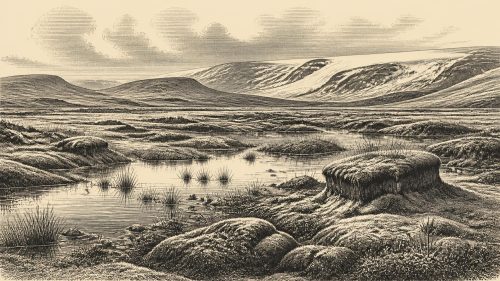
The best Irish environmental records for the wider Middle Midlandian, or MIS 3, interval come from deposits preserved beneath later glacial sediments. At Derryvree near Maguiresbridge in County Fermanagh, organic silts between tills retained the remains of mosses, sedges and other cold-adapted plants from a treeless wetland landscape. Such deposits show that, during at least some pre-Last Glacial Maximum intervals, parts of Ireland supported freshwater pools, marshy ground and tundra-like vegetation rather than permanent ice. They cannot be treated as a weather report for 30,760 BCE, and their chronology has broad uncertainties; nevertheless, they provide a rare local counterweight to any assumption that Late Pleistocene Ireland was lifeless.
This was not woodland country. Dwarf shrubs, herbs, grasses and mosses would have dominated exposed ground, with vegetation varying according to drainage, altitude, soil and proximity to ice. Open habitats could support grazing mammals, while fens and shallow pools offered plant food, invertebrate life and water for animals. Strong winds, seasonal darkness, frost action and short growing seasons shaped the terrain. The physical landscape was also unstable: permafrost processes disturbed soils, rivers carried glacial sediment, and ice could advance over or erase earlier surfaces. Much of the archaeological record that may once have existed has consequently been destroyed, displaced or buried.
Castlepook’s Bone Archive
The most important evidence directly relevant to this period comes from Castlepook Cave near Doneraile in north County Cork. Excavated principally in the early twentieth century, the limestone cave yielded a remarkable accumulation of Pleistocene animal remains. Later study and improved radiocarbon methods have shown that some of the older cave fauna belong to MIS 3, while also demonstrating why dates from old collections must be handled with care. The cave’s deposits accumulated through several episodes and processes. A bone recovered from a cave is not automatically evidence that the animal died there, still less that people lived there.
Castlepook’s fauna includes reindeer, woolly mammoth, giant deer, brown bear, wolf, Arctic fox, lemmings and spotted hyaena. Together these animals indicate a varied cold-stage ecosystem in southern Ireland across a long span of time, not a single perfectly synchronous community. Reindeer and giant deer could browse or graze across open country; mammoths belonged to the wider mammoth-steppe world of northern Eurasia; small mammals are especially useful indicators of cold environments. Spotted hyaenas add an important caution. Carnivores could carry limbs and carcass fragments into caves, chew and scatter bones, and create the kind of assemblage that earlier excavators might not have been able to disentangle fully.
For that reason, Castlepook is best understood as a bone archive rather than a settled Ice Age village. It preserves traces of animal movements, deaths, scavenging and denning, but its old excavations did not recover the carefully recorded layers, samples and spatial evidence expected today. Recent fieldwork has confirmed that deposits survive in parts of the cave, yet the 2022 excavation recovered no cultural artefacts. This negative result matters. It does not disprove every earlier suggestion of human activity, but it means that a human occupation floor, hearth, tool-making area, dwelling or burial of this age has not been demonstrated in Ireland.
A Reindeer Bone and a Large Claim
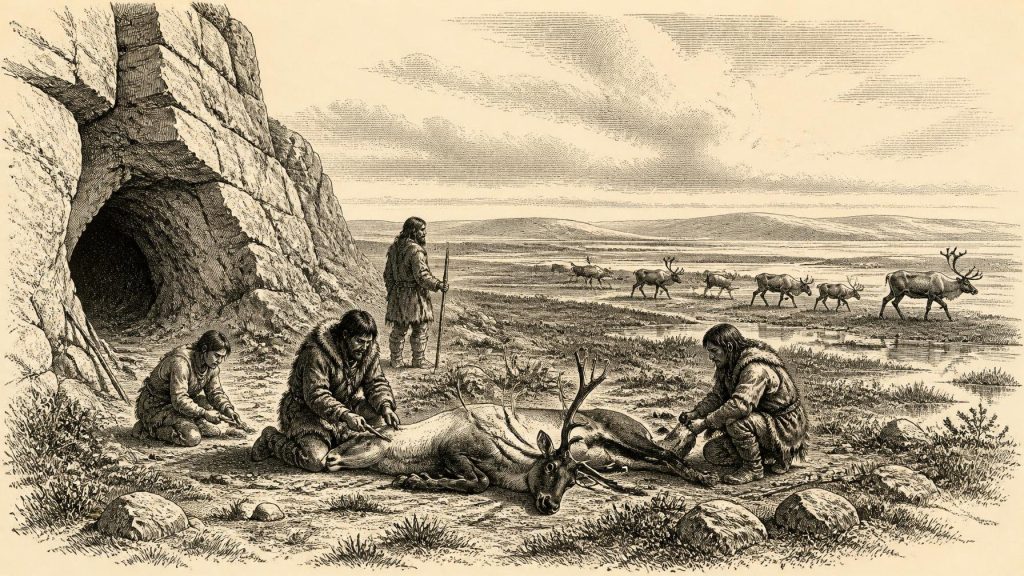
One Castlepook object makes this date especially significant: a fragment of reindeer femur in the National Museum of Ireland’s Natural History collections, publicly described as dating to about 31,000 BCE and bearing a deep mark interpreted by zooarchaeologist Ruth Carden as damage from a sharp stone tool during butchery. County Cork heritage material presents it as evidence that Upper Palaeolithic hunters processed a reindeer in the Doneraile area. If that interpretation is sustained, it would push evidence for human activity in Ireland tens of millennia earlier than the formerly accepted terminal-Pleistocene record.
Its importance should not remove the need for precision. The radiocarbon age dates the death of the reindeer, not necessarily the exact moment the mark was made. The specimen was recovered during historic excavations, rather than from a recently excavated and securely recorded layer. No stone tool has been found with the bone, and no human remains, fireplace or associated camp has yet been identified. A single modified bone cannot establish whether people killed the animal, encountered a carcass, removed meat, hide or sinew elsewhere, or how long they remained in Ireland. It does, at most, provide a potentially powerful indication of carcass processing by people during this broad period.
That distinction is crucial for an entry centred on 30,760 BCE. The most responsible conclusion is not that Ireland possessed a permanent human population, a named band, or an established hunting territory in that year. Rather, the marked femur makes a short-lived Upper Palaeolithic visit or visits plausible. Such visitors may have moved within wider north-west European networks, following animal herds and exploiting seasonally available places. But no Irish tool assemblage currently permits archaeologists to assign them securely to a named archaeological culture such as the Aurignacian or Gravettian. Those labels describe material traditions elsewhere in Europe; they should not be imported into Ireland without diagnostic finds.
Life Beyond the Evidence
If people did reach Ireland in this interval, their subsistence was almost certainly based on hunting, scavenging and the flexible use of animal resources. Reindeer offered meat, marrow, hides, sinew, antler and bone, while other large mammals could have provided comparable resources. Yet Castlepook cannot show which of these were taken, nor whether hunting rather than opportunistic butchery occurred. It offers no evidence for cultivation, livestock, pottery, metalworking, long-term houses or a local exchange economy. ‘Trade’ and ‘economy’ in the later prehistoric sense are therefore not subjects that the evidence can support here.
Nor can archaeology identify political authorities, territories, diplomacy, warfare, languages, personal names or religious beliefs for Ireland at this date. Small mobile foraging groups elsewhere in Upper Palaeolithic Europe certainly had social ties, technical knowledge and cultural lives, but none of that can be reconstructed specifically for Ireland from a reindeer bone and a mixed cave fauna. It would be equally unwarranted to imagine Irish cave art, ritual burial or formal conflict simply because such practices are known in some contemporary regions of Europe. Absence of evidence is not proof of absence, but it is a firm limit on responsible storytelling.
A Landscape Soon Transformed
The larger historical development was environmental. The intervals represented by Ireland’s MIS 3 wetlands and cave fauna preceded the more severe ice-sheet conditions of the Last Glacial Maximum. Later ice would reshape hills and valleys, lay down tills, redirect drainage and eliminate many accessible traces of earlier landscapes. The scarcity of evidence around 30,760 BCE is thus itself historically meaningful: the Irish archive has been repeatedly overwritten by glaciation as well as by erosion and rising post-glacial seas.
For modern readers, the Doneraile femur is valuable precisely because it is modest. It does not yield a conventional political history, but it challenges the old assumption that Ireland had no human story before the end of the Ice Age. Around the modernly calculated year 30,760 BCE, the island was a cold, mobile and ecologically rich frontier. Mammoths, reindeer, hyaenas and giant deer belonged to its wider natural world. Whether a small number of hunters briefly crossed that frontier remains a question concentrated in one marked bone, awaiting the securely stratified tools, dates and deposits that could turn possibility into a fuller history.
Primary Sources
- A reconsideration of the radiocarbon dating of the Marine Isotope Stage 3 fauna from southern Ireland
- The Irish Quaternary Fauna Project
- The exploration of Castlepook Cave, County Cork
- Heritage Artefacts of County Cork
- 2022:564 – Castlepook Cave, Castlepook South, Cork
- Archaeology Research Excavation Grant 2022: Final Report
- New insights on the fauna of Ireland's Younger Dryas and Early Holocene from Alice & Gwendoline Cave
- First evidence of a Late Upper Palaeolithic human presence in Ireland
- The Archaeology of Caves in Ireland
- Figure 6: The subdivision of the Quaternary Period in Ireland
- Dimensions and chronology of the last ice sheet in Western Ireland
- Trimlines, blockfields and the vertical extent of the last ice sheet in southern Ireland
- Growth and retreat of the last British–Irish Ice Sheet, 31,000 to 15,000 years ago: the BRITICE-CHRONO reconstruction
- Pattern and timing of retreat of the last British-Irish Ice Sheet
- Character of advance and retreat of the southwest sector of the British-Irish Ice Sheet during the last glaciation
- Oscillating retreat of the last British-Irish Ice Sheet on the continental shelf offshore Galway Bay, western Ireland
- Maximum extent and readvance dynamics of the Irish Sea Ice Stream and Irish Sea Glacier since the Last Glacial Maximum
- Radiocarbon age calibration curves 0–55 cal kBP
- A 60,000 year Greenland stratigraphic ice core chronology
- The colonization of Ireland: A human ecology perspective