Elephant Hall Reexcavation30567 BCE
Around 30,567 BCE, Ireland experienced a cold, fluctuating Marine Isotope Stage 3 climate, near Greenland Interstadial 5.2. Castlepook Cave, County Cork, preserves important but disturbed pre-Last Glacial Maximum animal remains, including large grazers, predators and cold-adapted species. Wetland deposits elsewhere indicate varied open habitats, marshes and freshwater pools, not forest. Ireland was ecologically linked to Britain and continental Europe during favourable periods, although later glaciers destroyed much evidence. No securely dated human settlement, tools or burials exist. A possibly cut-marked reindeer bone may indicate brief human activity, but cannot demonstrate permanent occupation. Careful re-excavation seeks better dating and undisturbed contexts.
Dateline
The label 30,567 BCE should not be mistaken for a recoverable Irish date in the modern sense. No document, settlement horizon or securely dated event allows historians to describe a single year so far back. It is a retrospective calendar conversion, approximately 32,500 years before AD 2000, and must be handled as a broad chronological point rather than an anniversary. On the Greenland ice-core timescale, it lies close to the transition into Greenland Interstadial 5.2, whose onset is dated to about 32,500 years b2k, with stated chronological uncertainty. For Ireland, the responsible evidence is still less precise: cave bones, sediments, landforms and wider North Atlantic climate records illuminate a changing Late Pleistocene landscape, not a year-by-year human history.
A Brief Mild Interval
This was part of Marine Isotope Stage 3, a long cold phase of the last glacial cycle marked by abrupt swings rather than uniform winter. Greenland Interstadial 5.2 represents one of the relatively milder episodes registered in Greenland ice cores before the far more extensive ice growth that culminated in the Last Glacial Maximum. ‘Milder’ is comparative. It does not mean an Irish climate resembling the present, nor does it establish a particular temperature or season at any Irish location. It means that the North Atlantic climatic system was temporarily less severe than during the adjoining Greenland stadials.
The position of Ireland at the Atlantic edge of north-west Europe made it especially sensitive to such changes. Shifts in sea ice, ocean circulation, wind, moisture and temperature could alter vegetation and animal habitat rapidly. The island’s record is fragmentary because later glaciers eroded, buried and reworked older surfaces. Consequently, a warm pulse recognised in Greenland cannot simply be translated into a detailed Irish weather report. It is best understood as the large-scale climatic setting within which suitable patches of open grassland, herb-rich tundra, scrub and wet ground may have expanded or contracted.
The Cave at Castlepook
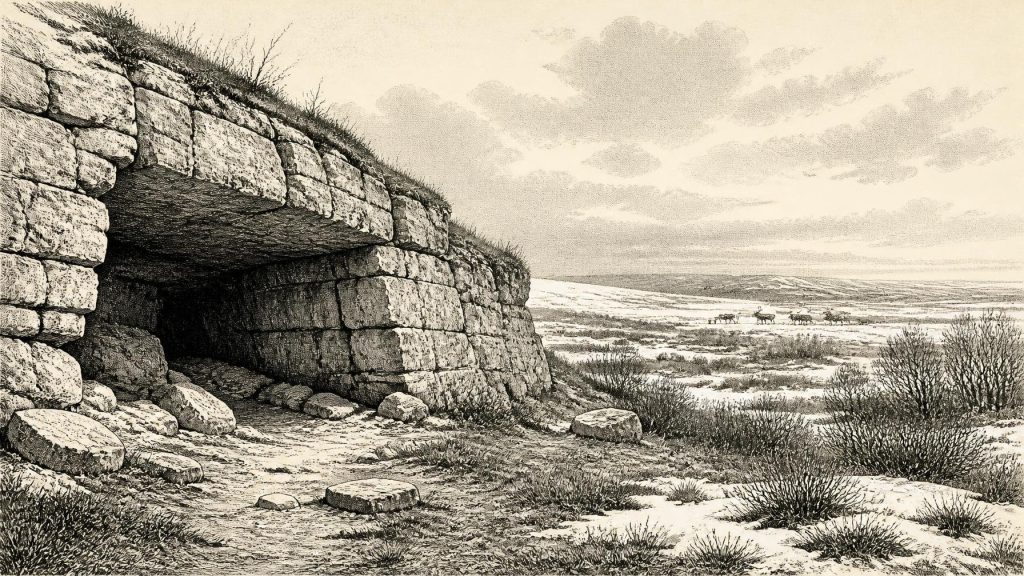
The most important Irish locality for this remote interval is Castlepook Cave, also called Mammoth Cave, near Doneraile in north County Cork. Early twentieth-century cave exploration there recovered a remarkable collection of animal remains. Later work by the Irish Quaternary Fauna Project and more recent redating have shown that parts of the assemblage belong to the period before the Last Glacial Maximum. Castlepook is therefore vital evidence that southern Ireland supported substantial mammals during parts of Marine Isotope Stage 3.
Its value must nevertheless be qualified. The historic excavations were undertaken before modern standards of stratigraphic recording, and some deposits were disturbed or mixed. Individual bones can be radiocarbon dated, but they do not necessarily prove that every species represented in the cave lived together, in one precise landscape, or in the calendar year 30,567 BCE. Cave assemblages are also shaped by how remains arrived there: carnivores may drag prey inside, bears may die during denning, water may move bones, and earlier excavators may inadvertently combine material from different layers. Castlepook is an extraordinary archive, but it is not a frozen snapshot.
Recent fieldwork has sought surviving deposits in parts of the cave system including Elephant Hall and the lower passages. That work is important not because it has produced a ready-made narrative of Ice Age settlement, but because securely excavated sediments, micromorphology and new dating offer the best prospect of separating genuine Pleistocene contexts from disturbed material. The history of research is thus part of the history of evidence: Ireland’s deep past is being revised through the careful re-examination of old museum collections and caves long thought exhausted.
Animals in a Changing Country
Castlepook and other southern Irish cave sites attest a richer Late Pleistocene fauna than Ireland possessed in later periods. Mammoth, reindeer, giant deer, horse, brown bear, wolf, fox, Arctic fox, hare, lemmings and spotted hyaena are among the animals reported from Irish pre-Last Glacial Maximum records. They evoke a landscape unlike the wooded and farmed Ireland familiar today. Large grazing mammals required extensive forage; hyaenas and wolves indicate predation and scavenging opportunities; small cold-adapted mammals point to open, often severe environments.
Yet the list should not be turned into a single illustrated procession. Mammoth or hyaena remains from Castlepook demonstrate that those species reached Ireland during broad earlier intervals; they do not show a mammoth standing outside the cave in 30,567 BCE. Revised dating suggests that some animals, including spotted hyaena and giant deer, may have disappeared locally before the Last Glacial Maximum, perhaps around 40,000 calibrated years ago. Reindeer are especially relevant to the colder, open habitats of the later interval, but their exact population history remains incomplete. The most secure conclusion is that Ireland had not always been biologically isolated or poor in large mammals: during favourable windows, it was part of a wider north-west European ecological zone.
Plants, Water and Ground
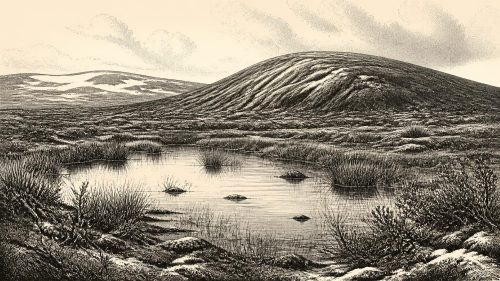
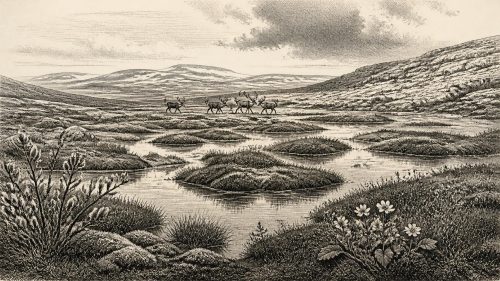
Irish sub-till organic deposits, notably those at Derryvree and Maguiresbridge in County Fermanagh, preserve plant macrofossils, pollen and insects from earlier and fluctuating phases of the last glacial cycle. They demonstrate the great potential of wetland sediments to record sedges, mosses, dwarf shrubs and aquatic plants beneath later glacial deposits. Such sequences establish that cold-stage Ireland could contain freshwater pools, marshes and vegetated ground rather than being a featureless expanse of ice or bare rock.
They cannot, however, be securely assigned to this particular numerical year without a direct dated correlation. Their chief contribution is comparative. They show the kinds of local ecological mosaics that could develop during intervals when water was available and the climate was less extreme: shallow pools edged by sedges and mosses, open ground carrying hardy herbs, and sheltered places where low shrubs might take hold. There is no evidence for mature forest at this point. The economy of the landscape was biological rather than agricultural, governed by seasonal plant growth, animal movement, snow cover and access to water.
Regional change was already the defining force. Ice masses were growing elsewhere in the British–Irish Ice Sheet system and would later transform much of Ireland’s terrain. The maximum phase lay thousands of years in the future, but its eventual advance would scour bedrock, rearrange sediments and obliterate many open-air traces of earlier life. This helps explain why caves and protected sediment pockets matter so much. They are rare repositories that escaped complete removal, even if their contents were subsequently disturbed.
People: Possibility, Not Population
There is no securely excavated Upper Palaeolithic camp, hearth, stone-tool assemblage, dwelling, burial or human bone from Ireland that can be placed at or close to 30,567 BCE. Accordingly, no Irish community, language, kin group or political territory can responsibly be described. There were no recorded rulers, states, diplomacy or wars. Even the concepts of ‘Ireland’ and ‘Irish society’ are geographical conveniences here, not identities held by people at the time.
A reindeer femur from Castlepook has nonetheless made this period especially significant. It has been presented as bearing an incision consistent with a sharp stone edge, and has been associated with a date of roughly 33,000 years ago. If the mark is confirmed as a human butchery trace and is genuinely contemporary with the bone’s deposition, it would be evidence that one or more people handled a reindeer in Ireland well before the Last Glacial Maximum. That would be a major addition to the island’s human record.
But the inference remains limited. The bone came from an old cave collection rather than a newly excavated, sealed occupation layer; it has no associated tools, hearth or living floor. A single modified bone cannot demonstrate permanent settlement, a continuous population, a hunting territory or routine travel to the island. It may indicate a brief visit or a small party exploiting an animal. It may also require further taphonomic testing. The distinction matters: evidence for a possible human act is not evidence for a settled society.
Connections Beyond the Sea
Across Europe, Upper Palaeolithic people were adapting to cold, highly variable environments and hunting large game with sophisticated stone, bone and antler technologies. Ireland’s faunal record shows ecological connections with Britain and continental Europe, but it supplies no securely Irish material culture from this moment. It would be unsafe to assign Castlepook people, if any were present, to a named archaeological culture solely because a contemporary mainland culture is known.
Nor can trade or seafaring be reconstructed from the evidence. Lower sea levels altered the shape of the surrounding shelves, while advancing ice and changing coastlines complicated routes between Ireland and Britain. Whether people could have reached Ireland on foot across ice, by crossing exposed terrain and channels, or by watercraft is a question for particular times and places, not one answered by one bone. No boat, exchange good or imported tool documents contact at this date.
Culture Without Monuments
There is no basis for identifying religion, art, formal learning or funerary custom in Ireland around this point. Cave deposits should not be confused with ceremonial cave use: animal bones in a cave primarily require natural explanations before ritual ones. The elaborate cave art, figurines and burials known elsewhere in Upper Palaeolithic Europe demonstrate what some human groups were capable of, but they cannot be projected across the sea into an Irish archaeological silence.
The most meaningful story for this date is therefore environmental and evidential. Around the boundary of Greenland Interstadial 5.2, Ireland was a cold Atlantic landscape in transition, intermittently capable of supporting varied animal communities. At Castlepook near Doneraile, cave deposits preserve a rare, imperfect record of that world: predators and grazers, perhaps mammoth and reindeer, and a tantalising but unresolved indication of human activity. The approaching glacial advance would erase much else. What survives asks for precision in method and restraint in imagination.
Primary Sources
- A Stratigraphic Framework for Abrupt Climatic Changes During the Last Glacial Period Based on Three Synchronized Greenland Ice-Core Records: Refining and Extending the INTIMATE Event Stratigraphy
- A Reconsideration of the Radiocarbon Dating of the Marine Isotope Stage 3 Fauna from Southern Ireland
- The Irish Quaternary Fauna Project
- The Exploration of Castlepook Cave, Co. Cork. With 3 Plates
- 2022:564 – Castlepook Cave, Castlepook South, Cork
- First Evidence of a Late Upper Palaeolithic Human Presence in Ireland
- New Insights on the Fauna of Ireland's Younger Dryas and Early Holocene from Alice & Gwendoline Cave
- The Colonization of Ireland: A Human Ecology Perspective
- Figure 6.— The Subdivision of the Quaternary Period in Ireland
- The Last Eurasian Ice Sheets – a Chronological Database and Time-Slice Reconstruction, DATED-1
- Sedimentology and Chronology of the Advance and Retreat of the Last British-Irish Ice Sheet on the Continental Shelf West of Ireland
- Pattern and Timing of Retreat of the Last British-Irish Ice Sheet
- Growth and Retreat of the Last British-Irish Ice Sheet, 31,000 to 15,000 Years Ago
- Dating Constraints on the Last British-Irish Ice Sheet: A Map and Database
- The IntCal20 Northern Hemisphere Radiocarbon Age Calibration Curve (0–55 cal kBP)
- The IntCal20 Northern Hemisphere Radiocarbon Age Calibration Curve (0–55 cal kBP)
- OxCal
- The Stratigraphic Position and Age of the Gortian
- Ireland's Palaeolithic Archaeology – Fleeting Footprints in a Frozen Land
- The Exploration of Castlepook Cave: Contemporary Review in Geological Magazine