Derryvree’s Glacial Overrun30340 BCE
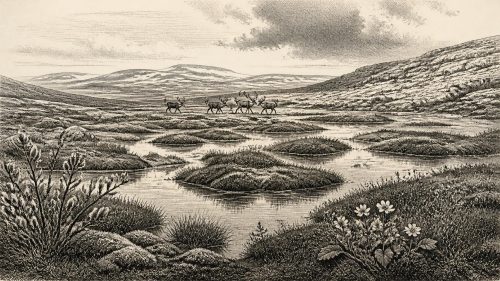
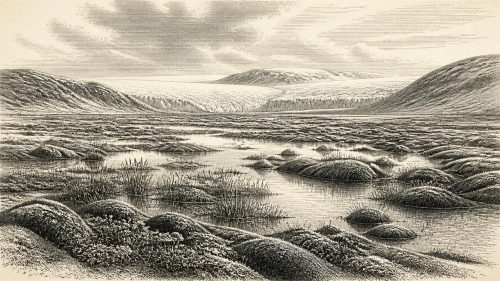
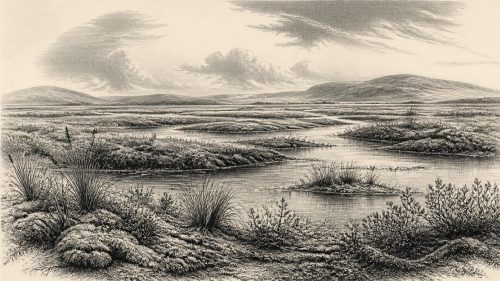
At 30,340 BCE, Ireland’s past can be reconstructed only broadly from environmental evidence. Derryvree in Fermanagh preserves organic freshwater sediments between glacial tills, dated broadly to later Marine Isotope Stage 3. They show an ice-free periglacial wetland with tundra vegetation, mosses, sedges and shallow water, later buried by renewed ice. Climate fluctuated sharply, with mobile ice margins. Southern cave remains indicate intermittent access for mammoth, reindeer and other cold-stage fauna, though they do not represent a single time or community. A possibly cut-marked reindeer bone suggests tentative human contact, but no evidence supports permanent settlement or social organisation in Ireland.
Dateline
Modern calendar-year precision is not available for Ireland in 30,340 BCE. No written chronology, settlement layer or environmental deposit can be assigned responsibly to that individual year. The date is best treated as a point within the Late Pleistocene, around 32,290 calendar years before AD 1950, in Marine Isotope Stage 3 (MIS 3). Ireland’s history at this depth is reconstructed from glacial sediments, fossil plants and insects, cave faunas, radiocarbon measurements and wider North Atlantic climate records. These sources can illuminate a broad interval; they cannot supply an annal of events.
The closest substantial Irish environmental archive is at Derryvree, near Maguiresbridge in County Fermanagh. There, roadworks in 1969 exposed freshwater silts and fine sands rich in organic matter between two thick tills, the unsorted deposits left by glacial ice. The sequence is important because its order is unambiguous: ice had occupied the ground, a wetland then formed during an ice-free interval, and later ice or glacial sediment sealed the wetland below another till. Its radiocarbon determination, BIRM-166, was reported as 30,500 radiocarbon years BP, with a large uncertainty. Radiocarbon years are not calendar years; calibration against changing atmospheric carbon levels turns that result into a broad range rather than a date on which one can hang a particular season or occurrence.
A Date Within a Range
Later use of modern calibration curves places the Derryvree determination broadly in the later MIS 3 world, approximately c. 37,000–31,700 calibrated years BP. The nominal year 30,340 BCE falls near the younger part of that wide window. This makes Derryvree directly relevant, but it does not prove that every organism in its deposits lived in 30,340 BCE, nor that the whole island shared precisely the same conditions. A sediment bed accumulates over time, and a dated sample provides an estimate with statistical limits. The responsible historical question is therefore not “what happened in Ireland that year?” but “what sort of Irish landscape is securely evidenced for the interval into which that year falls?”
The older term “Derryvree Cold Phase” is useful shorthand for this episode in the Irish Quaternary sequence. It should not be imagined as a single, island-wide freeze. Greenland ice cores show that the last glacial period was marked by abrupt changes between colder stadials and comparatively milder interstadials. At Crag Cave in County Kerry, episodic growth of stalagmites provides separate evidence that south-west Ireland responded sensitively to such fluctuations: calcite could form only when liquid water, soils and temperatures permitted it. The precise alignment of every Irish deposit with every Greenland event remains a matter of chronological interpretation, but the larger conclusion is secure. Ireland’s climate was unstable, and its ice margins were mobile.
Water Between the Tills
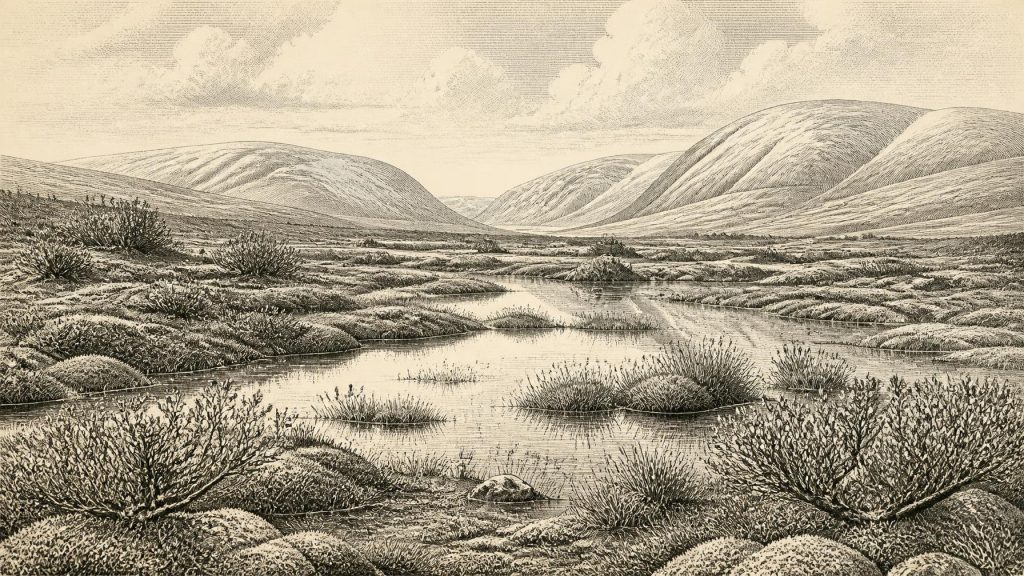
Derryvree preserves something easily lost from popular pictures of the Ice Age: a functioning freshwater landscape. The fossil assemblage in the organic silts included remains of wetland and open-ground vegetation, mosses and small invertebrates. Its investigators interpreted the evidence as open tundra vegetation within a periglacial climatic regime. “Periglacial” does not mean that a glacier stood on the precise spot. It describes ground exposed to severe cold, frost action and the influence of nearby ice, where seasonal thaw, snowmelt and poorly drained hollows could create pools and saturated soils.
The plants point to a treeless setting rather than a forested refuge. Grasses, sedges, herbs, mosses and low shrubs could exploit a short growing season. Fossil bogbean or buckbean (Menyanthes trifoliata) indicates wet ground or shallow freshwater, while dwarf willow and arctic-alpine elements are consistent with cold open terrain. Such evidence supports a mosaic of shallow water, sedge margins, damp mossy surfaces and exposed mineral ground. It does not justify a detailed painted panorama of the whole island. Derryvree was one locality in what is now Fermanagh, and local relief, drainage, snow cover and proximity to ice would have mattered greatly.
Nevertheless, the deposit overturns the idea that Ireland was continuously a featureless ice sheet throughout the last Ice Age. For at least part of the interval represented by the silts, water stood or moved slowly in a hollow and plants completed their life cycles. Insects and other small organisms inhabited the wetland. Frost, wind and seasonal melt shaped the surrounding ground. Yet this was not benign country. The absence of woodland signals hard ecological limits: long winters, exposed terrain, short summers and likely repeated freezing. The later upper till records a renewed advance or overriding of glacial ice, which buried and protected this fleeting ecological archive.
Animals at the Atlantic Edge
Caves in southern Ireland provide a different, less tightly dated kind of evidence. Castlepook Cave, near Doneraile in County Cork, is the most significant Irish repository of cold-stage mammal remains. Historic excavations recovered material attributed to mammoth, reindeer, giant deer, wolf, red fox, Arctic fox, stoat, lemmings, bear and spotted hyaena. The assemblage establishes that, at various points in MIS 3, parts of Ireland were accessible to a remarkable cold-climate fauna. Reindeer and mammoth imply open feeding grounds; Arctic fox and lemmings indicate severe environments; hyaenas and wolves reveal predators and scavengers within a larger food web.
There are essential cautions. Castlepook’s cave deposits accumulated over a long period, and much material came from early twentieth-century investigation rather than modern excavation of intact, finely recorded layers. Recent reassessment of radiocarbon dates has shown that some older estimates for southern Irish fauna needed revision. A list of species from the cave is therefore not a list of animals all alive together, still less an inventory for a single year. Nor should the Fermanagh wetland be merged casually with the Cork cave. The sites are separated by geography and by the different ways caves and freshwater sediments trap and preserve evidence.
A reindeer femur from the Castlepook collection has attracted particular attention because a deep incision has been interpreted as a possible fresh-bone cut made by a stone tool. If that reading and its chronological association are sustained by fuller publication and analysis, it may indicate a very early human encounter with an animal carcass in Ireland during this broad period. Its importance lies precisely in its rarity. It is not a settlement surface, hearth, tool assemblage, dwelling or burial, and it cannot demonstrate a resident population, a route of arrival or continuing occupation.
What Cannot Be Reconstructed
There are no recoverable political affairs for Ireland in 30,340 BCE: no named peoples, rulers, territorial boundaries, diplomacy, laws or institutions. There is likewise no sound basis for describing warfare, trade, kinship systems, language, religion, art, formal learning or domestic routines. The archaeological record supplies neither monuments nor graves, neither stores of goods nor evidence for exchange. It would be misleading to borrow the rich record of Upper Palaeolithic societies elsewhere in Europe and present it as Irish evidence. Similarities in climate or fauna do not establish that the same communities, customs or technologies existed here.
This evidential silence is not proof that no person ever entered the island during the period. It is a statement about what has survived and been securely identified. The human question is particularly difficult because glacial advances could remove, disturb or bury open-air traces, rising seas later altered coastal landscapes, and caves have complex depositional histories. The strongest securely documented human evidence in Ireland remains vastly later than the Derryvree interval, while the Castlepook femur is a valuable but limited lead. Around 30,340 BCE, environmental evidence is firmer than social history.
An Intermittently Living Landscape
The principal development appropriate to this date is thus ecological and glacial. Ireland was not yet the familiar wooded island of later prehistory, nor a historical country with a known population. It was part of a changing north-west European environment in which ice expanded and retreated, low vegetation colonised available ground, freshwater accumulated in sheltered hollows and large mammals entered suitable terrain. The British–Irish Ice Sheet was growing during the wider interval, though its extent changed markedly by region and through time. Derryvree’s lower and upper tills make the point on a local scale: a wetland world existed between episodes of ice.
For 30,340 BCE, the most defensible Irish narrative is consequently modest but vivid. In and around the date’s broad chronological horizon, a Fermanagh hollow held cold freshwater among sedges, mosses and low tundra plants. In southern caves, bones preserve evidence of an Ice Age animal world whose members did not necessarily share one moment. Somewhere within this unstable landscape there may have been opportunities for animal movement, and perhaps brief human visits, but not evidence of an enduring community. Ireland’s earliest recoverable past here is a history of water, frost, vegetation, fauna and advancing ice—not a calendar of invented events.
Primary Sources
- Middle Midlandian Freshwater Series at Derryvree, Maguiresbridge, County Fermanagh, Northern Ireland
- Middle Midlandian Freshwater Series at Derryvree, Maguiresbridge, County Fermanagh, Northern Ireland
- Figure 6—The Subdivision of the Quaternary Period in Ireland
- The IntCal20 Northern Hemisphere Radiocarbon Age Calibration Curve (0–55 cal kBP)
- IntCal: History
- A Stratigraphic Framework for Abrupt Climatic Changes During the Last Glacial Period Based on Three Synchronized Greenland Ice-Core Records: Refining and Extending the INTIMATE Event Stratigraphy
- Episodic Speleothem Deposition Tracks the Terrestrial Impact of Millennial-Scale Last Glacial Climate Variability in SW Ireland
- Growth and Retreat of the Last British–Irish Ice Sheet, 31,000 to 15,000 Years Ago: the BRITICE-CHRONO Reconstruction
- BRITICE-CHRONO Maps and GIS Data of the Last British-Irish Ice Sheet 31 to 15 ka
- The Timing and Magnitude of the British–Irish Ice Sheet Between Marine Isotope Stages 5d and 2
- The Deglaciation of the Western Sector of the Irish Ice Sheet from the Inner Continental Shelf to its Terrestrial Margin
- Timing and Pace of Ice-Sheet Withdrawal Across the Marine–Terrestrial Transition West of Ireland During the Last Glaciation
- Oscillating Retreat of the Last British-Irish Ice Sheet on the Continental Shelf Offshore Galway Bay, Western Ireland
- Deglaciation Chronology of the Donegal Ice Centre, North-West Ireland
- Trimlines, Blockfields and the Vertical Extent of the Last Ice Sheet in Southern Ireland
- A Reconsideration of the Radiocarbon Dating of the Marine Isotope Stage 3 Fauna from Southern Ireland
- Occurrence of Mammalia Relicts at Site Castlepook Cave
- First Evidence of a Late Upper Palaeolithic Human Presence in Ireland
- New Insights on the Fauna of Ireland's Younger Dryas and Early Holocene from Alice & Gwendoline Cave
- The Mesolithic in Ireland: When Was It?
- The Problem of a Late Quaternary Landbridge Between Britain and Ireland
- Biogeography of Ireland: Past, Present, and Future