Valentia Signals, Lombard Oaths1858 CE
In 1858, Ireland experienced political, technological and social change. James Stephens founded the secret Irish Republican Brotherhood in Dublin, supported by Irish-American networks and committed to republican revolution. Valentia Island became the Irish terminus of the first transatlantic telegraph cable, briefly linking Britain and North America before failure. Post-Famine society continued to be reshaped by emigration, altered farming, poverty administration and Griffith’s Valuation. Infrastructure included Ballinacourty lighthouse, while Edward James Harland acquired Belfast’s Queen’s Island shipyard. Dundalk opened a free public library. These developments revealed uneven modernisation, connecting Ireland more closely with Atlantic migration, imperial commerce, industry and revolutionary politics.
Dateline
In 1858, Ireland stood at two sharply different thresholds. On the Atlantic edge of County Kerry, engineers made Valentia Island a western terminus of an astonishing experiment in instant communication with North America. In Dublin, meanwhile, James Stephens and a small circle of associates began the secret organisation that would develop into the Irish Republican Brotherhood (IRB). One undertaking relied on capital, science, ships and imperial connections; the other on private oaths, personal trust and a belief that Irish independence could be won only by revolution. Neither story represented the experience of most people on the island. Yet both were rooted in a society still being remade by the Great Famine, emigration, new systems of administration and uneven economic change.
A Brotherhood Begins in Dublin
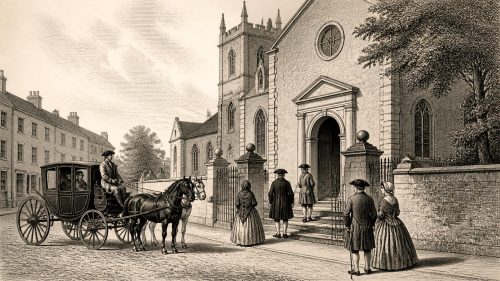
The best-established political event of the year occurred on St Patrick’s Day, 17 March. James Stephens, a former participant in the Young Ireland rising of 1848, received funding and authority from Irish-American supporters to organise a revolutionary movement in Ireland. That day, he and his associates took an oath directed towards the creation of an independent democratic republic. The body did not at once possess the elaborate membership or nationwide reach associated with later Fenianism, and its early title was not always used consistently. Historians nevertheless treat this moment as the foundation of the Irish Republican Brotherhood.
Its method mattered as much as its declared aim. Stephens drew lessons from the failure of 1848: an open, poorly prepared rising could be crushed quickly. The new organisation was intended to be secret, disciplined and organised through small units led by trusted ‘centres’. It aimed to join political purpose to patient preparation rather than depend upon parliamentary lobbying or a single dramatic insurrection. Stephens became known as the ‘head centre’, though the movement’s apparent hierarchy should not obscure its fragile beginnings. In 1858 it was still a small conspiracy, dependent on personal networks and money sent from across the Atlantic.
The transatlantic connection was fundamental. John O’Mahony, Michael Doheny and other exiles in the United States kept alive the memory of Young Ireland and sought to turn emigrant resources into action at home. The later Fenian Brotherhood in America and the IRB in Ireland were distinct organisations, but they were linked by people, funds and a shared republican outlook. This was a new political consequence of migration: the dispersal of Irish people did not end their engagement with Ireland. It created channels through which news, remittances, political arguments and revolutionary ambitions could return.
The year also supplied an early warning of how vulnerable such work was to surveillance. Jeremiah O’Donovan Rossa’s Phoenix National and Literary Society had been formed at Skibbereen in 1856, publicly presenting literary and national interests while also nurturing physical-force ideas. It was brought into Stephens’s growing network during 1858. On 5 December, Rossa and other local activists were arrested. They were held for months before trial, demonstrating both the authorities’ readiness to act against suspected conspiracy and the risks faced by men whose political activity was only beginning to acquire the name ‘Fenian’.
It would be wrong to project the importance that the IRB later attained back onto every corner of Ireland in 1858. Constitutional nationalism, local concerns, religious allegiance and the necessities of work and migration remained much more immediate for most households. But the founding oath was consequential. It created an institutional thread that ran through the Fenian movement of the 1860s and, by complex later routes, into the revolutionary politics of the early twentieth century.
Valentia and the Atlantic Experiment
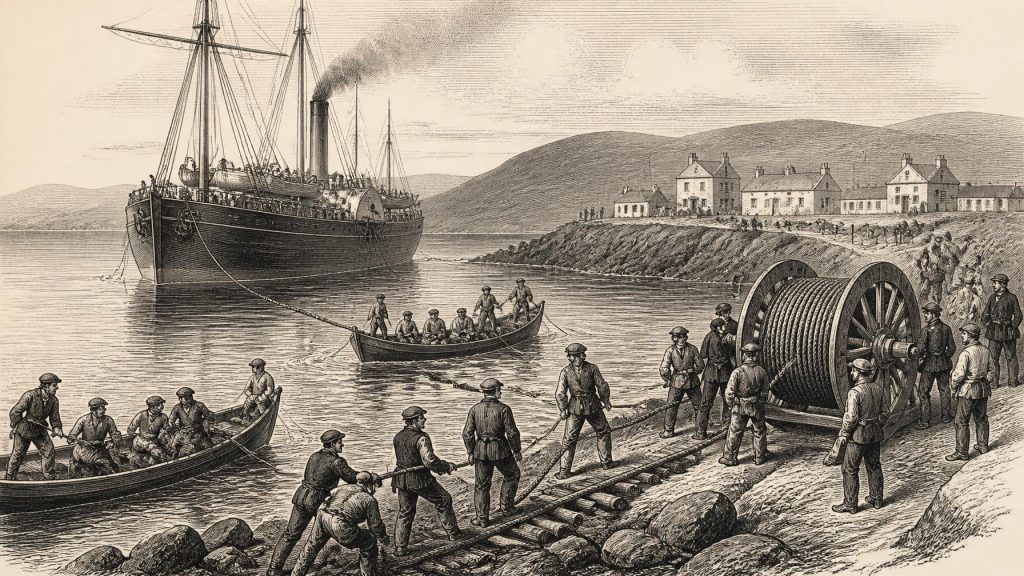
At almost the same time that clandestine republican links were being formed, Ireland became a conspicuous point in a very public international network. The Atlantic Telegraph Company’s cable-laying expedition reached its destinations in early August: the Agamemnon landed the Irish end at Valentia Harbour on 5 August, while the Niagara reached Trinity Bay, Newfoundland. The cable connected Ireland to the existing British telegraph system, making the island the European gateway for an attempted electrical link to North America.
For several weeks, the achievement seemed to abolish the old tempo of oceanic communication. News and diplomatic correspondence that normally travelled by ship over many days could, in principle, cross by electrical signal. The most celebrated exchange came on 16 August, when Queen Victoria’s message to President James Buchanan and his reply were transmitted through the cable. The process was far from instantaneous in practice: weak signals and technical limitations made transmission painfully slow. Yet the symbolism was immense. A remote Kerry harbour had become associated with a project advertised as binding continents together.
The success did not last. The cable’s performance deteriorated rapidly and it failed in early September. Its collapse exposed the gulf between a spectacular demonstration and a reliable commercial system; a durable transatlantic cable would not be achieved until 1866. Still, the 1858 attempt had placed Valentia in global public view and confirmed the strategic value of Ireland’s western seaboard to communications between Britain and North America. For local people, visiting crews, equipment, telegraph staff and the attention of reporters brought an unusual concentration of international activity to an island community.
The contrast with Fenian organisation is striking but not accidental. Both the cable and the IRB depended on connections across the Atlantic. One was backed by investors, naval vessels and engineering expertise; the other by emigrant politics and clandestine correspondence. In different ways, each made clear that Irish affairs could no longer be understood solely within the island’s shores.
Rebuilding After Catastrophe
For most of the population, 1858 was not defined by either a cable station or a secret oath. It was a year within the long, difficult post-Famine transformation. The all-Ireland population had fallen from 6,552,385 in the census of 1851 to 5,798,967 by 1861. Those figures do not provide a count for 1858, but they establish the direction of the decade: death and departure had changed the scale of communities, while emigration continued to drain young adults and prospective families from townlands, villages and ports.
Rural life was being reorganised rather than simply restored. Holdings were often larger than before the Famine, while the potato, though still important, no longer occupied the overwhelming position it had held in the pre-Famine subsistence economy. Cattle, dairying and other livestock-based farming gained relative weight in many areas. This did not make the countryside uniformly prosperous. Agricultural labourers, cottiers and small tenants could face insecure employment, low cash incomes and dependence on seasonal work. Regional differences were profound: commercial towns, linen districts and eastern farming country did not offer the same prospects as many western and south-western localities.
The Poor Law remained a hard-edged element of everyday administration. Workhouses, boards of guardians and the poor rate were no longer emergency inventions but established institutions shaping the choices of people in distress. The 1858 annual report of the Poor Law Commissioners recorded the continuing business of relief and, notably, disputes over the removal to Ireland of poor people from England and Scotland. Such cases reveal that poverty, mobility and official responsibility crossed the Irish Sea. The workhouse was a safety net, but one deliberately designed to be unattractive; entry could separate families and carry a lasting social stigma.
At the same time, the state’s view of land and household was being made more exact. Sir Richard Griffith’s Primary Valuation was in progress across the country, ultimately published county by county between 1847 and 1864. Valuers recorded occupiers, immediate lessors, buildings and land, and assigned a net annual value used for local taxation. In 1858 this immense survey was still turning fields, cottages, shops, mills, bogs and fisheries into administrative entries. It provides modern researchers with an invaluable record, but at the time it also made property the basis on which the costs of poor relief and local government were apportioned.
Coasts, Industry and Reading Rooms
Other firmly dated developments show a country of very uneven modernisation. On 1 July, the light at Ballinacourty Point, near the entrance to Dungarvan Harbour in County Waterford, was first exhibited. Designed by George Halpin junior, the lighthouse improved navigation on a coast where fishing, coastal trade and larger maritime routes all depended on safer approaches. It was a modest piece of infrastructure beside the drama of Valentia, but it served practical local and commercial needs year after year.
In Belfast, Edward James Harland bought Robert Hickson’s Queen’s Island shipyard in September 1858. Gustav Wolff was then Harland’s assistant; their formal partnership, and the famous name Harland & Wolff, would come in 1861. The purchase nevertheless marks a real beginning. Belfast’s industrial growth rested on linen, engineering, harbour works, shipping and access to British and overseas markets. Harland’s yard would soon employ more than a thousand workers, a sharp contrast to the rural underemployment found elsewhere on the island. Its future success was not predetermined in 1858, but the acquisition signalled the growing importance of iron shipbuilding on Belfast Lough.
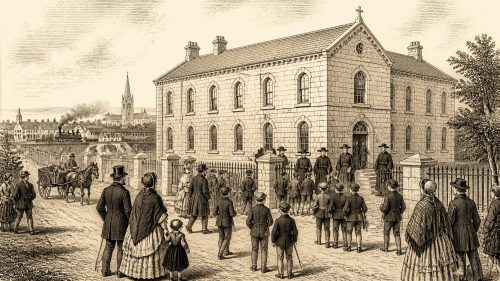
Learning and public culture also acquired a small but meaningful new space at Dundalk. The town’s Free Public Library opened during 1858 after the Literary and Scientific Institute transferred its books to the town commissioners. A lending library and reading room could not overcome unequal schooling, poverty or illiteracy, but it widened access to print beyond private collections and fee-paying institutions. This development sat within a contested educational landscape. The Catholic University in Dublin, lacking state funding and recognised degree-awarding powers, was struggling after John Henry Newman’s departure in 1858, while the Queen’s Colleges remained contentious for many Catholic bishops and families.
Thus 1858 was neither a clean beginning nor a settled recovery. It was a year in which Irish people inhabited altered landscapes of landholding, relief and migration, while new technologies and organisations stretched their horizons. The flickering messages from Valentia soon ceased; the oath taken in Dublin remained hidden. Both, however, pointed towards an Ireland increasingly connected—to America, to empire, to new industries and to political futures not yet visible to most of those living through the year.
Primary Sources
- Stephens, James | Dictionary of Irish Biography
- O'Donovan Rossa, Jeremiah | Dictionary of Irish Biography
- The Irish Republican Brotherhood | History Ireland
- The Sovereign People | Irish Political Thought and the Union
- History of the IRB
- Transatlantic Telegraph Cable | Valentia Island
- The First Transatlantic Telegraph Cable 1858 | Institution of Engineering and Technology
- Atlantic Telegraph Company: Minutes of Proceedings
- Messages Carried by the 1858 Cable
- The Laying of the Atlantic Cable: Paintings | Metropolitan Museum Journal
- The Telegraphic Messages of Queen Victoria and President Buchanan | Library of Congress
- Harland, Sir Edward James | Dictionary of Irish Biography
- Harland and Wolff | Science Museum Group Collection
- TITANICa: Harland & Wolff, The Beginning | Ulster Transport Museum
- Public Libraries Act | Ask About Ireland
- Ballinacourty Point Lighthouse | Irish Lights
- Ballynacourty Point Lighthouse | Buildings of Ireland
- Census Through History | Central Statistics Office
- What Is Griffith's Valuation? | Ask About Ireland
- The Union: Poor Law Unions and Their Records | Ask About Ireland
- 11th Annual Report of the Commissioners for Administering the Laws for Relief of the Poor in Ireland, 1858
- Agriculture: Crops and Livestock | Central Statistics Office
- Farming on the Eve of the Great Famine: Output and Productivity | Ireland: A New Economic History 1780–1939
- The Building of the State
- Information Object Browse: Catholic University Records | Irish Jesuit Archives