Free Trade1779 CE
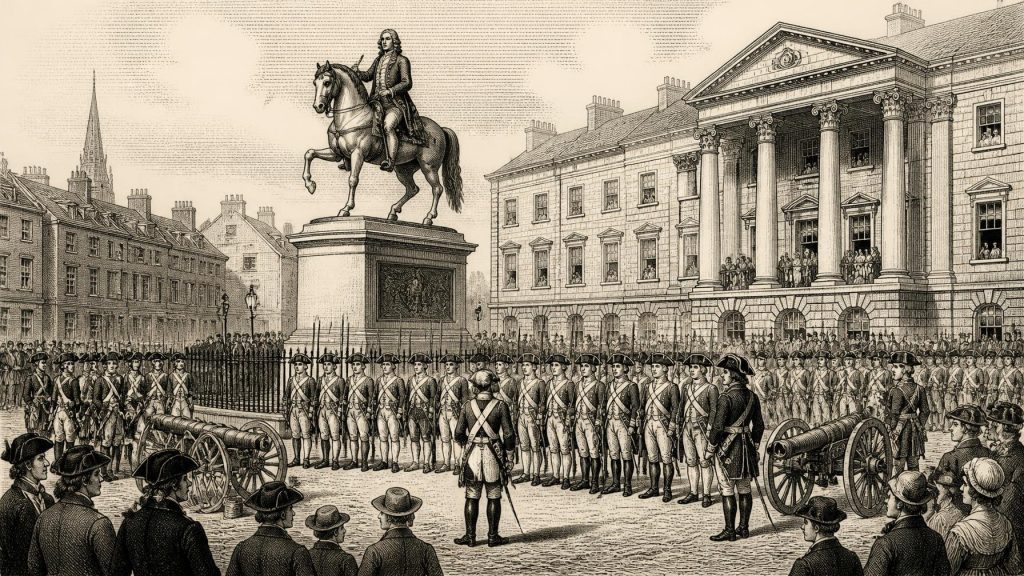
During 1779, war with France and Spain exposed Ireland’s defences, encouraging the growth of locally organised, predominantly Protestant Volunteers. Their armed presence strengthened a campaign for freer trade, prompted by imperial restrictions, falling agricultural prices and impaired credit. Merchants, producers and Patriot MPs, notably Henry Grattan, pressed the Irish Commons to seek commercial relief and use control of supply against government. On 4 November, Dublin Volunteers paraded artillery outside Parliament House, demanding free trade. Crowds added disorderly pressure. Britain promised concessions, although legislation followed later. The agitation linked popular mobilisation with parliamentary action and anticipated demands for Irish legislative independence.
Dateline
In 1779, Ireland’s most consequential political drama did not begin with an election, a rebellion or a new law. It took shape in armed drills, merchant resolutions, pamphlets, parliamentary manoeuvres and, on 4 November, a public display before the Irish Parliament House on College Green. The immediate issue was trade. Yet the agitation exposed a larger constitutional question: how far could an Irish parliament, dependent on the Crown’s administration and subject to Westminster’s asserted authority, protect the economic interests of the kingdom it governed?
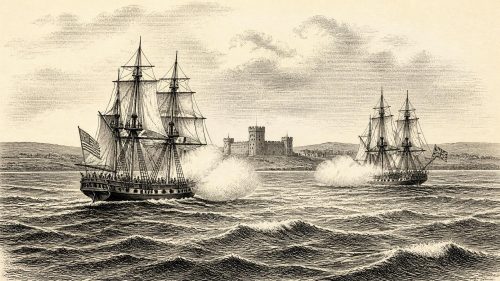
The year unfolded against the expanding American war. France had entered the conflict against Britain in 1778, and Spain joined France in 1779. Ireland, with a reduced regular military presence and a long, vulnerable coastline, appeared exposed to invasion. That danger gave urgency to the Volunteer movement: locally raised, armed companies intended to supplement defence. But the Volunteers’ importance soon extended beyond military preparedness. Their uniforms, parades and weapons made visible a political force that Irish merchants, Patriots in parliament and sections of the urban public could not ignore.
War, Defence and Armed Association
The Volunteers had begun to form in 1778, initially from Protestant property holders and middle-class townsmen concerned by the possibility of a French landing. During 1779 their numbers, geographical spread and public confidence increased sharply. They were not a national army directed by the state. Companies elected or accepted local officers, obtained arms and uniforms through local initiative, and cultivated civic prestige through reviews, dinners and ceremonies. Their character varied by district, but their public face was overwhelmingly Protestant, and the movement did not erase the political and legal divisions of eighteenth-century Ireland.
That limitation matters. The Irish House of Commons was elected on a narrow Protestant franchise; Catholics remained excluded from parliament and municipal corporations. The Catholic relief act of 1778 had eased major restrictions on Catholic landholding and inheritance, a significant change whose consequences were still new in 1779, but it had not produced political equality. Presbyterians, too, faced disabilities under the established Anglican order. Thus the Volunteer claim to speak for “Ireland” was powerful as rhetoric but incomplete as social fact. It nevertheless brought landlords, merchants, professional men, shopkeepers and artisans into a shared public language of country, commerce and constitutional liberty.
The threat from France gave this language particular force. Volunteers could present themselves as loyal defenders of the Crown and the island while simultaneously insisting that Ireland deserved better treatment within the British imperial system. This was not, in 1779, a straightforward demand for separation from Britain. Many leading Patriots envisaged a more prosperous Ireland within the empire. But defence in Irish hands made it harder for officials to dismiss Irish complaints as mere commercial lobbying.
Distress and the Meaning of Free Trade
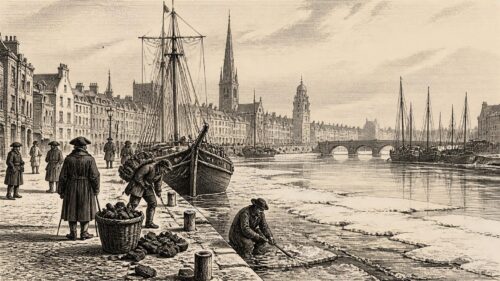
“Free trade” was the great slogan of the year, though contemporaries did not mean by it simply the modern ideal of low tariffs everywhere. They wanted the removal of restrictions that prevented Irish merchants and manufacturers from trading on terms closer to those enjoyed by Britain. Long-standing imperial rules had limited Irish access to colonial markets and had restrained Irish production or export in trades liable to compete with British interests, notably woollens and glass. The disruption of war made such restrictions feel still more damaging.
Economic grievance was reinforced by a difficult commercial climate. Arthur Young, writing his assessment of Ireland at the end of 1779, recorded widespread complaints among farmers and landlords as prices for agricultural produce fell. He noted particularly low butter prices and a marked decline in grain prices. Young was an observant but highly opinionated visitor, so his diagnosis should not be treated as a complete social survey. Still, his evidence captures a real contemporary sense of contraction: producers who had expected cash from livestock, butter, grain, linen or provisions faced unstable demand and constrained markets.
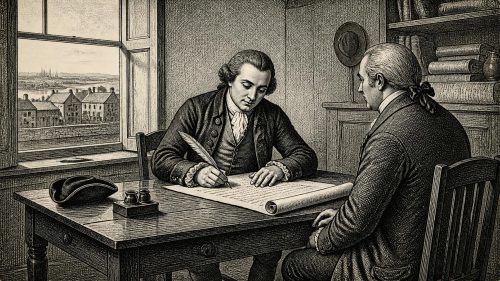
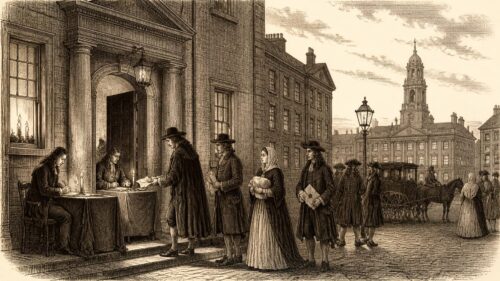
John Hely-Hutchinson’s The Commercial Restraints of Ireland, published in Dublin in 1779, gave these anxieties a sophisticated political-economic form. Hely-Hutchinson was no simple outsider: he held office, was provost of Trinity College and had close connections to government. Yet his pamphlet marshalled evidence about declining revenue, impaired credit, the effects of war and the injury done to Irish trade. It argued, in language influenced by Adam Smith’s recent work, that a richer Ireland would strengthen rather than weaken the wider empire. The publication demonstrates that the free-trade campaign was not only a street movement. It was also a contest of printed argument, commercial information and competing ideas of imperial advantage.
Everyday life lay behind the abstractions. Linen spinning and weaving provided income across much of Ulster; cattle, butter, hides, pork and grain connected rural districts to ports such as Cork, Waterford, Limerick and Dublin. A restriction at Westminster, an embargo on provisions, a fall in overseas demand or a shortage of credit could reach a household through lower wages, reduced farm income or dearer borrowing. The demand for freer commerce therefore joined the interests of large exporters to those of smaller producers and urban tradespeople, even if its benefits would never have been shared equally.
Parliament Takes Up the Demand
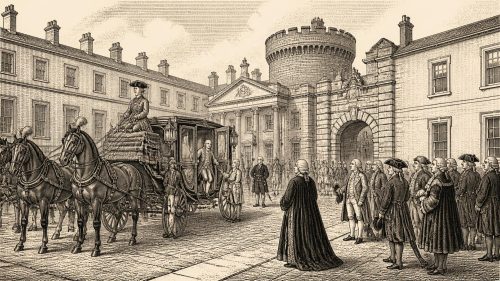
The Irish Parliament met on 12 October. In the opening speech at Dublin Castle, the lord lieutenant acknowledged that trade and commerce were central objects of public attention and referred to the kingdom’s distresses. Over 12 and 13 October the House of Commons ratified an address to the king seeking free trade. Henry Grattan emerged conspicuously in these debates as a Patriot spokesman. His importance lay not merely in eloquence but in connecting the economic claim to parliamentary leverage: he urged that supply should be granted only through a short, six-month money bill, rather than allowing ministers the security of longer financial provision.
This was a constitutional tactic of real consequence. Parliament’s authority over taxation and supply was one of the few effective instruments available to a representative body otherwise constrained by patronage, executive influence and Westminster’s claims of legislative supremacy. The free-trade campaign therefore converted commercial frustration into a test of whether Ireland’s Commons could insist upon conditions before voting public money. It also helped create a new alliance, never wholly stable, between Patriot parliamentarians and popular pressure outside the chamber.
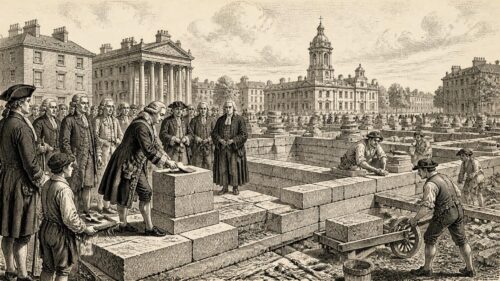
The alliance was on display when the Commons’ address was carried towards Dublin Castle under Volunteer protection. It was even more striking on 4 November, William III’s birthday. About 1,000 Dublin Volunteers, including shopkeepers and the 2nd duke of Leinster, their colonel, assembled around the equestrian statue of William on College Green. Cannon fired volleys, while slogans attached to the artillery proclaimed the choice in blunt terms: “Free Trade—or this.” The setting was deliberately charged. William’s statue stood before Parliament House and evoked the Protestant constitutional settlement; the Volunteers used that symbolism to associate commercial redress with liberty and armed vigilance.
From Ceremony to Disorder
The College Green parade was disciplined theatre, but the agitation could not be fully contained by elite leadership. In mid-November a large crowd of Dublin artisans gathered around Parliament House demanding free trade and attacked the home of John Smith, the attorney general. Efforts were also made to pressure members of parliament into promising that they would support free trade and short money bills. Such incidents should not be mistaken for an organised revolution: the Volunteers, the Dublin crowd and parliamentary Patriots did not constitute one uniform movement. They do show, however, that the free-trade issue had escaped the drawing rooms and chambers of the political class.
For government, this was a dangerous conjunction. Britain was fighting a major international war; Ireland required defence; its revenue and commerce were under strain; and armed citizens were demonstrating beside the legislature. On 25 November, when the British Parliament met, Lord North’s ministry moved towards meeting Ireland’s commercial grievances. The decisive statutory changes were not all completed within 1779: measures easing particular restrictions followed over the ensuing months of 1779–80. That distinction is important. By the close of this calendar year, Ireland had won a political commitment to substantial relief, not yet the full legal settlement often summarised as the achievement of “free trade”.
A Painted Political Moment
One reason 1779 remains unusually vivid is that its defining demonstration was recorded almost at once. Francis Wheatley’s painting, The Dublin Volunteers on College Green, 4th November 1779, made in 1779–80, shows the city’s Volunteers gathered around William III’s statue. Wheatley was present at the event. The work is not a neutral photograph of the crowd: it gives prominence to uniforms, rank, ceremony and spectatorship. Yet it preserves an essential truth about the year. Political change was being made visible in public space, through bodies, weapons, print, ceremony and the claim that Irish prosperity was a matter of national right.
1779 did not settle Ireland’s constitutional position, abolish the penal order, democratise parliament or guarantee prosperity. Its importance lies in setting a new relationship between public mobilisation and parliamentary action. The commercial concessions set in motion that winter would soon lead Patriots and Volunteers to ask a further question: if trade depended upon British permission, how secure could Irish liberty be? College Green’s cannon had announced a demand for commerce. They also foreshadowed the struggle for legislative independence that would follow.
Primary Sources
- Through a Lens Tour: Irish History — The Dublin Volunteers on College Green, 4th November 1779
- The Volunteers of the City and County of Dublin, 4 November 1779
- The Dublin Volunteers on College Green, 4th November 1779
- Grattan, Henry
- Caulfeild, James
- Fitzgerald, William Robert
- Tandy, James Napper
- Hutchinson, John Hely-
- Meeting Ireland's Terms
- A Tour in Ireland: State of Ireland, Brought Down to the End of the Year 1779
- A Tour in Ireland; with General Observations on the Present State of that Kingdom
- The Commercial Restraints of Ireland
- Part 11: History of the Commercial and Financial Relations Between England and Ireland
- Part 12: History of the Commercial and Financial Relations Between England and Ireland
- An Enquiry How Far the Restrictions Laid upon the Trade of Ireland Are a Benefit or Disadvantage
- The Catholic Relief Act in Ireland, 1778
- Ecclesiastical Politics and the Dismantling of the Penal Laws in Ireland, 1774–82
- The Catholic Relief Act, 1778
- ‘More Patrick’s House than Any Other’: Parliament House, Bank of Ireland and the Iconography of the Irish Patriotic Project
- Ireland in the Age of Revolution, 1778–1803