Omagh Castle1512 CE
In 1512, Irish power rested on military mobility, castles, hostages, revenue and patronage amid overlapping crown, Gaelic and ecclesiastical jurisdictions. Returning from pilgrimage, Aodh Dubh O’Donnell raised hired troops, defeated Edmund Burke’s forces, destroyed Esker castle, secured hostages, and compelled Art O’Neill to terms before rebuilding Omagh castle, asserting authority in Tyrone. Meanwhile, Gerald FitzGerald, earl of Kildare and justiciar, campaigned through Connacht and Ulster, capturing and demolishing strongholds including Belfast. Annals also record church patronage, learned households, deaths and Dublin appointments, demonstrating that warfare, negotiation, religion and administration jointly reshaped Ireland’s unsettled political landscape during this exceptionally documented year.
Dateline
In 1512, power in Ireland was displayed not principally through proclamations or fixed frontiers, but through the ability to move armed followers, take castles, exact hostages, feed retainers and make opponents accept terms. The year is unusually well illuminated by the Irish annals. Their notices concern the northern and western lordships most closely, while also recording the actions of Gerald FitzGerald, eighth earl of Kildare and justiciar of Ireland. Together they reveal an island of overlapping jurisdictions: the English crown’s lordship, administered from Dublin but dependent on Kildare’s local strength; Gaelic lordships with their own dynastic claims; and church institutions that remained centres of patronage, burial, learning and hospitality.
Care is needed with chronology. The Annals of the Four Masters and Annals of Ulster both place much of the fighting under 1512, although their treatment of Aodh Dubh O’Donnell’s return from pilgrimage differs by an annal-year. The broad sequence is secure: O’Donnell returned to an unsettled north-west, raised a substantial force, and confronted both Art O’Neill of Tír Eógain and Edmund Burke, Mac William of Clanricarde. Exact dates are supplied only for a small number of deaths, not for the campaigns themselves.
A Pilgrim Returns
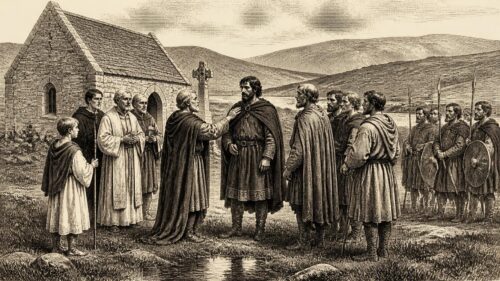
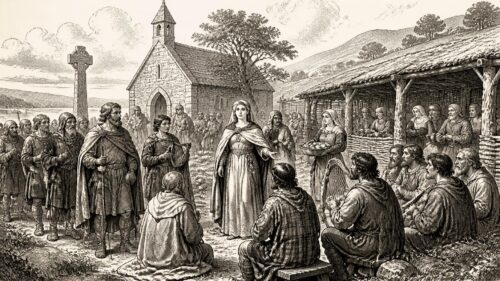
Aodh Dubh O’Donnell, lord of Tír Chonaill, had left Ireland for Rome in 1510 after a dangerous Munster campaign. His journey connected a Gaelic lordship directly with the wider Christian world. The Four Masters say that he spent sixteen weeks in London on the outward journey and another sixteen on the return, receiving honour from Henry VIII. A modern biographical study adds that the king knighted him in 1511. Yet O’Donnell’s return was not a simple homecoming. The annals report that he landed safely but was laid low by fever in Meath before travelling back to Donegal, where clergy and laity welcomed him.
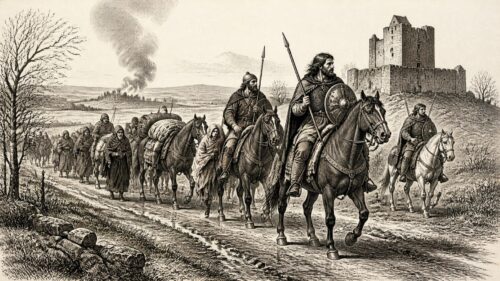
His absence had exposed Tír Chonaill. In 1511 Art O’Neill had raided into Donegal, burning Glenfinne and lands west of the Swilly and compelling O’Dochartaigh to provide hostages. O’Donnell’s response in 1512 was therefore at once retaliatory, strategic and demonstrative. He hired 1,500 axe-men from Tír Chonaill, Fermanagh and Connacht, and quartered them in those regions. This is a rare, vivid indication of the practical burden of war: local communities had to supply food and lodging for a large paid force, while the lord who could assemble such men announced both wealth and extensive influence.
War Along the Moy
O’Donnell’s first recorded operations ranged far into north Connacht. With his son Manus, he marched from Derry towards the castle of Béal an Chláir, in the country of Gallen, took the settlement and left a garrison. Edmund Burke, Mac William, countered by surrounding the place, but withdrew when O’Donnell approached. The struggle then shifted into Tír Fhiachrach, where Burke provisioned and garrisoned Esker castle. O’Donnell pursued him across Sliabh Gam. Burke escaped by swimming the Moy, while men, horses and armour were captured by O’Donnell’s pursuing force.
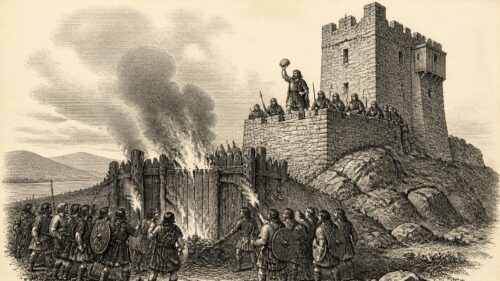
The castle of Esker fell after four days of hard labour. O’Donnell took Burke’s son and heir, Ulick, as a hostage, but granted protection to the captured warders; the fortress was then pulled down. Such episodes show that warfare involved more than open battle. A castle was a storehouse, a refuge, a command post and a claim to local lordship. Demolition denied an adversary a future base. Hostage-taking, meanwhile, was an instrument for enforcing an agreement or compelling good conduct, not merely an incidental cruelty. Burke subsequently met O’Donnell at Donegal and satisfied his demands sufficiently to recover his son.
Terms at Dungannon
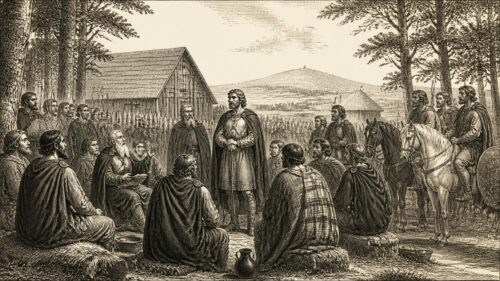
O’Donnell next led a coalition of chiefs from Lower Connacht and Fermanagh, together with hired soldiers, into Tír Eógain. The annals describe a week of burning and devastation as the army advanced to Dungannon, the O’Neill centre. Art O’Neill then made peace. In the terms recorded by the Four Masters, he surrendered disputed ancestral claims to the rents of Cénel Moen, Inishowen and all Fermanagh. Whether every detail of this formulation represented a permanent settlement is less certain than the immediate fact of O’Donnell’s military advantage; it nevertheless shows that revenue rights, not simply territory, lay at the heart of inter-lordship conflict.
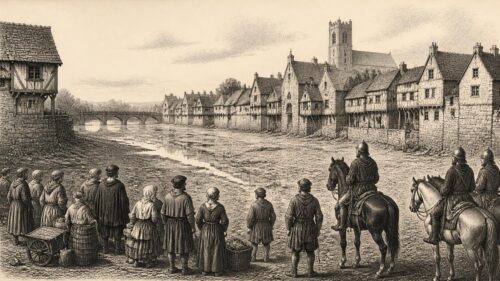
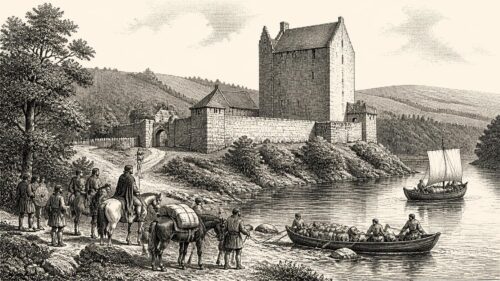
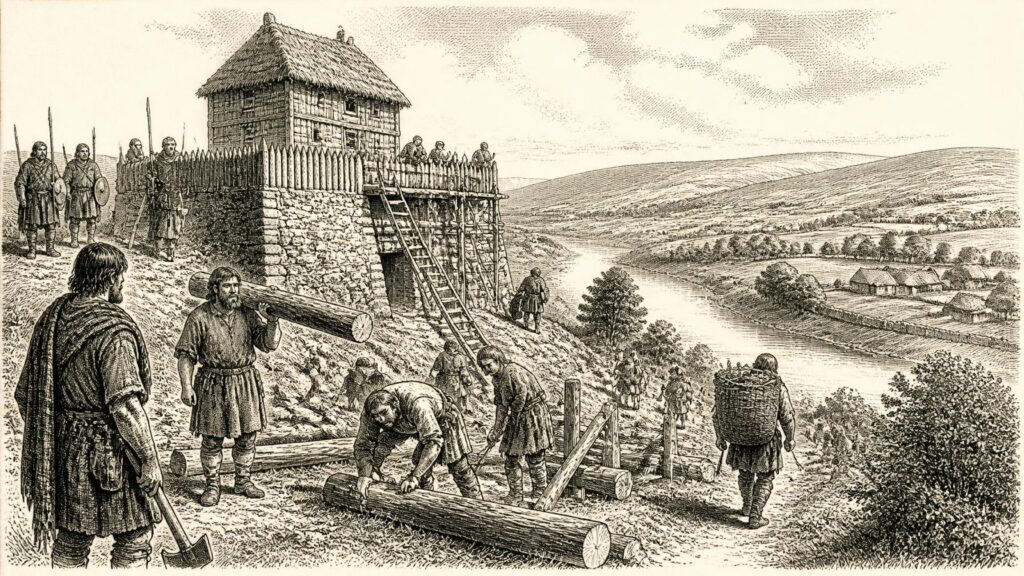
Afterwards O’Donnell went to Omagh and rebuilt its castle in a week, installing his own warders. The annals emphasise that Kildare had previously demolished the castle, in 1509. Its rapid reconstruction was a pointed assertion that neither Kildare’s earlier intervention nor O’Neill’s authority could determine the future of this strategic place. Omagh was not yet a modern county town but a contested strongpoint in the valley system linking Tyrone, Fermanagh and Donegal. The rebuilt castle made O’Donnell’s peace settlement tangible: garrison, timber, labour and a defended site translated a claim into presence.
Kildare’s Separate War
The same year also shows the extraordinary geographical reach of Kildare’s authority. Gerald FitzGerald was justiciar, the crown’s chief governor in Ireland, but his government rested heavily on his own magnate household, alliances and military following. Historians term this wider arrangement the Kildare ascendancy: English monarchs accepted a measure of delegated power because royal revenue and military resources in Ireland were limited. Kildare’s expeditions could therefore be presented as royal action while also strengthening his own family’s standing.
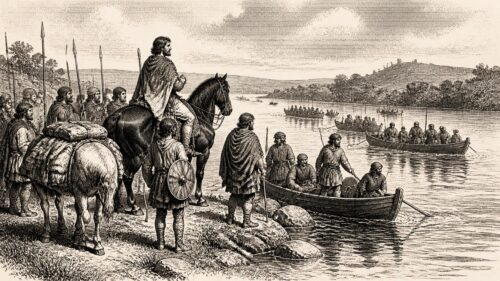
Marching west across the Shannon at Athlone, Kildare raided and burned Clann Conway, took Roscommon and left warders there. He continued into Moylurg, captured Baile na hUamha castle and devastated much of the surrounding country. O’Donnell brought a large force on foot through the Curlew Mountains to confer with him, apparently seeking a league. The encounter did not produce a clearly recorded formal alliance. O’Donnell turned back that night; a number of his men were killed at Bealach Buidhe; he then besieged Sligo and ravaged the lands of the descendants of Brian O’Conor without taking the town. The episode demonstrates diplomacy conducted under arms, with negotiation, raiding and siege existing side by side.
Belfast and Clandeboye
Kildare also campaigned in eastern Ulster against Trian Conghail, or Clandeboye. The annals state that he took the castle of Béal Feirste, demolished the castle of Mac Eoin Bissett in the Glens of Antrim, plundered the Glens and much neighbouring country, and carried off Aodh, son of Niall O’Neill, with other hostages. Béal Feirste was a castle site near the tidal ford and Lagan estuary, not the later industrial city; its value lay in controlling movement through a strategically placed river crossing. The campaign reached from the coast to the Glens, disrupting communities as well as lordly rivals through seizure of goods, burning and the removal of leading people.
The death of Niall Mór O’Neill, lord of Trian Conghail, on 11 April gave this campaign an added political charge. The Four Masters praise him as an independent lord who had not paid tribute to neighbouring powers or the English deputy; the Annals of Ulster say that he died at Carrickfergus after receiving communion and was buried with honour among the Franciscans. The tribute is conventional in form, but its emphases are revealing. Niall’s reputation rested on hospitality, support for churches and religious orders, and learning in history, poetry and music. Authority in Gaelic Ireland was expected to sustain intellectual and religious dependants as well as armed followers.
Church, Learning and Administration
Several deaths reinforce that picture. Tuathal Ó Cléirigh, ollamh, or chief learned poet, to O’Donnell, died on 12 November after receiving unction and penance. The annals remember him both as a master of history and poetry and as the keeper of an open house for poor and powerful alike. Art, son of Conn O’Donnell, died suddenly on 23 December in the Franciscan monastery at Donegal and was buried there. Margaret, daughter of Conchobhar O’Brien and wife of Eoghan O’Rourke, also died in this annal-year. The Annals of Ulster record that she was buried in a wooden church she had built beside the Friars Minor at Druim Dá Éthiar; Connacht annals associate her burial with the Franciscan foundation at Creevelea. These records preserve women’s religious patronage as a public and political act.
In Dublin, meanwhile, William Rokeby was transferred from Meath to the archbishopric in January and served as lord chancellor from May. His appointment represented a different strand of power: a canon lawyer, trained in England and elevated within the church, placed in a major office of the Dublin administration. It did not replace Kildare’s military system. Rather, 1512 shows crown office, magnate command, Gaelic lordship, monastic patronage and learned households functioning together, sometimes cooperatively and often in competition.
The year’s most lasting image is consequently not a single battle but Omagh’s rebuilt castle. It marked a settlement won by force, while Kildare’s captures at Roscommon and Belfast showed how rapidly another lord could undo local arrangements elsewhere. Across Ireland, fortresses could fall or rise within days; peace depended on warders and hostages; and prestige required generosity to churches, poets and dependants. In 1512, the political map was not fixed. It was continually remade by armies on the road, negotiations in camps, and the labour of rebuilding.
Source References
Hover over a number to see the source. Select it to open the source.

- [1] Annals of the Four Masters
- [2] The Annals of Ulster, Year U1512
- [3] Annála Connacht, Annal 1512
- [4] Annála Connacht
- [5] Annals of Loch Cé A.D. 1014–1590
- [6] FitzGerald, Gerald (Gearóid Mór)
- [7] O'Donnell (Ó Domhnaill), Sir Aodh Dubh
- [8] O'Neill, Niall Mór
- [9] O'Neill (Ó Néill), Aodh
- [10] Rokeby, William
- [11] O'Rourke (Ó Ruairc), Eoghan
- [12] O'Donnell, Manus (Ó Domhnaill, Maghnas)
- [13] English Lordship of Ireland and the Irish Sea World: Re-assessing the Origins of the Kildare Ascendancy, c.1390–c.1513
- [14] Tudor Policy and the Kildare Ascendancy in the Lordship of Ireland, 1496–1534
- [15] Food and Power in Sixteenth-Century Ireland: Studying Household Accounts from Dublin Castle
- [16] Béal Feirste / Belfast: ‘approach of/to the tidal ford’
- [17] Letters and Papers of Henry VIII: research guide
- [18] State Papers Ireland 1509–1782: government papers on Irish affairs
- [19] Letters and Papers, Foreign and Domestic, Henry VIII
- [20] The Cambridge History of Ireland: Bibliography
Primary Sources
- Annals of the Four Masters
- The Annals of Ulster, Year U1512
- Annála Connacht, Annal 1512
- Annála Connacht
- Annals of Loch Cé A.D. 1014–1590
- FitzGerald, Gerald (Gearóid Mór)
- O'Donnell (Ó Domhnaill), Sir Aodh Dubh
- O'Neill, Niall Mór
- O'Neill (Ó Néill), Aodh
- Rokeby, William
- O'Rourke (Ó Ruairc), Eoghan
- O'Donnell, Manus (Ó Domhnaill, Maghnas)
- English Lordship of Ireland and the Irish Sea World: Re-assessing the Origins of the Kildare Ascendancy, c.1390–c.1513
- Tudor Policy and the Kildare Ascendancy in the Lordship of Ireland, 1496–1534
- Food and Power in Sixteenth-Century Ireland: Studying Household Accounts from Dublin Castle
- Béal Feirste / Belfast: ‘approach of/to the tidal ford’
- Letters and Papers of Henry VIII: research guide
- State Papers Ireland 1509–1782: government papers on Irish affairs
- Letters and Papers, Foreign and Domestic, Henry VIII
- The Cambridge History of Ireland: Bibliography