Trim Miracles1412 CE
The surviving evidence for 1412 presents Ireland not as a single political unit but as a country of intensely local powers, connected by warfare, kinship, devotion and movement. Annalists recorded raids and counter-raids from the Moy to Fermanagh, the escape of a high-status captive from Dublin, a campaign across Connacht involving Gaelic and Anglo-Irish forces, and reports of miracles at a Marian shrine in Trim. These were not episodes on a national stage directed from one centre. They reveal overlapping lordships, towns and ecclesiastical institutions, each vulnerable to events beyond its own boundaries. The sharpest account of violence comes from the eastern edge of Bréifne.
Dateline
The surviving evidence for 1412 presents Ireland not as a single political unit but as a country of intensely local powers, connected by warfare, kinship, devotion and movement. Annalists recorded raids and counter-raids from the Moy to Fermanagh, the escape of a high-status captive from Dublin, a campaign across Connacht involving Gaelic and Anglo-Irish forces, and reports of miracles at a Marian shrine in Trim. These were not episodes on a national stage directed from one centre. They reveal overlapping lordships, towns and ecclesiastical institutions, each vulnerable to events beyond its own boundaries.
A Violent Night in Tullyhunco
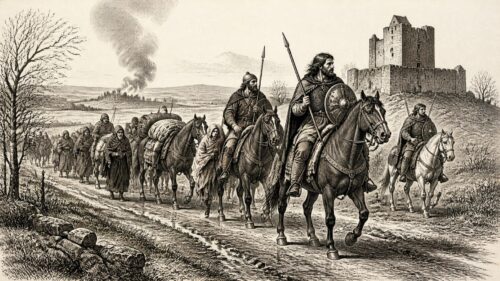
The sharpest account of violence comes from the eastern edge of Bréifne. Cú Connacht Mág Tighearnáin, chief of Tellaig Dunchada, was killed in his own house at Cruachan in a night attack by the Fir Manach, the people of Fermanagh. The Annals of Ulster add the most disturbing detail: the attackers killed women, men and children, burned the settlement of Mág Tighearnáin, and returned home safely. This was more than the removal of one rival lord. An attack on a chief’s residence, households and dependants could devastate a local community, destroy stores and livestock, and demonstrate that the lord had failed in the essential duty of protection.
Such a raid also illustrates the political geography of the period. Tellaig Dunchada lay in what is now north-west County Cavan, while the attackers came from the Fermanagh lordship to the north-west. Neither modern county boundaries nor a simple opposition between ‘Irish’ and ‘English’ explains the event. It belonged to a world in which neighbouring dynasties competed for security, cattle, clients, prestige and the strategic routes through lakes, woods and uplands. The annal’s stress on the night assault and the safe return of the raiders shows what contemporaries regarded as a successful military operation.
Losses among ruling families were reported elsewhere. Tigernán Óg Ó Ruairc, described as a notably capable son of a king and a man expected to become king of Bréifne without contention, died between Easter and May Day, according to the Connacht annals; he was buried at Sligo. His death did not itself record a battle, but it removed a potential stabilising successor in a lordship where succession could never be taken for granted. Domnall, son of Niall Ó Domhnaill, also died. These notices are brief, yet they register changes within the families whose alliances and rivalries shaped north-western politics.
Raiding, Retaliation and Food
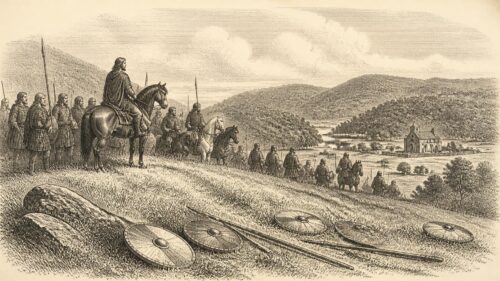
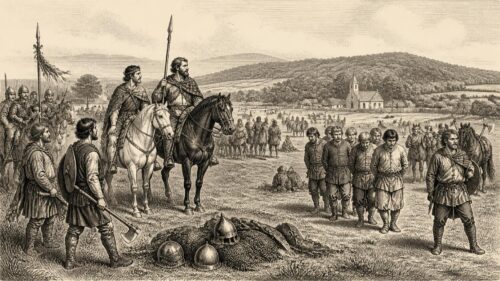
In north Connacht, Richard Barrett led a foray into Cúil Cearnú, generally identified with Coolcarney. Local nobles caught his party and drove it towards the River Moy, where Barrett drowned; many of his followers were drowned, killed or captured. The agreement between the Annals of Ulster and Annála Connacht makes this one of the firmer events of the year. It was a costly reversal for a raiding force, and the river itself became decisive terrain: pursuit could turn a mounted or mobile band into a trapped body of men at a crossing or bank.
Raiding was not merely a clash between armed elites. It exposed cultivators and settlements to the seizure of animals, the destruction of food and the taking of prisoners. In Meath, Domnall Ó Ferghail waged what the annals call a great war against the ‘Foreigners’ of Meath. Fore was burned and many people were killed or captured. The word ‘Foreigners’ in this context meant the English or Anglo-Irish population and political interests, not recent arrivals from overseas. The entry offers no reliable total for losses, but its pairing of burning, death and captivity indicates the human consequences borne by people well below the level of chiefs.
The year also saw a dispute within the Ó Domhnaill sphere. Ó Catháin and the sons of John Ó Domhnaill attacked the Ó Domhnaill, killing fourteen of their people. This small recorded number should not make the episode seem trivial. Northern lordship rested on negotiated allegiance among leading kindreds; killings within or around a ruling network could alter the balance of a wider conflict. The annals’ compressed notices preserve outcomes, rather than the negotiations, grievances and calculations that led to them.
Brian Ó Conchobair’s Connacht Circuit
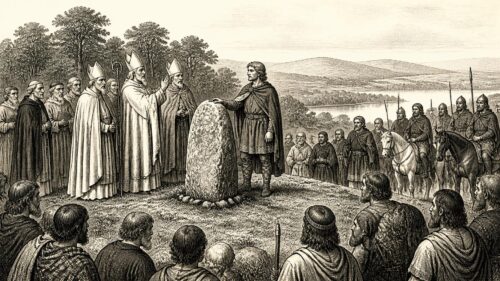
A much larger expedition, recorded by the Annals of Ulster, brought together the mixed political society of Connacht. Brian, son of Domnall Ó Conchobair, led a hosting into Gallen, Cera, Clann Cuain and Conmaicne, taking Clann Muiris and its predatory force with him. In opposition assembled Clann William de Burgh, the Uí Fhlaithbheartaigh, Muintir Mháille, Clann Goisdelb, the Jordans of Exeter, the Barretts and others. The annalist explicitly says that both ‘Foreigners and Gaels’ were present. That phrase matters: descent, language and inherited legal traditions did not create two sealed communities. Anglo-Irish and Gaelic lineages could fight together, bargain with one another or take opposite sides according to local interests.
Brian’s forces burned defended places at Caisleán an Bharraigh, Leth Inse and Lough Mask, cut the opponents’ cornfields and drove Clann Muiris back into its own territory. Cutting standing crops was a calculated assertion of power. It threatened the coming food supply, weakened a lord’s capacity to sustain retainers and could oblige an opponent to make terms without a pitched battle. The annalist concludes that Brian exacted peace from both the Foreigners and the Gaels of Connacht. That should be read as a claim of successful coercion, not as proof that the province entered lasting tranquillity. Indeed, the Connacht annals separately report that the town of Galway was burned in 1412, without securely identifying the perpetrators or circumstances. Even a growing walled port and market town was exposed to the conflicts around it.
Dublin Captivity and Ulster Politics
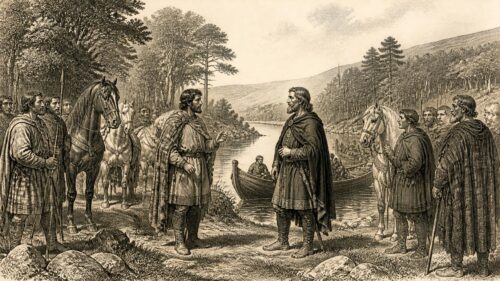
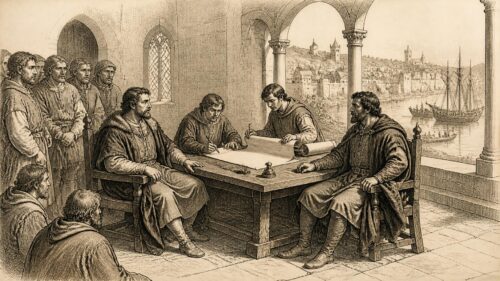
One of the year’s most consequential personal movements was the escape of Aodh, son of Henry Ó Néill, from Áth Cliath, medieval Dublin. The Annals of Ulster state that he had spent ten years in captivity there and escaped with many other captives. The Annals of the Four Masters identify among them a son of Maguire and a son of Ó Néill who was Aodh’s nephew. Hostage-taking was a political instrument, not simply imprisonment after war: prominent detainees could underpin agreements, restrain a lord’s family or provide leverage in negotiations.
The Four Masters further connect Aodh’s escape with renewed disorder across Ulster, as support was sought against Eoghan Ó Néill, Ó Domhnaill, Maguire and the men of Oirghialla. The precise sequence and scope cannot be reconstructed from this terse statement alone. Nonetheless, the escape plainly mattered beyond Dublin. It returned a claimant or political actor to northern networks after a decade away and released other valuable hostages at the same moment. This is a reminder that Dublin, though the seat of the English lordship’s administration, was woven into Irish lordly politics through detention, diplomacy and family rivalry.
The annals also record that Hugh de Lacy and the son of the earl of Kildare met at Cill Mochallóg and killed one another. The entry supplies neither a fuller cause nor a date within the year. Its importance lies in its stark evidence that prominent men associated with the English lordship could be drawn into lethal private conflict. Authority in and around the lordship of Ireland was fragmented not only by the power of Gaelic dynasties, but also by competition among magnates and their followers.
Mary at Áth Truim
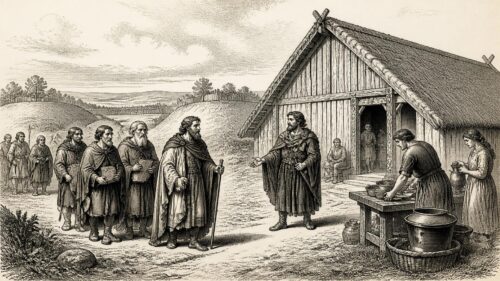
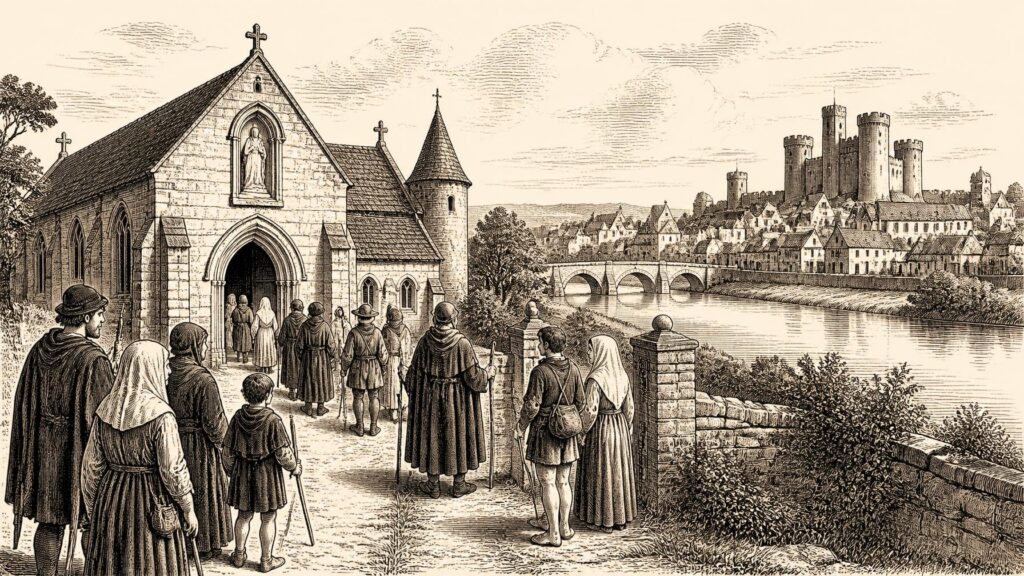
Against this background of coercion and insecurity, the annalists’ notice that the image of Mary at Áth Truim wrought great miracles in 1412 offers a different kind of movement: pilgrimage. The object was at the Augustinian priory of St Mary in Trim, County Meath. This was not a sudden invention of the year. Royal protection had been granted in 1400 to people travelling to the shrine, including those described in official language as Irish rebels as well as the king’s obedient subjects. The protection suggests that pilgrims’ journeys, lodging and offerings were already important to the priory and town.
The 1412 report does not specify individual cures or miracles, so none should be supplied. It does demonstrate that the shrine’s reputation had become strong enough to enter major Irish historical compilations. Pilgrimage brought people across political frontiers to seek healing, intercession or spiritual benefit; it also supported clergy, accommodation, food sellers, transport and the circulation of news. In a year when the annals so often present people as captives, raiders or victims, Trim’s Marian image points to another form of connection, organised around devotion and the institutional resources of an Augustinian house.
What 1412 Reveals
1412 cannot responsibly be reduced to one national turning point. Its firmly dated annalistic events are local, while their wider significance lies in the patterns they expose. Chiefly households could be destroyed in a night raid; crop-cutting and burning were weapons of political negotiation; towns such as Galway remained vulnerable; captive nobles linked Dublin to Ulster; and a shrine at Trim drew attention across divisions of status and allegiance. Ireland’s political landscape was a mosaic, but it was not isolated. Rivers, roads, fortified residences, market towns, churches and lordly networks joined its regions together—often through violence, and sometimes through faith.
Source References
Hover over a number to see the source. Select it to open the source.

- [1] The Annals of Ulster, Year U1412
- [2] Annals of Ulster otherwise Annala Senait, Year U1412
- [3] Annála Connacht, Annal 1412
- [4] Annals of the Four Masters, Annal M1412 (English translation)
- [5] Annals of the Four Masters, Annal M1412 (Irish text)
- [6] Annales Breves Hiberniae
- [7] The Annals of Ulster: CELT Project and Witness List
- [8] Annála Connacht: CELT Project
- [9] Annals of the Four Masters, Volume 4: CELT Project
- [10] Annals of the Four Masters: Manuscript Sources and Editorial Statement
- [11] The Miraculous Statue
- [12] Trim Castle
- [13] The Gaelic Learned Tradition
- [14] The Rise and Fall of the Clann Éinrí Aimhréidh Uí Néill: Dynastic Feuding and Geopolitics in the Late Medieval Irish Sea World
- [15] Richard II and the Wider Gaelic World: A Reassessment
- [16] Gaelic Ireland: Land, Lordship and Settlement, c.1250–c.1650
- [17] ‘Geographical Loyalty’? Counties, Palatinates, Boroughs and Ridings
- [18] Medieval Irish Political and Economic Divisions
- [19] The Annals of the Four Masters: Irish History, Kingship and Society in the Early Seventeenth Century
- [20] Annals of the Kingdom of Ireland: National Library of Ireland Catalogue
- [21] CELT: List of Published Texts
Primary Sources
- The Annals of Ulster, Year U1412
- Annals of Ulster otherwise Annala Senait, Year U1412
- Annála Connacht, Annal 1412
- Annals of the Four Masters, Annal M1412 (English translation)
- Annals of the Four Masters, Annal M1412 (Irish text)
- Annales Breves Hiberniae
- The Annals of Ulster: CELT Project and Witness List
- Annála Connacht: CELT Project
- Annals of the Four Masters, Volume 4: CELT Project
- Annals of the Four Masters: Manuscript Sources and Editorial Statement
- The Miraculous Statue
- Trim Castle
- The Gaelic Learned Tradition
- The Rise and Fall of the Clann Éinrí Aimhréidh Uí Néill: Dynastic Feuding and Geopolitics in the Late Medieval Irish Sea World
- Richard II and the Wider Gaelic World: A Reassessment
- Gaelic Ireland: Land, Lordship and Settlement, c.1250–c.1650
- ‘Geographical Loyalty’? Counties, Palatinates, Boroughs and Ridings
- Medieval Irish Political and Economic Divisions
- The Annals of the Four Masters: Irish History, Kingship and Society in the Early Seventeenth Century
- Annals of the Kingdom of Ireland: National Library of Ireland Catalogue
- CELT: List of Published Texts