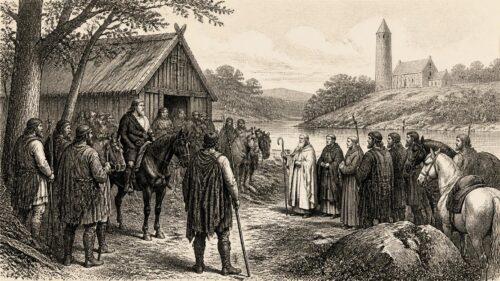
Callan Patron1407 CE
In 1407, conflict, succession, learning and subsistence shaped Ireland’s localised political world. Tadhg Ó Cearbhaill of Éile was killed at Callan by Stephen le Scrope’s forces during wider Leinster–Munster struggles; annalists praised him as a leading military protector and patron of poets. In Connacht, rivals contested the kingship, and Cathal Ó Conchobair’s defeat at Cell Achaid brought captures and losses. Archbishop Muirchertach Ó Ceallaigh died at Tuam, remembered for wisdom, charity and learning. Northern captures, raids and internal violence exposed fragile alliances. Very bad weather and cattle losses damaged regional livelihoods, while warfare, church authority and cultural patronage remained intertwined.
Dateline
A Year of Connected Wars
In 1407, Ireland’s political geography was not divided into neat national camps. Authority was intensely local, built around lordships, kin-groups, church offices, castles and alliances that could cross linguistic and cultural boundaries. Yet several events securely placed in this year show how quickly a conflict in one district could draw in men and interests from another. The year’s most resonant death was that of Tadhg Ó Cearbhaill of Éile, killed at Callan in September. His loss mattered not only in the warfare of south Leinster and Munster, but also because Irish annalists remembered him as an exceptional patron of learned people in Ireland and Scotland.
The surviving annals must be used carefully. They are not neutral administrative reports: they record what their compilers and patrons considered memorable, often attaching praise, blame and genealogical detail to events. Their agreement across several traditions nevertheless gives 1407 a firm outline. Warfare and captures are prominent, but so too are an archbishop’s death, a succession crisis in Connacht, the vulnerability of cattle in harsh weather, and the continuing value attached to poets, clerics and learned households.
Callan and Tadhg Ó Cearbhaill
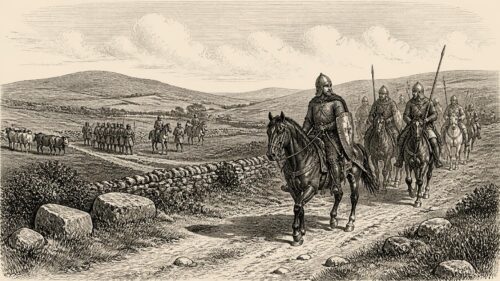
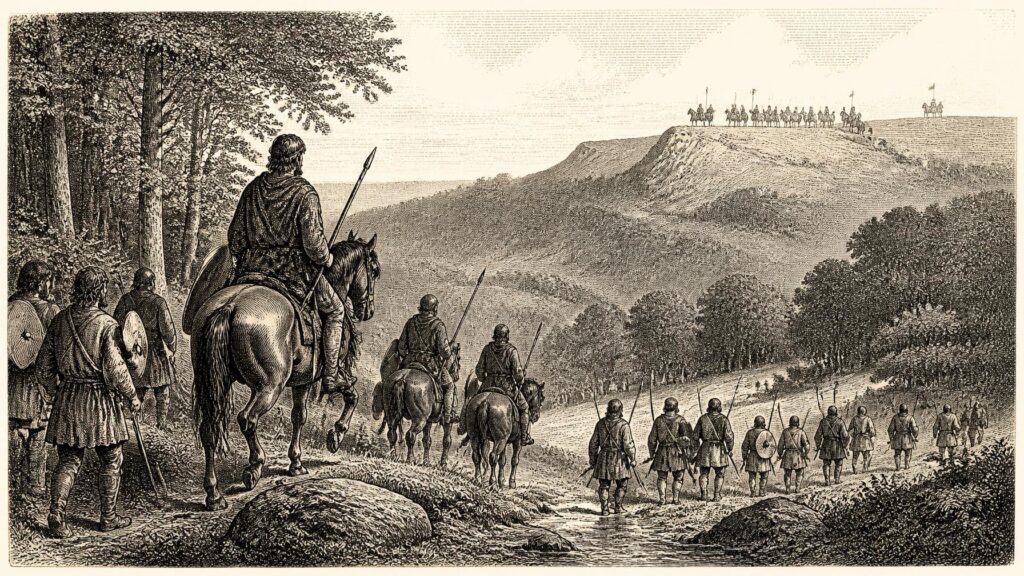
The best-documented episode occurred at Callan, County Kilkenny, on 9 September 1407. Tadhg Ó Cearbhaill, king of Éile, was defeated and killed by forces described in the Irish annals as the Foreigners or English, under Stephen le Scrope. Walter de Burgh, grandson of the Earl of Ulster, was captured in the same reverse. The immediate political setting was the struggle around Art Mac Murchadha Caomhánach, the dominant Gaelic lord of Leinster. Tadhg had renewed his association with Mac Murchadha’s cause after defeating an Ó Cinnéide branch linked to Butler interests; Scrope and the Anglo-Irish earl of Ormond then moved into Mac Murchadha’s heartland. Callan was therefore not an isolated border skirmish, but part of a wider contest over routes, lordship and military initiative across the Leinster–Munster frontier.
The defeat demonstrates the mixed character of armies and alliances in late medieval Ireland. Tadhg’s force included Walter de Burgh, a member of the great de Burgh connection, while the victors combined the resources of the Dublin administration with those of the Butler interest. Labels such as “English” and “Irish” in the annals should not hide this complexity. Gaelic rulers could ally with families of Anglo-Norman descent; those families themselves had long-established Irish lordships, local affinities and rivalries. The decisive question was usually not ancestry alone, but which coalition could command followers, provisions, horses and defensible ground.
Tadhg’s obituary is unusually revealing. Annals of Ulster calls him the foremost general protector in Ireland in his time, while the Connacht annals call him a general patron of the poets of Ireland and Scotland. These are laudatory judgements, not measurements that can be quantified, but they show that his reputation travelled far beyond Éile. Patronage was political infrastructure. A ruler who supported poets, historians, lawyers and clerics gained prestige, public memory and a learned class able to articulate the honour of his lineage. Tadhg’s death at Callan was thus a military loss and a cultural bereavement, marked in annalistic language usually reserved for figures of exceptional standing.
Connacht’s Contested Kingship
Events in Connacht occupied an equally important place in the record. The killing of Toirdelbach Óg Ó Conchobair Don in December 1406 had left competing claims to the kingship of Connacht. In 1407 Cathal, son of Ruaidrí Ó Conchobair, claimed the title after that killing. His position was challenged by Cathal Dubh, son of Ó Conchobair Ruadh, and by allied powers including the sons of Maelsechlainn Ó Ceallaigh and Ruaidrí Mac Diarmata of Moylurg.
About the feast of St John the Baptist, late June, this alliance won a battle at Cell Achaid. Cathal son of Ruaidrí and William Burke were captured, while many others were killed or taken. The Four Masters add that horses and coats of mail were abandoned after the rout: a useful reminder that mounted fighting and protective equipment were valuable assets, not mere decoration. Captivity was also a central instrument of politics. A captured claimant or magnate could be ransomed, exchanged, constrained through hostages, or used to reshape a disputed succession. Victory at Cell Achaid did not settle Connacht permanently, but it sharply checked one claimant’s bid for royal recognition.
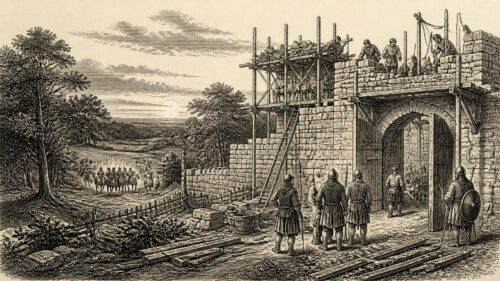
The fighting was connected to fortified places and ceremonial claims. The annals recall that Tulsk castle had earlier been demolished by Brian Ó Conchobair of Sligo and Clann Donnchadha, and that Cathal son of Ruaidrí had been installed on Carn Fraoich. The wording matters: inauguration on a recognised site was a visible assertion of legitimate rule, while the destruction of a castle removed a rival’s hard military base. Power in Connacht rested on landscapes of lordship as well as on battlefield success: assembly hills, monasteries that received burials, cattle-rich plains and strongholds all helped make a claimant’s authority credible.
Church, Learning and Bereavement
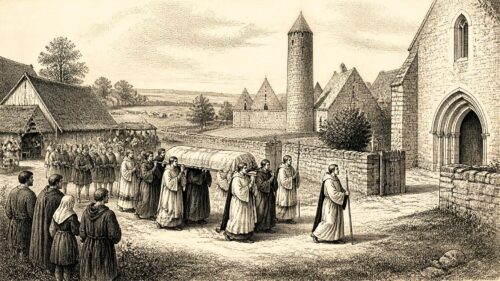
On the feast of St Michael, 29 September, Muirchertach mac Pilib Ó Ceallaigh, archbishop of Tuam, died at Tuam. His death is securely dated and was commemorated with exceptional warmth. The annals praise his wisdom, charity and humanity; the Four Masters additionally emphasise hospitality and piety. Such language reflects ideals expected of a senior churchman, but Muirchertach’s career also illustrates how ecclesiastical office, dynastic influence and cultural patronage overlapped. He came from the ruling Ó Ceallaigh lineage of Uí Maine, had previously been bishop of Clonfert, and was associated with the learned compilation now known as the Book of Uí Mhaine.
The book was made before his death rather than in 1407 itself, and should not be presented as a new production of this year. It is, however, essential context for the archbishop’s passing. Its mixture of genealogy, history, place-lore, poetry and other learning shows the intellectual world in which a major Gaelic prelate operated. Learned writing was not detached from public affairs. Genealogies defined claims; poetry preserved reputations; historical lore placed families within an inherited order. The same year that annalists mourned Tadhg Ó Cearbhaill as poets’ patron, they mourned Muirchertach as a leading churchman and learned figure. Both notices reveal the social importance of sustaining scholarship.
Captures, Raids and Local Survival
Further north, the Annals of Ulster record the death of John, son of Tadhg Ó Ruairc, an eligible heir to the kingship of Breifne. He died in Moylurg and was buried at Drumlane. His death removed a prospective ruler in a region where succession was often disputed among close kin. The same annal records the capture, “in treachery”, of Aodh Mag Uidhir, tánaiste of Fermanagh, together with Conchobhar Mag Uidhir and many others, in the town of Cathal Ó Ruairc the Deaf. Men of Tír Chonaill carried out the seizure, apparently at Breifne’s prompting. The chronicler’s enduring name for the episode, the ‘Hospitality of Malignity’, suggests a breach of the obligations normally associated with receiving guests.
This was not merely colourful moral language. Hospitality created political bonds and personal safety; betrayal at a place of hospitality was especially shameful because it converted a social expectation into a trap. The incident also shows the reach of northern alliances: Tír Chonaill, Breifne and Fermanagh were interconnected by negotiations, raids and family competition. Elsewhere, Turlough Ó Domhnaill led a hosting into Carbury and plundered it, while the Magennis lordship of Iveagh suffered violent internal disruption. Such entries make plain that warfare was rarely confined to grand campaigns. Raiding could mean the removal of livestock, food and movable goods, with immediate consequences for households dependent on animals and stores.
Weather, Cattle and the Year’s Limits
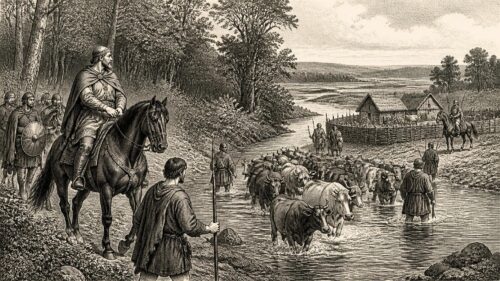
The Connacht annals end their 1407 notices with “very bad weather” and great destruction of cattle. No surviving entry safely permits a precise reconstruction of the seasons, the places worst affected, or a nationwide famine. The report should therefore be treated as a regional annalistic observation, not proof of an island-wide catastrophe. Even so, its significance is clear. Cattle were a basis of food, transport, status, tribute and exchange. Heavy losses could weaken a lord’s capacity to feed retainers, pay obligations and recover from raiding; for smaller households, they threatened everyday security more directly.
By year’s end, 1407 had brought no general settlement. Scrope’s victory at Callan displayed the continued striking power of the Dublin-based lordship, yet its political reach remained limited and costly. In Connacht, military victory had altered the balance among Ó Conchobair claimants without ending competition. In the north, the capture of leading Maguires exposed the fragility of diplomatic custom. And the deaths of Tadhg Ó Cearbhaill and Archbishop Muirchertach Ó Ceallaigh deprived Ireland of two men whose contemporary reputations rested not simply on office or arms, but on their support for learning, hospitality and public standing. The annals make 1407 memorable precisely because war, culture, religion and subsistence were so closely entwined.
Source References
Hover over a number to see the source. Select it to open the source.

- [1] The Annals of Ulster, Year U1407
- [2] Annála Connacht, Year 1407
- [3] Annals of Loch Cé, Year LC1407
- [4] Annals of Loch Cé A.D. 1014–1590, Irish text
- [5] Annals of the Four Masters, Year M1407
- [6] Annals of the Four Masters, CELT document record
- [7] Annála Connacht, CELT document record
- [8] The Annals of Ulster, CELT document record
- [9] Ó Ceallaigh, Muircheartach (Mauricius, Maurice), Dictionary of Irish Biography
- [10] O'Carroll (Ó Cearbhaill), Tadhg Ailbhe, Dictionary of Irish Biography
- [11] A Lancastrian Prince in Ireland
- [12] Codices Hibernenses Eximii III: Book of Uí Mhaine
- [13] Irish Historic Towns Atlas: Tuam, Text
- [14] Exploring the Irish Annals
- [15] Chronicon Scotorum
- [16] Chronicon Scotorum, Bibliography and Introduction
- [17] Annals of the Kingdom of Ireland, Volume 4
- [18] Annals of Ulster, historical edition scan
- [19] The Annals of Loch Cé: A Chronicle of Irish Affairs from A.D. 1014 to A.D. 1590, Volume II
- [20] The Red Book of the Earls of Kildare
Primary Sources
- The Annals of Ulster, Year U1407
- Annála Connacht, Year 1407
- Annals of Loch Cé, Year LC1407
- Annals of Loch Cé A.D. 1014–1590, Irish text
- Annals of the Four Masters, Year M1407
- Annals of the Four Masters, CELT document record
- Annála Connacht, CELT document record
- The Annals of Ulster, CELT document record
- Ó Ceallaigh, Muircheartach (Mauricius, Maurice), Dictionary of Irish Biography
- O'Carroll (Ó Cearbhaill), Tadhg Ailbhe, Dictionary of Irish Biography
- A Lancastrian Prince in Ireland
- Codices Hibernenses Eximii III: Book of Uí Mhaine
- Irish Historic Towns Atlas: Tuam, Text
- Exploring the Irish Annals
- Chronicon Scotorum
- Chronicon Scotorum, Bibliography and Introduction
- Annals of the Kingdom of Ireland, Volume 4
- Annals of Ulster, historical edition scan
- The Annals of Loch Cé: A Chronicle of Irish Affairs from A.D. 1014 to A.D. 1590, Volume II
- The Red Book of the Earls of Kildare