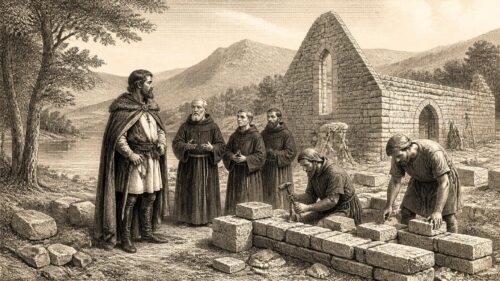
Caol Uisce Accord1402 CE
In 1402, Irish politics was characterised by negotiated, contested local authority rather than national unity. At Caol Uisce, Niall Óg Ó Néill of Tyrone made peace with Toirdelbach Ó Domhnaill of Tír Chonaill, whose submission acknowledged northern precedence without ending rivalry. In Connacht, Uilleag and Walter Burke became competing Mac Williams, illustrating divided Burke lordship and its links to Munster conflict. The killing of Louth sheriff John Dowdall and the bloody capture of Carraig Locha Cé exposed insecurity. Quin’s traditional Franciscan foundation reflected Gaelic patronage. Conflicting annal dates require caution, especially concerning Niall Óg’s death, which scholarship places in 1403.

Dateline
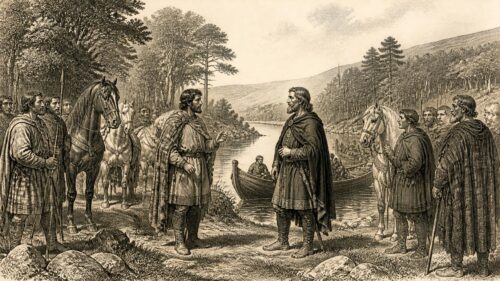
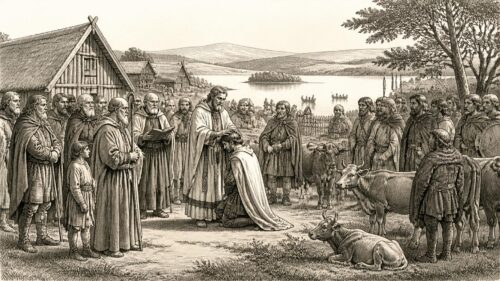
In 1402, Ireland’s political landscape was shaped less by a single island-wide contest than by a series of local settlements, rival successions and armed manoeuvres. The most clearly dated development was a meeting at Caol Uisce, the narrow waters linking Lough Erne and the River Erne in Fermanagh. There Niall Óg Ó Néill, king of Tyrone, and Toirdelbach Ó Domhnaill, king of Tír Chonaill, made peace. The Annals of Ulster add a striking detail: Ó Domhnaill gave submission to his rival. For contemporaries, such a gesture was not merely ceremonial. It was an acknowledgement of precedence in a northern political order in which military strength, kinship, hostages, tribute and reputation all mattered.
Peace at Caol Uisce
The accord came after years of hard campaigning between the leading dynasties of north-western Ireland. Niall Óg had inherited the kingship of Tyrone in 1397 and had expanded his authority across much of Ulster. Ó Domhnaill’s Tír Chonaill, centred in modern Donegal, was one of the few powers capable of resisting him. Their reconciliation in 1402 therefore marked a real, if precarious, alteration in the regional balance. It did not turn either ruler into the servant of the other, nor did it end the competition of their wider kindreds. It did, however, release Niall Óg from one major front and offered Ó Domhnaill a respite from destructive warfare.
Caol Uisce was an apt place for such an agreement. The Erne waterway connected Fermanagh with Donegal and the Atlantic approaches, while its islands, fords and lake margins made movement, refuge and supply strategically important. A meeting there shows that lordship in late medieval Ireland was exercised through routes and landscapes as much as through fixed capitals. Kings travelled with household troops, clients, clerics and dependants; political authority had to be repeatedly displayed in person.
The submission recorded by the annalist should nevertheless be read carefully. Annals commonly describe relationships in the language of hierarchy, and a ruler could concede precedence under immediate pressure while retaining substantial independence. The peace was also temporary. Later conflict between the Ó Néills and Ó Domhnaills demonstrates that the settlement was a tactical arrangement, not a final constitutional settlement for Ulster. Yet it was firmly connected to 1402 and reveals a political world capable of diplomacy as well as raiding.
Succession and the Two Mac Williams
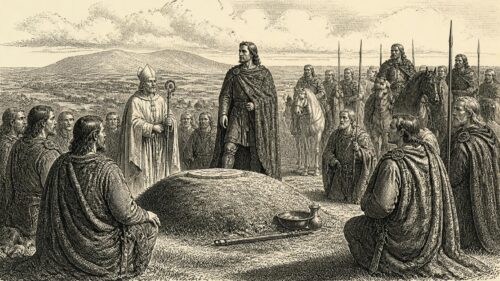
Another concise entry in the Annals of Ulster records that two men were made Mac William in 1402: Uilleag Burke and Walter Burke. The title Mac William, borne by powerful branches of the de Burgh or Burke family, was a Gaelicised lordly title rather than a royal appointment from Dublin or Westminster. Its holders dominated extensive territories in Connacht, commanded fighting men and negotiated with neighbouring Irish, Hiberno-English and Scottish interests on their own terms.
The annal’s wording points to a disputed and divided inheritance. Uilleag represented the senior Burke power of Upper Mac William, later known as Clanricarde, while Walter belonged to the northern or Lower Mac William line. Walter was said to yield precedence to the Upper Mac William lord because of seniority, but the very need to record two Mac Williams shows how far authority was dispersed. The Burkes had descended from a great Anglo-Norman family, yet by 1402 their political vocabulary, alliances and methods of succession were deeply embedded in Gaelic Ireland.
This mattered far beyond Connacht. The two Mac Williams were important enough to appear in the same year’s reports of Munster conflict, where they came to assist the earl of Ormond against the earl of Desmond. The precise campaigning is difficult to assign securely to a modern calendar year because the principal annals do not always align: Annála Connacht places the war under 1402, while the Annals of Ulster place it under 1403. What can responsibly be said is that the crisis belonged to this immediate period, and that Burke intervention connected the politics of Connacht with the long rivalry of the great Munster earldoms.
Power Beyond the Lordship
The contest between James Butler, third earl of Ormond, and the Desmond FitzGeralds illustrates the limits of crown government. Ormond was one of the most powerful magnates in the English lordship and had close links with the Lancastrian king, Henry IV. Desmond, meanwhile, had passed in 1399 to the young Thomas FitzGerald, whose lands were administered during his minority by his uncle Maurice. A war in this setting could involve competing family claims, local lordship, unpaid service, contested land and older personal enmities at once.
Neither earl represented a simple ethnic or political category. The Butlers and FitzGeralds were descendants of Anglo-Norman settlers, but they ruled in a multilingual and culturally interconnected Ireland. They made alliances with Gaelic lords, used Irish intermediaries and depended upon local followings whose interests could differ sharply from policies devised at the Dublin administration. The participation of the Mac Williams in support of Ormond makes the point: military aid travelled along networks of lordship, kinship and advantage, not along a neat line between “English” and “Irish”.
In the north-east, the killing of John Dowdall, sheriff of Louth, during 1402 gives a different view of political fragility. Dowdall was killed by neighbours rather than in a celebrated battle with a Gaelic army. The episode underlines the insecurity of authority even within the lordship’s eastern core. Sheriffs collected revenue, executed writs and represented royal justice, but their office could provoke dangerous resentments in a frontier county where local landed families, towns, Gaelic communities and cross-border raiders all had claims on power.
Lough Cé and Local Fortunes
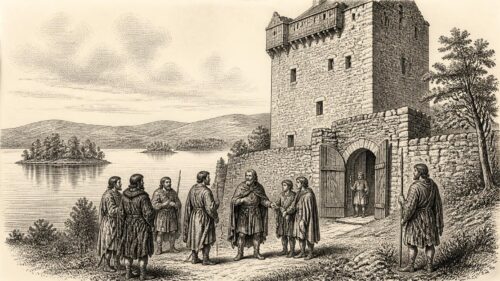
The Annals of Ulster also record the taking of Carraig Locha Cé, the Rock of Lough Cé, by the sons of Fergal Mac Diarmata. The entry reports many people killed and drowned around it. This was not an incidental place-name. The Mac Diarmatas were lords of Magh Luirg, in the region around modern Boyle, and the rock was a defensible focus of their power on the lake. Control of such a site meant control of a household centre, storehouses, boats, landing places and the people who depended upon them.
The annal’s compressed notice offers a rare glimpse of the human cost of a local seizure. Fighting around lake fortifications could turn water into both defence and hazard. We should not supply details the source does not give: it does not identify every combatant, nor describe the victims’ status. But its reference to drowning alongside killing makes clear that warfare affected more than named lords. Retainers, servants, boatmen and inhabitants were all vulnerable when a stronghold changed hands.
These events also caution against imagining rural Ireland as politically empty between famous battles. Local lordships maintained residences, ecclesiastical links, food stores, herds, armed followings and routes to markets. Their rivalries shaped ordinary security. A harvest could be protected or consumed; livestock could be accumulated, seized or driven away; and a family’s prospects could change quickly with the capture of a lake stronghold or the elevation of a new lord.
Quin and Religious Patronage
In Thomond, later Franciscan tradition associated 1402 with Síoda Cam Mac Conmara and Quin. The tradition says that he established a Franciscan house at Quin as a burial place for himself and his lineage, on ground occupied by the remains of the de Clare castle. Quin’s surviving fabric preserves the unusually close relationship between a religious foundation and a former fortress: parts of the medieval castle were incorporated into the friary complex.
The date requires qualification. Sources and modern heritage accounts differ over whether 1402 marks the foundation of a friary, the construction of particular elements such as the cloister, or a stage in a longer development that began with an earlier church. The formal introduction of Franciscan Observance belongs to 1433, not 1402. Still, the association of Síoda Cam Mac Conmara, Quin and this year is well established in later tradition and is historically meaningful. It shows a Gaelic lord using religious patronage, burial and building to assert family memory in a landscape once dominated by a colonial castle.
A Year of Negotiated Authority
Some apparent 1402 events must be left outside a strict account of the calendar year. Annála Connacht places the deaths of Niall Óg Ó Néill and his son Brian under 1402, but the Annals of Ulster record them in 1403, and modern scholarship dates Niall Óg’s death to autumn 1403. This discrepancy is a reminder that annal headings are indispensable evidence but not infallible modern dates. The securely placed events of 1402 are revealing enough: a peace and submission at Caol Uisce, contested Mac William leadership in Connacht, violence at Lough Cé, vulnerability in Louth, and religious commemoration at Quin. Together they show an Ireland of many centres, where authority was constantly made, challenged and renegotiated.
Primary Sources
- Annals of Ulster otherwise Annala Senait, Annals of Senat
- Annála Connacht
- Annals of Loch Cé A.D. 1014–1590
- Annals of the Four Masters
- Mac Carthaigh's Book
- List of Published Texts at CELT
- O'Neill (Ó Néill), Niall Óg
- Richard II
- Butler, James
- FitzGerald, John
- FitzGerald, Gerald fitz Maurice (‘Gearóid Iarla’)
- Crisis and Survival in Late Medieval Ireland: The English of Louth and Their Neighbours, 1330–1450, Chapter 3: Richard II and his Legacy, 1382–1405
- English Lordship of Ireland and the Irish Sea World: Re-assessing the Origins of the Kildare Ascendancy, c.1390–c.1513
- Richard II and the Wider Gaelic World: A Reassessment
- The Rise and Fall of the Clann Éinrí Aimhréidh Uí Néill: Dynastic Feuding and Geopolitics in the Late-Medieval Irish Sea World
- Quin Franciscan Friary
- Quin Franciscan Friary
- Medieval Abbeys & Friaries of County Clare
- Quin (Co. Clare)
- The History of the County of Mayo to the Close of the Sixteenth Century