Dreach and the Erne Lords1379 CE
On 31 May 1379, Niall Mór Ó Néill defeated Pilib Mag Uidhir, lord of Fir Manach, and Domnall Ó Néill at Dreach, probably near Kinawley. Annals record serious Maguire losses but not the battle’s course. The victory asserted Ó Néill influence without ending Fir Manach’s power. Subsequent killings, including that of Pilib’s son Cú Chonnacht, exposed fragile lordships and kin rivalries. Notices of Gaelic, English and Hiberno-English elites, marriage alliances, church officers and learned figures reveal a plural political society. Edmund Mortimer’s October appointment as lieutenant foreshadowed intervention, though he arrived only in 1380. Ordinary people’s experiences remain largely unrecorded.
Dateline
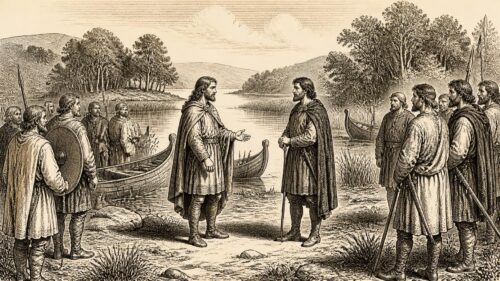
The best-dated Irish event of 1379 was fought on 31 May, when Niall Mór Ó Néill defeated Pilib Mag Uidhir, lord of Fir Manach, and Domnall Ó Néill at Dreach. The entry in the Annals of Ulster is unusually precise: it gives the date as the second day before the kalends of June, or 31 May. Yet it remains a compact annalistic notice, not a battle narrative. It records neither the size of the forces nor the manoeuvres that brought them together. Its value lies elsewhere. It captures a moment when lordships around Lough Erne, and the wider balance of power in Ulster, were being tested by armed rivalry, alliance and loss.
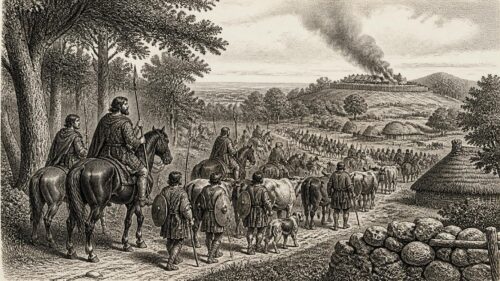
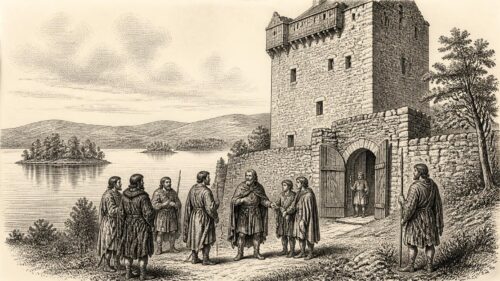
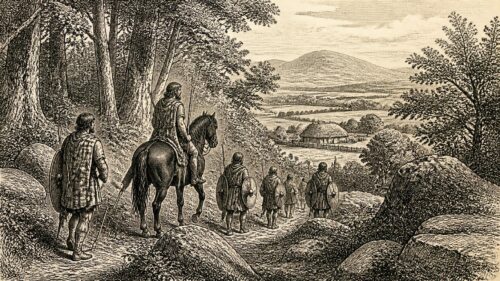
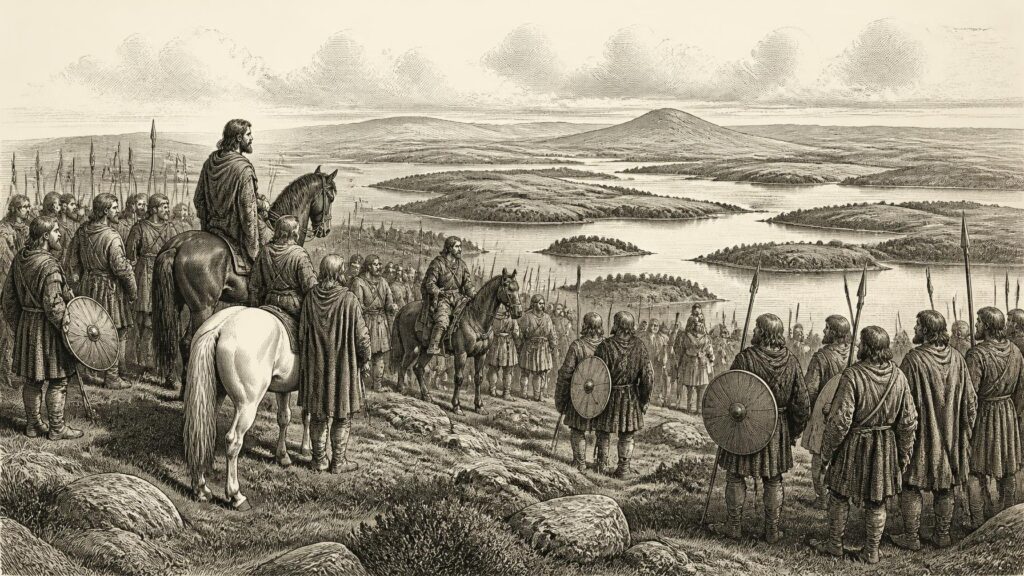
Dreach is generally identified in editorial notes with Dragh, in the parish of Kinawley in south-western Fermanagh, though medieval place-name identifications should be treated cautiously. If that identification is right, the battle lay in a landscape of lakes, rivers, upland routes and cultivated pockets near the frontier between several lordships. Such country favoured local knowledge and made control of passage, pasture and clients as important as possession of a fixed line on a modern map. In 1379, however, neither Fermanagh nor Tyrone existed as modern counties; Fir Manach and Tír Eóghain were political territories whose authority depended on families, followers, church lands and negotiated loyalties.
A Defeat at Dreach
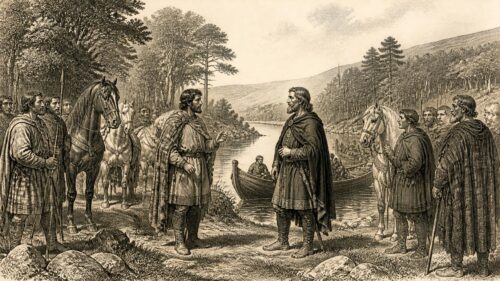
The annals call the encounter “the defeat of Dreich”, inflicted by Ó Néill, explicitly identified as Niall Mór, upon Pilib Mag Uidhir and Domnall Ó Néill. The dead named on the defeated side show that this was not a minor affray. They included Tadhg Mag Uidhir; two sons of Maghnus; Toirdelbach, son of Donnchadh Mag Uidhir; Brian, son of Mac Craith Mag Uidhir; and Muirchertach, son of Milchu, besides others unnamed. The Annals of the Four Masters, compiled much later but drawing on earlier materials, preserves a closely related list. Both sources therefore support the fact of an Ó Néill victory and serious losses among the Maguire party, even if they cannot supply a full reconstruction of the fighting.
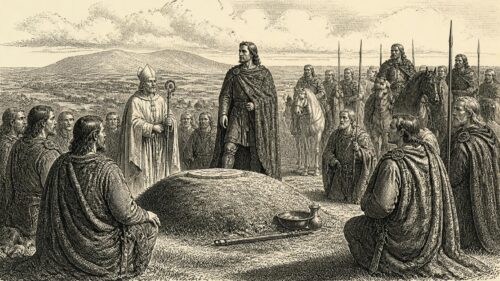
The contest mattered because Pilib Mag Uidhir was no ordinary local captain. He had succeeded to the kingship of Fir Manach in 1363 and had built a reputation as a warrior and patron. The Maguires had become the leading power around the Erne, while the Ó Néills of Tír Eóghain were extending their influence eastward and south-westward after the collapse of the de Burgh earldom of Ulster’s effective authority earlier in the century. Niall Mór, king of Tír Eóghain since 1365, was one of the principal beneficiaries of that changing world. His victory at Dreach was thus an assertion of regional superiority, not evidence that Fir Manach had ceased to be a substantial lordship.
The record also warns against imagining neat opposing blocs. Domnall Ó Néill fought beside Pilib Mag Uidhir against Niall Mór, demonstrating that kinship within a great dynasty did not prevent conflict. Earlier in the same year, Pilib and Domnall had killed Richard Mac Cathmhaíl. The annals place that killing before Dreach, but do not expressly say that it caused the battle. It would be irresponsible to turn their sequence into a certain chain of vengeance. What can be said is that, in the space of one annalistic year, the sources show alliances being made and broken, a leading man slain, and rival branches or interests within the Ó Néill world confronting one another through the Maguire conflict.
The human cost did not end on the field. Cú Chonnacht, Pilib Mag Uidhir’s son, was killed later in 1379 by Clann Domnaill of Clann Cheallaigh. The annalist praised him as a man fit to be king of Fir Manach because of his nobility and generosity. This is important language. Lordship was judged not solely by victory but by a ruler’s capacity to protect dependants, reward retainers, receive guests and sustain learned and ecclesiastical people. The loss of a promising heir after a battlefield reverse made the year particularly damaging for Pilib’s family, although Pilib himself survived and remained lord until 1394.
Power Beyond the Battlefield
Elsewhere, 1379’s entries reveal a political order in which lordship was repeatedly exposed to internal violence. David Ó Duinn, chief of Uí Riagáin in the midlands, was killed treacherously by his own kinsmen. Mac an Chaoich Ó Raghallaigh was killed by a son of Annadh Ó Raghallaigh. In Thomond, Cú Mara Mac Conmara, chief of Clann Chuiléin, was likewise killed by his own kinsmen. These notices do not prove that all Ireland was in general revolt, nor do they disclose the motives behind each killing. They do demonstrate, however, that succession, kin rivalry and the control of resources could be lethal within ruling families as well as between them.
The death of Philip Dalton, lord of Westmeath, provides a different reminder of Ireland’s plural political landscape. The Daltons were among the long-established families of the English lordship, whose estates and influence were rooted in the central counties. Their presence in the annals beside the Ó Néills, Maguires, Mac Conmaras and Ó Raghallaighs should not be read as an exotic interruption. By 1379, Gaelic, Hiberno-English and Anglo-Irish elites were all integral to Irish political life, though their languages of law, landholding and lordship could differ. The Four Masters also records that Máelmór Óg, son of Máelmór Ruadh Ó Conchobair Fáilghe, was killed by “the English”. It gives no place, date or identity for those opponents; the entry is evidence of a killing, not licence for a larger unrecorded campaign.
In Connacht, Finnghuala, daughter of Ó Ceallaigh and wife of Mac William de Burgh, died. Her notice points to the value of marriage in linking powerful families across cultural and territorial boundaries. The de Burgh lordships remained important in Connacht, but their position was no longer that of an undivided earldom. Thomas de Burgh, Mac William of Lower Connacht, was trying to preserve authority amid strong Ó Conchobair resistance and the growing independence of other de Burgh branches. Finnghuala’s death belongs to the year’s political history because elite marriages formed part of the web through which claims, alliances and obligations were maintained.
A Lieutenant Appointed, Not Yet Arrived
Developments in England also bore directly upon Ireland. On 22 October 1379 Edmund Mortimer, third earl of March and earl of Ulster in right of his wife Philippa de Burgh, was appointed the king’s lieutenant in Ireland. He did not land until May 1380, so no campaign by Mortimer should be placed in 1379. His appointment nevertheless belonged firmly to the year and signalled a coming attempt to restore the position of a magnate whose inherited interests reached into Meath, Ulster and Connacht.
Mortimer’s commission should not be treated as the immediate explanation for Dreach. The battle occurred nearly five months before his appointment, and it emerged from rivalries already active in Gaelic Ulster. Still, the timing is revealing. Niall Mór’s victory came just before a royal decision to send a lord with a powerful hereditary claim to recover influence in precisely the regions where Ó Néill power had been expanding. The year therefore ended with a significant political contrast: on the ground, Niall Mór had shown military reach in Fir Manach; at court, the English crown had chosen Mortimer to lead a new intervention. The collision between those ambitions lay ahead, not within 1379 itself.
Church Offices and Learned Memory
Religious institutions were embedded in this same political landscape. James Ó Conghalaigh, prior of Devenish, died on 4 January, and Flaithbertach Ó Mongáin, erenagh of Rossory, died on 1 May. Devenish, on Lower Lough Erne, was a major ecclesiastical site, while an erenagh was the hereditary lay or clerical manager responsible for church lands and revenues. These deaths show the continuing practical importance of monastic and parish-centred institutions in Fermanagh. Their officeholders administered resources, maintained local standing and connected communities to the wider church.
The Four Masters also records the death in England of the bishop of Meath, calling him “Faltach”. Later ecclesiastical reference works identify the bishop who died in 1379 as Stephen Wall. The difference in naming illustrates a familiar difficulty in medieval Irish sources: people could appear under Irish, English, Latinised or descriptive forms. The sources establish a vacancy-producing death, but do not provide a day or circumstances beyond the annal’s statement that it occurred in England.
Loss was recorded among the learned as well. Firbis Mac Firbis died and was described as a learned historian. Richard Ó Dúgáin died as the intended ollam, or senior learned professional, of Uí Maine. William, son of Gilla Caech Mac Carthaigh, was remembered as pre-eminent among the Irish in music. These brief notices are precious evidence that historical learning, genealogy, poetry and music remained organised, esteemed disciplines. Such skills were not merely ornament. Historians and genealogists preserved pedigrees and precedents; poets articulated praise and status; musicians served aristocratic households and public ceremony. The deaths of named specialists also suggest how strongly cultural knowledge was attached to families and patronage networks.
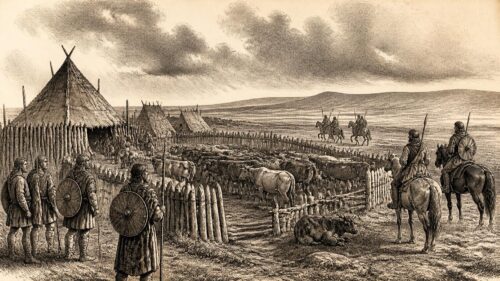
For ordinary people, 1379 supplies no reliable island-wide account of weather, harvests, prices or disease. It would be wrong to invent one from silence. Yet the year’s surviving notices make clear that the burdens of conflict, bereavement and political uncertainty reached far beyond the men named in the annals. A defeat could remove heirs and retainers; a kinsman’s killing could unsettle a lordship; the death of a prior or erenagh affected communities dependent on church land and hospitality. Dreach was therefore more than a single clash. It was the clearest dated expression, in 1379, of a hardening struggle for authority around the Erne, set against an Ireland of competing lordships, durable institutions and carefully maintained learned memory.
Primary Sources
- The Annals of Ulster, Year U1379
- Annals of the Four Masters, Annal M1379
- TEI Header for Annals of Ulster otherwise Annala Senait, Annals of Senat
- TEI Header for Annals of the Four Masters
- O'Neill (Ó Néill), Niall Mór
- Maguire (Mág Uidhir), Pilib (Philip)
- Mortimer, Edmund
- Colton, John
- FitzRalph, Richard
- Burke (de Burgh), Thomas
- Richard II and the Wider Gaelic World: A Reassessment
- The Rise and Fall of the Clann Éinrí Aimhréidh Uí Néill: Dynastic Feuding and Geopolitics in the Late Medieval Irish Sea World
- The Medieval Irish Chancery
- Dublin and the Windsor Crisis, 1369–78
- Calendar of the Patent Rolls Preserved in the Public Record Office: Richard II, 1377–1381
- Statute Law Revision Act, 1983, Schedule
- Pre-Union Irish Statutes
- Annals of Ulster, Otherwise Annals of Senat: A Chronicle of Irish Affairs, A.D. 1379–1541
- Annala Rioghachta Eireann: Annals of the Kingdom of Ireland, Volume 4
- Irish History Online: County Fermanagh
- Fermanagh: History & Society
- The Medieval Kingdom of Lough Erne: The Creation of a Unified Kingdom