Annaly’s Burning Reply1376 CE
In 1376, Sir William Windsor’s recall from Ireland followed resistance to his taxation and administration, as communities defended their customary right to consent. Maurice FitzGerald and then James Butler replaced him, but weakness persisted there. Warfare continued: English forces raided Annaly, whose O’Farrell lord retaliated with destructive incursions; Bran Ó Broin regained Wicklow and Newcastle castles; and northern lords faced captivity and death. Tadhg Ó Ruairc of West Breifne died, succeeded by his brother Tighearnán. Annals also recorded deaths among distinguished Gaelic historians, poets and ollamhs, underscoring the resilience of learned institutions amid fragmented authority, frontier conflict and contested lordship.

Dateline
The surviving record for 1376 does not yield a single, island-wide story. It instead reveals Ireland through several sharply different but connected arenas: a colonial administration in Dublin and Westminster under extraordinary pressure; contested lordships along the Leinster and Ulster frontiers; a major retaliatory raid in Annaly; and the continuing work of Gaelic learned families. The year is unusually well supplied with annalistic notices, but few give a day or month. They should therefore be read as events assigned to the year, not as a securely dated sequence. One exception is governmental business: Sir William Windsor, Edward III’s chief governor in Ireland, was recalled to England on 16 February. His removal marked a striking victory for organised opposition within the English lordship.
Windsor’s Recall
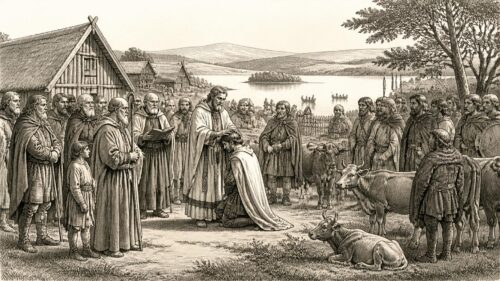
Windsor had governed in difficult circumstances. English royal authority in Ireland was strongest in the towns, counties and lordships of the east and south-east, yet it was expensive to defend. Garrisons, officials, castles and campaigns required money that the crown, committed to war with France, could not reliably provide. Windsor attempted to fill the gap with unusually persistent demands for taxation, provisions and service. These demands antagonised many of the English and Anglo-Irish magnates, clergy, towns and commons on whom the administration depended.
The confrontation had a constitutional as well as a financial importance. In 1376 communities in the counties, liberties and towns were instructed to elect representatives for consultation in England on the government of Ireland and an aid for the king. The communities did elect men, but repeatedly withheld authority to consent to a subsidy. They asserted that, under the liberties, laws and customs of the land of Ireland, they were not obliged to answer such a summons outside Ireland. They also stressed poverty and the costs already borne in local defence. This was not modern parliamentary democracy, nor a claim for an independent Irish state. It was a forceful assertion that taxation required consent from the political communities expected to pay it.
Complaints against Windsor and his officers accumulated at the English royal council. The charges were politically charged, and historians rightly caution that their full truth cannot now be established: many accusations were broad and difficult to prove. Yet their volume, coupled with Windsor’s association with the unpopular court circle around Alice Perrers, made him vulnerable during the upheavals surrounding England’s Good Parliament. His recall was real enough. Maurice FitzGerald, fourth earl of Kildare, acted as justiciar from June; James Butler, second earl of Ormond, succeeded him later in the year. The transition did not solve the underlying shortage of money or manpower, but it ended Windsor’s second Irish governorship and opened investigations into his administration.
A Muster Against Annaly
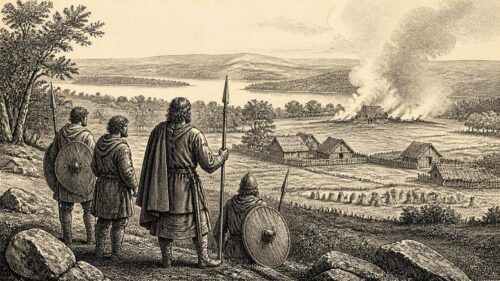
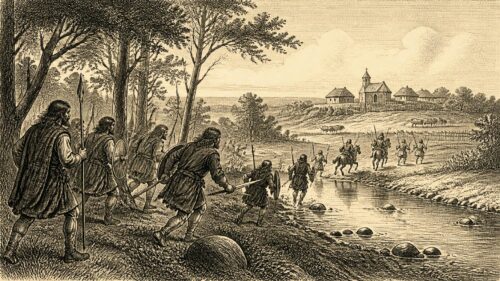
Governmental dispute did not suspend frontier warfare. The Annals of the Four Masters record that a general muster of the English of Meath, Ulster and Leinster entered Annaly, the O’Farrell lordship centred broadly on modern County Longford. The annalist calls the depredations committed there treacherous. That is partisan language, but it leaves no doubt that the raid was remembered as a serious assault upon O’Farrell country. Such hostings were not simply clashes between professional armies. They endangered cattle, stored grain, farmsteads and settlement itself, and their immediate purpose was often to seize livestock and portable wealth while compelling submission.
O’Farrell’s response was emphatic. With all his forces, according to the annal, he attacked the English of Ulster and Leinster in turn, burning farm-houses and towns, carrying off great spoil and returning home in triumph. The wording should not be inflated into a claim that Annaly defeated the whole English lordship. It does, however, show a lordship capable of answering a multi-regional expedition with raids across several neighbouring jurisdictions. The destruction of farm buildings points to the material reality behind political rivalry: warfare struck tenants, cultivators, traders and householders as well as lords. In a year when communities complained to the crown of the expense of defending their lands, Annaly supplied a vivid reason why defence and taxation were inseparable questions.
Succession in Breifne
In the north-west, Tadhg Ó Ruairc, king of West Breifne, died in 1376. The annals commemorate him in the high language reserved for a successful ruler, calling him the ‘Bear of Breifne’ and the ‘Lion of Leth Chuinn’, while the more restrained Annála Connacht simply notes his death and the succession of his brother Tighearnán. Both agree on the essential fact: leadership passed to Tighearnán Ó Ruairc. Breifne was not a peripheral backwater. Its position between Connacht, Ulster and the English borderlands made its rulers important participants in the politics of the north and west.
The succession appears to have been orderly, but it should not be mistaken for automatic inheritance in the later primogeniture sense. Gaelic kingship drew on a wider ruling kindred, and political capacity, alliances and acceptance by leading followers mattered. Tadhg had fought long struggles against rival branches of the Ó Conchobair dynasty in Connacht. Tighearnán inherited not only a title but an exposed network of rivalries, obligations and opportunities. His accession in 1376 would become the starting point for a notably energetic reign, though the developments that made him one of the region’s foremost rulers belong to later years.
Captivity and Conflict on the Frontiers
Other notices locate violence at very different points of the island. Aodh Ó Tuathail, lord of Imaal in the Wicklow uplands, was killed by ‘Galls’—the annalists’ usual term here for the English. He had been a consequential figure in the changing alliances of the Leinster marches, sometimes cooperating with the Dublin government and sometimes fighting its allies. His death was a loss to a dynasty whose territory lay immediately beside the settled counties and roads leading towards Dublin. The annals also report the death of Dalbach Ó Broin, an eminent Leinster lord, after he was wounded by his own spur: a small, grim reminder that aristocratic life, travel and warfare carried risks beyond pitched battle.
Leinster remained unstable. Modern reconstruction of the Ó Broin succession indicates that Bran Ó Broin again captured the royal castles of Wicklow and Newcastle in 1376, despite earlier English recoveries and rebuilding. Castles were not merely symbols on a map: they were storehouses, garrison bases, courts and instruments for controlling roads and local labour. Their repeated loss and recovery demonstrates how limited royal power could be beyond the immediately defended settlements.
Far to the north, Cú Maighe Ó Catháin, lord of Oireacht Uí Chatháin, was seized by English forces at the port of Coleraine and sent in fetters to Carrickfergus. The entry gives no explanation and no precise date, so the circumstances must remain unknown. Its geography is revealing nonetheless. Coleraine’s river port and Carrickfergus’s castle were points at which maritime movement, commerce, military power and custody met. The imprisonment of an Irish lord there shows that English enclaves in north-east Ulster could still project force, even while their wider regional position was insecure.
The terse entry in the Annals of Ulster for the death of Mac Craith Mag Uidhir belongs in the same northern setting. It offers no narrative, but it is a reminder that the Maguires of Fermanagh were an established political family in the borderlands between Ulster and Breifne. The different annals preserve different priorities: one notes a prisoner at a port, another an obituary, another a raid. Together they caution against treating any one chronicle as a complete national ledger.
The Passing of Learned Men
1376 was also conspicuous for losses among the learned professions. Annála Connacht records the deaths of Donnchadh Mac Fir Bhisigh; Ruaircín Ó hAdhmaill, ollamh to the Ó hAnluain; Eoin Ó Ruanaí, ollamh to the Mac Aonghusa; Máel Sechlainn Ó Maoilmheana, ollamh to the Ó Catháin; Conchobhar Ó Beacháin, described as a master of history; and Cellach Mac Cruitín, ollamh of Thomond in history. The Annals of the Four Masters, drawing on related traditions, additionally remembers poets and historians connected with the Magennises, Ó Catháin, Ó hAnluain and other patrons.
These were not ornamental court figures. In late medieval Gaelic society, learned families preserved and produced genealogies, historical writing, praise-poetry, legal learning and political memory. An ollamh was a senior master, normally attached to a lordly household or dynasty. His work helped establish precedence, legitimate claims, frame diplomacy and transmit cultural knowledge. The death of several named historians and poets in one annal-year was therefore a real institutional loss, even though we cannot identify every manuscript, poem or pupil affected. Annalists also praised hospitality: Ruaircín Ó hAdhmaill was remembered as maintaining an open house that refused no guest. Such notices show that learning, status and the feeding of visitors were closely connected.
A Divided Political Landscape
The Ireland of 1376 was not governed from one centre, nor divided into two simple camps. Edward III remained lord of Ireland, but his government could be challenged by the communities within the English lordship and could not easily finance its own defence. Gaelic rulers fought one another, made and broke alliances with English neighbours, and defended their territories through lordship, raiding and control of strongpoints. Towns and ports connected these contests to trade and sea routes, while schools and households of historians and poets sustained a learned culture across political boundaries. Windsor’s recall, O’Farrell’s counter-raid, Tighearnán Ó Ruairc’s succession and the deaths of prominent scholars are separate events. Taken together, they make 1376 a year of contested authority, local resilience and enduring intellectual life.
Primary Sources
- Annals of the Four Masters
- Annála Connacht
- The Annals of Ulster: Year U1376
- The Annals of Ulster
- Windsor, William
- O'Rourke (Ó Ruairc), Tadhg
- O'Rourke (Ó Ruairc), Tighearnán Mór
- O'Toole (Ó Tuathail), Aodh
- FitzGerald, Maurice fitz Thomas
- Butler, James
- O'Byrne (Ó Broin), Donnchadh
- O'Byrne (Ó Broin), Sir John
- Burke (de Burgh), Thomas
- The Anglo-Irish Colony Under Strain, 1327–99
- Friends Like These: William Windsor and Edmund Mortimer, 1369–1381
- ‘Ireland Corporate of Itself’
- The O’Clerys: Hereditary Historians and Poets
- Irish Bardic Poetry
- Chronicon Scotorum
- Annales Hiberniae
- The Windsor Crisis, 1369–1376
- Annals of the Four Masters: Royal Irish Academy Manuscripts