Donnchad Ó Fergail’s Pursuit1373 CE
In 1373, Irish annals record violence across contested lordships rather than a national campaign. Meath raiders killed Ruaidrí Ó Fergail, his son and followers in Annaly; Donnchad Ó Fergail pursued them, inflicted losses, but was slain by an arrow and his men defeated. Elsewhere, William Dalton and Meath’s sheriff were killed, while Connacht disputes brought treachery, hostage killing and injury. Dynastic murders affected Maguire and de Burgh figures. Deaths of noblewomen, churchmen, historians and poets reveal interconnected elites and learning. A destructive wind damaged churches. These entries portray overlapping Gaelic, settler and administrative powers, with chronology sometimes uncertain in places.

Dateline
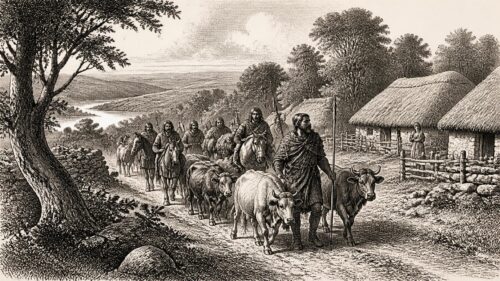
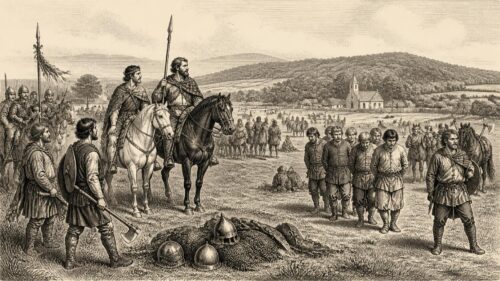
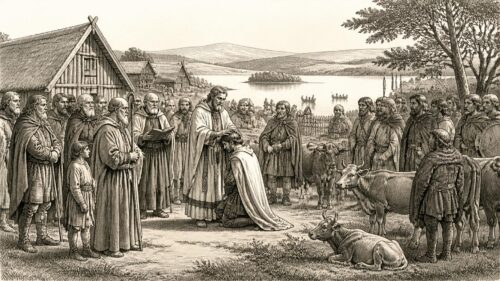
The clearest events assigned to 1373 in the Irish annals centre on a violent frontier running from Meath into Annaly, the Ó Fergail lordship broadly corresponding to modern County Longford. A raiding force described as the “Galls of Meath” entered Annaly, killed Ruaidrí, son of Cathal Ó Fergail, his son, and a number of their followers. Donnchad Ó Fergail gathered his forces and pursued the attackers. The pursuit initially succeeded: he killed many of them. Yet its outcome was personally catastrophic. Donnchad was struck and killed by an arrow or missile-shot, and his followers were defeated. The episode was not a set-piece battle between neatly bounded nations. It was a frontier raid, reprisal and reversal, involving a Meath-based colonial force and a Gaelic lordship whose survival depended upon armed mobilisation, kinship and the defence of local resources.
A Raid into Annaly
The annals do not name the precise day, route or battlefield, and no responsible reconstruction should pretend otherwise. They do, however, agree on the essential sequence. Annála Connacht, compiled from Connacht-centred materials, calls the raiders “Meath Galls”; the later Annals of the Four Masters calls them “the English of Meath”. In medieval Irish usage, Gall could identify people of settler, English or Anglo-Irish background, rather than a modern national identity. The language records political affiliation and social distinction, but cannot tell us the exact ethnic composition of every armed party.
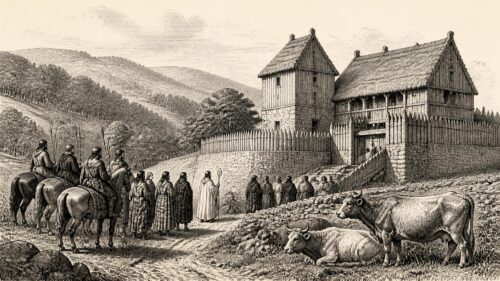
Annaly lay on a contested middle ground. Its rivers, woodland, pasture and routes connected Gaelic lordships in the central and north-western regions with Meath, where English royal institutions, marcher lordships and long-settled families retained substantial influence. Raiding was therefore more than a search for portable wealth. It challenged a lord’s capacity to protect dependants, retain fighting men and exact respect from neighbours. The killing of Ruaidrí and his son was a blow to the Ó Fergail kin-group; Donnchad’s rapid response was equally a public assertion that such an attack demanded retaliation.
His death reveals the risks inherent in that system. Commanders fought in the field, and a single arrow could change the outcome of a campaign. The annalists’ compressed report preserves both the initial success and final defeat, rather than supplying a consoling tale of resistance. For families in Annaly, the human consequences probably extended well beyond those named: dead or wounded retainers, disrupted husbandry, lost cattle and a newly unsettled balance among competing branches of the dynasty. Those consequences are reasonable inferences from raiding warfare, not separately dated facts recorded for 1373.
Meath’s Unsteady Border
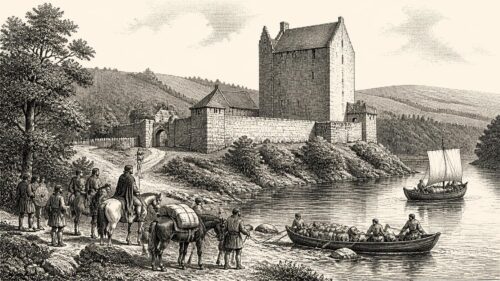
A second entry confirms that pressure around Meath did not run in only one direction. William Dalton and the sheriff of Meath were killed by Cenél Fiachach and Ó Mael Sechlainn. The sheriff was an officer of the English administration, while the Daltons were among the established landholding families of the region. Their deaths indicate that office and local lordship did not guarantee security beyond the most defensible centres. Yet the annals do not state whether the killings occurred in a single engagement, an ambush or separate incidents, and they should not be made to prove a general collapse of government.
What they do show is a political landscape of overlapping jurisdictions. The English crown claimed lordship over Ireland; its officials could appoint sheriffs and exercise authority in counties and liberties. In practice, especially in the midlands and along their western edges, power was negotiated through castles, local affinities, military service and accommodation with Gaelic rulers. The Dalton name itself is a reminder that descent from Anglo-Norman settlers did not make a family simply external to Irish society. By the fourteenth century, frontier life brought competition, intermarriage, cultural borrowing and shifting alliances as well as conflict.
The Annaly raid and the deaths of Dalton and the sheriff are firmly attached to the annalists’ year 1373. They are not, however, evidence for a centrally coordinated Ó Fergail–Ó Mael Sechlainn campaign. Medieval annals often preserve vivid results while withholding the negotiations, grievances and immediate calculations that lay behind them. Their value lies precisely in revealing how frequently authority was tested at the local level.
Connacht Treachery and Hostage Security
Further west, 1373 brought an episode in Conmaicne Dúna Móire, around Dunmore in north-eastern Connacht, which exposes the fragility of agreements between major families. Toirdelbach Ruad Ó Conchobair killed Mac an Phearsain Mac Feorais Bermingham, according to the annalistic account, after the Berminghams had acted treacherously against him as he travelled from Conmaicne Cúile. Toirdelbach escaped, though wounded. The aftermath was grimmer still: Andrias Mac Cinaith, whom Toirdelbach had left with the Berminghams as a hostage or surety for whatever compensation they might demand, was put to death.
The details matter. Hostages were not merely prisoners taken after defeat. They could be securities in a settlement: living guarantees that a payment, restitution or undertaking would be honoured. Their vulnerability made agreements credible, but also made the breaking of an agreement exceptionally dangerous. This 1373 killing should not be exaggerated into a province-wide war between “Gael” and “settler”. The Berminghams were a powerful lineage of Anglo-Norman origin whose members were deeply embedded in Connacht and Irish regional politics. The dispute instead illustrates a world in which dynastic rivalry crossed inherited cultural labels and in which a man’s safety depended on the reliability of personal bonds.
Fermanagh, Mayo and Local Succession
The Annals of Ulster add a northern and western dimension. Brian Mag Uidhir, described as a man fit to be king of Fir Manach, was killed by the sons of Art Mag Uidhir. The phrase does not establish that Brian actually held the lordship; rather, it signals recognised eligibility and stature within the Maguire succession. In a lordship where authority rested on a leading kindred and its supporters, the death of a viable claimant could sharpen internal competition. The entry is an unusually direct reminder that violence within a dynasty could be as important as warfare with a neighbouring power.
The same annals record the killing of Walter Mac William de Burgh by the Muintir Mhaighle, the people of the Ó Máille lordship in the western coastal region later associated with Mayo. The entry supplies no cause or location. Nonetheless, it belongs to a wider fourteenth-century reality in which the de Burgh inheritance in Connacht had fragmented into competing lordships, while maritime and coastal communities held considerable local leverage. It would be unsafe to attach this death to a particular succession dispute without further evidence; the responsible conclusion is simply that conflict reached a prominent de Burgh figure in the west during the annalists’ year.
Other deaths map the dense web of lordship and alliance across the island. Mór Ó Fergail, wife of Diarmait Mag Raghnaill, chief of Muintir Eolais, died and was honourably buried at Cluain Conmaicne. Barrdub Ó Ruairc, wife of Domnall Mag Tigernáin, also died. Such notices are brief, but they show that elite women were identified through both natal and marital connections, which tied together the Ó Fergail, Mag Raghnaill, Ó Ruairc and Mac Tiernan political worlds. Their recorded funerals and penance also point to the devotional language through which status and a good death were publicly expressed.
Churches, Scholars and a Violent Wind
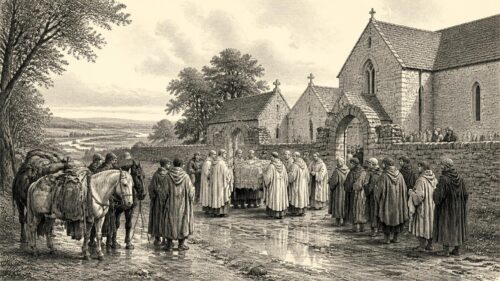
Religion and learning appear in 1373 not as separate spheres from politics but as part of the same social order. William Mac Carmaic, bishop of Ardagh, died; the Annals of the Four Masters praises his wisdom and piety. Ardagh’s diocese overlapped the region shaken by warfare in Annaly and Meath, making the loss of a bishop locally significant even though the sources do not describe the succession that followed. At Lisgoole in Fermanagh, Adam Ó Cianáin died as a canon and “master of history”. His notice demonstrates the continuing place of learned clerics in the preservation and transmission of historical knowledge.
The Ulster annals likewise record the death of Domnall Mac Brádaigh, called a general sage, and of John Ó Fialáin, an ollam, or master, of poetry. These notices cannot measure literacy across society, but they firmly place hereditary and professional learning within the politics of later medieval Ireland. Poets, historians, churchmen and legal specialists gave lordships memory, prestige and practical expertise. Their deaths were therefore events worth entering beside killings and raids.
Annála Connacht closes its 1373 sequence with an environmental shock: a very great wind wrecked many churches. Its wording does not identify every place affected, nor does it permit a precise meteorological reconstruction. Yet the emphasis on churches is revealing. Religious buildings were substantial communal investments, places of worship, burial, hospitality and local identity. Storm damage would have required labour, timber, roofing materials and patronage to repair. The event belongs beside the year’s warfare as a reminder that communities faced danger from weather as well as from armed neighbours.
What the Year Can Bear
The annalistic year labelled 1373 is unusually rich in local incidents but poor in administrative detail. It does not record a decisive national campaign, a parliament or a royal settlement. Its significance lies elsewhere: in the accumulated evidence of contested frontiers, vulnerable office-holders, fraught hostage arrangements, dynastic killing, learned communities and damage to churches. Ireland in this year was not divided into two simple blocs. Gaelic rulers, Gaelicised families of settler descent, church institutions and English administrative officers all operated within a patchwork of lordships whose boundaries were repeatedly tested.
There is one final chronological caution. The sources use their own annalistic systems, and modern editions warn that medieval year-headings do not always align perfectly with a modern 1 January–31 December calendar. The events discussed here are responsibly connected with the annalists’ 1373 entries; only where a source supplies a day, such as the death of John Ó Droma on 9 December, can an exact date be claimed. That restraint makes the central story clearer: Donnchad Ó Fergail’s pursuit was not an isolated drama, but one sharply recorded moment in a year when the safety of a lordship could turn on a raid, a hostage, a succession quarrel or an arrow-shot.
Primary Sources
- Annála Connacht: Annal 1373
- Annála Connacht
- The Annals of Ulster: Year U1373
- The Annals of Ulster
- Annals of the Four Masters: Annal M1373
- Annala Rioghachta Eireann: Annals of the Kingdom of Ireland, Volume 4
- Annals of the Four Masters, Irish Text
- Annals of Loch Cé
- Annala Locha Cé, Irish Text
- Annals of Loch Cé: Volume 1 English Translation
- Chronicon Scotorum
- Annals of Inisfallen: English Translation
- Irish Texts at CELT
- Exploring the Irish Annals
- Annals of the Kingdom of Ireland: National Library of Ireland Catalogue
- What Was the Distribution of Wealth in Ireland c. 1300?
- Upward Mobility in Later Medieval Meath
- Gaelic Ireland: Land, Lordship and Settlement, c.1250–c.1650
- Lordship and Principality: Colonial Policy in Ireland and Aquitaine in the 1360s
- Richard II and the Wider Gaelic World: A Reassessment
- Ireland’s ‘Norman’ Castles
- Kindred Lines: How Anglo-Norman Names Were Hibernicised
- William Buide O’Kelly and the Late Medieval Renaissance of the Uí Maine Lordship