Sligo Castle and Aed Brefnech1310 CE
In 1310, Ireland remained politically fragmented despite Edward II’s lordship. At Kilkenny Parliament, John Wogan, Richard de Burgh and church leaders addressed disorder, revealing reliance on powerful magnates. In Connacht, Aed Brefnech Ó Conchobair’s destructive campaign against Mac Diarmata included killings, capture and burning; his allies then sacked Buninna Castle. Aed was subsequently murdered by mercenaries, allegedly bribed by William de Burgh, whose soldiers imposed oppressive quartering. Feidlim Ó Conchobair emerged as king of Connacht. Richard rebuilt Sligo Castle, asserting contested authority. The year also saw scholar Tanaide Ó Maelchonaire’s death, wine landing in Magh Cétné, and violence across Ireland.
Dateline
Ireland in 1310 was not a country governed from a single centre. The lordship claimed by Edward II had its administration, courts and towns, but its effective reach varied greatly. In Connacht, Ulster, Thomond and the western marches, Gaelic dynasties, Anglo-Irish lords, ecclesiastical communities and military followings competed for land, tribute, hostages and recognition. The year is unusually vivid because several annals preserve closely connected episodes from Connacht, while the records of government show the political confidence of Richard de Burgh, earl of Ulster. Yet the evidence must be handled carefully: apart from the Kilkenny parliament, most events are entered under an annalistic year without a precise day or month, and later compilations sometimes preserve accounts shaped by family and regional loyalties.
A Parliament at Kilkenny
The firmest date belongs to the parliament held at Kilkenny from 8 to 12 February. John Wogan, the king’s justiciar in Ireland, presided over an assembly of bishops, magnates and representatives of the shires and towns within the lordship. Its survival in the record matters less for spectacular legislation than for what it reveals about the condition of English-administered Ireland. Government was worried by disorder on the marches, by private armed retinues imposed upon local communities, and by the difficulty of enforcing royal peace beyond the better-settled counties and boroughs.
Richard de Burgh occupied a conspicuous place there. The earl held the lordship of Connacht and the earldom of Ulster, extending his influence over a huge and politically varied portion of Ireland. At Kilkenny he was placed ahead even of the justiciar in membership of the king’s Irish council: a striking acknowledgement of his standing. Such precedence was not merely ceremonial. It reflected the fact that royal administration depended heavily upon magnates able to muster men, command castles and bargain with Gaelic rulers. In 1310, de Burgh was near the height of that power.
Churchmen were integral to this political world. At the close of the parliament, the archbishop of Cashel, the bishops of Ossory, Emly and Lismore, and the bishop-elect of Leighlin reportedly joined in excommunicating those who broke the ordinances made there. This was a public assertion that peacekeeping was both a governmental and a religious obligation. It should not be mistaken for evidence that the parliament could impose calm across all Ireland. Rather, the need for such sanctions underlines the weakness of law where local lordship and armed force prevailed.
Connacht’s Burning Raid
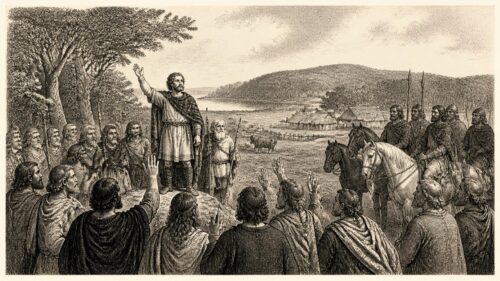
The most consequential fighting recorded under 1310 unfolded in Connacht, especially in the contested lands of Síol Muiredaigh and Moylurg. Aed Brefnech Ó Conchobair, son of Cathal Ruad and a claimant of the wider Ó Conchobair royal kindred, led what the Annals of Connacht calls the “Raid of the Burning” against Maelruanaid Mac Diarmata in Clogher. The name conveys its character. Donnchad Mac Diarmata was captured; his wife, a daughter of Ó Flannacáin, was killed; and other people, including women and children, were reported slain or burned. Aed’s force then established a stronghold at Uachtar Tíre against Mac Diarmata and the Síol Muiredaigh.
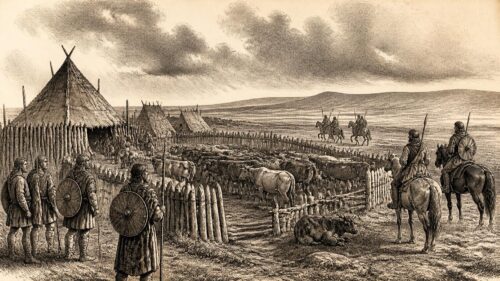
These entries offer an unvarnished view of warfare’s effect upon ordinary communities. A raid was not simply a clash of armed men. It targeted cattle, stored grain, houses, dependants and the social authority of an opponent. Captives could be hostages, bargaining assets or a means of humiliating a rival household. Burning was a military method: it deprived an adversary of food, shelter and revenues, while demonstrating that he could not protect those who owed him allegiance. The annalists’ notice of the captured man’s wife is therefore significant. Elite conflict entered households and disrupted the lives of people whose names rarely appear in the record.
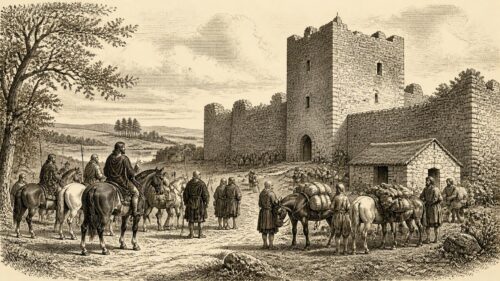
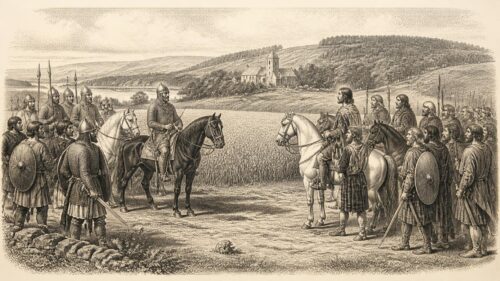
William de Burgh, Richard’s kinsman and leading agent in Connacht, responded by encamping at Kilcolman or Killummod opposite Aed’s forces. While he watched Aed, however, Aed sent secret messages to his brother Ruaidri. Ruaidri, Aed son of Maghnus and their followers attacked Buninna Castle, which William had left behind, plundering and burning it with its wealth. The destruction of Buninna shows both the vulnerability of a frontier fortification and the logistical calculations behind campaigning. A commander concentrating men at one camp risked exposing a castle, its supplies and the surrounding estate elsewhere.
Buninna was one element in the castle landscape through which de Burgh authority was projected. Castles were not simply stone symbols standing apart from society: they were centres for storing produce, receiving renders, sheltering retainers and policing routes. Their loss or destruction could rearrange local power rapidly. Archaeological and documentary discussion suggests that Buninna may have been an earth-and-timber work rather than a great masonry fortress. Whether or not every architectural detail can be recovered, the annals are clear that it contained valuable goods and that its burning had political weight.
An Assassination and Its Cost
The counterstroke against Aed Brefnech was swift and, in the annalist’s telling, treacherous. Aed had a hired military company quartered near him under its captain, Seonac Mac Uidilin. When Aed was left comparatively isolated during the expedition against Buninna, Seonac and his men killed him. The Annals of Connacht explicitly allege that William de Burgh had promised Seonac a reward for the act. That allegation should be retained as the annalist’s charge, rather than presented as proven fact; nevertheless, it captures the atmosphere of mistrust surrounding de Burgh power and hired service in Connacht.
The same source mourned Aed as the finest king’s son in Ireland in his time, had God allowed him to fulfil that promise. Such praise is partisan, but it indicates that his death removed a formidable dynastic possibility. It also demonstrates the importance of personal followings. Mercenaries were valuable because they supplied trained fighting men beyond a ruler’s immediate kin, but their paid loyalty could become a danger. The killing was followed by raids against Aed’s supporters, conducted by William de Burgh, Mac Diarmata and the Síol Muiredaigh.
The burden of victory fell heavily upon the countryside. William installed two hundred soldiers from Mac Uidilin’s company in Síol Muiredaigh. The annalist states that there was no townland without permanent quartering, no tuath free of exaction, and no lord free from oppression while William controlled the area. This is unusually direct evidence for the everyday cost of campaigning. Billeting meant feeding men and horses; exactions could take grain, livestock, labour and hospitality. For cultivators and lesser landholders, the distinction between protection and predation was likely narrow when armed retainers had to be maintained.
Political instability did not end with Aed’s death. Maelruanaid Mac Diarmata, seeing both the exclusion of his foster-son from inheritance and the restrictive pressure of the ‘foreigners’—the annal’s term for the Anglo-Irish—prepared to advance his foster-son’s claim by force. The later annalistic tradition records Feidlim, son of Aed son of Eogan Ó Conchobair, taking his father’s place as king of Connacht in 1310. The exact sequence and local negotiations are not dated closely enough to reconstruct day by day. What is clear is that the year did not produce a settled de Burgh triumph: it reopened the question of who could speak for Connacht.
Sligo’s Rebuilt Stronghold
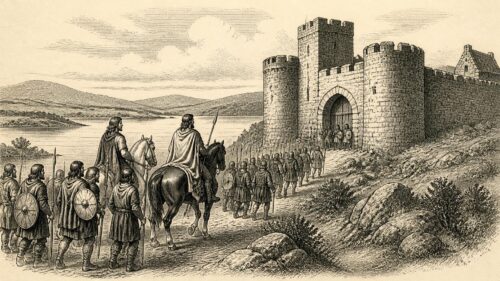
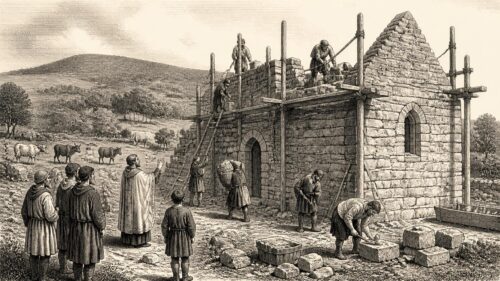
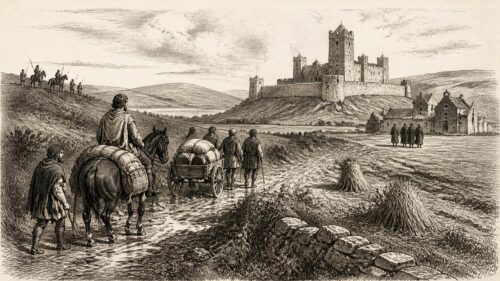
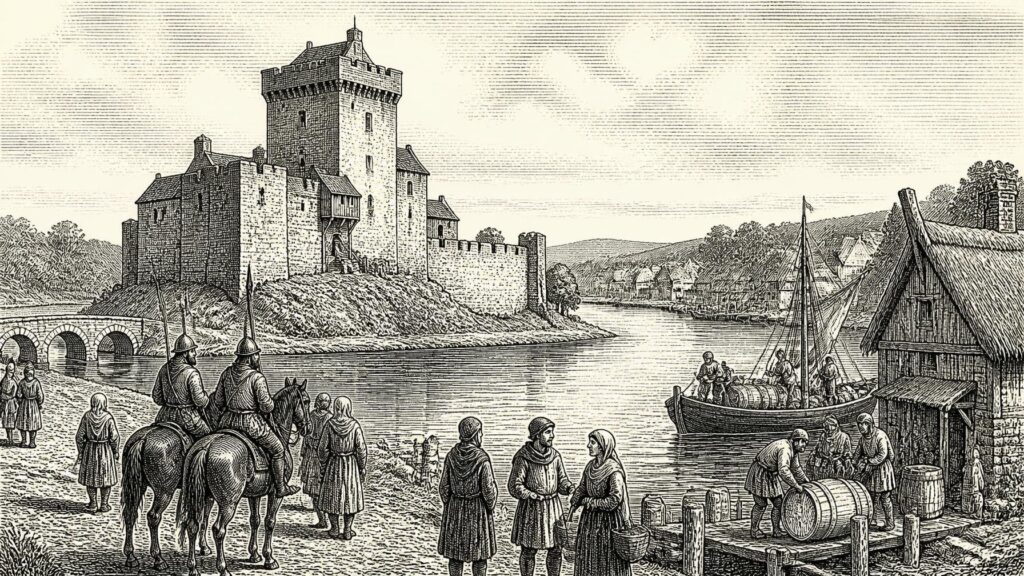
In the same year Richard de Burgh began or rebuilt Sligo Castle. The Annals of Connacht attribute the work directly to “the Earl”, and the later urban history of Sligo identifies the 1310 castle as a rebuilding by Richard de Burgo. Its position beside the Garavogue, close to a crossing and the port-facing settlement, made it important for communication between de Burgh interests in Connacht and the north-west. Sligo was already a place shaped by repeated contest: castles had been built, taken, destroyed and rebuilt there before. The 1310 work was therefore not the creation of order on an empty site, but a renewed attempt to secure a valuable and repeatedly disputed town.
Fortification had an economic meaning as well as a military one. A castle supported the collection and movement of agricultural surplus; it offered protection to officials and merchants; and it signalled an expectation of lasting control. Yet the same structure could intensify hostility, particularly where it embodied external lordship. In 1310, the rebuilding at Sligo and the destruction at Buninna expressed two sides of the same condition: powerful lords were investing in defensible centres, while their opponents demonstrated that such centres could be burned or bypassed.
Learning, Loss and Exchange
Not all the year’s losses were military. Early in the year, during what the Annals of Connacht calls a “hard spring”, Tanaide Ó Maelchonaire died. He was ollav—a chief master—in poetry and history for the Síol Muiredaigh. This was a serious cultural loss. Learned families such as the Ó Maelchonaires preserved genealogies, dynastic history, legal knowledge and praise poetry, skills that helped define rank, inheritance and political legitimacy. The terse notice does not permit a national conclusion about weather or harvests. It does, however, place the death of a leading scholar in a season remembered as harsh.
One remarkable note points towards Connacht’s wider connections. The annals record that twenty tuns of wine came ashore in Magh Cétné. The source does not securely establish the ship’s origin, cargo owner or whether this was wreckage, salvage or a deliberate landing. Still, wine on that scale was an imported luxury, and its appearance reminds us that even a province fractured by war participated in maritime exchange. Ports, river mouths and coastal landing places moved goods as well as warriors. Elite households, ecclesiastical institutions and towns supplied the demand for imported drink.
Elsewhere, the Irish annals preserve smaller but telling notices of a divided island. The Annals of Ulster record the killing of Niall Ó Domnaill, a defeat inflicted by Ruaidri Ó Conchobair on Muintir Raighillaigh at Druim Leathan, and the death of Niall, son of Brian Ó Néill, praised for generosity. The Four Masters also record the treacherous killing of Conchobar Ó Briain, described as an outstanding royal heir, by the “Black English”. These brief entries do not create a single national narrative, but they show that succession, rivalry and violence touched Ulster, Bréifne, Connacht and Thomond alike.
Thus 1310 was a year of statecraft and coercion rather than one decisive battle. At Kilkenny, royal government and church leaders tried to frame public order. In Connacht, de Burgh power rested on castles, councillors, military tenants and local allies, but met determined resistance from Gaelic dynasties. The building of Sligo Castle projected durability; the burning of Buninna exposed fragility. Aed Brefnech’s death altered a contest for Connacht, while the quartering of soldiers made its consequences felt across the townlands. Ireland entered the next years armed, politically unsettled and deeply connected—through learned families, castles, trade and warfare—across regions that no single authority securely controlled.
Primary Sources
- Annála Connacht: Annal 1310
- Annála Connacht
- The Annals of Ulster: Year U1310
- The Annals of Ulster
- Annals of the Kingdom of Ireland by the Four Masters: Annal M1310, English translation
- Annals of the Kingdom of Ireland by the Four Masters: Annal M1310, Irish text
- Annals of the Four Masters: Volume 2 English Translation
- Annals of Inisfallen: Annal I1310
- Annals of Inisfallen
- Annals of Inisfallen: Bibliography and Manuscript Information
- Burgh, Richard de
- Irish Parliaments in the Reign of Edward II
- Anglo-Norman Towns: Sligo Historical Notes
- Excavations 2008: Sligo, Sligo Abbey
- Irish Castles: 1180 to 1310
- The de Verdun Rebellion, 1312–15
- Pre-Union Irish Statutes Affected
- The Church and the Two Nations in Medieval Ireland: Index
- Donaghintraine, Castleconor and Buninna
- Anglo-Normans and O’Neills: The Situation in Ireland