St Mary’s Abbey Ablaze1304 CE
In 1304, Dublin suffered an accidental fire that destroyed St Mary’s Abbey, the Dominican house and much of the city, disrupting religious, commercial and administrative life. Chancery rolls covering 1291–1300 were lost, deepening later gaps in Ireland’s records. Justiciar John Wogan struggled to secure Athlone while Irish resources supported Edward I’s Scottish war. Richard de Burgh served in Scotland, but his wife and heir Walter died, altering succession. In Bréifne, Matha Ó Raighilligh was killed with his gallóglaigh, exposing volatile regional lordship. These events reveal interconnected vulnerabilities across medieval Ireland, though evidence offers little detail about ordinary people’s lives directly.
Dateline
For Ireland, 1304 is best approached through a small number of sharply recorded events rather than a misleadingly smooth national story. The year brought a destructive urban fire in Dublin, violence and succession shocks among powerful lordly families, continuing Irish involvement in Edward I’s Scottish war, and conflict in Bréifne and Connacht. The surviving evidence is uneven: Dublin’s catastrophe is preserved in Anglo-Irish annals and a later chancery memorandum, while Gaelic annals preserve the names, places and casualties of conflicts beyond the colonial towns. Together they show an island connected by lordship, warfare, religion and sea-routes, but not governed as a single political community.
A Fire at Dublin
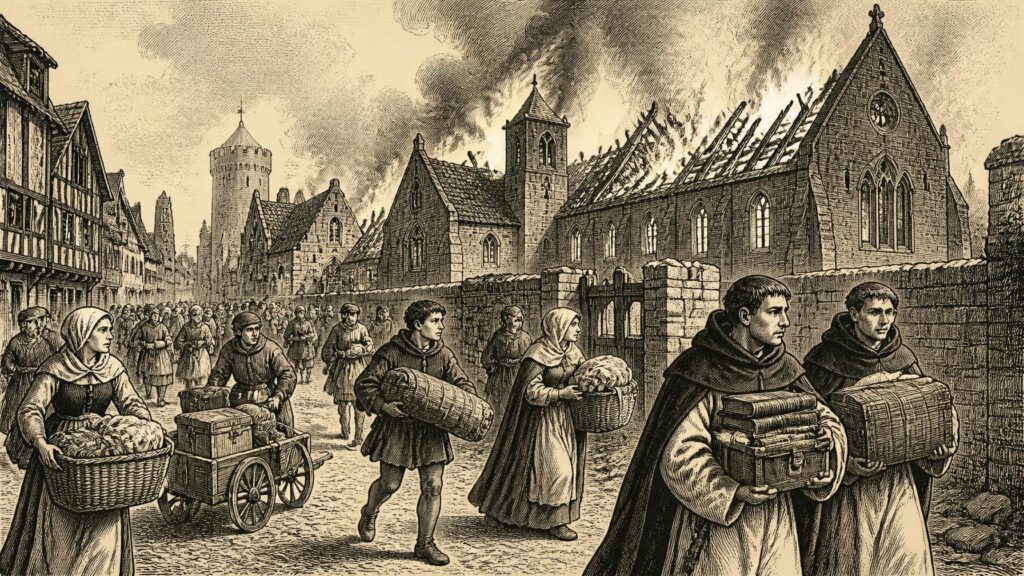
The most consequential event recorded within the year was the great fire at Dublin. The Annals of Ireland, associated with the Franciscan John Clyn, state that St Mary’s Abbey of Dublin, the house of the Dominican Preachers, and the suburb attached to it were burned on the feast of St Columba. A separate annalistic compilation records more cautiously that a large part of Dublin was accidentally burned. These accounts establish both the scale of the disaster and its accidental character, but they do not supply a reliable street-by-street route for the flames, a death toll, or a full list of destroyed homes and shops.
The institutions named make the fire especially significant. St Mary’s Abbey was a major Cistercian house near Dublin, while the Dominicans were among the most prominent preaching orders in the medieval town. Their churches and precincts were places of worship, burial, hospitality, administration and encounter between religious communities, townspeople, visitors and patrons. Damage to such sites therefore reached beyond masonry and religious furnishings. It disrupted the routines that depended on them: worship, almsgiving, commemoration of the dead, legal business and the movement of people through the city.
Medieval Dublin was the principal urban centre of the English lordship in Ireland, a port facing Britain and a place where civic, ecclesiastical and royal authority overlapped. A major fire in this setting was an economic as well as a religious emergency. It affected premises, stored goods and working capital, and it demanded labour, materials and credit for rebuilding. Yet the sources do not allow the losses of individual merchants, craftspeople or householders to be quantified. It is important not to fill that silence with invented scenes. What can be said is that the burning of substantial religious precincts and a large part of the city must have imposed a severe burden on an already densely used urban environment.
The Loss of Written Memory
The fire’s longest historical shadow fell on government records. A memorandum entered several years later on the back of an Irish chancery close roll states that, in the accidental great fire at St Mary’s Abbey, rolls of the Irish chancery were burned. It specifies a formidable loss: writs, inquisitions, bills and memoranda from the chancellorship of Thomas Cantock, beginning in late 1291, through Edward I’s twenty-eighth regnal year, 1299–1300. Only two rolls from that final regnal year were excepted.
This was not the destruction of every record ever made in medieval Ireland, nor should it be described that way. Charters, monastic documents, records held elsewhere and copies enrolled or preserved in England could survive. But the loss was still grave. The chancery produced and retained instruments through which royal government communicated orders, granted favours, managed land and inheritance, and recorded legal and administrative business. The 1304 fire removed much of the central written trail for a crucial phase in the development of English administration in Ireland.
There is an irony in the survival of the memorandum itself. It gives historians unusually precise evidence of an archive destroyed by an earlier disaster, while the roll on which it was written was itself ultimately lost in the Four Courts fire of 1922 and is now known through a facsimile. The event of 1304 therefore matters not only as a Dublin calamity, but also as a reason why the documentary record for late thirteenth-century Ireland is fragmented. Gaps in later histories are sometimes not gaps in medieval activity, but gaps created by flames.
Government Under Pressure
John Wogan remained justiciar of Ireland in 1304. His office represented the king’s authority in the lordship, but authority in practice depended on cooperation from magnates, royal officials, towns and local communities. Wogan’s government had spent much of the preceding decade raising men, ships, provisions and money for Edward I’s wars in Scotland. That wider war remained an immediate Irish concern, drawing resources and leading figures across the sea.
Within Ireland, the justiciar also faced insecurity. A campaign undertaken by Wogan in Connacht during 1304 failed to remove the threat to Athlone, the strategically important Shannon crossing and royal castle. The failure is a useful corrective to any impression that the royal administration could simply command the west. Castles and counties gave the crown points of authority, but they did not erase the military power of Gaelic rulers, the ambitions of Anglo-Irish lords, or the difficulties of campaigning over long distances.
Late in the year, on 4 November, Edmund Butler was appointed custos and acting justiciar during Wogan’s absence. Butler had come of age in January and inherited part of the extensive FitzGerald–FitzJohn estate, while Richard de Burgh received the other portion. His appointment demonstrates how government and aristocratic inheritance were intertwined: the king’s administration relied on men whose own landed interests made them leading actors in Irish politics. It also indicates that even routine continuity of government required deputies and careful delegation.
The Red Earl and Scotland
Richard de Burgh, the Red Earl of Ulster and lord of Connacht, stood at the intersection of Irish, English and Scottish affairs. He had led a substantial force from Ireland to Scotland in 1303. In 1304 he helped negotiate the submission of John Comyn, was present at the siege of Stirling, and returned to Ireland only on 31 July. His service illustrates that the Irish Sea was not a boundary isolating Ireland from British politics. Men, ships, supplies, lordly alliances and military obligations moved across it.
The Irish force under de Burgh was not simply an English expedition exported from Dublin. It included Anglo-Irish followers and Irish rulers from Ulster, and its participation reflected de Burgh’s own regional authority as much as royal command. In Scotland, Edward I’s campaign was moving towards the submission of the remaining Scottish political leadership. In Ireland, however, the resources committed abroad could leave the administration and local lordships with fewer men and less money to meet their own conflicts.
While de Burgh was still engaged in the Scottish campaign, his household suffered a double bereavement. The Annals of Loch Cé and Mac Carthaigh’s Book record the deaths in 1304 of the countess, wife of Richard de Burgh, and Walter de Burgh, described as the earl’s heir. Walter’s death altered the immediate succession within one of Ireland’s greatest lordships; the inheritance would pass through Richard’s younger son John. The annals do not explain the causes of either death, and no responsible account should add one.
Bréifne’s Violent Succession
In the Gaelic world, the year’s most striking recorded killing occurred at Achadh na Corra in Bréifne. The Annals of Loch Cé state that Matha, son of Gilla Íosa Ó Raighilligh and called king of Bréifne, was killed there by the Teallach Dúnchadha. His gallóglaigh were killed with him, while Mac Samhradháin and Mac Dorchaidh were wounded. Mac Carthaigh’s Book gives the same essential account and places it under the year beginning with the kalends of January.
The entry is unusually revealing despite its brevity. It names not merely a slain leader but the military companions around him and wounded allied figures, showing that lordship rested on personal followings and negotiated ties between kindreds. The presence of gallóglaigh, warriors associated with the Hebrides and western Scotland who had entered Irish service from the thirteenth century, points to the wider maritime military world linking Ireland and western Britain. Their deaths alongside Ó Raighilligh demonstrate that this was no minor private quarrel.
Chronology requires care. The later Annals of the Four Masters place Matha Óg Ó Raighilligh’s killing by the Teallach Dúnchadha under 1305, while the Annals of Loch Cé and Mac Carthaigh’s Book enter the episode in 1304. The latter two sources provide the strongest basis for connecting it to this year, but the disagreement means that an exact day should not be asserted. What remains firm is the political significance: the struggle exposed the volatility of power in Bréifne, where kinship, armed service and territorial control could be contested with lethal consequences.
A Year of Connected Vulnerability
The evidence from 1304 does not support claims of a single island-wide crisis, famine or decisive constitutional change. It does show several kinds of vulnerability operating at once. Dublin’s fire exposed the fragility of a town built around religious and administrative institutions. The destruction of chancery records damaged the state’s capacity to remember its own business. Wogan’s difficulties at Athlone revealed the limits of royal reach. De Burgh’s Scottish service demonstrated Ireland’s involvement in the politics of the neighbouring kingdoms, even as deaths in his family reshaped his domestic position. In Bréifne, a killing recorded by Gaelic annalists showed that regional kingship depended on armed networks whose loyalties could fracture.
For ordinary people, the surviving sources are least eloquent. They rarely name those who rebuilt burned precincts, carried supplies, tended fields, crewed vessels or suffered when armies took food and stock. Nevertheless, 1304’s records make clear that their lives were affected by decisions and disasters made far above them: a fire in the capital, campaigns tied to Scotland, contested lordship in the west and north, and the loss of documents that governed property, obligation and justice. The year survives as a reminder that medieval Ireland’s local worlds were never wholly local.
Primary Sources
- Annals of Loch Cé: Annal LC1304 (English translation)
- Annals of Loch Cé: Annal LC1304 (Irish text)
- Mac Carthaigh’s Book: Annal MCB1304 (English translation)
- Mac Carthaigh’s Book: Annal MCB1304 (Irish text)
- Annals of the Four Masters: Part 14
- Annales Breves Hiberniae
- Annalium Hiberniae Chronicon ad annum MCCCXLIX
- Annals of Ulster otherwise Annala Senait, Annals of Senat
- Burgh, Richard de | Dictionary of Irish Biography
- Burgh, William Liath de | Dictionary of Irish Biography
- Wogan, John | Dictionary of Irish Biography
- Butler (le Botiller), Edmund | Dictionary of Irish Biography
- Quantock (Cantok), Thomas | Dictionary of Irish Biography
- Calendar of Documents Relating to Ireland, 1171–1307
- Reconstructing the Past: The Case of the Medieval Irish Chancery Rolls
- CIRCLE: A Calendar of Chancery Letters
- Edward I, Ireland and the War in Scotland, 1303–1304
- From Kingdom to Colony: Framing the English Conquest of Ireland
- The Naval Miscellany
- Having the Right Kit: Galloglass Fighting in Ireland