Ballysadare and Sliabh Gamh1285 CE
In 1285, records from Connacht and Bréifne depict contested local power rather than a national crisis. Magnus Ó Conchobair defeated Adam Cusack’s settler force at Ballysadare, killing many and capturing Colin Cusack, but Pilib Mac Gosdelb soon routed Magnus’s followers at Sliabh Gamh, with heavy losses among lesser levies. Ruaidrí Ó Gádra, king of Sliabh Lugha, was killed by Mac Feorais near Lough O’Gara. Simon Ó Ruairc, bishop of Bréifne, died, as did Alis, daughter of Cormac, and Enri Mac Gilla Finnein. Annals emphasise fluid alliances, strategic routes, hostage-taking, and precarious lordship, while warning against chronologically misplaced later annalistic entries.

Dateline
The securely dated Irish record for 1285 is concentrated in Connacht and Bréifne. It does not describe a kingdom-wide turning point, a parliament, or a single campaign which can be made to stand for all Ireland. Instead, it preserves a tightly connected sequence of defeats, killings and deaths: Magnus Ó Conchobair’s victory over Adam Cusack’s force at Ballysadare; the swift reverse inflicted on Magnus’s followers by Pilib Mac Goisdelb at Sliabh Gamh; the killing of Ruaidrí Ó Gádra, king of Sliabh Lugha; and the death of Simon Ó Ruairc, bishop of Bréifne. Taken together, these notices show an Ireland in which authority was local, military power was contested, and the distinctions between Gaelic and settler interests were important but never simple.
The dating deserves care. Annála Connacht and the closely related Annals of Loch Cé explicitly place their entries under 1285, giving the calendrical heading of 1 January falling on a Monday. Their agreement provides the soundest framework for this year. Later compilations sometimes shift events: the Annals of the Four Masters, for example, place the death of Maurice ‘the Bald’ FitzGerald in 1285, whereas Annála Connacht and Loch Cé enter it in 1286. It is therefore better not to turn that death into an event of 1285. Likewise, material copied under a chronologically displaced heading in the Annals of Ulster belongs with 1289, not with this year.
A Victory at Ballysadare
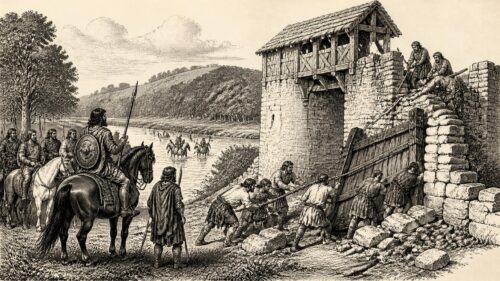
The foremost event was a major defeat delivered by Magnus Ó Conchobair to Adam Cusack and the Gallaibh Iarthair Connacht, the ‘Foreigners’ or settler forces of western Connacht, at Lecc Essa Dara: Ballysadare. The annalists say plainly that many people were killed. Colin Cusack, Adam’s brother, was taken prisoner after severe losses among his company. Their concise formula does not permit a reconstruction of the battle’s hour, numbers or exact ground. It does, however, make clear that it was not a casual raid. It was an encounter serious enough to produce many dead and a high-value captive.
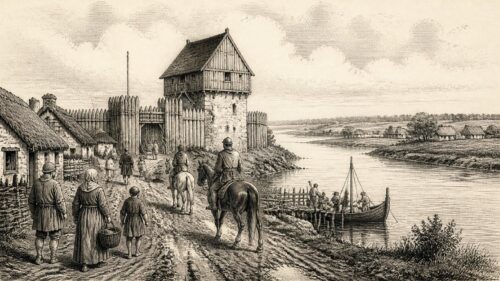
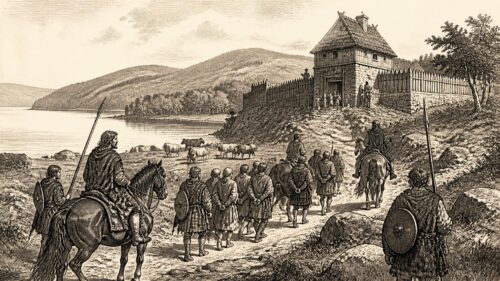
Ballysadare lay on a route of exceptional practical and strategic value. Its river crossing, coastal inlet and access towards north Connacht made it a natural point at which armed bodies, livestock, supplies and messengers could move between Sligo and the wider west. Such places mattered in a society where lordship depended on the ability to assemble followers, protect allies, exact food-renders and deny an opponent freedom of movement. The capture of Colin Cusack was accordingly more than a battlefield detail. A prisoner of standing could be held as security, exchanged, ransomed, or used to compel an accommodation. The annal does not say which outcome followed, so none should be presumed; its significance lies in the leverage that captivity created.
The opposing labels should not be made more rigid than the evidence allows. Magnus belonged to the Ó Conchobair dynasty, whose rival branches competed for the kingship of Connacht. Adam and Colin Cusack came from a family of Anglo-Norman origin established in Ireland. But warfare in thirteenth-century Connacht did not simply pit two sealed ethnic blocs against one another. Gaelic rulers could seek settler allies, while magnates of colonial origin recruited local Irish followers and pursued their own family interests. The wording ‘Galls of West Connacht’ identifies the defeated force as such in the annalistic viewpoint; it does not prove that every man present shared one origin, language or political purpose.
The Reverse at Sliabh Gamh
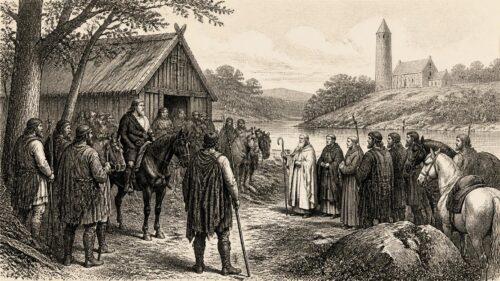
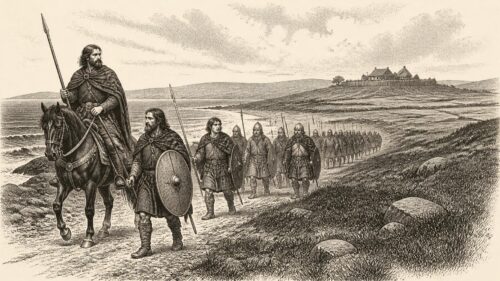
Any impression that Ballysadare settled the balance is immediately corrected by the next notice. Pilib Mac Gosdelb routed Magnus Ó Conchobair’s followers at Sliabh Gamh, rendered in the English edition as the Ox Mountains. Many of Magnus’s glaslaith and fodain—translated as young levies and lesser followers—were killed. The contrast between the two entries is the year’s central fact: one military success did not confer durable security. A lord’s reputation might be enhanced by a victory, but his force could be caught, scattered or diminished soon afterwards in another district.
The reference to young and lower-status fighting men gives a rare, if sombre, glimpse beyond named leaders. Annals generally preserve the names of kings, bishops, chiefs and prominent captives rather than those of ordinary combatants. Here the dead are counted socially rather than individually. They were men whose labour, kin ties and service sustained their lord’s household and military following. Their loss would have been felt in farms and settlements as well as in the immediate fighting force: households lost sons or dependants, and local communities lost men able to herd cattle, travel with a hosting, guard a route or fulfil obligations to a superior. This is an inference from the nature of lordship, not evidence for a particular village’s losses.
The location also matters. The uplands of Sliabh Gamh formed a difficult frontier zone between territories and routes leading across north Connacht. In such country, local knowledge, control of passes and the speed with which allies could be summoned were often as consequential as formal claims to lordship. The annals do not identify a castle besieged or a treaty made after the encounter. Their silence is itself a warning: 1285 should be seen as a year of unresolved competition, not as the founding moment of a new settled order.
Local Kingship and Violence
Another killing underlines how many levels of power coexisted. Ruaidrí Ó Gádra, described as king of Sliabh Lugha, was killed by Mac Feorais ‘on his own lake’, conventionally understood as Lough O’Gara. Sliabh Lugha was a regional lordship in the north Connacht world, not a small modern county. The title ‘king’ records recognised authority within that political landscape, while the killing reveals its vulnerability. The annal provides neither a cause nor the names of all participants; it should not be converted into a story of assassination, battle or judicial execution. What can be said is that Mac Feorais—of the Bermingham family—was sufficiently powerful to kill a regional ruler in his own country.
This event sits beside, rather than beneath, the Ballysadare and Sliabh Gamh clashes. The same year could contain conflicts involving an Ó Conchobair leader, the Cusacks, Mac Gosdelb, Mac Feorais and Ó Gádra without their forming one unified war. Alliances overlapped, rivalries crossed territorial boundaries, and a family’s interests could change from one expedition to the next. Modern maps with fixed county borders can obscure that reality. The more relevant geography was made of lordships, rivers, hills, lake margins, roads, ecclesiastical estates and seasonal paths for people and animals.
Church, Record and Loss
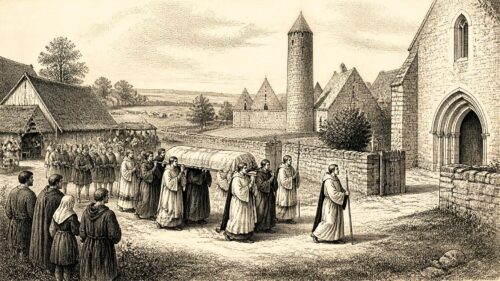
Simon Ó Ruairc, bishop of Bréifne, died in 1285. The entry is brief—he ‘rested’—but it indicates the enduring public importance of episcopal office amid political disorder. A bishop was not merely a sacramental figure. He stood at the centre of a diocese’s clerical personnel, churches, landed resources and connections with religious communities and secular patrons. The annal does not name Simon’s successor or describe a disputed election, so it would be unsafe to infer a vacancy crisis. Nevertheless, his death marked the removal of an important institutional figure in the north-western and midland borderlands.
Two further deaths receive notice: Alis, daughter of Cormac, and Enri Mac Gilla Finnein. Nothing in the entries identifies Alis’s family more fully, her age or status, or the circumstances of either death. Their preservation is still revealing. Annalists did not attempt a census of mortality; they selected people whose passing mattered to the communities from which the record descended. The inclusion of a named woman alongside cleric, ruler and military events is a reminder that kinship remained central to political society, even where the surviving text withholds the relationships that once made a name immediately meaningful.
A Narrow but Vivid Year
There is no firm 1285 evidence here for harvest failure, epidemic, major building works, overseas commerce or national legislation. Those subjects should not be manufactured merely to make the year look comprehensive. Yet the recorded events still illuminate everyday conditions. Fighting near Ballysadare and in the Ox Mountains threatened travel and the movement of goods; the loss of followers reduced households’ capacity; hostage-taking turned family connection into political pressure; and the death of a bishop touched the organisation of religious life. Ireland in 1285 was not politically uniform, and Connacht was not a passive edge of a Dublin-centred lordship. It was an arena in which Gaelic dynasts and settler families repeatedly measured force, influence and survival against one another.
The year’s clearest image is therefore not of a final triumph, but of rapid reversal. Magnus Ó Conchobair won a notable encounter at Ballysadare and saw a Cusack prisoner taken. Before the year’s record ends, Pilib Mac Gosdelb had defeated Magnus’s people in the hills. That sequence captures the precarious character of power in late thirteenth-century Connacht: authority had to be enacted continually, through followers, alliances, movement and the ability to recover from defeat.
Primary Sources
- Annála Connacht (English Translation)
- Annála Connacht: Edition and Bibliographical Information
- Annals of Loch Cé A.D. 1014–1590, Annal LC1285 (English Translation)
- Annals of Loch Cé A.D. 1014–1590, Annal LC1285 (Irish Text)
- Annals of the Four Masters, Annals M1282–M1291 (English Translation)
- Annals of the Four Masters, Annals M1286–M1291 (Irish Text)
- The Annals of Ulster, Year U1285 (English Translation)
- Annala Uladh: Annals of Ulster Otherwise Annala Senait, Annals of Senat (Irish Text)
- Annals of Connacht: Manuscript and Edition Catalogue Record
- The Annals of Connacht, in Irish 1224–1544, 1562: Manuscript Catalogue Record
- The Annals of Connacht: Connacht Extracts from the Annals of the Four Masters
- Normans & Natives in Medieval Connacht
- Kindred Lines: How Anglo-Norman Names Were Hibernicised
- Annales Dominicani de Roscoman
- The Genealogies, Tribes, and Customs of Hy-Fiachrach, Commonly Called O'Dowda's Country
- Caithréim Thoirdhealbhaigh, Part 1
- Irish Texts at CELT
- List of Published Texts at CELT
- CELT Project: Annals of Ulster Otherwise Annala Senait, Annals of Senat
- CELT Project: Annals of the Four Masters
- Annals of Connacht, Annals 1280–1289 (English Translation)