Glenmalure Victory1276 CE
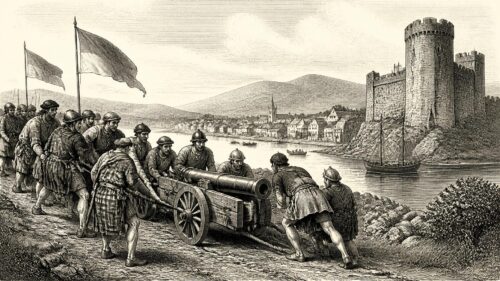
In 1276, Ireland remained politically fragmented, with English lordship dependent on local power, finance and force. In Connacht, rivalry between Tadc Ó Conchobair and Áed Muimnech produced alliances, burnings, cattle raids, recoveries and deaths, affecting wider lordly communities. In Wicklow, Geoffrey de Geneville’s expedition was defeated at Glenmalure by Art Mac Murchada, Gearóid Ó Broin and allies, demonstrating mountain resistance to Dublin’s authority. Edward I replaced Geneville with Robert de Ufford, whose government sought firmer control through administration, military spending and fortifications at Rindoon and Athlone. Possible Irish interest in English common law also exposed law as a negotiable privilege.
Dateline
In 1276, Ireland’s political geography was emphatically not a simple division between an English-controlled east and a Gaelic west. Authority was layered, local and contested. The Dublin government of Edward I claimed a lordship extending across the island, yet its practical reach depended on castles, sheriffs, magnates, rents, mounted service and negotiated submissions. Beyond, beside and often within that framework, Irish kings and chieftains retained their own dynastic claims, client networks and military capacity. This was particularly clear in two very different theatres during the year: Connacht, where rival branches of the Uí Conchobair fought over the provincial kingship, and the wooded mountain approaches of Wicklow, where an expedition led by the lordship’s chief governor was defeated.
The year is unusually well illuminated by Annála Connacht, whose carefully dated entries make it possible to follow a sequence of raids and reverses in the west. It is less well served by narrative sources for the Wicklow campaign, but the broad result is confirmed by modern scholarship and by the change in chief governorship that followed. These sources should not be made to say more than they do: they do not supply a day or a full battlefield narrative for Glenmalure, nor do they preserve the voices of ordinary people caught in the violence. They do, however, reveal the political pressures under which people lived.
A Contested Connacht
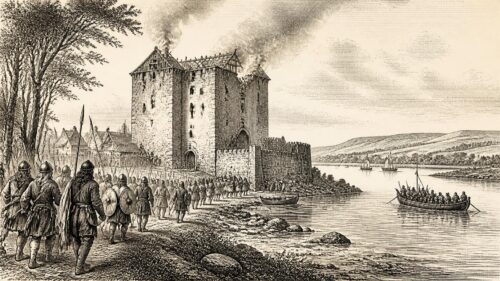
Connacht in 1276 was divided by a succession struggle within the Uí Conchobair dynasty. The established king was Tadc, son of Toirrdelbach, descended from Cathal Crobderg. His position was challenged by Áed Muimnech, son of Fedlimid, who had been away in Munster and now sought protection from Domnall Ó Domnaill of Tír Chonaill. Ó Domnaill raised an army in his support and advanced with him as far as Aghanagh, near Ballyshannon. There the Donegal ruler turned back; Áed continued into Connacht but did not immediately secure the kingship.
The episode demonstrates that protection was a political instrument rather than merely a refuge. A powerful ruler could receive a claimant, assemble a hosting and escort him towards a disputed province without necessarily committing to a decisive war. For Áed, Ó Domnaill’s support advertised status and created a potential threat to Tadc. For Ó Domnaill, intervention projected influence southwards while limiting the risks of a prolonged campaign. The annal’s wording is notably restrained: Áed remained in Connacht, while the sons of Toirrdelbach carried out many burnings but achieved no further advantage. That is an image not of a settled royal victory but of competing parties probing one another’s strength.
Raiding was the daily mechanism of that competition. The sons of Toirrdelbach attacked Áed’s party and the sons of Mac Diarmata, killing Gilla Crist Ó Máelbrénainn. Áed’s son, in turn, raided Clann Muirchertaig. Pursuit after the taking of livestock or other movable wealth brought its own danger: Gilla na nAingel Ó Conrai and others of Áed’s men were killed during such a pursuit. Ruaidrí, another son of Toirrdelbach, raided Muintir Nechtain but was routed; the prey was recovered, and Domnall Ó Ruairc, called the Butter Lad, was among those killed on Ruaidrí’s side. Ruaidrí then killed Gilla Crist and Uilliam Ó Nechtain.
These were not marginal incidents. Cattle were mobile capital, food, milk, traction and the basis of payments and hospitality. A raid could weaken an opponent’s household, reward followers and publicly test a chief’s ability to protect dependants. Burnings harmed crops, buildings and stores; the recovery of prey mattered as much as its initial seizure. The named dead also show that warfare joined together dynastic princes, local lordly families and their armed companions. Connacht’s conflict was therefore experienced far beyond the narrow circle of rival candidates for the provincial kingship.
Defeat in Glenmalure
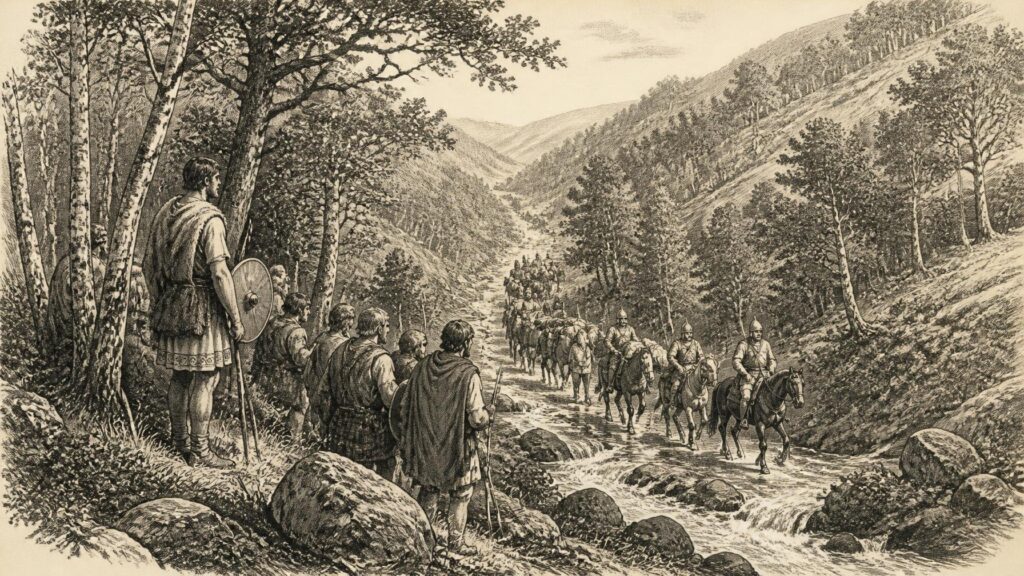
While Connacht’s rivals fought within a Gaelic political order, the Dublin government faced a sharp rebuff in Leinster. Geoffrey de Geneville, lord of Trim and justiciar of Ireland, led a campaign into Glenmalure in the Wicklow Mountains and was defeated there in 1276. The victory belonged to the Irish of east Leinster, led in this phase by Art Mac Murchada, brother of the imprisoned Muirchertach Mac Murchada, together with Gearóid Ó Broin and allied Ó Tuathail forces. Muirchertach had been captured in 1275, but imprisonment had not dissolved the coalition or the political importance of the Mac Murchada kindred.
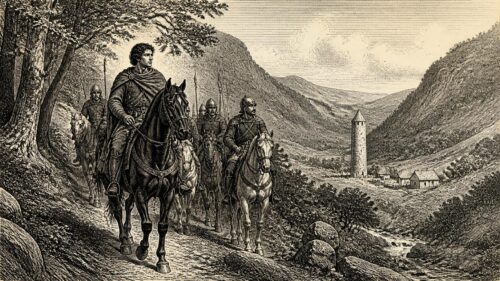
Glenmalure was an excellent place to expose the limits of conventional lordship warfare. Its steep-sided valleys, woods, streams and narrow approaches favoured defenders who knew the ground and could restrict the movement of horses, carts and heavily equipped troops. The point is not that Gaelic armies possessed a single timeless mountain tactic, nor that every man in the force fought in the same manner. Rather, terrain helped a local coalition deny an invader the advantages of open-country movement, supply and command. It also made the attempt to impose authority costly. The governmental accounts for 1275–76 allowed more than £2,300 for the expedition to Glenmalure, a striking reminder that military action consumed cash as well as political credit.
The defeat was particularly embarrassing because it was the second major reverse suffered by forces of the Dublin administration in the Glenmalure area within a few years. It showed that the lordship’s jurisdiction did not automatically follow its claims on parchment. Castles, manors and markets in the lowlands remained important centres of English power, but the mountainous interior could sustain autonomous leadership and make punitive expeditions fail. For surrounding communities, this conflict brought requisitions, military movement, the threat of plunder and uncertainty over which armed group could safely be resisted, supplied or accommodated.
A New Justiciar
The governmental response was administrative as well as military. On 17 June 1276 Edward I appointed Robert de Ufford justiciar of Ireland, replacing Geneville after his resignation. Ufford had served Edward on crusade and was an experienced royal officer; the office made him the king’s principal governor in Ireland, responsible for justice, finance, defence and the supervision of royal officials. The appointment is firmly dated, although the evidence suggests that he began acting in Ireland from Michaelmas, late in September, rather than immediately in June.
Ufford did not inherit a blank slate. He inherited the consequences of Glenmalure, the continuing instability of Connacht and a lordship in which magnates held extensive liberties with considerable local autonomy. His appointment nevertheless marked a determination at the royal court to restore effectiveness. Subsequent campaigns in Wicklow would prove more successful, but those belong chiefly to 1277 and 1278. In 1276, the important fact is the change of governor itself: defeat had helped expose a need for firmer direction, and Edward selected a trusted household knight to provide it.
There was also a revealing constitutional issue emerging around this transition. A report from Ufford to Edward, dated either late in 1276 or in 1277, stated that Irish leaders were offering 7,000 marks for the grant of English common law. Because the surviving correspondence cannot securely be placed within 1276, it should not be treated as an event certainly concluded that year. Yet it belongs closely to the new justiciar’s first period in office. The proposal shows that English law could be regarded not only as an instrument of exclusion but as a valuable royal concession sought by some Irish elites. It also underlines the king’s power to withhold, sell or condition legal status.
Fortresses and Fiscal Reach
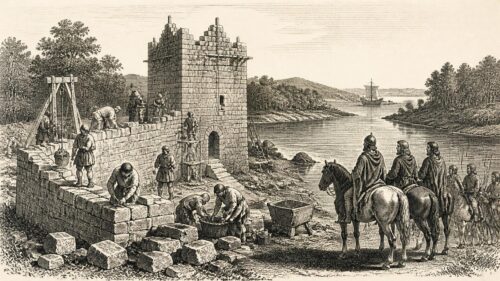
The change in leadership also coincided with renewed expenditure on the central-western defensive line. Ufford’s account for the financial year 1276–77 records more than £2,136 spent on fortifications and buildings at Rindoon on Lough Ree and at Athlone, the Shannon crossing. The accounting year straddles 1276 and 1277, so it cannot demonstrate that every recorded structure was begun in the calendar year 1276. It does show, however, that Ufford’s administration quickly committed substantial resources to the fortified corridor connecting the Dublin-centred lordship with Connacht.
Such spending meant work for carpenters, masons, labourers, boatmen, suppliers and garrisons, while drawing money and materials from a society already burdened by warfare. Rindoon and Athlone were not simply isolated military monuments. They were nodes in networks of river traffic, roads, food supply, tolls, royal revenue and political communication. Their maintenance expressed an official belief that durable control required defended movement across the Shannon and secure bases from which officials and armies could operate.
The Shape of the Year
Thus 1276 was not a year of a single Irish war or a single Irish government. In Connacht, dynastic rivalry turned cattle-raiding, burning and pursuit into the practical language of power. In Wicklow, Art Mac Murchada and his allies demonstrated that the lordship’s chief governor could be beaten in difficult country. In Dublin and at Edward I’s court, Geneville’s replacement by Robert de Ufford signalled a renewed effort to govern through office, finance and fortification. The records preserve kings, justiciars and named casualties more readily than cultivators, craft workers and households. Even so, the constant concern with prey, provisions, fortresses and payments makes plain that the consequences of high politics reached deeply into everyday life.
Source References
Hover over a number to see the source. Select it to open the source.

- [1] Annála Connacht
- [2] Part 54 of Annála Connacht
- [3] The Annals of Ulster, Year U1276
- [4] The Annals of Ulster
- [5] Annals of the Four Masters, Volume 3 English Translation
- [6] Part 10 of Annals of the Four Masters
- [7] Annals of Loch Cé A.D. 1014–1590
- [8] Annales Hiberniae
- [9] Ufford (Offord), Sir Robert of
- [10] MacMurrough (Mac Murchada), Muirchertach
- [11] O'Byrne (Ó Broin), Murchad
- [12] Edward I and the Proposed Purchase of English Law for the Irish, c. 1276–80
- [13] Vaucouleurs, Ludlow and Trim: the Role of Ireland in the Career of Geoffrey de Geneville (c. 1226–1314)
- [14] English Rule in Ireland, c.1272–c.1315
- [15] Calendar of the Patent Rolls Preserved in the Public Record Office: Edward I, A.D. 1272–1281
- [16] Calendar of the Patent Rolls Preserved in the Public Record Office: Edward I, A.D. 1272–1281 (PDF)
- [17] Robert de Ufford, Named 1256 to 1442
- [18] Inquisitions and Extents of Medieval Ireland
- [19] Castlekevin Conservation Report CMF 22-2-WI001
- [20] Athlone Castle: Its Early History
- [21] Annales Dominicani de Roscoman
- [22] Irish Historic Towns Atlas: Tuam
- [23] Texts Beginning with the Letter C
- [24] Calendar of the Patent Rolls Preserved in the Public Record Office: Edward I, A.D. 1272–1281
Primary Sources
- Annála Connacht
- Part 54 of Annála Connacht
- The Annals of Ulster, Year U1276
- The Annals of Ulster
- Annals of the Four Masters, Volume 3 English Translation
- Part 10 of Annals of the Four Masters
- Annals of Loch Cé A.D. 1014–1590
- Annales Hiberniae
- Ufford (Offord), Sir Robert of
- MacMurrough (Mac Murchada), Muirchertach
- O'Byrne (Ó Broin), Murchad
- Edward I and the Proposed Purchase of English Law for the Irish, c. 1276–80
- Vaucouleurs, Ludlow and Trim: the Role of Ireland in the Career of Geoffrey de Geneville (c. 1226–1314)
- English Rule in Ireland, c.1272–c.1315
- Calendar of the Patent Rolls Preserved in the Public Record Office: Edward I, A.D. 1272–1281
- Calendar of the Patent Rolls Preserved in the Public Record Office: Edward I, A.D. 1272–1281 (PDF)
- Robert de Ufford, Named 1256 to 1442
- Inquisitions and Extents of Medieval Ireland
- Castlekevin Conservation Report CMF 22-2-WI001
- Athlone Castle: Its Early History
- Annales Dominicani de Roscoman
- Irish Historic Towns Atlas: Tuam
- Texts Beginning with the Letter C
- Calendar of the Patent Rolls Preserved in the Public Record Office: Edward I, A.D. 1272–1281