Aengus, Poet of Ireland932 CE
In 932, Irish annals recorded the death of Aengus son of Aengus, probably chief poet of Ireland, indicating the public importance of learned culture and its links with churches and aristocratic patrons. They also note Flann son of Máel Sinna, king of Brega, killed by the Uí Echach, alongside the deaths of Loingsech of Dál Araide and Colla of Norse-Gaelic Limerick. These notices reveal competing regional powers, unstable succession and maritime connections. Differing annalistic chronologies prevent precise dating of related events. Beyond elite records, political changes could directly affect farming, obligations, travel and security, though no nationwide catastrophe is evidenced.
Dateline
For Ireland in 932, the surviving record is unusually spare but still revealing. One annal names the death of Aengus son of Aengus, identified by its modern editor as chief poet of Ireland. Another records the killing of Flann son of Máel Sinna, king of Brega, and the deaths of Loingsech, king of Dál Araide, and Colla, king of Limerick. These short notices do not describe a single national drama. Instead, they preserve fragments from several political worlds: a poet’s standing across Ireland, violent competition in the central east, a change of ruler in north-east Ulster, and succession in the Norse-Gaelic port of Limerick.
Dating a Sparse Year
The evidence requires care. The Annals of Inisfallen place Aengus’s death under 932, while Chronicon Scotorum assigns the deaths and killing of secular rulers to the same annal-year. Neither source gives a month, day or precise place for these events. The Annals of Ulster contain related notices in an entry headed “AD 931 alias 932”, while the much later Annals of the Four Masters place comparable material under 930. Such variations are a familiar feature of medieval Irish annals, caused by differing chronological systems, copying histories and later editorial arrangements.
It would therefore be wrong to convert every neighbouring annal into a firmly dated event of 932. In particular, the Ulster notices of the killing of the Scandinavian jarl Torulb, the death of the churchman Airmedach of Cúl Rathain, and a fleet on Lough Ree belong to the closely connected sequence of the early 930s, but cannot all be assigned to this calendar year with confidence. What can responsibly be said is that 932 fell within a period of active warfare, maritime mobility and contested lordship, especially around Ulster, the midlands and the Irish Sea.
A Poet Remembered Nationally
The clearest cultural notice is the death of Aengus son of Aengus. The surviving Inisfallen entry is damaged or abbreviated, and the identification of him as ardfhile, chief poet of Ireland, is an editorial restoration. Even so, the wording points to a rank of real consequence. A chief poet was not merely an entertainer or composer of verses. In learned Irish society, poets and other men of letters helped to preserve genealogies, royal praise, legal and historical knowledge, place-lore and memorable speech. Their work could travel with patrons, clerics and pupils between kingdoms and ecclesiastical centres.
Aengus’s commemoration in a Munster-derived chronicle suggests a reputation extending beyond one locality. That does not allow us to reconstruct his poems, identify his patrons, or claim that he served any particular king in 932. No surviving verse can securely be tied to his death notice. But the annal’s decision to record him shows that poetry remained an institution of public importance. In a society whose political claims depended greatly on ancestry, reputation and the remembered deeds of predecessors, trained verbal expertise had practical value. A ruler’s legitimacy could be articulated in genealogical and historical language as well as defended with armed followers.
The notice also reminds us that literacy and learning were not confined to a distant, purely clerical sphere. Monasteries supplied many of the settings in which manuscripts were copied and historical records were maintained, yet poets moved within wider networks of aristocratic patronage. Irish learning in 932 was sustained by the interaction of ecclesiastical communities, hereditary learned families and royal households. The loss of a leading poet was therefore a loss within the political culture of the island as well as within literature.
Kingship Without Unity
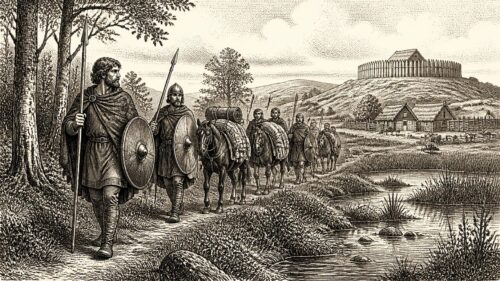
Chronicon Scotorum records that Flann son of Máel Sinna, king of Brega, was killed by the Uí Echach. Brega, centred broadly on the rich plains around the Boyne and lower Liffey, was one of the most politically valuable regions in Ireland. It contained major royal and ecclesiastical landscapes, including Tara’s wider district and the great churches of the north-east midlands. Its rulers operated amid strong neighbouring dynasties and in the shadow of Dublin. Flann’s killing is thus a sharp indication that authority there depended on continuing local alliances and armed strength.
The annal does not name a battlefield, explain the grievance, or specify which Uí Echach branch was responsible. It should not be inflated into evidence for a kingdom-wide war. Yet “killed by” is more than a routine obituary: it records a political death, and political deaths could rapidly alter claims to tribute, clientship and land. The killing would have affected Flann’s kin, dependants and rivals, while also creating opportunities for more powerful neighbours to intervene. Such changes were often felt most immediately by ordinary households through demands for provisions, escorts, cattle, labour or hostages.
Two further obituaries show that kingship was equally unstable elsewhere. Loingsech, grandson of Lethlobar, king of Dál Araide, died. Dál Araide was a leading people of the north-east, traditionally influential within the shifting politics of Ulaid. His death did not necessarily mean violence; the annal gives no cause. But it created a succession question in a region where rival ruling lineages, church communities and Scandinavian forces all mattered. The distinction is important: an annalistic death may mark a peaceful transition, whereas a killing reports conflict. The sources do not permit us to treat them alike.
Colla, grandson of Báirid, king of Limerick, also died in 932 according to Chronicon Scotorum. The title is striking. It identifies a ruler of Luimnech at a time when Limerick was a Norse-Gaelic power at the Shannon estuary, not simply a raiding camp on Ireland’s western edge. The annal gives no detail of Colla’s ancestry beyond his grandfather, no cause of death, and no successor. Nonetheless, his obituary demonstrates that the political society associated with Limerick had recognisable leadership and dynastic memory.
Limerick and the Inland Waters
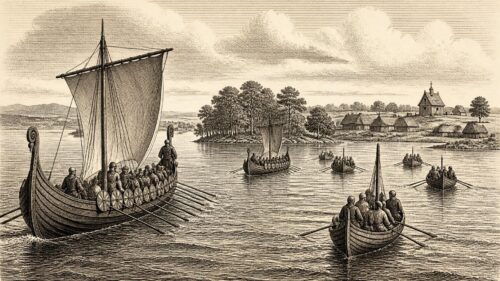
Colla’s death belongs to a wider setting of Scandinavian activity that had transformed Irish waterways over the previous century. Longships and other vessels could move people, weapons, livestock, captives and portable wealth between coastal bases and inland lakes. The Shannon system, including Lough Ree, connected Munster, Connacht and the midlands. Earlier annals describe fleets from Limerick operating on those waters and attacking islands and churches. That earlier evidence must not be mistaken for an event of 932, but it explains why the succession of a Limerick ruler was relevant far beyond the estuary.
The word “foreigners” in Irish chronicles was also less simple than a modern national label. Scandinavian leaders and settlers in Ireland could make alliances with Irish rulers, employ Irish followers, intermarry, rule mixed communities and fight one another. Likewise, Irish kings were not united against them. Political advantage, tribute and local rivalries frequently shaped alliances. The evidence for 932 therefore supports a picture of several overlapping power networks rather than two fixed blocs, Irish and Viking.
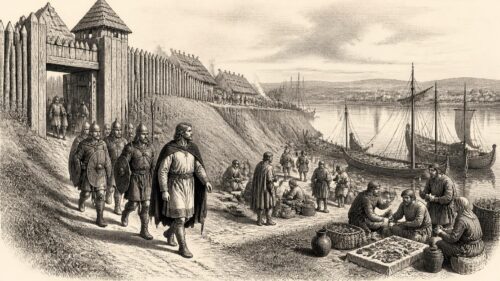
Limerick’s maritime position also linked warfare with exchange. Ports were places through which silver, slaves, textiles, weapons, luxury goods and everyday necessities might circulate, although no specific cargo or market transaction is recorded for this year. The annals’ fixation on fleets, plunder and rulers reflects elite concerns, but those concerns rested on practical systems of shipbuilding, food supply, craft production and local labour. A ruler’s death could unsettle not only a war-band but the web of obligations that provisioned a settlement.
Churches, Farms and Everyday Security
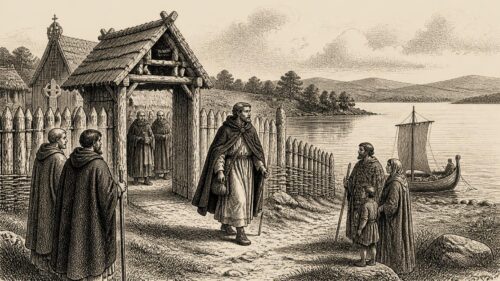
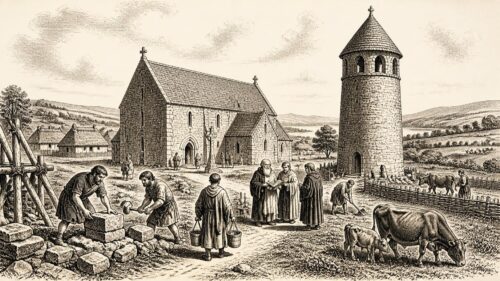
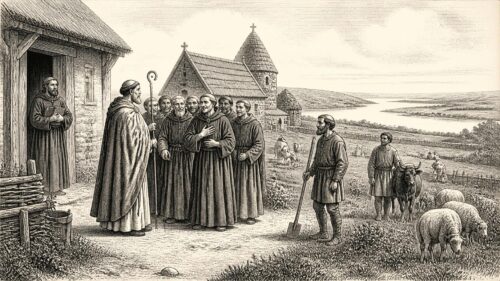
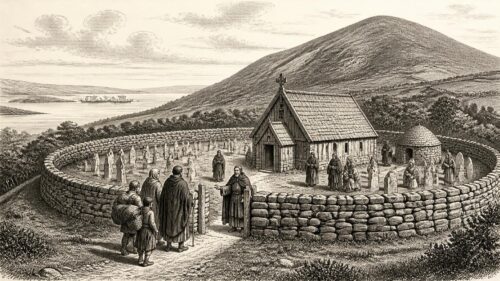
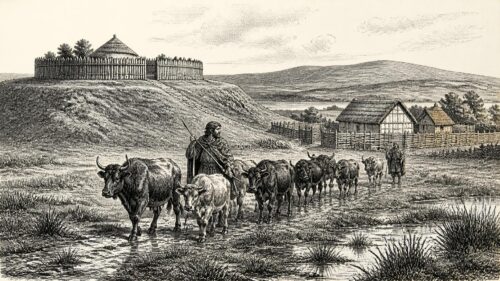
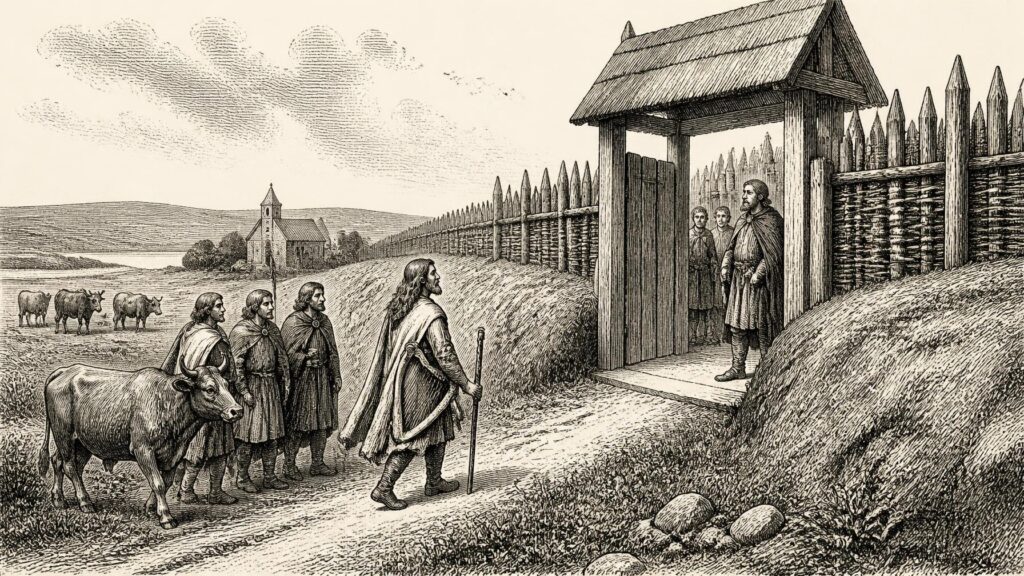
Most people in 932 lived outside the annals’ narrow field of vision. They inhabited dispersed farmsteads, often enclosed by earthen banks or stone cashels, and relied on cattle, dairy produce and cereal crops. Cattle remained a central measure of wealth, while grain had to be grown, harvested, dried and ground. Kinship, lordship and customary obligation shaped access to land and protection. Religious sites ranged from small churches to major monasteries with agricultural lands, craftspeople, tenants, scholars and travellers. These communities were spiritual centres, but also important economic and social institutions.
The year’s royal notices illuminate that everyday world indirectly. A killing in Brega, a death in Dál Araide and a succession in Limerick could change who demanded food-renders, military service or political loyalty. They could affect the safety of roads, river crossings and shoreline settlements. Yet there is no surviving evidence that Ireland as a whole suffered famine, epidemic or a general campaign in 932. Silence should not be mistaken for tranquillity, but neither should it be filled with imagined catastrophe.
What survives from 932 is consequently a small but meaningful cross-section. Aengus’s death records the standing of learned culture. Flann’s killing exposes the danger surrounding regional rule. Loingsech and Colla’s deaths show that leadership changed in both north-east Ulster and Norse-Gaelic Limerick. Together, these notices reveal an Ireland made up of many connected but competing centres of authority, in which poets, churches, farms, kings and waterborne settlements all helped to shape public life.
Primary Sources
- The Annals of Ulster
- The Annals of Ulster, Year U932
- The Annals of Ulster, Year U933
- Annals of Ulster: Irish and Latin Text
- Chronicon Scotorum
- Chronicon Scotorum, Annals CS925–CS929
- Chronicon Scotorum, Annals CS930–CS934
- Chronicon Scotorum: Bibliography
- Annals of the Four Masters
- Annals of the Four Masters, Part 3
- Annals of the Four Masters, Part 4
- Annals of Inisfallen
- Annals of Inisfallen, Annals AI930–AI939
- Annals of Inisfallen: Irish and Latin Text, Part 5
- List of Published Texts at CELT
- Exploring the Irish Annals
- Annals of Inisfallen to Go on Public Display in University College Cork
- Annals of the Kingdom of Ireland: Table of Contents
- Cultural Heritage Resources: River Shannon, Meelick to Limerick
- Farming and Archaeology: The Irish Historic Landscape
- Rathbeagh Ringfort, Co Kilkenny
- Patrician and Early Christian Architecture
- Early Christian Monasteries
- Ordinary People in Early Christian Ireland