Tamlacht’s Empty Fair810 CE
In 810, Tallaght’s monastic community prevented the royal fair at Tailtiu after the Uí Néill violated its sanctuary, leaving the assembly devoid of expected horses and chariots. Subsequent gifts to Tamlacht indicate public redress and demonstrate ecclesiastical leverage over Áed son of Niall’s kingship. Nuadu, abbot of Armagh, carried Patrick’s law and a casket to Connacht, extending Patrician claims without recorded outcome. The Ulaid defeated Scandinavian raiders, the first surviving annalistic Irish victory, though details remain unknown. Death notices recall monastic and aristocratic life, while the disrupted fair depended upon agricultural surplus and rural exchange across early medieval Irish society.
Dateline
The evidence for this year is unusually revealing, not because the annals offer a full narrative, but because three terse notices expose the working connections between kingship, church authority and military defence. The chronology needs care. The Annals of Ulster place these entries under their annal U811 while explicitly equating that annal with AD 810; Chronicon Scotorum numbers comparable material CS811, and the later Annals of the Four Masters use another offset. This article therefore treats the events as belonging to 810 in the Ulster annal’s AD reckoning, while avoiding claims to a more precise date or season unless the source supplies one.
A Fair Stopped at Tailtiu
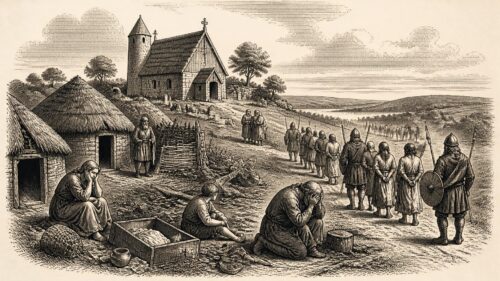
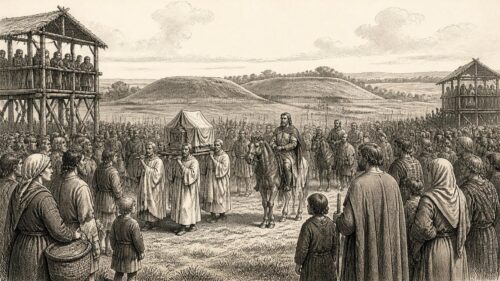
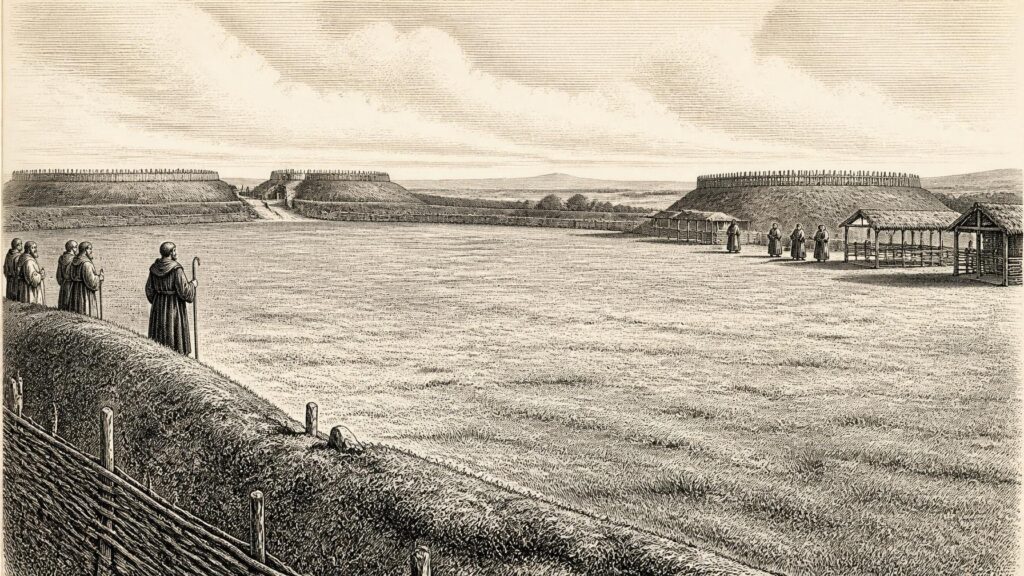
The most striking recorded development was the failure of the fair of Tailtiu, near modern Teltown in County Meath. The annalist says that it was prevented from taking place on a Saturday under the aegis of Áed son of Niall: neither horse nor chariot arrived. This was no ordinary local market cancelled by bad weather. Tailtiu was a major Uí Néill assembly-place, associated with royal authority, public meeting, sporting and ceremonial gathering, legal business and exchange. To prevent its holding was to make a public challenge to the order that a powerful king was expected to maintain.
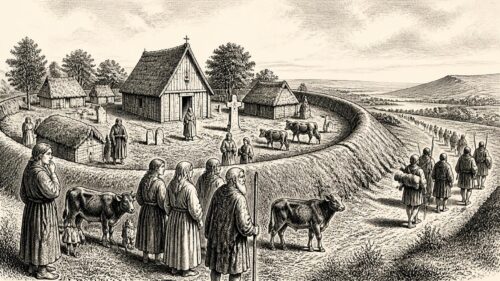
The community responsible was Tamlacht, modern Tallaght, the monastery founded by Máel Ruain. Its grievance was specific: the Uí Néill had violated Tamlacht’s sanctuary or termon. A sanctuary was not merely a patch of protected ground around a church. It was an acknowledged zone of ecclesiastical immunity, backed by custom, status and the threat of religious sanction. The annal does not say who had entered it unlawfully, what violence or seizure had occurred, or whether Áed himself ordered the breach. Those omissions matter. Yet it does make plain that the offence was grave enough for Tamlacht’s community to mobilise a boycott capable of emptying Tailtiu.
That the fair had no horses or chariots is a vivid formula, but it should not be read as a literal census of every traveller. It signals the absence of the traffic and display expected at a royal gathering. Horses were valuable working animals and emblems of aristocratic mobility; chariots, whether used in practice on the journey or invoked as a conventional image of elite attendance, belonged to the language of high-status assembly. The episode shows that a monastery could impede royal spectacle and the networks of obligation on which it depended.
The dispute ended in accommodation. “Many gifts” were subsequently given to Tamlacht’s community. The annal does not identify the donor, list the gifts, or state whether they constituted compensation, restitution or a negotiated settlement. It is safest to see them as public redress rather than to invent a treaty. Even so, the political meaning is clear. Áed, the leading Uí Néill ruler of his generation and king of Tara, could not simply disregard a religious house whose support, or at least whose non-hostility, mattered at the centre of Ireland.
Tallaght’s Moral Authority
Tamlacht’s leverage had roots in the character of the community established there in 774. Máel Ruain had died in 792, but his monastery remained a prominent centre of the reforming religious tendency later called the Céli Dé. Its associated teaching stressed disciplined communal life: prayer, celibacy, manual labour, fasting and moral correction. Tallaght was also linked with learning. Texts associated with its milieu include the Martyrology of Tallaght, while the early ninth-century Félire Óengusso belongs to the same wider intellectual world.
None of that permits a simple picture of monks standing outside politics. The boycott demonstrates the opposite. Religious reform did not mean withdrawal from society; it supplied communities with a language of privilege, justice and sacred protection that kings had to recognise. In early medieval Ireland, monasteries held land, dependants, livestock and food-rents, and their heads could be influential figures within regional political networks. The protection of a saint’s household had practical as well as devotional consequences.
The event also illuminates the nature of kingship. Ireland was not a unitary kingdom ruled through a permanent capital or bureaucracy. It consisted of many small polities, overlaid by larger dynastic claims. Authority had to be renewed through hostings, tribute, judgements, gift-giving and assemblies. A king’s ability to convene a fair was therefore part of government. Tallaght’s action exposed a breach between royal power and ecclesiastical right; the recorded gifts suggest an effort to repair it before the breach hardened into wider opposition.
Patrick’s Law in Connacht
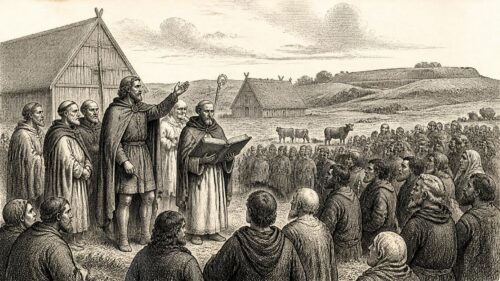
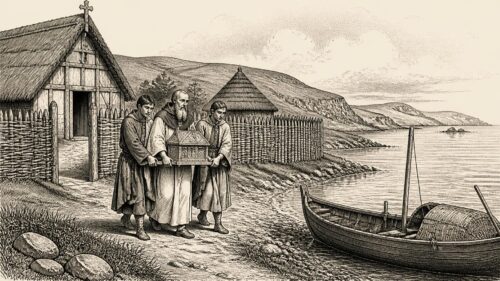
A second ecclesiastical notice has equally large implications. Nuadu, abbot of Ard Macha, travelled to Connacht carrying “Patrick’s law and his casket”. The entry gives no route, destination within Connacht, or explanation of the business. It does, however, identify an organised assertion of Armagh’s Patrician authority far from its northern base.
“Patrick’s law” should not be imagined as a surviving statute-book carried unchanged from the fifth century. In this setting, a saint’s cáin or law was a body of privileged protection, claims and obligations upheld in the saint’s name. It could be proclaimed by clerics who travelled with relics or other sacred objects. The “casket” in the Annals of Ulster is best understood cautiously as an object of ecclesiastical authority, perhaps a reliquary or shrine; the source does not specify its contents. Its presence made the journey more than an administrative visit. It joined legal demand, cult and material display.
Armagh had already seen Patrick’s law promulgated by Áed son of Niall a few years earlier, during the upheavals of the great pestilence recorded for 806. Nuadu’s Connacht journey in 810 therefore belongs to a continuing process, not a sudden invention. Armagh’s leaders sought recognition for their church and saint across provincial boundaries. Connacht’s rulers and churches were not necessarily passive recipients: a travelling law required local acceptance, negotiation and enforcement. The annal records the mission, not its result, so it would be wrong to claim that Connacht was brought under Armagh’s control in this year.
A Northern Victory, Briefly Told
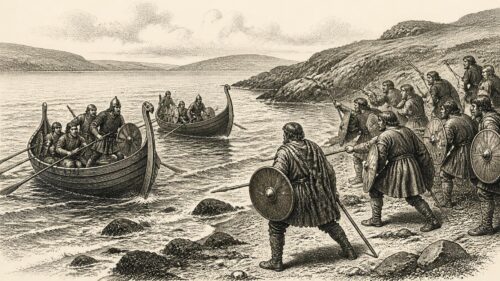
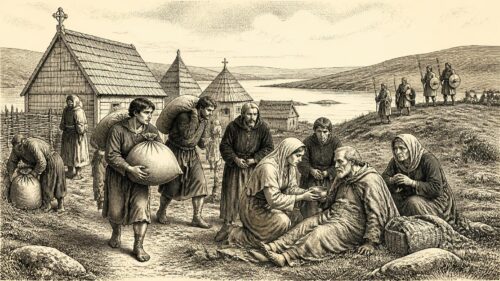
The third major entry is the tersest: “a slaughter of the heathens by the Ulaid”. In early ninth-century Irish annals, “heathens” normally denotes Scandinavian raiders. This is the first recorded Irish victory over them in the surviving annalistic sequence. It is important, but its limits must be respected. No place is named, no leader is supplied, no number of ships or casualties is given, and the account does not say whether the Ulaid struck men ashore, intercepted boats, or defeated a raiding party after an attack.
The Ulaid occupied much of eastern Ulster, including the coasts and sea-lanes facing Scotland and the Isles. Their victory came after a disturbing sequence. Raiders had attacked Rathlin or Rechru in 795; in 802 Iona was burned; in 806, sixty-eight members of Iona’s community were killed; and in 807 raiders burned Inis Muiredaig and attacked Ros Camm on the western seaboard. These were still generally small, mobile incursions, not the large fleets, fortified bases and permanent towns of later decades. The Ulaid’s success in 810 should consequently be seen as a local counterstroke in an unsettled maritime world, not as the expulsion of Vikings from Ireland.
Its significance lies partly in what it disproves. Irish communities were not simply helpless targets waiting for foreign settlement. Coastal kingdoms had boats, armed followings, local knowledge and the capacity to organise resistance. The annal’s wording is celebratory but spare; it preserves the fact of a victory without allowing historians to turn it into a fully described battle.
Churches, Households and the Rural Year
The remaining notices are deaths, yet they help locate the year’s larger events within ordinary institutional life. Admaer, daughter of Áed of Leinster, died “at a good old age”, an unusual reminder that aristocratic women appear in the record not only as wives in dynastic alliances but as persons whose longevity could be commemorated. Dímán, an anchorite of Ara in Munster, “ended his life happily”. Tuathgal, abbot of the elders of Cluain, died, as did Blathmac grandson of Muirdibor, abbot of Dairmag, better known as Durrow. Such notices reveal a landscape densely marked by churches, monastic households, scribes, teachers and ascetics.
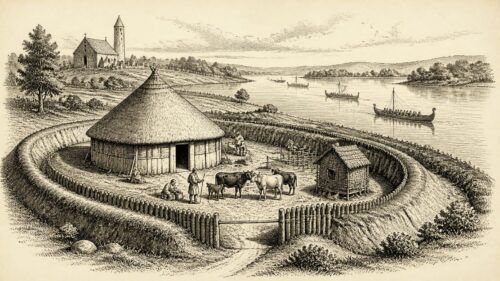
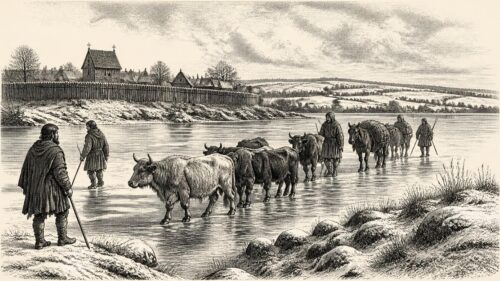
Most people, however, lived in rural settlements rather than monasteries or royal centres. Cattle remained central to wealth, food and social rank, while cereal cultivation was becoming increasingly important. Archaeological and environmental research points to growing agricultural surplus in the eighth and ninth centuries, supported in some places by watermills and improved grain-drying technology. The fair at Tailtiu depended upon this countryside: people needed surplus animals, food, textiles and craft goods to travel, exchange gifts and sustain temporary crowds. The annal does not itemise Tailtiu’s trade in 810, but the very shock of its failure shows how significant such gatherings were.
Nothing in the evidence supports a dramatic environmental event, nationwide famine or general war for this calendar year. Nor does silence mean that daily life was peaceful everywhere. It means that the surviving annals chose to preserve certain moments: an ecclesiastical boycott that checked royal display, an Armagh mission carried under Patrick’s authority, and an Ulster victory over seaborne raiders. Together they make 810 a year in which power was tested not only with weapons, but through sanctuary, assembly and the claims of saints.
Primary Sources
- The Annals of Ulster, Year U811
- The Annals of Ulster
- Chronicon Scotorum, Entries CS810–CS813
- Chronicon Scotorum: Introduction and Editorial Matter
- Annals of the Four Masters
- The Annals of Tigernach
- Annals of Inisfallen
- Irish Texts at CELT
- Vikings in Irish Chronicles, 794–902: Data
- Chronological Synchronisation of the Irish Annals
- The Chronology and Sources of the Early Irish Annals
- Vikings in Ireland and Scotland
- The Vikings in Ninth-Century Ireland: Sources and Settlements
- Viking Incursions in Ireland
- Máel-Ruain
- Félire Óengusso: Problems of Dating
- Early Christian Ireland: An Introduction to the Sources
- Gathering Communities: Locality, Governance and Rulership in Early Medieval Ireland
- Landscapes of Kingship in Early Medieval Ireland, AD 400–1150
- Agriculture, Settlement and Society in Early Medieval Ireland
- Early Medieval Ireland, AD 400–1100: The Evidence from Archaeological Excavations
- County Dublin Urban Archaeological Survey: Tallaght
- The Vikings in Ulaid
- The Beginning of the Viking Age in the West