Ailbe’s Law at Emly793 CE
In 793, Ireland’s annals depict religious institutions as instruments of regional power rather than a unified kingdom. Muirgius of Connacht supported the promulgation of Comán’s law, while Munster’s Artrí was formally acknowledged as king alongside Ailbe’s law, probably strengthening Emly’s ecclesiastical claims. Armagh suffered the death of abbot Dub dá Leithe, other notable obituaries, and violent violation by Uí Chremthainn, followed by restoration. Tóla’s relics were taken on circuit, extending sacred authority beyond monasteries. In south-west Munster, the king of Corcu Duibne died at Conchenn. Chronological uncertainties remain, and however no securely recorded Viking raid occurred in Ireland that year.
Dateline
The events conventionally placed in 793 reveal an Ireland in which religious institutions were central to politics, law and public authority. This was not a year dominated by one island-wide ruler or a single battle. Instead, the annals preserve a sequence of ecclesiastical enactments, changes in leadership, a violent intrusion at Armagh, the movement of relics, and a local Munster conflict. Together they show how kingship and church patronage worked through particular regions and communities.
A chronological caution is necessary. The entry customarily cited as Annals of Ulster 793 carries an internal anno Domini calculation of 792, while the Annals of Inisfallen places several overlapping notices under 793. Such discrepancies are normal in early Irish annals, whose surviving manuscripts and chronological systems were compiled long after many of the events they record. The developments below therefore belong responsibly to the annalistic year conventionally rendered as 793, but cannot generally be assigned to a particular day, month or season.
Saints’ Laws and Provincial Authority
The most consequential notice records that the law of Comán was promulgated “in the three Connachta” by Aildobur and Muirgius. The three Connachta were the principal divisions of the western province, and the Muirgius named here was Muirgius son of Tommaltach, the Uí Briúin ruler whose rise to provincial pre-eminence had followed fighting in the previous year. His victory over Cináed son of Artgal at Sruth Cluana Argait, probably Cloonargid in modern County Roscommon, is treated by the annals as the beginning of his reign.
The text does not preserve the contents of Comán’s law, nor does it explain Aildobur’s identity. It would be unsafe to present it as a surviving written statute book or as a modern-style code imposed uniformly on every household. In early medieval Ireland, however, a saint’s cáin or law could be a public assertion of a church’s protection, privileges and claims to renders. It depended upon the backing of kings and other leading figures. The notice thus shows Muirgius operating, at least publicly, across Connacht in partnership with an ecclesiastical cause. It was a means of turning recent military success into recognised authority, while extending the standing of a cult associated with Comán.
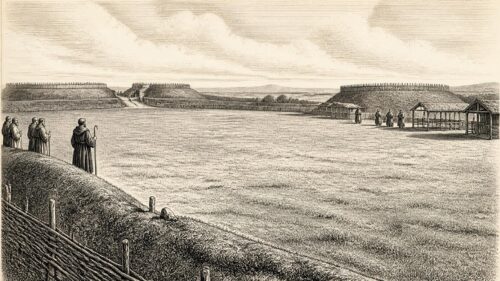
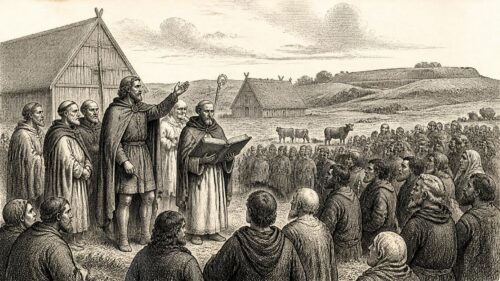
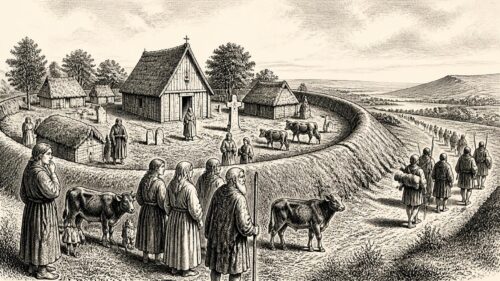
A comparable but even more striking event took place in Munster. The annals pair the promulgation of the law of Ailbe in Mumu, or Munster, with the ordinatio of Artrí son of Cathal as king of Munster. Ailbe was the patron saint of Emly, or Imlech Ibair, on the modern Tipperary–Limerick border. Emly was among Munster’s leading churches and Ailbe its pre-eminent saint. The juxtaposition of law and royal ordination strongly suggests a single political-religious occasion rather than two unrelated announcements.
Artrí belonged to the Éoganacht Glendamnach, one of the dynasties contesting the Munster overkingship after the death of the powerful Cathal son of Finguine in 742. He had evidently secured enough support by the 790s to be acknowledged as provincial king. The annal’s use of ordinatio is exceptional and should not be casually equated with a later coronation ceremony. Nevertheless, it points to a formal religious acknowledgement of his rule. Modern scholarship associates the occasion with Emly and its churchmen, and understands Ailbe’s law as giving that foundation a basis for ecclesiastical exactions or dues. The arrangement was mutually useful: Artrí gained prestige through the saint and church of Emly; the church gained a powerful royal guarantor.
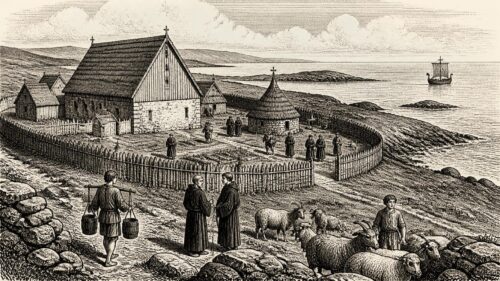
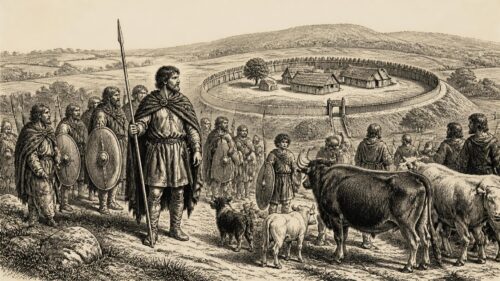
For ordinary people, such a promulgation would not have been an abstraction. A provincial gathering required travel, hospitality, food supplies, clerics, royal followers and representatives of local communities. Its practical effects may have included obligations of payment, safe-conduct, or respect for ecclesiastical rights, although the surviving entry does not permit the details to be reconstructed. What can be said confidently is that the law was announced broadly enough to merit the phrase “in Munster”. It was a public performance of authority in a landscape still governed through personal lordship, kinship and church networks rather than permanent state institutions.
Armagh in Crisis
The northern church of Armagh experienced both bereavement and violence. Dub dá Leithe son of Sínach, abbot of Armagh, died in the annalistic year. His office was not simply spiritual. As successor of St Patrick, the abbot led a major ecclesiastical federation with extensive political claims. Dub dá Leithe had previously advanced Armagh’s interests in Connacht, where the Law of Patrick had been proclaimed at Cruachain in 783 with royal cooperation. He was also founder of Clann Sínaig, an ecclesiastical lineage that would supply numerous later heads of Armagh.
His death came amid an unusually crowded obituary list. Crunnmael, abbot of Clonard; Cinaed, abbot of Durrow; Doimthech, superior of Treóit Mór; Flaithgel, abbot of Druim Rátha; and Cairpre son of Laidcnén, king of southern Leinster, are all recorded as having died. This concentration does not prove a common disaster: the annals give no epidemic, famine or battle to connect them. Yet it reminds us that monasteries were not isolated retreats. Their heads were prominent figures whose deaths mattered to regional politics, learning, landholding and the management of client communities.
The same year’s Armagh notice is more alarming. It reports the “profanation” of Faendelach by Gormgal son of Dindanach; the entry and ravaging of Armagh by the Uí Chremthainn; killings within it; and Faendelach’s subsequent reception again at Armagh. The compressed wording does not identify a precise sequence, motives or numbers of dead. Nor can it safely tell us whether Faendelach was an individual, an office-holder, or the focus of a dispute over ecclesiastical rights. What is clear is that a recognised sanctuary and centre of authority was violated, people were killed there, and an act of restoration or reconciliation followed.
The episode exposes a basic condition of Irish church life. Great monasteries possessed sacred status and could shelter people, relics and books, but they lay within competitive political territories. Armagh’s wealth, prestige and strategic importance made control of its leadership consequential. The death of Dub dá Leithe and the violence reported in the same annalistic year should not automatically be treated as cause and effect, but they belong to a period of instability in which rival ecclesiastical factions and regional dynasties could contest the Patrickine centre.
Relics on the Road
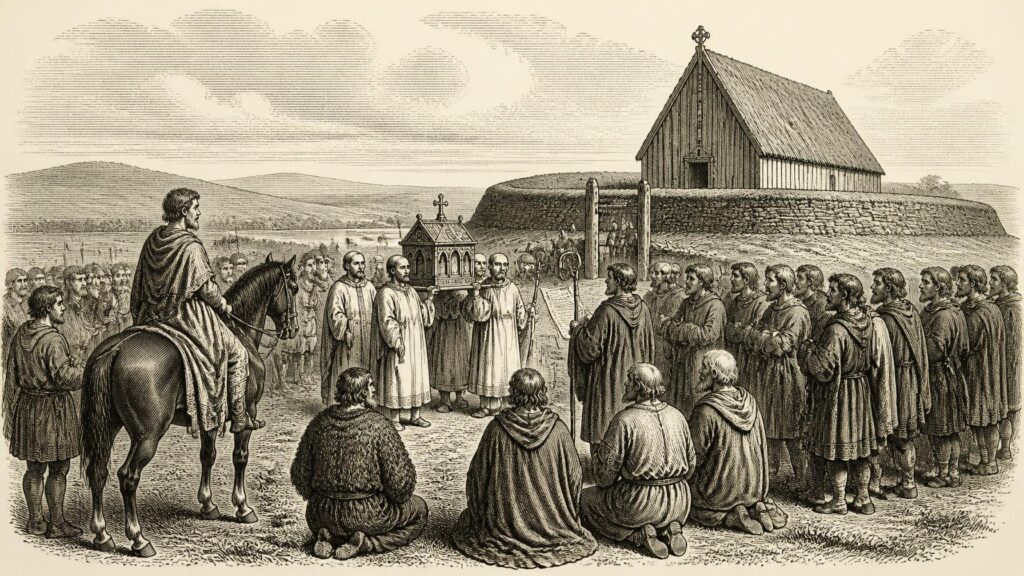
The annals also note the taking on circuit of the relics of Tóla. No route, sponsoring church, destination or reason is supplied, so the event cannot be turned into a detailed pilgrimage narrative. Even the saint’s identity must be treated cautiously in the absence of further specification. The notice nevertheless matters. Moving relics was an important way to make a saint’s presence visible beyond one settlement. A shrine, carried by clergy and accompanied by followers, could gather people, reinforce obligations, seek protection, settle disputes or publicise a church’s claims.
Relic processions therefore belong beside the laws of Comán and Ailbe. All three actions brought sacred authority into public space. They depended on roads and waterways, places of hospitality, and the participation of lay patrons as well as clerics. They also reveal that religious culture in 793 was mobile. The holy was not confined to an altar or monastic enclosure: it could travel through territories, bind communities to a saint and give ceremonial weight to negotiations among the powerful.
Conflict in the South-West
The Annals of Inisfallen, whose coverage is especially valuable for Munster, adds the battle of Conchenn, in which the king of Corcu Duibne fell. Corcu Duibne occupied the Dingle peninsula and adjacent parts of south-west Munster. Neither the ruler’s name nor the victor is preserved, and the location of Conchenn is not securely identified by the brief entry. The episode must consequently remain a local conflict, not evidence for a general war across Munster.
It does, however, provide a necessary counterpoint to the formal recognition of Artrí. Munster’s overkingship did not erase the power of local peoples and their rulers. A king of Corcu Duibne could still be killed in battle within the same year that a Munster king was ceremonially ordained and Ailbe’s law proclaimed. Provincial authority was negotiated and asserted, but it was never the same thing as direct administration of every district.
What 793 Does Not Show
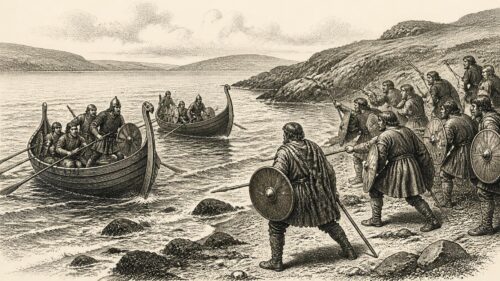
This was the calendar year of the famous Viking attack on Lindisfarne in Northumbria, but no Irish annalistic entry securely places a Scandinavian raid in Ireland in 793. It is important not to import that British event into the Irish record. The early notices of “heathens” and attacks on Irish islands belong to the following years and have their own chronological problems. In 793, Ireland’s surviving evidence is instead concerned with its internal political geography: Connacht under Muirgius, Munster under Artrí, Armagh under pressure, and churches using law and relics to organise authority.
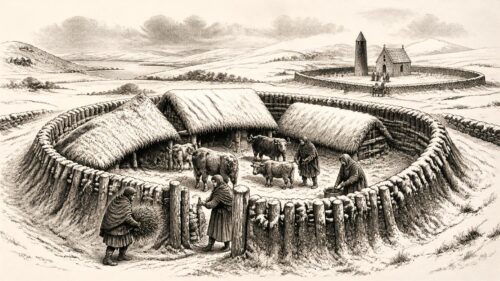
The sources likewise say nothing reliable about harvests, weather, prices, overseas trade, building works or the routines of particular farming households in this year. Silence should not be filled with picturesque certainty. Yet the recorded events offer a vivid glimpse of the structures that shaped everyday life: rulers required followers and supplies; monasteries commanded labour, learning and land; saints’ cults could establish obligations across regions; and even the foremost churches remained vulnerable to armed intrusion. In that sense, 793 was a year when sacred institutions did not stand apart from politics. They were among the chief instruments through which power was proclaimed, contested and restored.
Primary Sources
- The Annals of Ulster
- The Annals of Ulster: Year U793
- The Annals of Ulster: Latin and Irish Text
- Annals of Inisfallen
- Annals of Inisfallen, Annals AI790–AI799
- Annals of the Four Masters
- Annals of the Four Masters, Annals M787–M793
- Chronicon Scotorum
- Chronicon Scotorum: Bibliographical and Manuscript Information
- Exploring the Irish Annals
- Artrí
- Muirgius
- Dub-dá-leithe
- Ailbe
- Áed Oirdnide
- The Church and the World in Early Christian Ireland
- Early Irish Monasteries and their Dynastic Contexts
- Vikings in Irish Chronicles, 794–902: Data
- Vikings in Scotland and Ireland in the Ninth Century
- The Vikings in Ninth-Century Ireland: Sources and Settlements