Donnchad’s Cnoc Báine Hosting771 CE
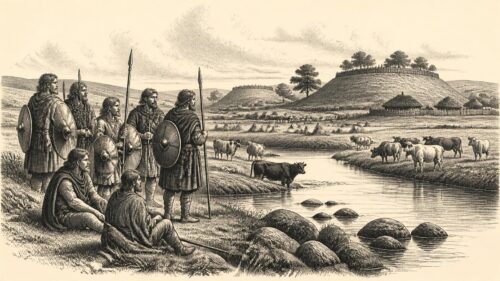
In annalistic year 771, Donnchad mac Domnaill, king of Tara, led a hosting to Cnoc Báine, probably in modern County Tyrone, demonstrating authority rather than recording a confirmed victory. The annals also note killings of Conchobor and Connacht rulers Áed Aithgein of Uí Maine and Art of Aidne. The law of saints Comán and Aedán was renewed across the three Connachts, illustrating church and secular collaboration. A severe Michaelmas thunderstorm prompted widespread fasting. Deaths included ecclesiastics from Clonard and Cluain Eidnig, and Suibne, abbot of Iona. Chronological discrepancies among later annals require caution when assigning additional events to this year.
Dateline
In the annalistic record for 771, Ireland appears not as a single kingdom obedient to one ruler, but as an island of competing dynasties, powerful churches and regional alliances. The most overtly political notice is a hosting by Donnchad mac Domnaill, king of Tara and leading figure of Clann Cholmáin, to Cnoc Báine in the north. Yet the year is remembered just as strongly for a frightening storm at an assembly around Michaelmas, for island-wide fasting ordered in response to it, for the enforcement of a saint’s law in Connacht, and for deaths which touched monasteries from Clonard to Iona. These entries are brief, but together they show how military power, religious authority and public anxiety overlapped in eighth-century Ireland.
A Year with a Chronological Caution
The principal contemporary-style evidence is the Annals of Ulster. Its relevant section is headed U772 but is calibrated by its editors to AD 771. Other annal collections and modern reference works do not always align their year-numbers in this period, because medieval Irish annals used differing chronological systems and later copies introduced further difficulties. This article therefore treats the notices discussed here as securely associated with the annalistic year corresponding to 771, while avoiding claims about an exact sequence of events unless the source itself supplies one. The exception is Michaelmas: the annal explicitly identifies the alarming gathering as occurring on 29 September.
This restraint matters. The later Annals of the Four Masters place several battles and deaths under their year 771, including fighting among the Dál nAraidi and the death of Cellach, king of Leinster. Parallel evidence, however, assigns some of those events differently, and the chronology of the Four Masters in this era cannot simply be converted into firm calendar dates. They are valuable witnesses to medieval historical memory, but they should not be used to crowd the year 771 with confidently dated incidents that the earlier annalistic framework does not securely place there.
A Northern Demonstration of Power
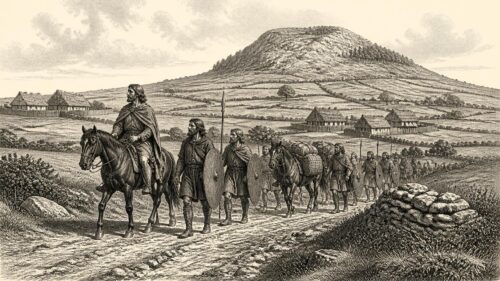
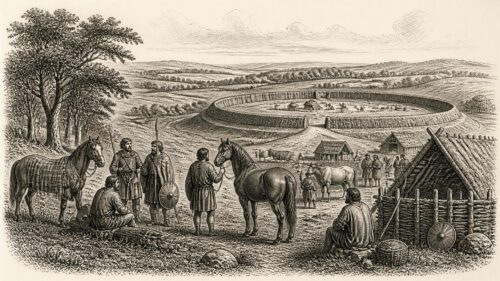
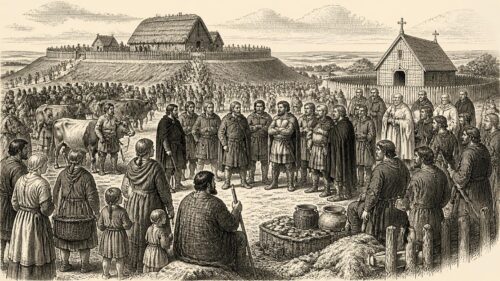
The year’s clearest royal action was “the hosting of Donnchad to Cnoc Báine”. A hosting was an organised royal expedition, not necessarily a pitched battle. It could involve mustering fighting men, moving through allied or contested territory, taking provisions, receiving submissions, threatening opponents or displaying a ruler’s ability to mobilise followers. The annal gives no outcome, no list of casualties and no statement that a battle occurred. Its silence is important: Donnchad’s northern march should be understood as a demonstration of authority, not turned into an invented victory.
Donnchad, often called Donnchad Midi, belonged to Clann Cholmáin of the southern Uí Néill, whose power base lay in the midlands. His father, Domnall Midi, had been king of Tara before him. Cnoc Báine is generally identified in modern scholarship with a place in present-day County Tyrone, so the hosting carried Donnchad’s force into a region where northern Uí Néill dynasties and their neighbours possessed their own interests and military resources. A high king’s title expressed pre-eminence, but it did not mean that Ireland was administered from Tara as a unified state. Authority had to be renewed through personal relationships, tribute, hostages, patronage and, when needed, armed movement.
The expedition also belongs beside Donnchad’s actions in the immediately surrounding years. In 770 he had campaigned against Leinster and also led a northern hosting; the annals record another northern move at Cnoc Báine in the year considered here. This pattern suggests sustained political pressure rather than a single decisive conquest. Donnchad’s reach was real, but so were the limits upon it. The annal’s economy—recording the march but no submission—may itself reflect an operation whose principal significance was the act of appearing with an army.
Violence Beyond the King’s Route
Elsewhere, the annal records the killing of Conchobor, grandson of Máel Dúin, without saying where, by whom or why. Such terse notices are frustrating, but they reveal something basic about political life: kinship placed individuals inside networks of inheritance and rivalry, while violence could remove a claimant or a leading noble without becoming a fully narrated national event. The absence of further detail means that neither Conchobor’s political standing nor the motive for his death can responsibly be reconstructed.
Connacht saw more clearly identified losses. Áed Aithgein, king of Uí Maine, and Art son of Flaithnia, king of Aidne, were killed. Uí Maine occupied an important stretch of eastern Connacht, while Aidne lay farther west and south, around the later south Galway–north Clare borderlands. Their deaths did not signify the fall of a province; Connacht was not a centralised kingdom in that sense. Rather, they demonstrate the vulnerability of local and regional kings whose authority depended on maintaining their own client groups while negotiating with larger powers. The annal does not say whether the two men died in one encounter, were victims of separate conflicts, or fell to external enemies. What can be said is that 771 brought a serious disruption to two neighbouring Connacht polities.
Comán and Aedán’s Law
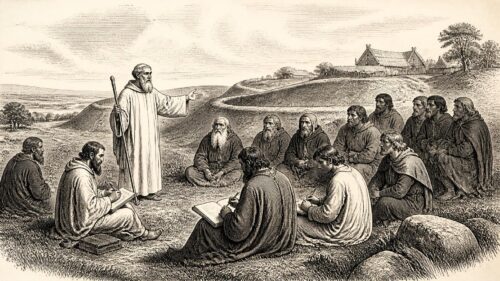
The year also records that “the law of Comán and Aedán” was enforced for a second time over the three Connachts. In this context, a saint’s “law” was not a surviving book of legislation comparable to a modern statute. It was a religious and social programme upheld through ecclesiastical authority, secular protection and the prestige of a saint. Such laws could establish protected persons and places, prescribe penalties, reinforce moral obligations, and generate dues or tribute for the saint’s church. Their enforcement commonly depended on agreement between church leaders and kings.
The notice therefore signals more than private devotion. To extend the law across the three Connachts—usually understood as the major divisions of the province—required travel, proclamation and local co-operation. Relics, clerics and agents of the associated churches may have moved with such a campaign, although the annal does not describe its practical arrangements. The repetition, “a second time”, is especially revealing. Religious protections and claims needed renewal. Their effectiveness rested not simply on sacred memory but on continuing political consent, public recognition and the ability to impose fines or sanctions.
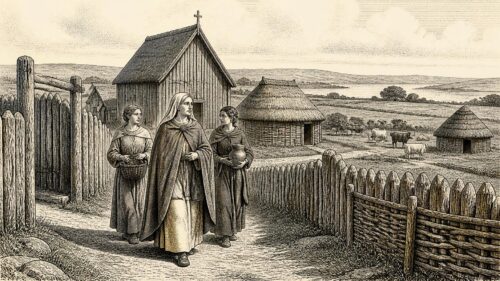
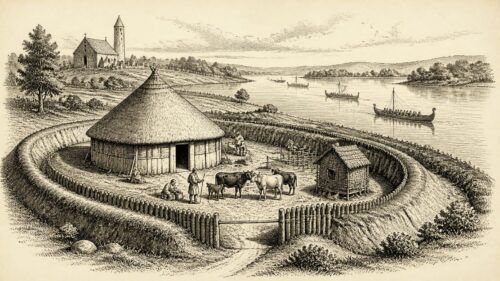
This was characteristic of a society in which monasteries were major landholders and centres of learning, craft production, hospitality and exchange. Monastic settlements were not isolated communities of prayer. Their churches, workshops, cultivated lands, cattle, tenant households and visitors connected them to surrounding kingdoms. A saint’s law could thus regulate relationships that were simultaneously spiritual, legal and economic. The Connacht entry is a small but unusually direct glimpse of churchmen and rulers acting together on a provincial scale.
Fire from Heaven
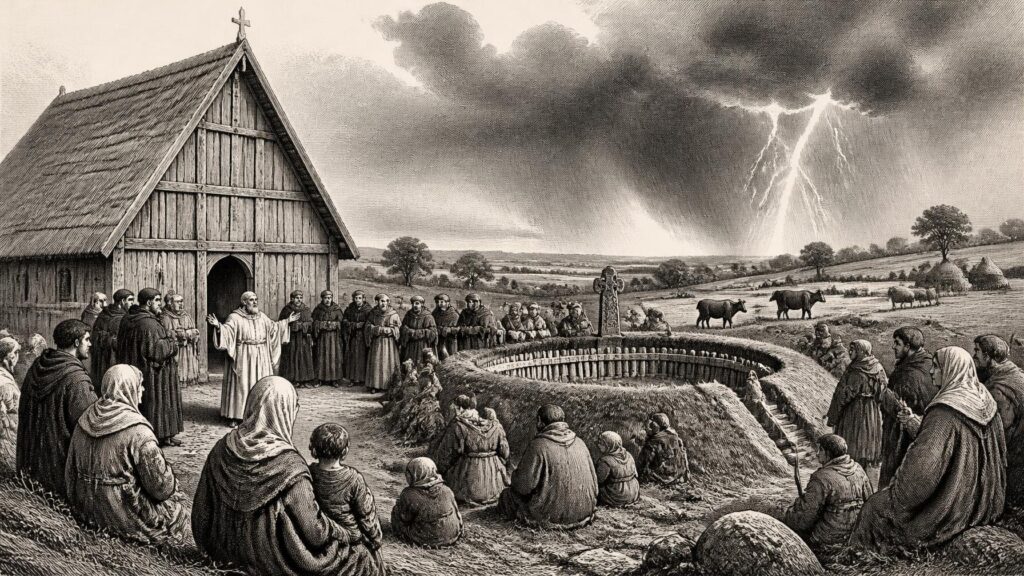
The most vivid notice for the year concerns an assembly called the “hand-clapping”. At it, the annalist says, there was lightning and thunder “like the day of judgement”. The entry identifies this hand-clapping assembly with Michaelmas, 29 September, and says that it “called fire from heaven”. The language is religious and dramatic, but lightning is explicitly named. The passage should therefore be read as evidence for a violent thunderstorm interpreted through Christian expectations of judgement, rather than as proof of a supernatural event in a modern historical sense.
Its social consequences are more firmly recorded. Fear of the fire led “the Irish” to fast for two periods of three days, with a single meal between. The phrase is broad and may be rhetorical; it cannot demonstrate that every household in Ireland observed precisely the same discipline. Nevertheless, the annalist clearly presents the response as collective and extensive. Clerical direction, public penitence and fasting were practical means by which communities confronted danger that lay beyond human control. A storm at a gathering could be terrifying in a largely rural world of timber buildings, livestock, stored crops and scattered settlements, where lightning and fire posed immediate material as well as spiritual threats.
Churches and Connected Seas
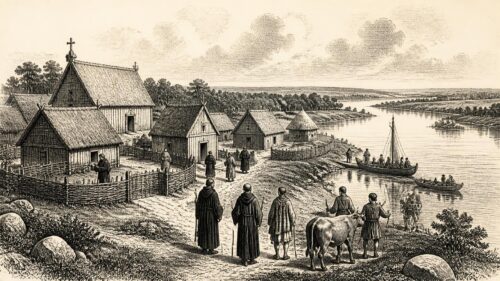
Several ecclesiastical deaths frame the year. Airlíth of Clonard died, as did Máel Aichthen, abbot of Cluain Eidnig. Most significant beyond Ireland was the death of Suibne, abbot of Í, the island monastery of Iona. Iona stood in Dál Riata on the western seaways but remained deeply connected to Irish churches through the Columban federation founded in the memory of Columba. Its abbot’s death was therefore relevant to Irish religious and political networks, not an incidental event from another country.
Clonard, in the Boyne valley region, was likewise a major ecclesiastical centre whose reputation as a place of learning long outlived the individuals named in its obituaries. The annals do not tell us what Airlíth taught, built or administered. Nor do they describe Suibne’s succession. But their names demonstrate the importance attached to recording changes in leadership at institutions which linked religious communities, aristocratic patrons and wider territories. In an age before Viking-founded ports, monasteries were among Ireland’s most substantial centres of population, literacy, skilled work and long-distance communication.
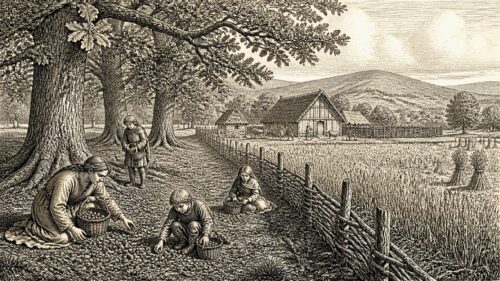
For ordinary people, the year’s great events would have been felt through obligations rather than annalistic headlines: supplying a royal hosting, tending cattle and crops, travelling to a religious assembly, paying dues, or joining penitential observances after a frightening storm. The evidence does not permit a detailed reconstruction of one household’s experience. It does, however, show a society in which political mobilisation, ecclesiastical law and environmental fear could all make demands upon the same communities. In 771, Donnchad’s northern hosting projected royal ambition; Connacht’s saintly law asserted organised religious authority; and the Michaelmas storm reminded contemporaries how quickly the natural world could be understood as a judgement upon human order.
Primary Sources
- The Annals of Ulster
- Annals of the Four Masters
- Annals of Inisfallen
- Donnchad Midi
- Donnchad mac Domnaill: (733–797), high-king of Ireland
- CELT Project: Annals of Tigernach
- The Annals of Tigernach
- CELT Project: Annals of Inisfallen
- CELT Project: Fragmentary Annals of Ireland
- Exploring the Irish Annals
- The Powers of Kings
- Kingship, Society, and Sacrality: Rank, Power, and Ideology in Early Medieval Ireland
- The Church and the World in Early Christian Ireland
- Monastic Identity in Early Medieval Ireland
- Early Christian Monasteries
- County Kildare Urban Archaeology Survey
- A Major Monastic Centre? Rethinking Lismore’s Place in the Ecclesiastical Landscapes of Early Medieval Britain
- The Annals Attributed to Tigernach
- Annals of Tigernach, NLW MS 4655E
- The Céli Dé and Ecclesiastical Government in Ireland
- Notes on the Early History of the Dioceses of Tuam, Killala and Achonry
- The Annals of Ulster: Translation and Notes