Loch Fén665 CE
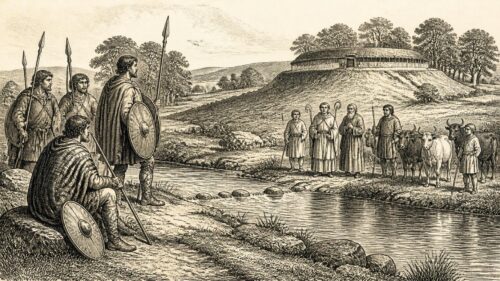
In 665, Ireland faced the devastating buide Chonaill, or yellow mortality, while conflict continued between regional powers. The Annals of Inisfallen record a battle at Loch Fén between Munster and Connacht, in which Talamnach son of Laidcenn was killed, but give no cause or victor. The epidemic caused the deaths of major rulers, including Diarmait Ruanaid, Blathmac and probably Cathal Cú cen Máthair of Munster, altering dynastic politics without ending established kingdoms. It also struck leading churchmen and monasteries. Differing annal dates limit certainty, but the evidence shows epidemic, succession and warfare reshaping Ireland simultaneously.
Dateline
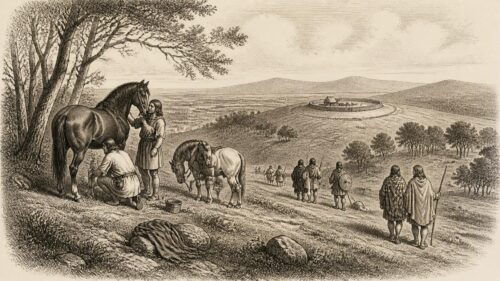
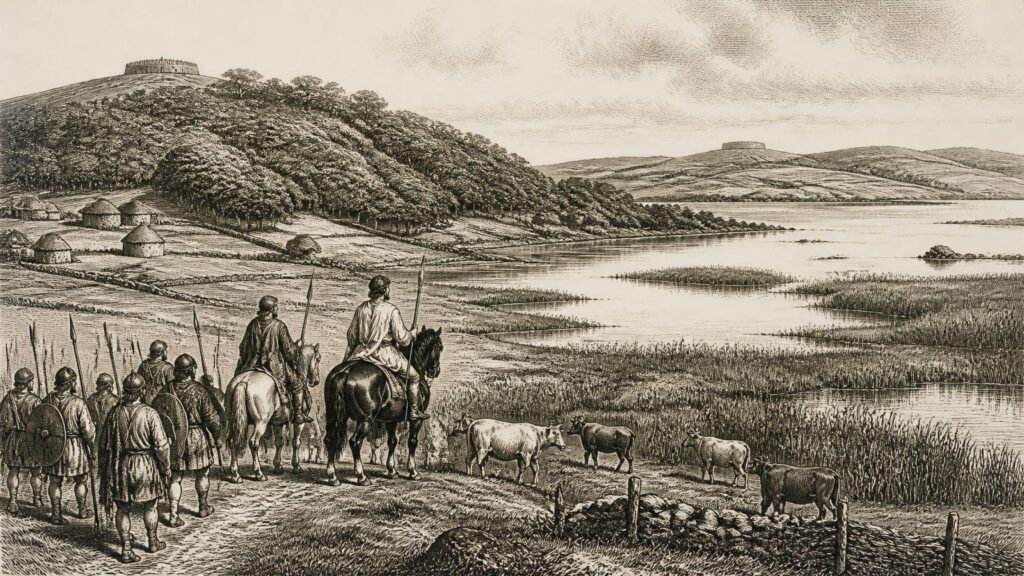
In 665 CE, Ireland stood in the shadow of a grave mortality while conflict still continued between powerful regional groups. The clearest event placed directly in this calendar year is the battle of Loch Fén, recorded by the Annals of Inisfallen as a fight between the men of Munster and Connacht in which Talamnach, son of Laidcenn, was killed. The notice is stark: it supplies neither a victor nor a cause. Yet its very brevity is revealing. Even amid epidemic loss, kings and war-bands remained able to mobilise, cross regional boundaries and contest territory or political influence. The battle also warns against imagining seventh-century Ireland as a single kingdom. It was a country of many lordships, alliances and rival dynasties, in which the authority claimed from Tara, Cashel or Connacht depended upon personal followings and the capacity to command tribute, cattle, fighting men and ecclesiastical support.
A Battle With Few Answers
Loch Fén is the only securely year-specific military event for 665. Its participants are named collectively as Mumu, or Munster, and Connachta, rather than by the particular dynasties and kings who led them. Talamnach’s death is the sole individual outcome preserved. That leaves important questions unanswered: whether he was a king, a leading noble, a commander or an ally; whether one side won decisively; and whether the encounter formed part of a longer border struggle. A responsible account cannot fill those silences with a reconstructed campaign. What can be said is that a confrontation between Munster and Connacht mattered sufficiently to be retained in an annal compiled in the south-west of Ireland.
The battle occurred at a difficult political moment for Munster. Cathal Cú cen Máthair, of the Éoganacht Glendamnach dynasty, was king of Munster after the death of Móenach in 662. His death is conventionally dated to 665 or 666, because the annalistic record does not align perfectly from one chronicle to another. The Annals of Ulster place his obit among the notices associated with the great mortality, while the Annals of Inisfallen puts it under its following annal. Thus 665 may have seen Munster fighting Connacht while its overkingship was threatened by the death, or impending loss, of Cathal. That is a plausible setting, but not a proven explanation for the battle of Loch Fén.
The Great Mortality
The dominant condition connected with 665 was the epidemic called buide Chonaill, usually rendered ‘the yellow plague’ or ‘yellow mortality’. Early Irish annals record enormous numbers of deaths, including rulers, bishops, abbots and unnamed multitudes. Their dates vary because different chronicles preserve different chronological systems and sometimes shift a cluster of notices by a year. The Annals of Ulster place the deaths of Diarmait Ruanaid and Blathmac, sons of Áed Sláine, together with major churchmen, in an annal whose internal calendar corresponds to 664, whereas modern reference works conventionally give both rulers’ deaths as 665. The Annals of Inisfallen records the great mortality and several related deaths under 666. These differences should not be mistaken for evidence of separate disasters: they show the hazards of converting early medieval annal dates into a modern calendar.
For the year 665, therefore, the sound conclusion is that Ireland was experiencing the devastating phase of an epidemic that had reached the island by August 664 and persisted afterwards. The Chronicon Scotorum says that the plague first raged in Mag Itha among the Fotharta and names it the buide Conaill. Bede, writing from Northumbria, independently reported that the same pestilence afflicted Ireland no less severely than Britain. The disease cannot be diagnosed securely from the surviving descriptions. ‘Plague’ in a medieval translation does not establish bubonic plague in the modern clinical sense, and the label ‘yellow’ is not a medical report. What is firm is the scale of remembered mortality and its geographical setting within a wider epidemic world around the Irish Sea.
This was not simply a tragedy recorded in monasteries after the event. Mortality at this level would have disrupted households, food production, fostering ties, lordly retinues and religious communities. It may have weakened the ability of some rulers to collect renders or protect dependants, while creating sudden opportunities for surviving rivals. Such consequences are reasonable inferences from a society centred on kin groups and agricultural production, rather than particular results documented for every district. The annals do not tell us how each community endured the crisis, nor do they permit a national population total.
Deaths at Tara and Cashel
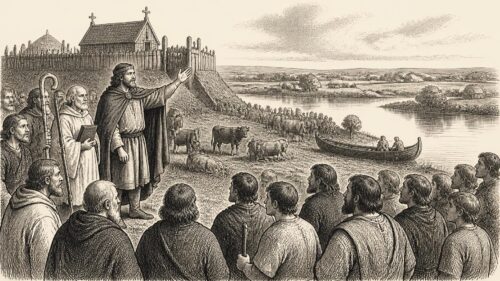
The epidemic’s political effect is most visible in the deaths associated with the kingship of Tara. Diarmait Ruanaid and his brother Blathmac belonged to Síl nÁedo Sláine, an important southern Uí Néill lineage rooted in Brega. Their rule had not necessarily been harmonious: earlier conflict within their kindred had already exposed the instability beneath royal titles. Their near-contemporary deaths removed two senior figures at once. Later annalistic tradition places the first year of Sechnassach, Blathmac’s son, in 665. This succession did not create a modern-style central government; ‘king of Ireland’ in the sources expresses a high claim to pre-eminence, not administration of a territorially unified state. Still, control of Tara and Brega carried immense symbolic and political weight, and a change there mattered well beyond the Boyne valley.
The same mortality was associated with the death of Cú cen Máthair of Munster. His probable loss, alongside the battle involving Munster and Connacht, makes 665 a year in which regional politics could be rapidly altered by absence as much as by victory. Dynastic succession was never merely private. Kings relied on clients, allied churches and competing branches of their own families. When disease killed rulers and followers together, it could unsettle arrangements of tribute and protection that held a kingdom together. Yet the records do not support a claim that either Tara or Munster collapsed. They show continuity as well as loss: Sechnassach succeeded within his father’s family, and Munster’s Éoganacht dynasties continued to contend for authority.
Monasteries Under Pressure
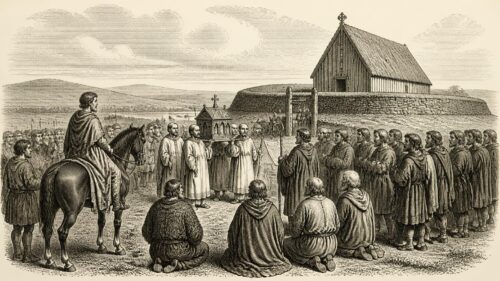
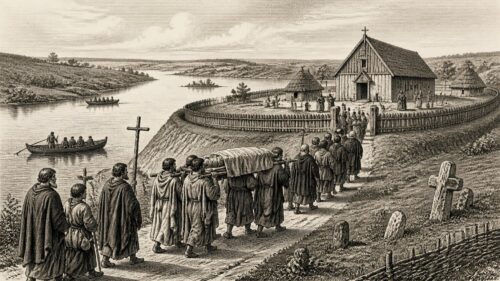
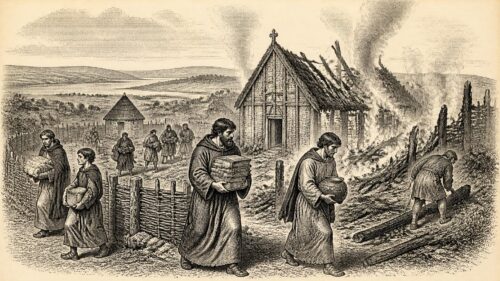
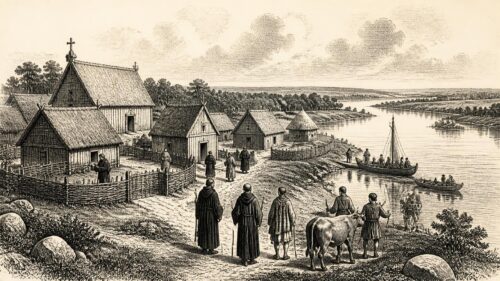
The roll of ecclesiastical deaths is unusually striking. Annals associated with the epidemic name Ultán of Clonard, Féichín of Fobar, Ailerán ‘the learned’, Crónán son of Sílne, Manchán of Liath, and abbots connected with Clonmacnoise, among others. The exact grouping and dating differs between sources, but the cumulative testimony is clear: the disease struck centres of teaching, worship and patronage as well as royal households. Ailerán’s epithet is especially significant. Learned clerics preserved and interpreted Latin Christian learning, taught students, composed texts and maintained links between religious houses. Their deaths were losses of expertise as well as of revered individuals.
It would be wrong, however, to portray Irish Christianity in 665 as isolated or culturally uniform. The previous year’s Synod of Whitby in Northumbria had rejected the Easter calculation defended by Colmán, bishop of Lindisfarne, whose background and ecclesiastical formation were Irish and Columban. Bede records that Colmán left Lindisfarne after the decision and returned to the ‘Scots’, a term his Latin usage could include the Irish. This movement is directly relevant to Ireland in 665 because it marks an immediate reorientation of an Irish-led Northumbrian church network. But the chronology must be respected: Colmán’s later settlement on Inishbofin off the west coast of Ireland belongs to 668 in the Annals of Ulster, not to 665. In this year he should be understood as a figure in transit and consultation, not as founder of an Irish monastery already established.
Ordinary Security and Subsistence
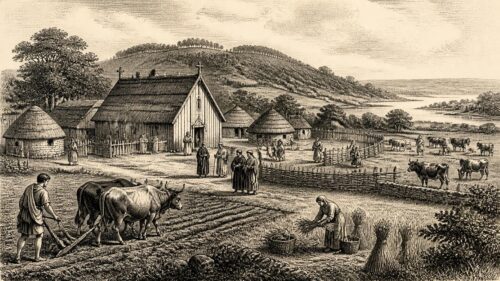
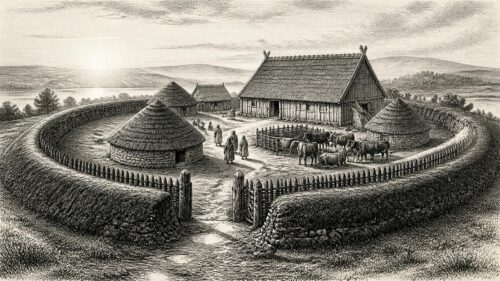
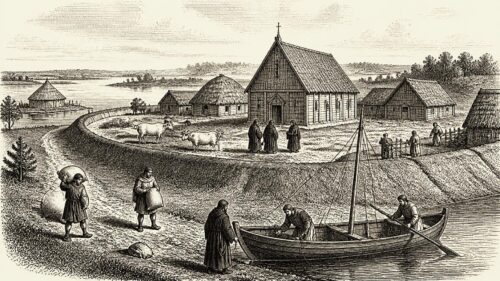
For most people, life in 665 was lived in small rural communities rather than in royal centres. Archaeology and early medieval evidence show a landscape of enclosed farmsteads, often called ringforts, where extended households managed cattle, crops, dairying, craftwork and seasonal labour. Cattle were central to wealth, food and status; they also figured in tribute, compensation and the raiding that underpinned political competition. The killing at Loch Fén and the epidemic would therefore have had meanings beyond the battlefield or monastery: the loss of adult labour, dependants and livestock keepers could affect sowing, harvesting and herd management.
That broader picture must remain context, not a claim that every farmstead was deserted or every harvest failed in 665. No surviving source records a general famine for this precise year, and no annal offers a detailed account of prices, weather or trade. Nor is there evidence for towns in the later medieval sense. Ireland’s economy was predominantly local and agrarian, though monasteries and royal households concentrated labour, learning, prestige goods and obligations. Coastal and overland connections with Britain were real, as the shared epidemic and Colmán’s movements demonstrate, but they should not be exaggerated into evidence for a particular commercial voyage or market in 665.
A Year of Recorded Limits
What survives for 665 is a record of limits: a battle without a stated winner, a disease without a secure diagnosis, and successions whose dates must be reconciled across later manuscripts. These constraints are not defects to be hidden. They are central to understanding early Irish history. The annals preserve a world in which violence and mortality were remembered through the deaths of named elites, while the experience of most families can only be approached indirectly. Loch Fén demonstrates that rivalry between Munster and Connacht continued; the buide Chonaill demonstrates that epidemic crisis crossed political boundaries; and the deaths around Tara, Cashel and major monasteries show why 665 became a hinge between established authority and uncertain recovery.
Primary Sources
- The Annals of Inisfallen
- The Annals of Ulster
- Chronicon Scotorum, Part 64
- Annals of the Kingdom of Ireland by the Four Masters
- Fragmentary Annals of Ireland
- The Annals of Tigernach
- Diarmait Ruanaid
- Blathmac
- Cathal Cú Cen Máthair
- Colmán
- Cenn-Fáelad
- Áed Sláine
- Bede: Ecclesiastical History, Book III
- Bede: Book III
- The Identification of Some Pestilences Recorded in the Irish Annals
- Plagues, Pandemics and Epidemics in Irish History Prior to COVID-19
- Early Medieval Archaeology Project: Report 2
- Early Medieval Collections
- The Rough Fort
- Exploring the Irish Annals