Blathmac’s Sons651 CE
In 651, Irish annals record the killing of Dúnchad and Conall, sons of Blathmac of the powerful Síl nÁedo Sláine dynasty, at Máel Odhrán’s mill. Máel Odhrán, identified as a man of Leinster, was named as their killer, though the location and circumstances remain uncertain. Later sources add unconfirmed details, while annalistic verse portrays the deaths as the loss of an eminent lineage. A separate Christian moral judgement interpreted them as punishment for Blathmac’s alleged sexual transgression. The episode illustrates the links between regional dynastic conflict, rural productive sites, vernacular poetry and monastic historical memory in early medieval Ireland.
Dateline
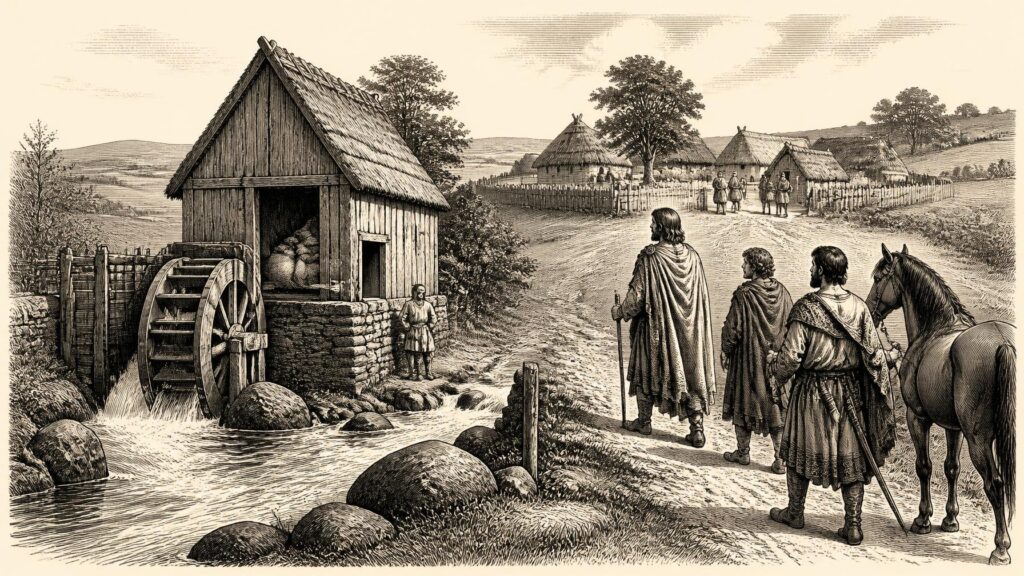
In 651 CE, the Irish annals associate one striking episode with the year: the killing of Dúnchad and Conall, sons of Blathmac son of Áed Sláine, at or beside the mill of Máel Odhrán. The surviving accounts are terse, poetic and chronologically complicated, so the event should not be treated as a securely dated incident on a modern calendar day. Yet it is firmly lodged in the annalistic sequence conventionally discussed under 651. The deaths mattered because the victims belonged to the powerful Síl nÁedo Sláine of Brega, a leading southern branch of the Uí Néill. Their violent end, remembered through a watermill and a short Irish verse, offers an unusually vivid glimpse of how kinship, local rivalry, agricultural technology and Christian moral commentary could meet in seventh-century Ireland.
An Annalistic Year, Not a Diary
The principal early record is the Annals of Ulster, whose entry headed U651 notes the “killing” of Blathmac’s two sons, Dúnchad and Conall. The related Annals of Tigernach identify their killer as Máel Odhrán “of the Laigin” and place the deaths in Máel Odhrán’s mill. Chronicon Scotorum preserves much the same notice. These closely related compilations derive from an earlier body of Irish annalistic material, but the manuscripts and their chronological systems are later. They should therefore be used critically: they preserve an early historical tradition, not an eyewitness report written at the scene.
Calendar alignment is particularly important here. The Annals of Ulster place the episode in their U651 entry, while the much later Annals of the Four Masters put it under 647. Such differences arise from omissions and shifts in the chronological frameworks of the annals, rather than from evidence for two separate killings. For an Ireland Year by Year account, 651 is the conventional annalistic setting, but neither the season, exact place nor immediate sequence of events can responsibly be recovered. The record tells us that the brothers were killed; it does not provide a campaign narrative, a formal judgement, or an explanation in the language of modern criminal investigation.
Blathmac’s Lost Sons
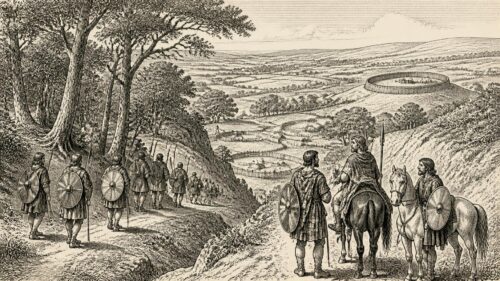
Dúnchad and Conall were not anonymous victims. Their father Blathmac was a son of Áed Sláine, whose descendants dominated Brega, the rich and politically important region between the Liffey and the southern part of modern County Louth. In the seventh century, Brega’s ruling kindred were central players in the contests among the various Uí Néill dynasties. Later king lists counted Blathmac, together with his brother Diarmait, among the kings of Tara. That later reputation should not be projected too simply back onto 651: the evidence for exactly when and how their wider authority operated is contested. What is clear is that Blathmac’s family possessed a pedigree that made the deaths of two sons politically resonant.
The annalistic verses make this status explicit. They call the dead young men the descendants, or “seed”, of Cerball, and compare the mill’s grinding not with ordinary oats but with precious red wheat. This is a poetic way of saying that an eminent lineage had been cut down. It does not prove that the brothers were heirs apparent in any formal sense, nor does it identify their ages. In an age when political capacity rested heavily on kin groups, fosterage, landholding, clients and armed followings, however, the death of sons could diminish a ruler’s immediate household and alter the balance within a dynasty.
The identity of Máel Odhrán is equally revealing and equally elusive. The Annals of Tigernach calls him a man of the Laigin, or Leinster. This need not mean that the encounter occurred deep within the later province of Leinster; political labels in the annals could identify an allegiance or dynastic connection rather than supply a precise map reference. Modern historical interpretation has plausibly connected the episode with pressure exerted by Blathmac’s Bregan kindred into the lakeland country of the midlands, but that remains an interpretation, not an annalistic statement. No excavated mill can be identified as Máel Odhrán’s, and no secure place-name fixes the location.
Violence at the Mill
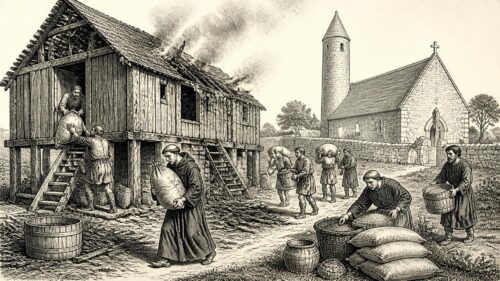
The mill is the episode’s most memorable feature. A mill was not merely picturesque scenery. It was a place where grain from surrounding farms was transformed into meal and flour, where labour and water-power were organised, and where people, animals and produce converged. Archaeology demonstrates that water-powered milling was already established in Ireland by the early seventh century. Millwrights selected and adapted freshwater and estuarine settings with care, and regional forms of horizontal water-wheel developed over time. The mill mentioned in the annals therefore belongs to a real technological landscape, even though its construction, wheel type and ownership cannot be reconstructed from the entry.
The wording also deserves restraint. The Four Masters, compiled about a millennium after the supposed event, expands the scene by placing the killing in the mill-race and naming Máel Odhrán’s associate Marcan. Those details may preserve genuine tradition, but they are not independently confirmed by the earliest surviving annalistic wording. The earlier sources do, nevertheless, retain the mill itself and a verse attributed to Máel Odhrán. The poem’s image is forceful: the mill has consumed not insignificant grain but members of a great family. It turns a local killing into a public statement about rank and loss.
One further death appears in the annalistic entry: Oiséne son of Oiserg was killed. The sources offer no reliable explanation of his relationship to the brothers, Máel Odhrán or the mill episode. It would be tempting to turn the notice into a single fight with a known list of casualties, but the evidence does not warrant this. The juxtaposition may record connected violence, or it may simply preserve separate items entered together. Silence is part of the historical evidence here.
Farms, Grain and Vulnerability
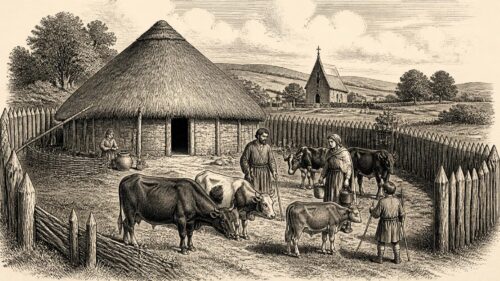
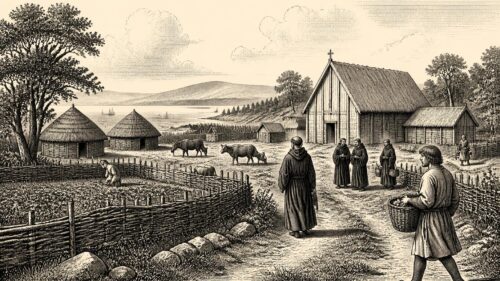
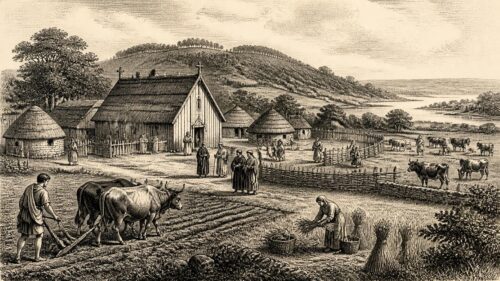
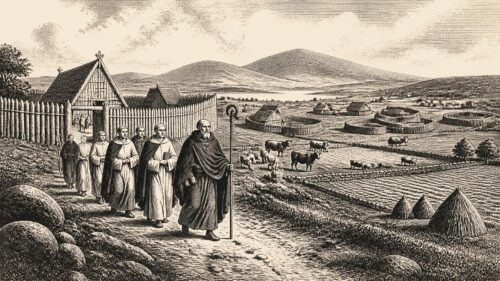
The mill poem allows a careful view beyond elite politics. Most people in Ireland in 651 lived in dispersed rural settlements, with farming households occupying timber-built or stone-built enclosures now commonly known as ringforts, raths or cashels. These were normally farmsteads rather than castles: they held houses, storage and livestock, while banks, ditches, walls and gates marked status and offered practical protection. Cereals were grown alongside the much more conspicuous wealth of cattle. Grinding grain was regular, necessary work, and a working mill could serve households beyond a single residence.
That makes the setting of the killings meaningful. Control of a productive place was a form of local influence, while movement to and from such a place exposed travellers to danger. Yet the annal should not be read as proof that this was a quarrel over milling rights, grain dues or a raid on a food store. Its authors did not say so. The responsible conclusion is narrower: agricultural installations stood within the same contested social world as royal kindreds and armed retinues. A mill could be both an economic asset and a memorable landmark at which violence occurred.
Christian Judgement and Historical Memory
The entry in the Annals of Ulster adds a separate four-line judgement on Blathmac. It says that Jesus would take his two sons from him as requital for his having begotten a son “through excess”. Later genealogical and narrative material was understood by some scholars to allude to Blathmac’s marriage to Eithne, presented as the widow of his father and thus a relationship prohibited by Christian moral teaching. The annalistic verse cannot establish the underlying allegation as fact. It does establish that a Christian compiler or tradition framed the sons’ deaths as divine punishment.
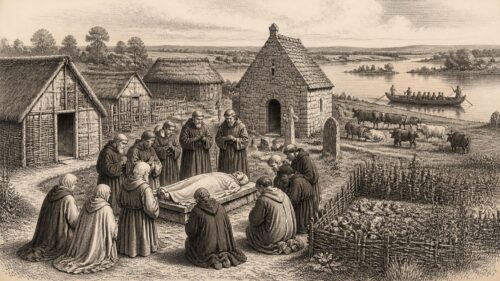
This moralisation is important in its own right. By 651, Christianity was deeply embedded in Irish political and cultural life: churches and monasteries were centres of worship, learning, landholding and elite patronage, and clerics participated in the preservation of genealogies and historical memory. The annals did not separate secular politics from religious interpretation. A killing among rulers could be recorded simultaneously as a dynastic blow, an occasion for vernacular poetry and a warning about sin. The form of the entry reflects literate monastic culture, while the verse within it suggests the continuing authority of oral composition and public recitation.
Nothing in the surviving notices proves that the mill itself belonged to a church, that clerics witnessed the killing, or that a monastery initiated the record. Nor should later ecclesiastical prominence at places such as Clonmacnoise, Armagh, Kildare or Iona be treated as an event of this particular year. Their importance forms the broader seventh-century setting in which annals were made and remembered, not an additional occurrence for 651.
A Small Event with Large Connections
For 651, the historical record is narrow but unusually textured. It does not offer a national assembly, a named battle or a securely located royal accession. Instead, it preserves the loss of two high-born brothers, the name of their alleged killer, the working image of a mill, another unexplained killing, and verses that recast violence as both political tragedy and divine judgement. The episode shows why early medieval Ireland cannot be reduced either to isolated monasteries or to an island-wide monarchy. Power worked through regional dynasties, productive landscapes and relationships that could become deadly at intensely local places.
The deaths of Dúnchad and Conall did not end Blathmac’s line. Other sons, including Sechnassach and Cenn Fáelad, later held high kingship according to the annals. But that is subsequent history, not evidence for what happened at the mill in 651. The year’s proper focus remains the annalistic memory of Máel Odhrán’s mill: a real kind of early Irish workplace, transformed by a killing into a durable image of lost princely promise.
Primary Sources
- The Annals of Ulster, Year U651
- The Annals of Ulster, Year U651 (Irish text)
- The Annals of Tigernach, Annal T651
- The Annals of Tigernach, Annal T651 (English translation)
- Chronicon Scotorum, Annal CS651
- Chronicon Scotorum: English translation and introductory chronology
- Chronicon Scotorum: Edition introduction
- Annals of the Four Masters, Annal M647
- Annals of the Four Masters, Annal M647 (Irish text)
- Orgguin trí mac Diarmata mic Cerbaill: Background Information
- Blathmac
- Blaímac mac Áeda [Blathmac]: (d. 665), joint high-king of Ireland
- Regnal Succession in Early Medieval Ireland
- Water-power as a Factor of Industrial Location in Early Medieval Ireland: The Environment of the Early Irish Water Mill
- The Technical Development of the Horizontal Water-Wheel in the First Millennium AD: Some Recent Archaeological Insights from Ireland
- The Annals of Inisfallen, Years I652–I661
- CELT Project: Annals of Inisfallen Bibliography
- Exploring the Irish Annals
- Ringforts / Ráthanna
- Irish Field Monuments: Ringforts
- National Monuments Service: Monument Class and Scope Notes
- Clonmacnoise Monastic Site
- High Crosses
- Fore Abbey