Editorial — Fergna — Death
Welcome to the Emerald Archives Gazette. In today’s issue we look back at the latest additions to the archive. Biosecurity Ireland — Animal HealthThe strategy document frames animal health surveillance as part of the Irish agri-food sector rather than a narrow veterinary exercise. It says that agriculture accounted for a notable share of exports and employment in 2014, and it places livestock enterprises at the centre of that sector. The same passage connects Ireland’s favourable animal health status with a state veterinary service, a laboratory service, and an animal identification system that supports movement tracking and product traceability.The same strategy also records continuing challenges.
Dateline
The Day in Irish History
Welcome to the Emerald Archives Gazette. In today’s issue we look back at the latest additions to the archive.
Biosecurity Ireland — Animal HealthThe strategy document frames animal health surveillance as part of the Irish agri-food sector rather than a narrow veterinary exercise. It says that agriculture accounted for a notable share of exports and employment in 2014, and it places livestock enterprises at the centre of that sector. The same passage connects Ireland’s favourable animal health status with a state veterinary service, a laboratory service, and an animal identification system that supports movement tracking and product traceability.The same strategy also records continuing challenges. It notes that while progress had been made against bovine tuberculosis, wildlife presence of M. bovis remained a…
Jacobs History — Origins WaterfordJacobs began in Waterford in 1851, when William and Robert Jacob started baking biscuits for Ireland. One account presents the company as rooted in the baking trade before it expanded into fancy biscuits, while another describes the firm as imagining and creating biscuits for Irish tastes from that date. Taken together, the surviving descriptions support a nineteenth century origin in Waterford and a later identity built around biscuit making rather than a single, fixed product line.The earliest corporate movement in Dublin is dated to 29 June 1851, when premises at 5 and 6 Peters Row were rented on the…
Pastoral Agriculture — Crop WorkThe clearest agricultural contrast in the museum material is between arable farming and pastoral practice. One gallery description states that medieval Ireland included both forms, and the folklife pages expand the arable side with potatoes, cabbage, onions, and carrots. Potatoes were often grown in spade-made ridges, while the farmer used a spade and other hand tools on small holdings. The picture is practical rather than theoretical: cultivation is described through soil preparation, ridge making, and the tools used to do the work.The same folklife material sets the agricultural year in sequence. In spring, the ground was prepared and ploughed;…
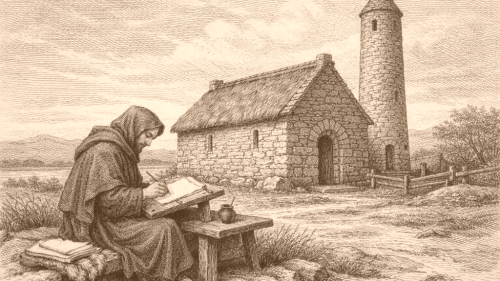
Ráth Guala — Yearly FrameThe year 623 CE survives in the annals as a cluster of short notices rather than a continuous narrative. In the Annals of Ulster, the annual slot marked AD 622 includes the death of Fergna, abbot of Í, the repose of Mac Laisre, abbot of Ard Macha, and Finnia, abbot of Ner, before the storming of Ráth Guala by Fiachna son of Baetán. The sequence is compact and factual, with no explanatory link between the items.The Annals of Inisfallen and the Annals of the Four Masters place nearby notices under their own year labels rather than under a single…
Nationalist Archives — Archive GuidesThe library guides present nationalist material as part of wider Irish history research rather than as a single closed corpus. One guide lists major institutional collections, including Trinity College Library, the Digital Repository of Ireland, Military Archives Online Collections, the National Library of Ireland, the Public Record Office of Northern Ireland, and the Virtual Record Treasury of Ireland. It also points to government and legal documents, Irish parliamentary debates, and collections of reprinted primary sources, showing a broad map of access points rather than a single route.The same guide also directs readers to specific subject clusters linked with Irish…
Fuel Protests — Fuel Queues — Fuel QueuesContemporary reporting on Ireland's petrol strikes presents the most immediate face of fuel protest: long queues, rationing, and the closure of garages when deliveries stopped. One RTÉ archive item describes motorists waiting for hours, garages forced shut by lack of supply, and remaining petrol being rationed. Another archive collection refers to queues in 1973 and 1979, showing that these shortages were not isolated to a single moment but recurred in more than one crisis.The same archive material also shows the visual and practical scale of the disruption. Cars are described as lining the streets bumper to bumper, with some…
Ireland Results — Study FramePISA 2025 is described by the Educational Research Centre as a global study by the OECD that assesses 15-year-olds in science, reading, mathematics, and an innovative domain that changes each cycle. The ERC says Ireland participated with 90 more countries and economies, and that this national report compares Irish performance with earlier cycles and with OECD and EU averages. The report also notes proficiency levels and links performance to student- and school-level factors.A separate ERC page states that the PISA 2025 main study in Ireland took place in March and April 2025. It reports more than 6,000 students from…
Golden Vale — Vale DefinedThe Golden Vale is presented as a named tract of lowland in county Tipperary and province of Munster. One topographical account says the parish of Cardangan extends into a plain that is called the Golden Vale because of its fertility and beauty, and adds that it contains some of the richest land in Ireland, though it also includes heathery mountain. Another account places Golden itself within what is called the Golden Vale.A second set of descriptions shows that the name is not used for a tiny spot alone. Lewis says the plain between the Kilnamanagh and Galtee ranges, with…
Saint Oliver Plunkett — Early LifeOliver Plunkett was born on 1 All Saints' Day in 1625 at Loughcrew, Oldcastle, in County Meath. He was a member of the influential Plunkett clan and was of Irish Norman ancestry, which connected him to many members of the ancient nobility of Ireland. His father, John, served as the Baron of Loughcrew, overseeing an estate that included a tower house, a corn mill, and an adjoining church. His mother, Thomasina, hailed from the well-connected family of the Earls of Roscommon. Through these parental ties and the Dillon family, Oliver maintained close bonds with senior aristocratic branches of the…
Conall’s Victory — Year EntryThe year 622 appears in these annals as a set of brief notices rather than a single connected story. Ulster opens with the year label and then lists a battle, a drowning, deaths, another battle, and further deaths. The Four Masters similarly mark 622 and continue with battles and obits. In both witnesses, the year heading is the secure anchor, while the notices remain compact and separate.Inisfallen also preserves the year, but it does so through later cross-references to AU 622. Those references attach Cennbag and Cenn Delgthen to the same year as Ulster. The wording is not identical…
Saint Aidan of Lindisfarne — Saint Aidan of Lindisfarne was a pivotal figure in the early medieval Christianisation of Northern Britain. Born in Ireland around 590 AD, he spent his early years as a monk on the island of Iona, off the west coast of what is now Scotland. This monastery, founded by Columba, served as a primary centre for the Irish Church and became the spiritual home for Aidan during his youth. While very little is known of his earliest life, his tenure at Iona prepared him for the missionary work that would eventually define his legacy in the kingdom of Northumbria. Royal summons…
Vacancy Politics — Vacancy RulesThe Electoral Commission defines a bye-election as an election to fill a vacant seat between general or Seanad elections. It says the Dáil seat may become vacant if a TD dies, resigns, or retires, and that the Dáil passes a resolution directing the returning officer to hold an election. The same page states that the writ must be issued within six months of the vacancy, unless a general election intervenes first.The same guidance also describes the voting process as the same as in a general election. It says voters mark preferences on the ballot, that first preferences are counted,…
Ulster Obituaries — Dating EvidenceThe clearest secure evidence for AD 621 is the Annals of Ulster year block headed with that date. In the surviving entry, the notices follow one another without day-level dating and name Cenn Deilgthen, Conaing son of Aedán, several deaths, Lindas, Caemgein of Glenn dá Locha according to some, Cennbag, Ailill son of Cellach, and Colgu son of Cellach. The record is terse, but the year itself is explicit.That same block also shows the limits of what can be said with confidence. The passage offers a sequence of notices, yet it does not explain how they relate to one…
Saint Finnian of Clonard — Saint Finnian of Clonard was a pivotal figure in the establishment of early Irish monasticism, traditionally regarded as one of the fathers of the monastic movement alongside Enda of Aran. While the exact dates of his life remain subject to historical uncertainty, tradition often cites his birth around 470 in the Kingdom of Leinster, specifically near present-day New Ross. He is described as the son of Findlog and a member of the Clanna Rudhraighe from the Ulaid. His early spiritual development began under the guidance of Bishop Fortchern of Trim, following his baptism by Abban. Continental Study Tradition suggests that…
Mongan’s Killing — Year RecordThe strongest evidence for 620 CE comes from the annalistic entry that explicitly labels the year and then lists several deaths. It gives the tenth year of Suibhne and records Seanach Garbh, abbot of Cluain Fearta Breanainn Clonfert; Colman son of Coimgellan; Aedh son of Cumascach; Ronan son of Tuathal, lord of the Airtheara; and Cormac Caemh with Illann son of Fiachra. On this wording alone, 620 survives as a compact year of named deaths.The same entry continues with two more notices securely tied to the year by the surrounding annal rubric. One says that Mongan son of Fiachra…
Thank you for reading today’s Gazette. Follow any of the links above to read the full article and explore its sources.