
Castlepook’s Cave-Bear Horizon
31,761 BCE is not a recoverable Irish historical year but a notional point within unstable Marine Isotope Stage 3. Radiocarbon calibration and disturbed deposits permit only broad chronological ranges. Derryvree, Fermanagh, preserves freshwater plants, insects and wetland sediments between tills, demonstrating locally treeless, tundra-like habitats during glacial fluctuations. Castlepook Cave, Cork, yielded MIS 3 remains of reindeer, mammoth, giant deer, bears, wolves, foxes, hyaenas, lemmings and other animals, indicating cold open-country ecosystems. A cut-marked reindeer bone suggests, but cannot prove, Pleistocene human activity. Later ice expansion, erosion and sea-level rise destroyed or buried evidence, leaving environmental traces, not social history.
View Record
Birm-166’s Permafrost Ledger
31,762 BCE is not a knowable Irish year but a broad Late Pleistocene horizon. Derryvree, County Fermanagh, dated through Birm-166, preserves freshwater silts, plants and small animals from roughly 36,900–31,700 years ago, indicating cold, open tundra and periglacial conditions before the ice sheet's maximum expansion. Castlepook Cave, County Cork, contains mixed remains of mammoth, reindeer, giant deer, bears, hyenas and other fauna, proving episodic animal access. A cut-marked reindeer femur may indicate human butchery, but neither permanent settlement nor associated tools are established. No polities, farming, trade or recoverable culture are evidenced; later ice obscured much of this fragile record.
View Record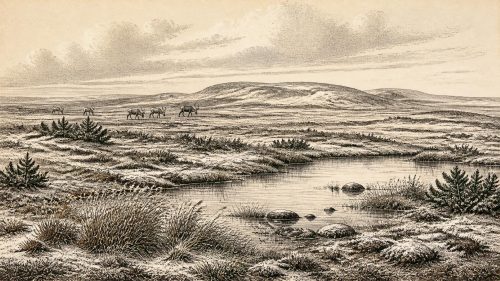
Maguirebridge’s Windblown Pools
“31,763 BCE” is a modern chronological label, not a year that can be recovered from...
View Record
Crag Cave’s Winter Drips
Around 31,764 BCE, Ireland was a climatically unstable Late Pleistocene landscape rather than a documented historical society. Derryvree deposits in County Fermanagh reveal freshwater pools, patchy tundra vegetation and periglacial conditions during a broadly dated interval encompassing this label. Crag Cave speleothems in Kerry show intermittent warmer phases when liquid water penetrated limestone. Cave fauna, including reindeer, giant deer, mammoth, bears, wolves and hyaenas, indicates intermittently habitable open country. A marked reindeer bone from Castlepook may suggest human handling, but cannot prove settlement. No evidence supports communities, politics, religion, trade or permanent occupation. Later glaciation obscured much of this record.
View Record
Birm-166 and the Drumlin
At 31,765 BCE, Ireland cannot be described through events or calendar dates, but through fragmentary environmental evidence from Marine Isotope Stage 3. Derryvree, County Fermanagh, preserves freshwater silts between glacial tills, demonstrating an ice-free tundra interval within a shifting climate and later glaciation. Mosses, sedges and pollen indicate exposed periglacial wetlands, not forest. Castlepook Cave, County Cork, contains a chronologically complex fauna of mammoth, reindeer, giant deer and predators, evidencing cold open habitats. A possibly tool-marked reindeer bone may signal brief human activity, but proves neither settlement nor society. Ireland remained climatically dynamic, ecologically connected intermittently, and therefore archaeologically elusive.
View Record
Birm-166’s Lost Waters
Labelled 31,766 BCE, this period cannot be tied to a precise Irish event, but falls within a broad Late Pleistocene calibrated range. Derryvree, County Fermanagh, preserves organic freshwater sediments between tills, indicating locally ice-free, treeless wet tundra with mosses, grasses, sedges, insects and severe seasonal conditions. Comparable northern deposits confirm environmental variation amid advancing glaciation. Castlepook Cave, County Cork, contains Marine Isotope Stage 3 fauna including mammoth, reindeer, hyaena and lemmings, demonstrating cold open habitats. A possibly stone-tool-marked reindeer femur suggests transient human activity, not settlement. Subsequent ice expansion reshaped habitats and erased or buried most evidence of earlier life.
View Record
Frostwater at Derryvree
Around 31,767 BCE, Ireland lay within the climatically unstable Marine Isotope Stage 3, not a historically identifiable year. Derryvree, County Fermanagh, preserves freshwater sediments dating broadly to 31,700–36,900 cal BP, indicating locally ice-free, treeless wet tundra with pools, sedges, mosses and insects. Castlepook Cave, County Cork, contains faunal remains from a wider period, including reindeer, mammoth, giant deer, bears, wolves and hyaenas, demonstrating biologically active cold-stage environments. A possibly cut-marked reindeer bone may indicate brief human activity, but no settlement is known. Later glaciation destroyed much evidence, leaving an incomplete record of shifting habitats, animal movements and uncertain human presence.
View Record
Derryvree’s Frozen Sedge Basin
31,768 BCE is a nominal modern date, not an identifiable Irish event, and belongs broadly to Late Pleistocene MIS 3. Derryvree, County Fermanagh, preserves freshwater organic sediments between glacial tills, dated broadly to 36,900–31,700 calibrated years BP. They reveal a cold, locally ice-free, treeless periglacial wetland of sedges, mosses, pools and short growing seasons, later overridden by ice. Northern sites corroborate open conditions. Castlepook Cave, County Cork, records cold-adapted fauna including mammoth, reindeer and hyaena, though not necessarily contemporaneously. A marked reindeer bone may indicate early human butchery, but lacks secure supporting context. No evidence establishes permanent settlement or institutions.
View Record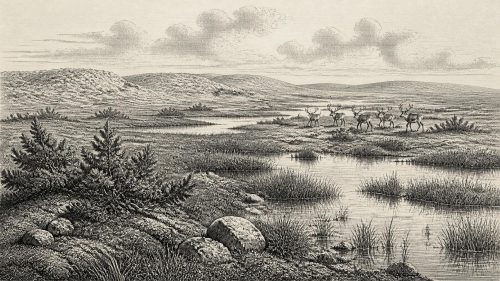
Maguirebridge’s Periglacial Reedbed
The label 31,769 BCE is a modern chronological convenience, not a date that can be...
View Record
Aghnadarragh’s Arctic Beetles
About 31,770 BCE, Ireland lay in the climatically unstable Late Pleistocene, although archaeological dating cannot identify conditions in a single year. Fermanagh sediments, including Aghnadarragh beetles, indicate cold, treeless tundra-like mosaics of grasses, shrubs, wetlands and seasonal pools, with severe winters and brief summers. Ireland was not necessarily fully ice-covered: the British–Irish Ice Sheet was expanding but had not reached its later maximum. Castlepook Cave preserves time-averaged remains of mammoth, reindeer, bear, hyaena and other fauna. A possibly cut-marked reindeer bone suggests early human activity, but cannot demonstrate settlement. Evidence supports environmental reconstruction, not claims about societies, routes or polities.
View Record