
Doneraile’s Reindeer Incision
At approximately 31,740 BCE, Ireland lay within the fluctuating cold conditions of Marine Isotope Stage 3, before the last British–Irish Ice Sheet reached its greatest extent. Castlepook Cave near Doneraile preserves remains of mammoth, reindeer, giant deer, hyaena, lemmings and other fauna, indicating open, largely treeless habitats. An incised reindeer femur may record processing with a stone tool and therefore a Upper Palaeolithic human visit. However, old excavation context and absence of associated tools or settlement prevent certainty. The evidence neither proves permanent occupation nor later ancestry. Ice and seas obscured traces; later human activity is confirmed in County Clare.
View Record
Castlepook’s Stone-Edge Question
31,741 BCE is a modern label for an uncertain Late Pleistocene interval, not a recordable Irish year. Castlepook Cave, County Cork, produced a reindeer femur dated broadly around 33,000 years ago, whose deep fresh-bone incision may represent stone-tool butchery. If confirmed, it would be Ireland’s earliest evidence of human contact, though excavation methods, mixed cave deposits and carnivore activity prevent stronger conclusions. Fauna indicate a cold, varied landscape of tundra, herbivores and predators. Derryvree sediments document ice-free periglacial wetlands during the wider period. Approaching ice-sheet expansion constrained possible mobile visitors; no settlement, society, route or repeated occupation is securely demonstrated.
View Record
Castlepook’s Deep Incision
31,742 BCE is a modern label, not a precise Irish date; the relevant setting is later Marine Isotope Stage 3, before glaciation. Ireland was a cold, unstable, open landscape with changing ice margins, lower seas and Pleistocene fauna. Castlepook Cave, County Cork, preserves reindeer, mammoth, giant deer, hyaena and remains, although antiquarian excavation and disturbed deposits limit interpretation. A reindeer femur, roughly 33,000 years old, bears a mark possibly made by a stone tool during butchery. If confirmed, it may be Ireland's earliest human trace, indicating brief activity rather than settlement. Further stratified excavation, dating and taphonomic study are required.
View Record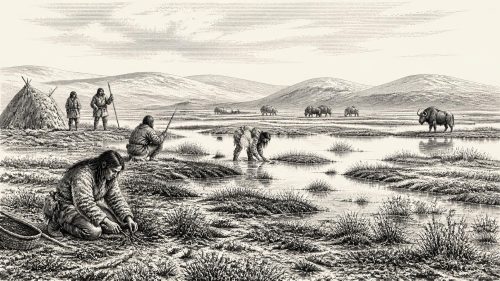
Derryvree’s Moss Beds
31,743 BCE is not a datable Irish event but an approximate point within unstable Marine Isotope Stage 3. At Derryvree, County Fermanagh, organic freshwater beds between glacial tills indicate a temporarily ice-free wetland, with mosses, sedges, open pools and treeless tundra vegetation. Cave calcite records show recurrent climatic warming episodes. Southern cave remains demonstrate that reindeer, mammoth, giant deer, bears and hyaenas occupied Ireland intermittently, although assemblages span long periods. A cut-marked Castlepook reindeer bone may indicate short human visits, not settlement. No institutions, farming or trade are evidenced. Before maximum glaciation, Ireland supported shifting habitats, fauna and transient foragers.
View Record
Maguirebridge’s Arctic Marsh
At the approximate horizon labelled 31,744 BCE, Ireland lay in late Marine Isotope Stage 3, approaching more extensive glaciation, rather than within a datable historical year. Derryvree, County Fermanagh, preserves freshwater silts between tills, indicating cold, open, periglacial wetlands with mosses, sedges and insects. Castlepook Cave, County Cork, contains MIS 3 remains of mammoth, reindeer, giant deer, bears, wolves and hyaena, demonstrating habitable terrain for large mammals. A possibly cut-marked reindeer bone suggests early human butchery, but cannot prove permanent settlement with certainty. Lower sea levels altered routes and coastlines; surviving evidence supports environmental reconstruction, not political or social history.
View Record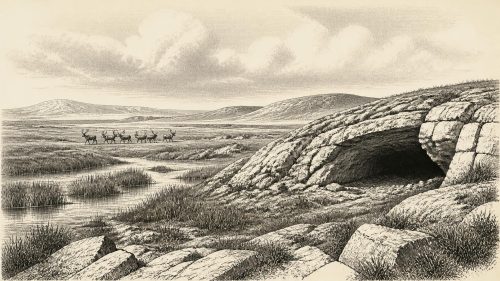
The Castlepook Bone Archive
31,745 BCE is a modern chronological label, not a recoverable Irish date in the manner...
View Record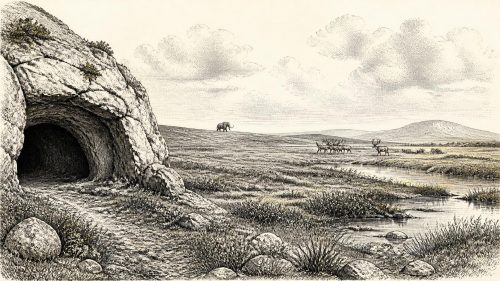
Hyaena Hall’s Bone Map
About 31,746 BCE, Ireland formed part of a climatically unstable MIS 3 Ice-Age landscape, with low sea levels, shifting ice margins and changing land connections. Castlepook Cave in County Cork preserves important, imperfect evidence: animal remains indicate open tundra-grassland habitats supporting mammoth, giant deer, reindeer, hyaena, wolves and Arctic species. These bones accumulated through natural processes as well as predators, while early excavation and revised dating limit certainty. A reindeer femur possibly bears a stone-tool cut mark, suggesting an exceptionally early human visit or carcass processing. It cannot prove settlement or continuity. Ireland’s evidence chiefly records fauna and environmental uncertainty.
View Record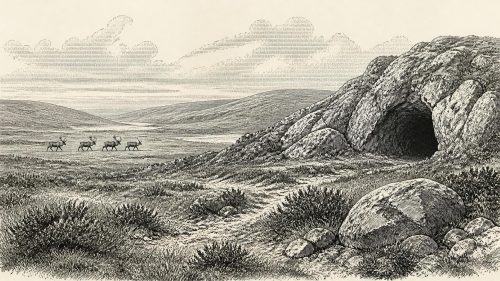
The Awbeg Reindeer Femur
Around 31,747 BCE, Ireland lay within the climatically unstable later Marine Isotope Stage 3, before the Last Glacial Maximum. Lower sea levels altered coasts and routes, but did not ensure a land bridge. Deposits at Derryvree indicate cold, open wetlands with seasonal plant life, while Castlepook Cave preserves diverse fauna, including reindeer, mammoth, giant deer, hyaena and wolf. A reindeer femur from Castlepook bears an incision possibly made by a stone tool, suggesting a brief Upper Palaeolithic human visit. However, disturbed cave deposits and absent campsites preclude evidence of settlement. Re-dating and palaeoecology instead reveal a dynamic Ice Age landscape.
View Record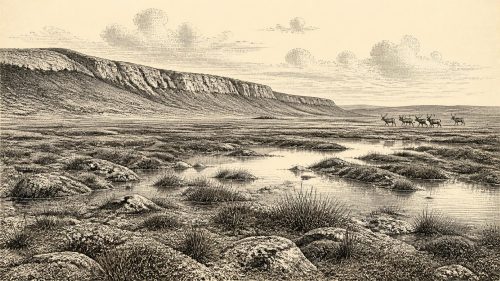
Hyenahall’s Mammoth Toothmarks
31,748 BCE is a nominal modern date within Marine Isotope Stage 3, not a precisely recoverable Irish event. Derryvree deposits indicate intermittent ice-free, treeless environments of sedges, grasses, juniper, wetlands and severe cold, between glacial advances. Ireland was approaching, rather than experiencing, the Last Glacial Maximum, with variable ice, coastlines and animal access. Castlepook Cave preserves mixed remains of mammoth, reindeer, giant deer, hyaena and other cold-adapted fauna, demonstrating episodic viable food webs. A reindeer femur possibly bears a butchery mark, suggesting transient Upper Palaeolithic human activity, but not settlement. Evidence supports environmental reconstruction, while year-specific narratives remain fundamentally impossible.
View Record
Castlepook’s Limestone Gateway
Rather than a recorded historical year, 31,749 BCE represents an uncertain Late Pleistocene interval around 34,000 calibrated years before present, during Marine Isotope Stage 3. Lower sea levels connected Ireland ecologically to north-west Europe, while volatile cold climates, changing vegetation and advancing ice shaped open landscapes. Cave fauna at Castlepook, County Cork, including reindeer, mammoth, musk ox, horse and predators, indicates varied mammoth-steppe habitats, although deposits combine different ages. A cut-marked reindeer femur may evidence a brief human visit around 33,000 years ago, but no settlement, tools or human remains confirm occupation. Glaciation erased evidence, leaving a fragile, revisable archive.
View Record