
Fermanagh’s Sealed Tundra
Around 31,578 BCE, Ireland lay within the climatically unstable Late Pleistocene, not a datable historical year. At Derryvree, County Fermanagh, freshwater silts between glacial tills, broadly dated to 36,900–31,700 calibrated years BP, preserve tundra-like wetlands, sparse vegetation and insect life during an ice-free interval. Other deposits confirm repeated advances and retreats of ice. Castlepook Cave records mammoth, giant deer, reindeer and carnivores, but its bones reflect complex accumulation processes. A cut-marked reindeer femur may indicate human butchery, yet cannot prove settlement or population. Evidence supports a harsh, ecologically active, repeatedly transformed island, while human presence remains unconfirmed. Routes remain uncertain.
View Record
Castlepook’s Reindeer Trace
Labelled 31,579 BCE, this period in Ireland belongs broadly to Marine Isotope Stage 3, not a datable calendar year. Before the Last Glacial Maximum, fluctuating cold conditions, low sea levels and changing routes linked Ireland intermittently with wider Europe. Derryvree sediments in Fermanagh record ice-free, waterlogged tundra vegetation and insects. Castlepook Cave in Cork preserves a disturbed important fauna, including reindeer, mammoth, giant deer, horse, predators and mammals. A marked reindeer femur, 33,000 years old, may indicate stone-tool butchery and Ireland’s earliest human visit. However, it proves neither hunting nor settlement; evidence remains fragmentary, and future study may revise conclusions.
View Record
Maguirebridge’s Winter Wetland
At the notional date of 31,580 BCE, Ireland lay within the climatically unstable Marine Isotope Stage 3. At Derryvree near Maguiresbridge, freshwater silts and organic deposits between glacial tills record an ice-free interval around 33,500 calibrated years BP. Mosses, sedges and insects indicate a cold, open tundra wetland with shallow pools and peat-rich ground. Other Fermanagh deposits suggest local non-glacial phases, while cave evidence shows climatic fluctuation and cold-adapted mammals, including reindeer and mammoth. No secure human occupation is known; a marked reindeer bone from Castlepook Cave only raises the possibility of a brief human visit. Later ice buried it.
View Record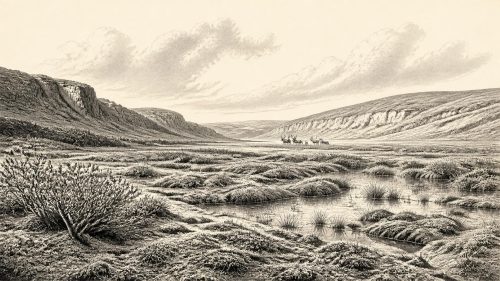
Castlepook’s Reindeer Question
Around 31,581 BCE, Ireland lay in Marine Isotope Stage 3, an unstable Last Ice Age interval known only through environmental evidence rather than annual history. Derryvree sediments in Fermanagh indicate an ice-free freshwater tundra landscape, with sedges, mosses, aquatic plants and sparse cold-adapted vegetation. Elsewhere, glaciers and ice centres were expanding, while lowered sea levels altered coasts and routes. Castlepook Cave in Cork preserves diverse fauna, including reindeer, mammoth, giant deer, predators and lemmings, although deposits span time and processes. A possibly tool-made reindeer-bone incision suggests brief human activity, but remains contested and proves neither permanent settlement nor continuous occupation.
View Record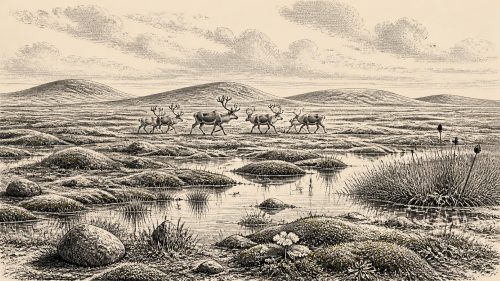
Maguirebridge’s Fossil Wetland
31,582 BCE is a modern label within an MIS 3 chronological range, not a datable Irish event. At Derryvree, County Fermanagh, freshwater sediments beneath glacial tills record an ice-free, periglacial tundra of wetlands, mosses, grasses and herbs, later overridden by advancing ice. Castlepook Cave, County Cork, preserves a mixed, long-accumulated fauna including mammoth, reindeer, giant deer, predators and cold-adapted small mammals, demonstrating Ice Age habitats. A marked reindeer femur may indicate stone-tool processing by people, but cannot prove settlement or sustained occupation. No evidence establishes later-style institutions. These sites reveal a dynamic, cold landscape before extensive Last Glacial Maximum ice.
View Record
The Maguiresbridge Freshwater Clock
Thirty-one thousand five hundred and eighty-three BCE is a label within Marine Isotope Stage 3, not a recoverable Irish year. At Derryvree, Maguiresbridge, freshwater silts between glacial tills, radiocarbon dated to 36,900–31,700 calibrated BP, show that north-central Ireland intermittently supported cold tundra wetlands, vegetation and animals before ice advance. Comparable deposits demonstrate fluctuating climates. Castlepook Cave preserves remains of mammoth, reindeer, giant deer, predators and cold-adapted fauna, although its mixed deposits cannot represent one moment. A marked reindeer femur may indicate early human butchery, but lacks context. Evidence confirms a dynamic glacial-edge landscape, not permanent settlement or a land bridge.
View Record
Derryvree’s Open Tundra
Around 31,584 BCE, an imprecise date within Marine Isotope Stage 3, Ireland experienced last-glacial conditions rather than uniform ice cover. Organic deposits beneath Derryvree drumlin in County Fermanagh preserve evidence of an ice-free freshwater wetland, with sedges, mosses and arctic-alpine plants amid open periglacial tundra. Castlepook Cave in County Cork records diverse fauna, including mammoth, giant deer, reindeer, predators and cold-adapted animals, although deposits span periods. A cut-marked reindeer bone may indicate fleeting human activity, not settlement. Lower sea levels altered routes and coastlines, while ice and erosion destroyed or buried much evidence. Ireland remained an unstable dynamic ecological frontier.
View Record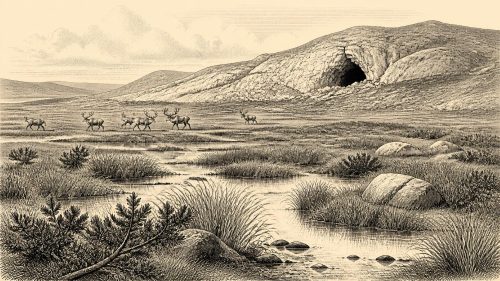
Reindeer Beside the Awbeg
Around 31,585 BCE, Ireland was a cold, open Ice Age landscape during Marine Isotope Stage 3. Radiocarbon evidence cannot identify this calendar year precisely, but Derryvree’s sub-till sediments indicate treeless tundra wetlands, grasses, sedges and freshwater habitats during a broadly relevant interval. Castlepook Cave preserves a diverse fauna, including reindeer, mammoth, giant deer, bear, wolf, Arctic fox, lemmings and hyaena, though dates and deposits require caution. A reported cut-marked reindeer bone suggests possible early human activity, but no secure evidence establishes settlement or a defined culture. Growing ice would later transform these landscapes. The period is understood through environmental evidence.
View Record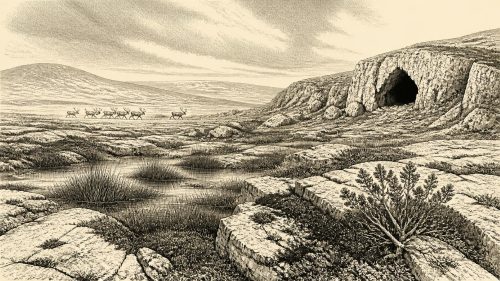
Elephant Hall’s Mixed Ages
31,586 BCE is only a filing label for a broad, uncertain interval during Marine Isotope Stage 3, when Ireland was cold, treeless and approaching glaciation. Wetlands at Derryvree indicate sedge-rich, muskeg-like habitats amid open ground, ponds and seasonal freezing. Castlepook Cave in County Cork preserves mixed animal remains accumulated over many episodes, including reindeer, mammoth, giant deer, bear, hyaena, wolf, Arctic fox and lemmings. A marked reindeer femur may indicate human butchery, but cannot prove settlement or continuity. No evidence supports farming, institutions or culture. The record instead reveals a changing tundra-like landscape, rich in mammals and possible human visits.
View Record
Derryvree’s Menyanthes Marsh
Around 31,587 BCE, Ireland lay in Marine Isotope Stage 3, a climatically variable Late Pleistocene period rather than a uniformly frozen landscape. Derryvree, County Fermanagh, preserves freshwater sediments between tills, indicating an ice-free wetland with open, treeless vegetation, including bogbean. Greenagho and Kerry speleothems similarly show intermittent milder, ice-free conditions. Lower sea levels enlarged surrounding land, though routes remain uncertain. Castlepook Cave fauna include reindeer and mammoth; a possibly cut-marked reindeer bone may indicate brief human activity, not settlement. Later ice-sheet advance erased much evidence. No reliable evidence supports contemporary politics, religion, economy, communities or sustained Palaeolithic occupation in Ireland.
View Record